Five-Character Regulated Verse: Impromptu at a Banquet (With Some Idle Words Appended)
2007/8/6 22:56:55
One wine, one poem—a delight of the human world. Wine without poetry is vulgar; poetry without wine is stagnant. Tonight the thirty-year-aged vintage is drained, transformed into forty words of new verse.
Impromptu at a Banquet
Chán Zhōng Shuō Chán
In the red dust, markets trade with ease,
We seldom bother with affairs and schemes.
By chance a line of heaven's truth is caught,
That leaves behind a merry, lasting name.
Raising the cup, I roam through earth and sky,
With sword in hand, through sun and rain I stride.
At times I sit atop the lonely peak,
And gaze upon the bright moon in the mind.
Today's rain fell in the wrong place and stopped at the wrong time, but in the end it yielded a five-character regulated verse, so this indulgent outing wasn't entirely wasted. This ID socializes across all walks of life, so indulgent gatherings are inevitable. There's another one this week at the Grand Hyatt with a French person—no baijiu to be had there. Drinking red wine produces absolutely no feeling for classical Chinese poetry; classical poetry always belongs to baijiu.
When I left today, I noticed that Xiaowan Zi, Da Dao, and others pointed out that the original segmentation had problems. Since this ID normally uses a different system and only uses Tonghuashun when writing posts, I hadn't noticed the subtle data differences between the two systems and just marked it accordingly. After carefully checking the data in the Tonghuashun system, the original segmentation was indeed problematic, so I corrected it immediately and then even posted a note from the car. Sina's refresh seems very slow—usually after this ID posts, I can't even see my own post when it goes up. I have to wait a while, though it can be seen immediately under "All My Articles"—it just doesn't show on the homepage or the latest articles list. I wonder if you all have this problem too.
Just now, after returning, I saw someone saying that data from other software differs from Tonghuashun's, and what doesn't count as a stroke in one software counts as a stroke in the other. This issue is actually quite normal. As I've already said in the lessons, each software may handle or process data slightly differently, so data discrepancies are perfectly normal. It's like microscopes of the same magnification—even from the same manufacturer, they can't be absolutely identical. So when analyzing, just stick consistently to the same microscope. The software this ID uses for watching the market is different from Tonghuashun, and I'll be more careful in the future not to copy directly. But these minute details don't significantly affect the overall judgment. Moreover, this segmentation is simpler and clearer than the original—more beautiful even.
Therefore, everyone must note: in any specific analysis, you must stick to the same software with the same data source. This way, data continuity is maintained under the same standard. Different segmentations caused by different software data will not substantively affect large-level classifications. From a practical trading standpoint, one should at minimum discuss operations at the 1-minute level, so such measurement errors are within acceptable range. Measurement errors do not affect the unity and rigor of the theory.
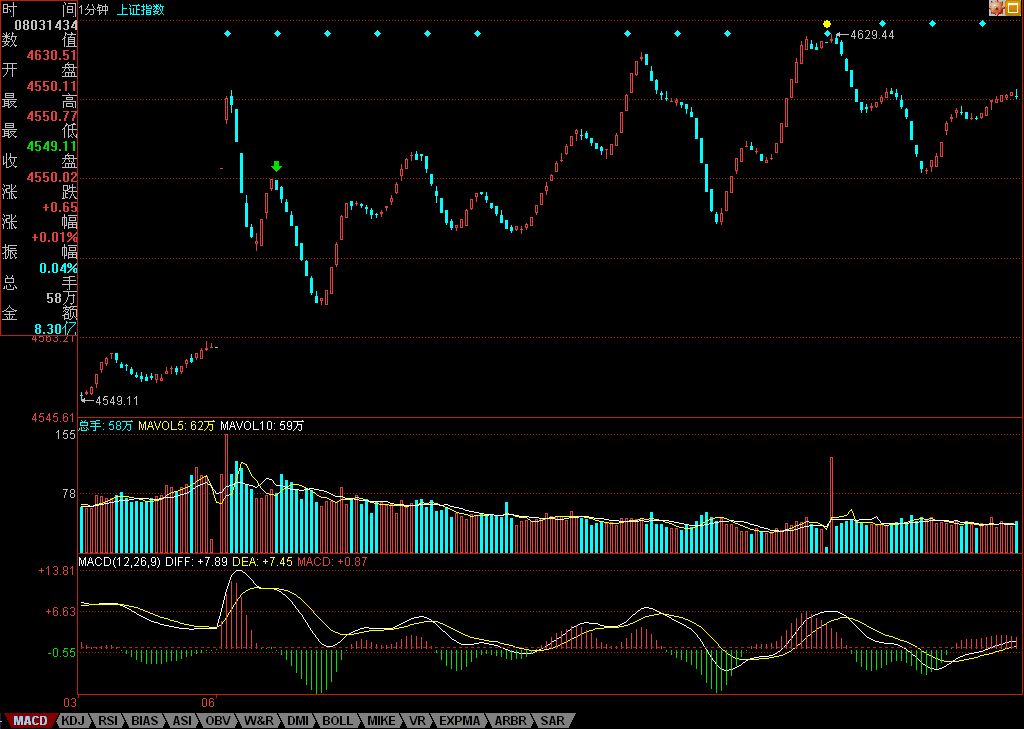
So how minute is such a discrepancy? You can see in the image below. The key is the two K-lines pointed to by the green arrows. The first bar's range is [4594.91, 4597.57], and the second bar's range is [4595.19, 4597.44]. Because the first bar closed at its high, and the difference between 4597.57 and 4597.44 is extremely minute—possibly just a 0.1-second data collection difference—in Tonghuashun there exists an inclusion relationship, while in other software the second bar's high is just slightly above the first bar's, making it not an inclusion relationship. The second bar then becomes the fractal top, and thus the stroke naturally becomes valid. If this stroke is valid, then the entire segmentation changes somewhat. However, this doesn't substantively affect the overall trend analysis. Everyone should also understand why, in practical classification, one must start from fractals and strokes, and then have line segments form the smallest-level hub. One reason is precisely that by the time we reach the smallest-level hub, such minute measurement discrepancies can be smoothed out as much as possible. At larger-level hubs, these issues cease to exist. Of course, this isn't the primary function of fractals, strokes, and line segments, but it is one of their functions.
This matter yields a conclusion: this ID's theory can be subjected to the most precise examination, and such examination is absolutely scientific and objective. It relates only to the specific chart being analyzed—as long as it's the same chart from the same software, there is one and only one answer. Before this answer, everyone is equally positioned. It does not matter that this ID developed this theory—this ID holds no special authority. Before the theory, all people are equal. This ID can also make mistakes, but this ID's theory will not err. The conclusion is uniquely objective. This is called rely on the method, not the person.
For any theory, there must be the most fundamental premise of rely on the method, not the person. The reason this ID's theory is objectively accurate is not because of this ID as a person, but because the theory is the most likely objective reflection of actual market trends. It has nothing to do with any person—regardless of whether they like or dislike this ID personally, as long as they are in the market, they are covered by this ID's theory. Just as a person in Euclidean space, no matter how much they despise 180, every triangle they can measure will forever torment them with 180—there is no escape. This ID's theory is the same: as long as you are in the market, whether you know it or not, whether you like it or not, you have no escape.
A netizen asked how to view images clearly. This ID's computer skills are basically at the typing stage, but I can still answer this. Right-click on the image, then open the properties, copy the address, and open it in a browser to see a clear, full-size image. This ID talking about computers is pure nonsense—if you all have better methods, please share.
Finally, a big red flower each for Xiaowan Zi, Da Dao, and the others.
Signing off for now, goodbye.