Teaching You to Trade Stocks 88: A Specific Case of Chart Growth
2007/11/6 22:38:43
This ID's theory provides the most definitive decomposition of all trends. All decompositions are essentially of only two types: continuation and reversal — or in more brutal terms, life and death.
The death of one trend type inevitably means the birth of another. Trends exist in this cycle of life and death, just like the lives of sentient beings — birth and death, reincarnating endlessly. If you truly see stock trends clearly, you should probably have some insight into life as well.
Once a trend type is established, it simultaneously confirms the death of the previous trend type, while also beginning its own existence toward death.
Just as in the cycle of life and death of sentient beings, between death and birth there is a stage called the "bardo" (intermediate state). Stock trends likewise have this stage. If we say the divergence or consolidation divergence of the previous trend type declares its death, then until a new trend type is established, there is a blurred, bardo-like phase.
To grasp the trend during this phase, one must analyze it in conjunction with parts of the preceding trend. In other words, the "karma" of the previous trend is exerting its influence. This karma, combined with the market's current new combined forces, constitutes the ultimate resultant force that determines the market's direction.
An example illustrates this very well.
In the chart below, the divergence at point 191 declares the death of the previous trend type. Technically, the new trend type should be analyzed starting from point 191. But at that point, the new trend type hasn't even completed its first line segment. Even by the time we reach point 193, the outline remains unclear. Therefore, this is a classic bardo phase, and we must rely on the hub formed starting from point 189 to complete the analysis and corresponding operations.
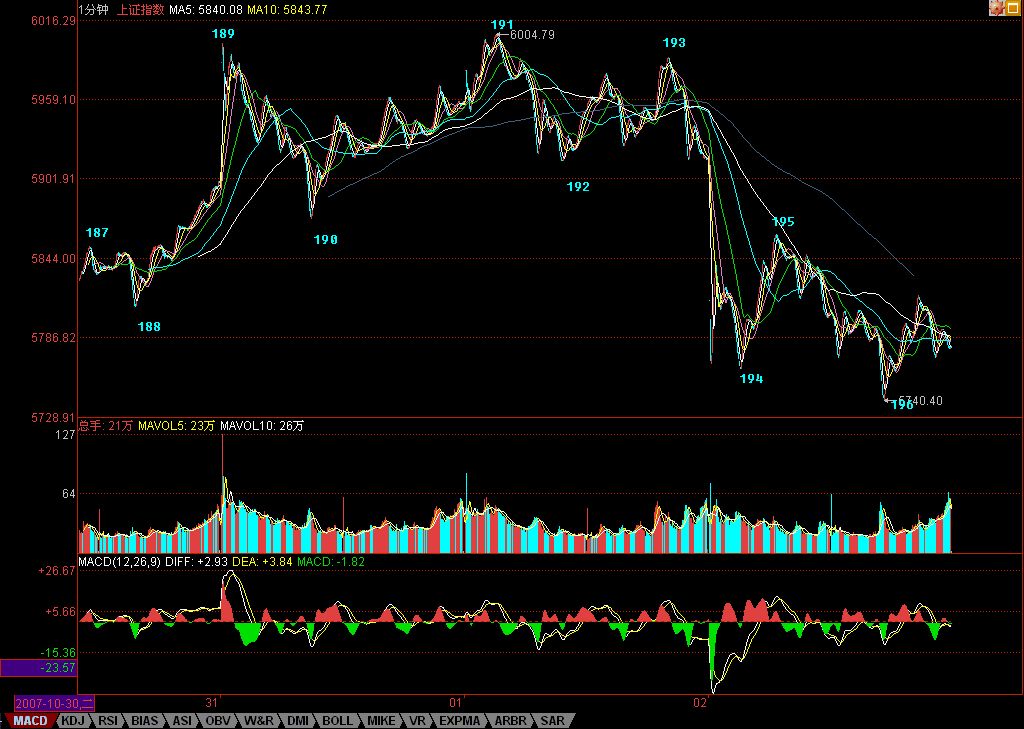
Starting from 191, both 192 and 193 are difficult to find any basis for. Certainly, one could say 193 is a second-type sell point — that's naturally correct. But from the perspective of the hub starting at 189, there exists a hub oscillation issue. This way, this bare second-type sell point gains a larger analytical foundation to rely on. All analysis regarding hub oscillation can be applied to the analysis of 192, 193, and subsequent moves — this amounts to having double analytical assurance.
Of course, the subsequent third-type sell point at 195 is also described from the bardo phase perspective. But this point is the dividing line between the bardo phase and the establishment of the new trend type. Once 195 appears, the initial form of the new trend type is established — meaning at minimum a line-segment-level downward move. At this point, the analytical focus can shift to the new trend type starting from 191. At this stage, you can basically stay at this line segment level without needing to consider what happened before 191.
But the trend before 191 doesn't become useless — rather, it takes effect at larger levels, such as the 1-minute, 5-minute levels, and so on. The moves occurring after 191 combine with what came before 191 to form large-level trend formations.
Therefore, once you become proficient, you don't necessarily need to keep adding labels continuously. For example, if you operate at the 1-minute level, the previous 191 line segment markers could potentially be simplified to fewer than 10 markers related to the 1-minute level. Only when the 1-minute trend that evolves from the moves after 191 ends would the 1-minute level marker count increase by one. This way, the number of markers remains very limited. And for the 5-minute level, 30-minute, daily, and so on, there would be even fewer.
For the sake of convenience and clarity, let's classify the marker levels. For example, use Xn for line segment markers, Yn for 1-minute level markers, Wn for 5-minute markers, Sn for 30-minute markers. For daily, weekly, monthly, quarterly, and yearly, we can use Rn, Zn, Mn, Jn, and Nn respectively. The n in each represents the specific number. This way, all trends can be labeled by this notation system with perfect clarity.
For example, for point 191, at the line segment level, its label is X191. At the 1-minute level, it might be some Yn label. Meanwhile, point 189 would only have a line segment label, which simultaneously shows that point 191 and point 189 have different levels of importance.
What is the most formidable point? It's one that has labels simultaneously from the line segment level all the way up to the yearly level. If it's a top, then it's a once-in-a-century top. Of course, whether you're fortunate enough to encounter such a point depends on your luck.
This notation system doesn't just serve convenience in reading and labeling — first and foremost, it cultivates in everyone a comprehensive, systematic habit. Looking at any trend, you must know that it's not merely a single line segment, but exists within a large, multi-layered system. Only this way will you not get lost in daily fluctuations.
Moreover, what does this labeling process imply? Since line segments have bardo phases, other levels naturally do too. So regardless of the level, after a peak point appears, there is a bardo phase of corresponding level duration.
Note — pay close attention. Why do many people who escape a top still end up trapped? Why do many who catch a bottom still fail to make money and get shaken out? It's because they're killed by the bardo phase of the corresponding level. Moreover, the larger the level of the reversal, the more deadly the bardo phase.
Just as human bardo is neither human nor ghost, the bardo phase of market trends also kills both bulls and bears, constantly churning and reversing. By the time the reversal is finally confirmed, it's as if reincarnation has already occurred — the rice is cooked. Still looking for raw rice? Is that going to work?
Some fools, during the bardo phase of a trend reversal, suddenly feel the world is beautiful again, or the world is terrible again — all being dragged along by karma.
The bardo phase, without exception, manifests as consolidation at various levels (note: this is only describing the form when we excerpt this phase in isolation — it doesn't mean the new trend type must be a consolidation). Specifically, it's hub oscillation around some portion of the preceding trend. Even so-called V-shaped reversals are the same — just with a deeper oscillation area.
Actually, any reversal, meaning after the first-type buy/sell point, corresponds to a V-shaped reversal at some level. For example, the reversal at 191: the move from 190-191 and 191-192 is actually a V-shaped reversal, just at an extremely small level. The level of this V-shaped reversal determines the level and intensity of the bardo. For instance, looking at the daily chart for the N days around the 6124 point, it's actually a V-shaped reversal at some level, and then the bardo phase begins simultaneously.
Note, after the bardo phase ends, there isn't necessarily a true reversal — it could also be a continuation in the same direction as the previous trend type. For example, up + consolidation + up — this kind of structure is perfectly valid. It's like how after a human's bardo, you don't necessarily become a ghost or something — you could become a so-called immortal. If your previous life started from being a ghost, ghost to human is an uptrend, and after bardo consolidation, human to immortal is also an uptrend.
But up + consolidation + down, up + down, and so on are equally possible outcomes. At this point, the only correct operation is one thing: if your technique is good, do some hub oscillation trading within this large hub oscillation. If your technique isn't good, grab a little stool and watch the show — watch whether it ascends to heaven or descends to hell, let the market choose for itself, then decide on operations.
However, from the perspective of this ID's theory, maximum efficiency means using this oscillation for hub oscillation trading. Having learned this ID's theory, the goal is to hone your technique. Once honed, you naturally won't need the little stool anymore — isn't it more fun to get on stage and perform yourself?
Of course, if you don't have the skill yet, don't try this move. Why? It's like how during the bardo stage, one can still practice and attain enlightenment, but you shouldn't therefore say, "I'll stop practicing now and wait until the bardo." If you really wait until then, with karma dragging you along, what the hell are you going to cultivate?
So, with real skill, no situation is fearsome — you can handle anything. The key is having real skill.