Teaching You to Trade Stocks 30: The Absoluteness of Chán Zhōng Shuō Chán's Theory
2007/2/13 15:07:02
Whether market prices fully reflect all information can be assumed at will — regardless of the assumption, it has little to do with actual trading. In trading, the only thing you need to be clear about is that regardless of whether market prices fully reflect information, you must trade at market prices, and your trades will constitute market prices. For trading, apart from price, there is nothing (volume can be viewed as repeating transactions at a given price within the smallest time interval for the number of traded units). All of this has nothing to do with whether market prices reflect all information, because all prices are in the present moment. If current information isn't reflected by the market, then it's simply information not reflected by the market at that moment — whether it will be reflected in prices at another time is a separate matter. From a purely trading perspective, price exists only in the present, the present contains only price, and apart from price and the movements extending through time, everything else in the market is negligible.
Price is also unrelated to whether people are rational. Whether you are rational or not, you trade at prices, and trades are recorded as prices — this is a fact that any theory must accept: trading is only reflected as price; a transaction at a certain price at a certain time — that is the entirety of trading. As for any factors behind the transaction, if one assumes that one or several of them determine the transaction price — whether those factors are fundamentals, psychology, technicals, politics, or anything else — that is typical God-mode thinking, all pointless nonsense. In fact, for prices, time doesn't need to be specifically noted, because the sequence in the price trajectory implies the time factor — that is, transactions can be ordered by time. This is another crucial characteristic of trading: trading has temporality, and this time is irreversible. While physics is still debating whether time is reversible, in the exploration of the trading space, this most difficult question of time already has the most unshakable answer. And this ID's theory, of course, takes this irreversibility of trading time as its premise. If today's transactions could become yesterday's, or simply be voided, this ID's theory would immediately collapse.
Trading, of course, has patterns, and these patterns are eternally unchanging. Summarizing the above: trading, with the irreversibility of time as its premise, is completely and equivalently reflected in the price trajectory. Of course, this eternal constancy also has its mutable aspect — for example, if transactions could suddenly be arbitrarily altered for some reason. Therefore, in a more logically rigorous statement, we call a market satisfying this rule a "price-sufficient effective market." This ID's theory targets precisely this kind of price-sufficient effective market, and such markets correspond to at least all formal trading markets in the world today. Do non-price-sufficient effective markets exist? Of course. For example, you spent 100 million yuan buying a stone yesterday, and today the stone seller's mafia boss puts a gun to your head saying yesterday's deal doesn't count — money's not being returned, and the stone is confiscated too. Markets with such transactions obviously cannot be price-sufficient effective.
The error of all previous market theories lies in attempting to investigate the factors behind the transactions that determine prices. Trading is human behavior — there's nothing to investigate. Humans are like madmen; even if their behavior is worth investigating, at the trading level it becomes not worth investigating. All theories attempting to explain trading motivations and behaviors have no trading value. Whatever reasons humans have for trading, as long as they trade, prices are generated and price trajectories exist — that is sufficient. From a purely trading perspective, the only thing worth mathematically investigating is this trajectory; all other research is misguided and meaningless for trading.
So, are prices random? This is yet another God-mode conjecture. Both determinism and randomness have as their underlying basis an eternal-factor theory, an eternal-pattern theory — that is, price behavior is eternally patterned by some mysterious theory. Whether this pattern is deterministic or random, the absurdity of such assumptions is identical. Trading comes only from reality; therefore, prices are determined by actual transactions. Accordingly, the above consideration can be expanded: trading is a real-world behavior; trading, with the irreversibility of time as its premise, is completely and equivalently reflected in the price trajectory.
The reality of trading is the only foundation trading can rely upon. So what does the reality of trading reflect, and what realistic inferences are possible? First, human reaction takes time — even neural transmission in the brain requires time. Second, the real-world multi-layered nature of social structures and individual differences determines that any group trading behavior lacks simultaneity — meaning that even identical trades caused by the same reasons cannot occur simultaneously; there must be a sequence. In other words, trading possesses "différance" — it will never completely converge. This is the realistic foundation for why trading can form analyzable movements.
Because trading possesses différance and lacks absolute uniformity, even in a system where trades are strictly determined by a single factor, analyzable price trajectories can still be generated. Any group trading behavior will not produce complete price uniformity — that is, it will never happen that all people make the same trade at the same instant. A completely absolutely convergent trade would be equivalent to gambling, where all buying and selling is no different from betting on big or small. Does such a system exist? Of course — for example, if a market maker bought 100% of all shares, and every single transaction involved only him with no one else participating. In that case, the movement would be equivalent to a big-or-small gamble. But as long as someone buys or still holds even 1 share of this stock, this trade can be described by this ID's theory, because a non-completely-absolutely-convergent trade has emerged. This is the other boundary of this ID's theory.
This ID's theory has only these two boundaries. As long as it is non-completely-absolutely-convergent trading in a price-sufficient effective market, this ID's theory is forever absolutely valid — this absoluteness is just like the uniqueness of contraction mapping fixed points for complete metric spaces. As for how many people study or apply this theory, it has no substantive impact on the theory itself, because even if everyone applied this ID's theory, due to social structures and individual differences, it would still not create completely absolutely convergent trading, and thus this ID's theory would remain valid. More importantly, this ID's theory is not a rigid set of operations — it is always built upon the present moment. For example, if a daily-level movement is judged to be entering a divergence segment, but due to some absolutely sudden current event — say someone accidentally presses the wrong button and sends another 1,500 nuclear bombs to Japan — causing sub-level structural fractures that eventually affect the larger-level structure, then the entire judgment would be based on a new movement foundation. And usually at such times, the actual trade hasn't occurred — unless you're incredibly lucky and just hit "buy" right as the bombs took off. Most people are habitually trapped in goal-oriented thinking, often overlooking that movements are being constructed in the present moment, and this ID's theoretical judgments are likewise built upon present-moment construction. This is yet another key characteristic of this ID's theory. This present-moment nature of the theory will be the focus of future lessons — by academic level, this is middle school curriculum.
And this ID's theory ultimately comes down to comparing the person themselves. Just as the eighth level of the Great Shifting of Heaven and Earth definitely can't beat the ninth level, but anything that isn't the Great Shifting of Heaven and Earth definitely can't beat the eighth level — there exists a martial art that towers above all others like a solitary peak, because the starting point already far surpasses others. When others' starting points are already wrong, how can they compete? Obviously, not everyone will believe in and apply this ID's theory, and therefore those who don't use this theory become the blood-sucking targets of this ID's theory. In reality, there aren't too few such targets — there are far too many. Furthermore, if market makers or funds secretly learn this method, it becomes a competition of which level of the Great Shifting you've reached. For large capital, you need to be at least two levels above retail investors just to fight them to a draw, because with larger capital, without higher skill, how can you shift it? More importantly, the larger the level, the greater the energy needed to control and interfere. For weekly-level and above, basically no one can fully control it. If it truly came to every market maker and fund competing to learn this ID's theory, then besides competing in skill at small levels, those with lesser skill can simply raise their operational level to enhance safety. More importantly, applying the same theory won't produce the same results in reality. Reality is a typical non-completely-absolutely-convergent system — just as the same nuclear theory didn't result in Germany and America simultaneously building atomic bombs. The same theory, under different capital scales, capital management levels, stock selection strategies, fundamental analysis, trader personalities, temperaments, etc., naturally presents different appearances. This guarantees non-completely-absolutely-convergent trading even with the same theory.
One thing must be clear about this ID's theory: it is a complete mathematical axiomatic theory for non-completely-absolutely-convergent trading in price-sufficient effective markets. The only thing requiring monitoring is whether the two premises — price-sufficient effective market and non-completely-absolutely-convergent trading — still hold. More importantly, this is fundamentally a theory about people, one that can only be refined through constant practice in trading, and ultimately what's compared is skill. For example, even something as simple as divergence, even with the same method, when it becomes group behavior, what's compared is mentality and skill. Those with poor mentality, who act too early or too late, will leave traces in prices. When convergence is relatively strong, it may cause persistent level extensions, giving those with deeper skill even better buy or sell prices. These subtle differences, accumulated over time, are enough to create vast disparities in profitability. This is also a deeper reason why this ID can publicly share the theory — because this ID's theory is an objective theory for non-completely-absolutely-convergent trading in price-sufficient effective markets. Even when made public, it won't change the theory one bit, just as Newtonian mechanics won't change gravitational attraction, and America's atomic bomb explosion won't prevent China's atomic bomb from appearing based on the same theory. As for the increased convergent trading the theory might cause, that was already accounted for in this ID's theory's calculations — what's compared here is present-moment skill.
No matter what trading method you use, as long as you're in non-completely-absolutely-convergent trading within a price-sufficient effective market, you're within this ID's theory's calculations. And to grow in skill within this ID's theory, you must first become a person who stands tall between heaven and earth — this is also why this ID asks everyone to read more of this ID's interpretations of the Analerta. Trading is merely one form of human behavior. To become a successful trader, you must first trace human behavior to its origins and gain its wisdom. Otherwise, a confused fool renders any theory useless. The foundational part of this ID's theory merely dissects the truth of reality, but this is far from enough — seeing clearly and walking the path are two different things. Of course, if you can't even see clearly, it's impossible to truly walk the path. And walking is cultivation — "seeing, hearing, learning, practicing" — none can be omitted. This ID's theory is like the Great Dao — no need to hoard it privately; all can learn, all can practice. But whether you can practice to the point of non-retrogression, whether ultimately you're still "learning as if you can't catch up, yet fearing you might lose it" — that depends on each person's own cultivation.
Theory merely dissects reality, but true skill lies entirely in the present moment. Not only must you use the theory's eyes to see reality clearly, but you must gradually become one with the movement. And what is the initial skill of practice? Ultimately, it is "just right." This "just right" is dynamic — no matter how many people there are, each person's behavior treated as a vector, everyone's behavior ultimately constitutes the movement's vector. The so-called "just right" is this total vector itself. How can you always be consistent with this total vector? You must first transform yourself into a zero vector. If and only if a zero vector is added to any vector superposition system will it not affect the final total vector. Strip away your greed and fear, let the market's movement become like your own breathing, observe movements as you observe your own breathing, and gradually your order placement will become divinely inspired. Your trading simply adds force in the direction of the market's total vector — this is what it truly means to follow the trend. Only thus can you be considered to have initially entered the gate, gradually shake off the pitiful state of being turned by movements, and let yourself become one with the movement, walking in harmony with that ever-changing total vector. As for the study of movement analysis, that's merely a warm-up outside the gate.
Someone might press further: if everyone becomes a zero vector, then what? The foundation for the existence of trading markets is human greed and fear. If everyone participating in the trading market had no greed or fear, the market would cease to exist, capitalism would be finished, currency would be eliminated, and at that point, this ID's theory would naturally cease to exist too. Only by approaching this market — built on human greed and fear — with "non-attachment" can one effectively extract the market's blood over the long term. The foundational part of this ID's theory, for the first time in human history, builds the trading market upon a rigorous axiomatic system. The purpose is to restore the market's true face, leaving human greed and fear with nowhere to hide. Only by clearly knowing the market's present-moment behavior can one gradually dissolve greed and fear, building trading behavior on a solid foundation of reality rather than on conjecture driven by greed and fear. Only wisdom can conquer greed and fear, and when all greed and fear are conquered, the death knell tolls for capitalist society itself — the physical embodiment of greed and fear.
Plagiarism is strictly prohibited; violators will be prosecuted.
Replies
缠中说禅 2007/2/13 15:14:57
[Anonymous] Little Bird
2007-02-13 15:12:38
Hello sister!
I feel my trading is basically successful now, but there's one thing I haven't grasped well — after a hub completes and the rise continues, roughly how far will it go? Although sister said it's better to leave late than leave early, I'm always too nervous and bolt at the slightest sign
Is it true that the two segments before and after a hub are roughly symmetrical? Like a butterfly, where the hub is the body and the two segments are the wings.
Thanks!
--
The segment that continues rising after a hub completes — if no divergence segment appears, then a second hub will form. If this hub's level is lower than the first one's, then the rise is really powerful, so there's no need to rush. The specifics will be covered in future lessons.
缠中说禅 2007/2/13 15:17:44
[Anonymous] Little Bird
2007-02-13 15:12:38
Hello sister!
I feel my trading is basically successful now, but there's one thing I haven't grasped well — after a hub completes and the rise continues, roughly how far will it go? Although sister said it's better to leave late than leave early, I'm always too nervous and bolt at the slightest sign
Is it true that the two segments before and after a hub are roughly symmetrical? Like a butterfly, where the hub is the body and the two segments are the wings.
Thanks!
--
The segment after the No. 1 hub that rises — if no divergence segment appears, a No. 2 hub will form. If this hub's level is lower than the No. 1 hub, then the rise is really powerful, so there's no need to rush. The specifics will be covered in future lessons.
==
To supplement — in other words, any case where first, second, and third-type buy points appear perfectly is basically quite powerful.
缠中说禅 2007/2/13 15:18:47
[Anonymous] 无言
2007-02-13 15:16:22
Chan sister, could you explain the venture capital concept more clearly? No need to mention specific stocks — just explain what form it takes. Thanks!
==
Venture capital, startup investment, VC.
缠中说禅 2007/2/13 15:23:02
[Anonymous] 恒旧常新
2007-02-13 15:13:22
Teacher, I have a question about hubs — does a head-and-shoulders top hub start from the left shoulder or from the head?
No. 2 question: With co-directional hubs 1, 2, and 3 — Hub 2 overlaps with Hub 1, Hub 3 overlaps with Hub 2 but not with Hub 1 — is this just an extension of Hub 1? And is the hub's range just Hub 1's range?
Wishing teacher a Happy New Year!!! Health and beauty!!!
==
There's really no need to consider so-called head-and-shoulders tops. Hub expansion has a precise mathematical definition. When a hub is still extending, there is only one hub — the question of Hub 1 and Hub 2 doesn't arise.
缠中说禅 2007/2/13 15:27:42
[Anonymous] 小丸子
2007-02-13 15:21:37
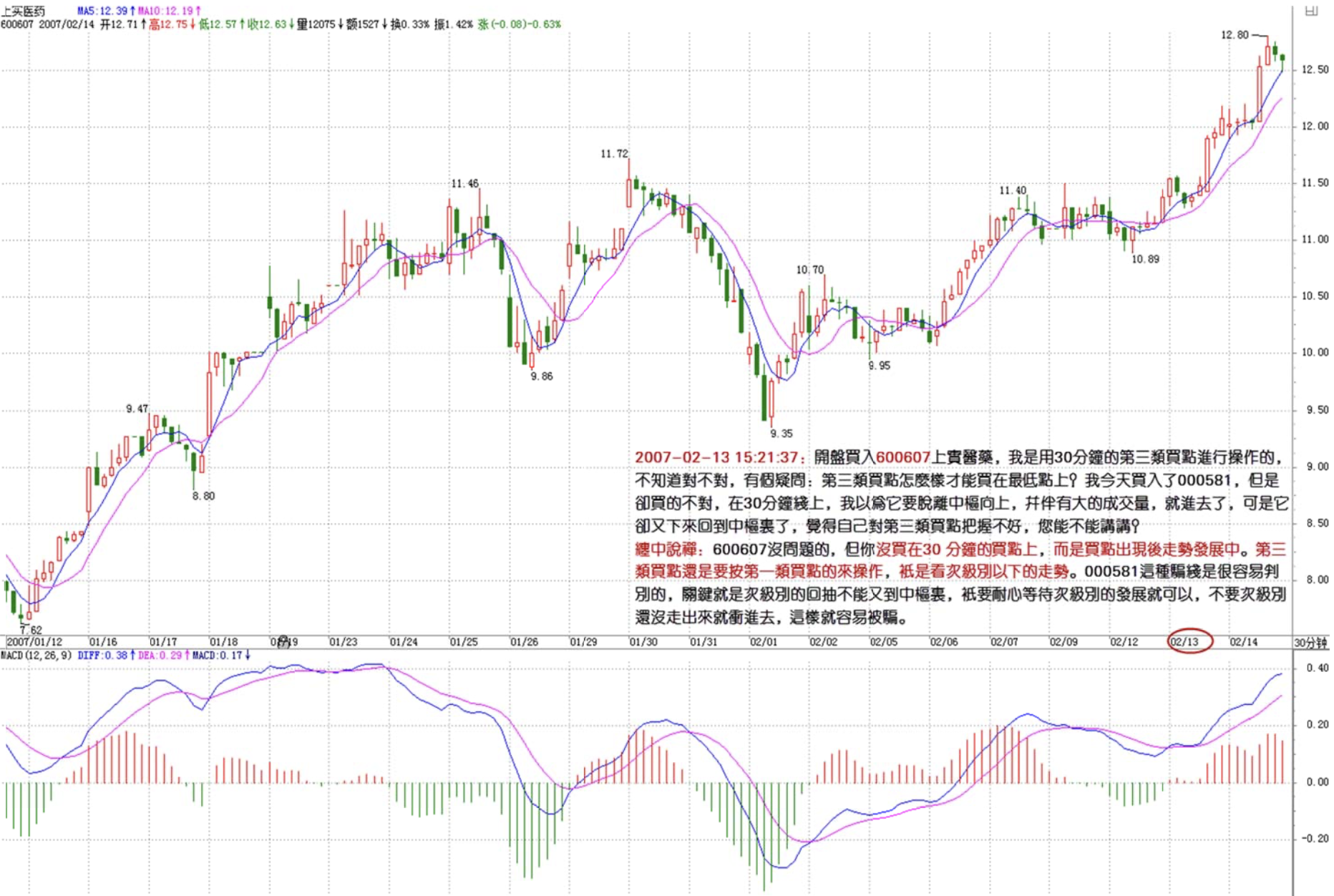
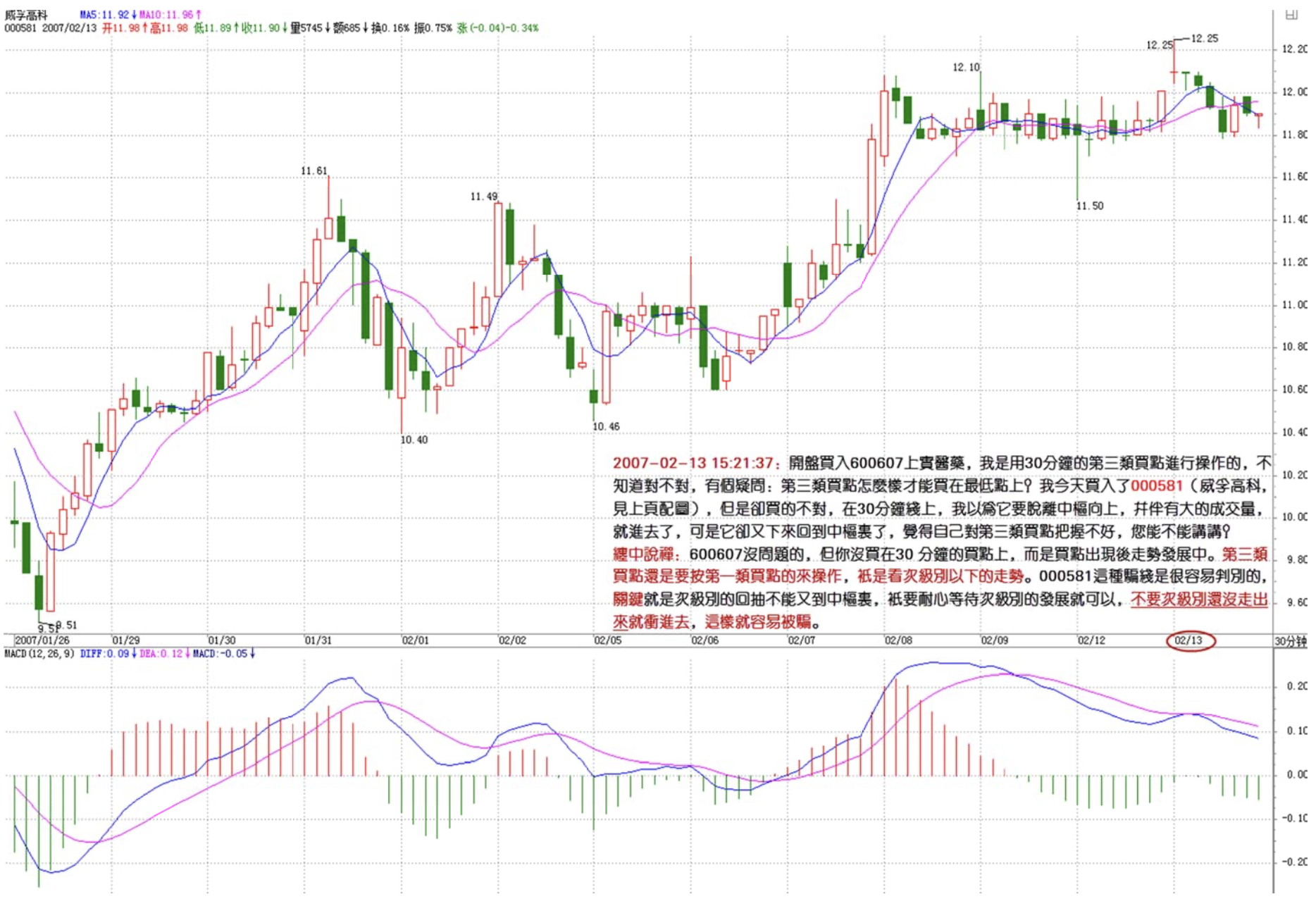
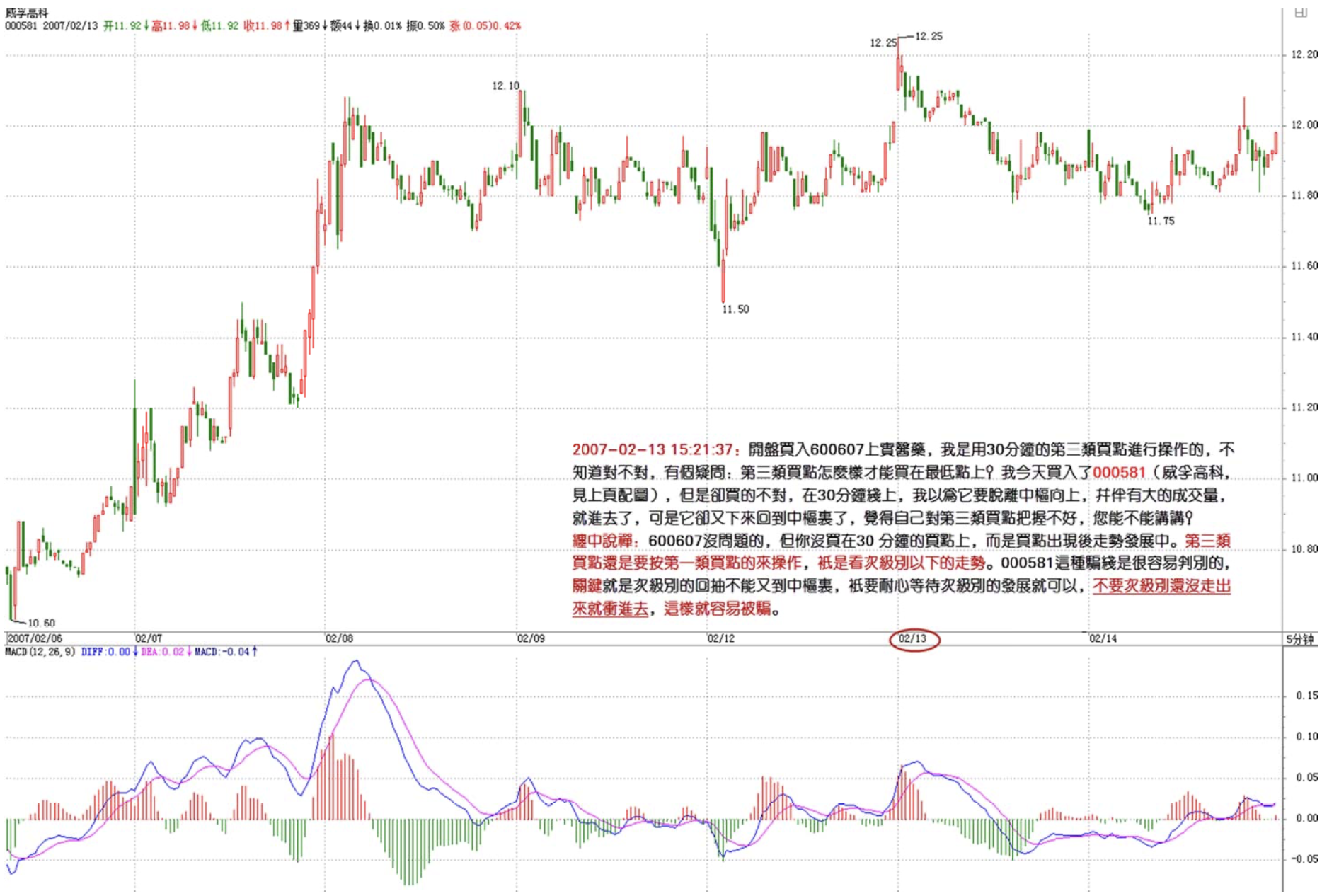
At the open I bought 600607 Shanghai Shiyao. Chan sister, I was using the 30-minute No. 3 buy point to trade — is that right? But I have a question: how can you buy at the absolute lowest with a No. 3 buy point? I also bought 000581 today, but that didn't go right. On the 30-minute chart, I thought it was breaking away from the hub upward with heavy volume, so I entered. But it came back down into the hub. I feel I'm not handling No. 3 buy points well — Chan sister, could you explain more?
Thank you!
==
This stock has no issues, but you didn't buy at the 30-minute buy point — rather at a point during movement development after the buy point appeared. Third-type buy points should still be operated like first-type buy points, just looking at sub-level and below movements.
000581 — this kind of false signal is easy to identify. The key is that the sub-level pullback must not re-enter the hub. Just patiently wait for the sub-level to develop. Don't rush in before the sub-level movement has played out — that's how you get fooled.
缠中说禅 2007/2/13 15:29:18
[Anonymous] 并不完美
2007-02-13 15:22:13
Chan girl, I see that on the 5-minute K-line of the market index, after breaking through the previous point of 2834.93, it will very likely become a 5-minute divergence — does that matter?
==
You don't need to predict anything. The key is: what emerges is what it is.
缠中说禅 2007/2/13 15:34:41
[Anonymous] A Grain of Rice
2007-02-13 15:31:33
Hello boss:
Last week, based on this theory, I bought 000688 and already have 13% paper gains. This has given me even greater confidence to walk alongside you. Everything of yours that I can learn, I will learn — first the form, then the spirit. I've studied stock trading theory for 10 years, and now I'm confident about grasping No. 1, 2nd, and 3rd buy/sell points. The concept of hubs is still fuzzy for me. Right now I'm observing and learning through the 1-minute chart every day. Once I have a solid foundation, I'll come to you with questions, so as not to waste your precious time.
Your theory has made me completely abandon all the stock trading methods I used before. Now I'm starting from scratch, spending a year or half, striving to graduate from kindergarten, elementary, middle, high school, and college level by level. When the country needs us to fight capital market wars in the future, I'll definitely serve the country alongside you.
Thank you again for your selfless spirit!
Giving us the opportunity to learn — a lifetime benefit. After I've mastered it, I'll be selflessly generous just like you.
==
Knowing how to buy also requires knowing how to sell, and you must constantly summarize — only then can you gradually master it proficiently.
缠中说禅 2007/2/13 15:39:58
[Anonymous] 晕
2007-02-13 15:31:58
Master Chan, I have one more subtle question: at the lowest level (say 1-minute), do the three overlapping K-lines need to be consecutive? At this level it seems different from higher-level A/C segments — there's no hub direction issue, so which ones are the Z trend segments?
==
Of course they must be consecutive — direction still applies. For example, one formed from a decline has the direction down-up-down. Actually, you generally don't need to use the 1-minute chart as the lowest level — the tick chart is clearer.
缠中说禅 2007/2/13 15:43:42
[Anonymous] 并不完美
2007-02-13 15:39:21
Chán Zhōng Shuō Chán
2007-02-13 15:29:18
[Anonymous] 并不完美
2007-02-13 15:22:13
Chan girl, I see that on the 5-minute K-line of the market index, after breaking through the previous point of 2834.93, it will very likely become a 5-minute divergence — does that matter?
==
You don't need to predict anything. The key is: what emerges is what it is.
=====================================
What I mean is, if it's divergence, then per the principle that all trends must complete, it should be at least above 2900 — so the focus should be on that moment. Is this way of thinking correct?
==
This has nothing to do with "all trends must complete." The current key issue is whether a second hub can form. Moreover, there's no theoretical necessity for above 2900 — only if a second hub forms around 2850 would it naturally go above 2900. The question is whether it can form, and that must be answered by the movement itself. No prediction needed.
缠中说禅 2007/2/13 15:45:08
[Anonymous] 袖手旁观
2007-02-13 15:41:40
Regarding yesterday's "learning" and "thinking" — the identity aspect of "thinking" is beyond doubt. Only the identity of the object of thought can guarantee that "thinking" bears fruit.
It was just nitpicking for fun — didn't find any cracks. Chan MM's reply was too kind.
==
Not at all — the key is that the most fundamental identity must be revealed. What people usually call identity is not the root-level kind.
缠中说禅 2007/2/13 15:57:45
[Anonymous] 晕
2007-02-13 15:26:41
2007-02-13 15:02:34
I have a question about No. 3 buy points. Please help me understand, Master Chan:
-------------
From Theorem 1, we can derive the No. 3 buy/sell point theorem: when a sub-level trend type departs upward from a Chán Zhōng Shuō Chán trend hub, then retests with a sub-level trend type, and its low point doesn't break below ZG, it constitutes a No. 3 buy point;
-------------
Why is the criterion based on not breaking below ZG rather than breaking below GG?
Per the earlier classification, this retest didn't break below ZG but did break below GG, so the new hub is still an extension of the original hub's level rather than a new one generated during the rise — can this still be traded?
==
The key is the hub, not the momentary fluctuations around it. Buy points are formed during declines, not when you chase higher after a rebound. If you missed the first-type buy point, wait for the second or third — it's that simple.
缠中说禅 2007/2/13 16:07:12
[Anonymous] 晕
2007-02-13 15:56:19
Thank you Master Chan for the answer, but I still don't quite understand:
-----------------
Of course they must be consecutive — direction still applies. For example, one formed from a decline has the direction down-up-down. Actually, you generally don't need to use the 1-minute chart as the lowest level — the tick chart is clearer.
----------------
-
Direction means whether this K-line is red or green, right?
-
What if the 1-minute chart is bouncing up and down wildly across a large range — is it possible that no hub forms? (Because the requirement is three consecutive bars) ==
Red or green has nothing to do with it, because red/green only reflects the closing situation — what happens within the 1-minute bar doesn't matter. If the prices are 10 yuan at minute 1, 5 yuan the next minute, then 7 yuan, no hub will form at all. A hub requires oscillation to stabilize before it can form.
缠中说禅 2007/2/13 16:11:23
[Anonymous] 咕咚
2007-02-13 16:04:04
Hello Chan sister~~ Today I have a chance to ask questions
________
Stocks selected under the same conditions end up with very different trend strength afterwards — is there a way to distinguish?
For example:
After Chan sister said to watch agriculture, I selected 3 stocks — 600540, 600359, 600506. First I eliminated 600540, then 600506, and entered 600359 on January 26 (No. 3 buy point). But afterwards 600506's trend turned out to be the strongest. Is there a way to identify this on a technical level?
==
600506's third-type buy point formed above the all-time high price — generally speaking, of course that's faster than 600359 which formed below the all-time high, because at minimum you save the grinding when crossing the high point. Of course, this is a general conclusion, not an absolute one.
缠中说禅 2007/2/13 16:27:18
[Anonymous] Hindsight
2007-02-13 16:13:47
Chan, last time with Jinxi Axle I bought between the buy point and the sell point. Fortunately, with your guidance, I exited at the 5-minute high.
This afternoon at 14:20 I bought 600001 — please advise, Chan! (The screen scrolls too fast — I've asked four times already)
Sorry for posting those stocks without organizing first. I wasn't trying to spam!
==
After exiting, you should find an opportunity to buy back — this stock's medium-term outlook is fine. Selling is also okay. 600001's medium-term is also decent.
The key is to clarify the purpose of your trading. If it's purely practice, then pick one stock and trade it repeatedly — this helps improve faster and gradually develops intuition.
Generally, for beginners, select stocks with fundamental support, prices not far from the bottom, and buy points appearing at large levels, then trade them repeatedly. This efficiency is much higher than constantly switching. Of course, once you're proficient, it's a different story.
缠中说禅 2007/2/13 16:29:10
[Anonymous] 袖手旁观
2007-02-13 16:15:28
Chán Zhōng Shuō Chán
2007-02-13 15:45:08
Not at all — the key is that the most fundamental identity must be revealed. What people usually call identity is not the root-level kind.
————————
Identity itself can be explored at different layers — at which layer the identity holds. What's fundamental at one layer may be merely surface-level at another.
Chan MM, when will you have time to add some content to the science and math section?
There are some foundations of foundations, roots of roots, that have been asked repeatedly since the beginning of written history, yet never answered. For example, continuous vs. discrete, finite vs. infinite, inertia vs. mass, and so on. These questions may be asked over and over again, but I feel that no matter how deep purely philosophical or purely mathematical exploration goes, it can never satisfy — just like the difference between the Lorentz transformation and special relativity; just like Riemannian geometry gave general relativity its mathematical tools, yet couldn't provide a picture of the real world on its own; just like the Copenhagen school were nearly pragmatic craftsmen, yet couldn't give people the magnificent feeling of classical theory. One can only sigh that human understanding lags far behind the evolution of mathematical systems themselves.
The above is also just rambling. I need to go out to handle some business — let me wish you a Happy New Year first.
==
When I have time, I will. Happy New Year.
缠中说禅 2007/2/13 16:37:46
[Anonymous] Leisurely
2007-02-13 16:09:45
If someone in the market controls 1/3 of a stock's float and the other holders aren't active traders, wouldn't transactions become much more convergent? Wouldn't that reduce the applicability of the theory?
Also, how should this passage be understood?
"More importantly, this ID's theory is not a rigid operation — it is always built upon the present moment. For example, suppose a daily-level trend is judged to have entered a divergence segment, and due to some absolute unexpected event in the present moment — say someone accidentally presses the wrong button and sends another 1,500 nuclear warheads to Japan — causing a sudden structural fracture at a small level that ultimately affects the large-level structure. At that point, the entire judgment is built on a new trend basis. And usually at that point, no actual trade has occurred, unless your luck is incredibly good — you just hit the buy button and those nukes go flying. Most people are accustomed to purpose-driven thinking, often overlooking that trends are constituted in the present moment. This ID's theoretical judgments are likewise built on present-moment constitution — this is yet another key characteristic of this ID's theory. Regarding the presentness of this theory, future lessons will focus on this — by education level, this is a middle school course."
What does "no actual trade has occurred" mean???
==
You don't operate the moment a large level enters a divergence segment — you must use the nested interval method for sequential positioning. Thus, if something unexpected suddenly happens, in all likelihood you haven't actually entered a position yet — you're still observing the nested interval evolution of the movement.
缠中说禅 2007/2/13 16:38:47
[Anonymous] 小注
2007-02-13 16:31:49
Hello Chan sister, is the 5-minute chart showing divergence at 10:45 on the market index? Why no action?
==
That was 1-minute level. It then came down to fill the gap — that was the response.
缠中说禅 2007/2/13 16:40:00
Sorry everyone, I have a dinner engagement tonight. Need to go.
Signing off. Goodbye.
缠中说禅 2007/2/13 15:09:43
The market showing a 1-minute level divergence and entering oscillation under the repeatedly emphasized 2850 pressure level is the most normal thing possible. After all, traitors and those influenced by traitors whose mentality has become unstable still make up the majority. Without some push-and-pull to stabilize morale and seek opportunities, it's unrealistic. There are still three days left to strive for a satisfactory index number for the Spring Festival.
Today the Shenzhen Stock Exchange continued its spirit of meddling in others' affairs, which indeed affected some plans. Nothing to say about individual stocks today. As a side note, starting today, venture capital concepts will gradually heat up — this is truly a sunrise industry.