Teaching You to Trade Stocks 98: Traditional Chinese Medicine, Military Strategy, Poetry, and Trading 2
2008/2/4 19:51:49
Before the holiday, I didn't plan to write another lesson. After all, there's no shortage of things to do at home during the holidays. But still, let me squeeze in a few words while I have time.
Changing one's way of thinking is very difficult because the existence of a particular thinking pattern is often unnoticed even by oneself. Especially after a strong market move appears, those old bad habits resurface. The market reversal of the past few days is a perfect example.
After a divergence — whether it's a consolidation divergence or a genuine divergence — the theory can only guarantee a pullback to the original hub. This is the correct way of thinking. As for what happens after the pullback, that involves prediction. The correct thinking is to completely classify all possible situations that may occur after the pullback, and based on the consequences corresponding to each classification, determine your own countermeasures.
For example, last Friday afternoon's divergence was very obvious — anyone could have identified it in real time. After entering on this divergence and the market closed, there were two possible scenarios: either continuing to push upward above the hub, or pulling back down again. The first scenario means the line segment starting from 362 would continue to extend, while the second scenario would first destroy the line segment starting from 362. So these two situations are very simple — just wait until Monday's opening to determine in real time whether this line segment has been destroyed.
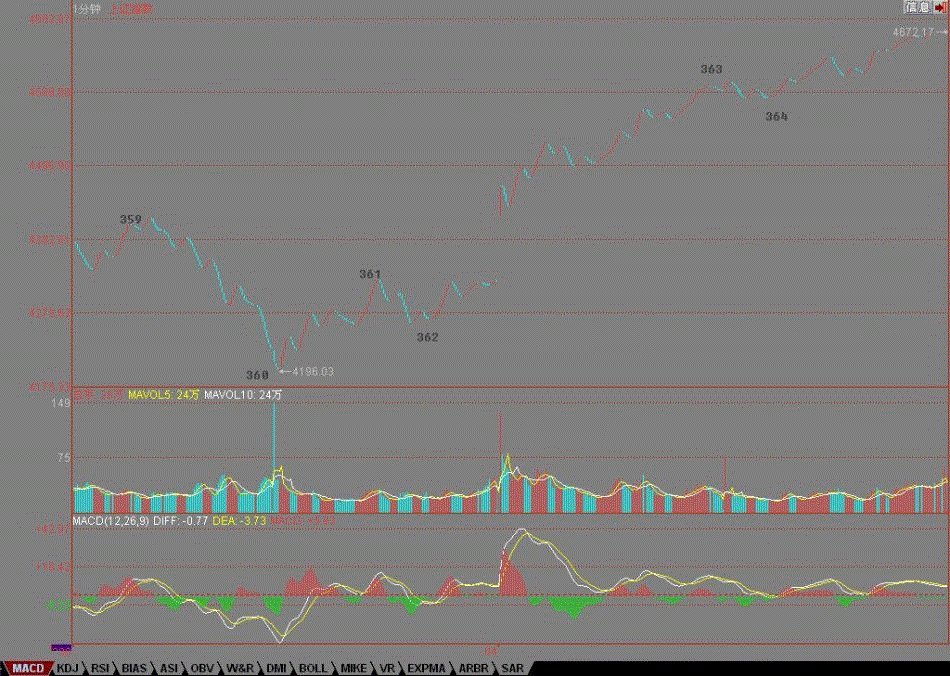
Note, this is strict theoretical thinking, completely unrelated to whether there's any news on Monday or whether there's positive news. In particular, if there were positive news yet the market still produced a move that destroyed the line segment starting from 362, then the problem would be serious. In reality, however, the market didn't destroy this line segment until 364. But at that point, there was no reason to exit — why? Because theoretically, the probability of this evolving into a line-segment-type rally was extremely high, unless the line segment starting from 363 broke below the 361 position. So afterward, you just needed to watch whether this line segment fell to that position, and obviously it didn't, so you continue holding.
After 364 appeared and a new line segment unfolded, since this was already the second line-segment-type hub, you needed to watch for possible near-divergence. This depends on tomorrow's opening — if it cannot maintain a similar rate of upward movement, then it would be perfectly reasonable for this line-segment-type rally to end and form a 1-minute hub.
You see, all the analysis above follows strict logical relationships. This is a necessary consequence of the theory and a correct way of thinking. Of course, whether a near-divergence of a line segment warrants selling some shares is a matter of personal preference and your operating timeframe.
This is like warfare — you cannot assume that a certain hilltop will still be in your hands tomorrow and then arrange your forces based on that assumption. Whether the hilltop is in your hands is determined in the present moment. Of course, you can fight back and forth over a hilltop, but you cannot assume that this hilltop will be 100% in your hands at some future moment.
This is also like Chinese medicine — you cannot assume your medicine will definitely have a certain effect. The effect is determined by "looking, listening, asking, and feeling the pulse" after the medicine has been taken, and the same patient's medicine must be adjusted as needed based on this continuous examination. Of course, you can also keep things unchanged — just as in an uptrend, you can hold your position. But once a reversal signal appears that exceeds your level, your operating threshold — that is, divergence — then your prescription must change, perhaps even drastically.
Therefore, if Monday had not produced today's positive news, your operating logic would not have changed at all. You would still act based on whether the chart at that time touched your operating classification boundaries. This is the correct way of thinking.
In other words, when you are trading, all possible situations you may face subsequently, along with their countermeasures, must be crystal clear to you. Otherwise, you have no business trading. For a true operator, no situation is unexpected, because all situations have been completely classified, all corresponding countermeasures have been prepared in advance — you're simply waiting for the market itself to choose, to trigger the switches we have preset.
Honestly, compared to Chinese medicine and warfare, stocks are the simplest. Why? Because with the existence of this ID's theory, the subsequent movements of stocks can all be strictly and uniquely given as unified complete classifications. Chinese medicine and warfare face potentially more complex situations. Especially in warfare, complete classification may only be a hypothetical possibility.
If your thinking still hasn't turned around, then there's no need to continue studying. First, get your thinking straightened out.
Some may ask: what if a pullback occurs and you can't exit your position bought at the divergence? Obviously, this is quite possible because with T+1, you may not be allowed to sell during the reaction time. However, a very simple countermeasure is: you must buy stocks that are stronger than the overall market — stocks that lead the market. This way, once the market reverses, these types of stocks will perform better than the market, naturally giving you enough room to make your choices.
Note, the best choice is stocks that are slightly ahead of the market — not those completely contrary to the market. The latter often face the possibility of catching-up declines, or contrarian shakeouts. For example, today's 600737 is a perfect illustration. Of course, new stocks are also a good option, though this requires that they don't open too high and show clear signs of new capital entering. During a rally of a certain level, these generally exhibit relatively stable performance. Then there are stocks that adjusted ahead of the market — like that clever donkey this time, which was exactly this type.
Of course, how to select stocks is a matter of experience that requires repeated practice before you develop intuition and sensitivity. Actually, stocks really aren't that complicated. Once you've developed that sensitivity, you open a stock's chart and can immediately tell whether this face is posturing and waiting to be favored — just like in a one-night stand, do you really need technical analysis to choose someone? Isn't it just a matter of one glance? The day you look at stocks with the same feeling as picking someone for a one-night stand, you're getting somewhere.