Teaching You to Trade Stocks 36: Simple Applications of Trend Type Connection Associativity
2007/3/13 9:00:49
The previous lesson mentioned the associativity of trend type connection operations — that is, trend type connections follow the associative law: A+B+C = (A+B)+C = A+(B+C), where A, B, C can be trend types of different levels. Therefore, from the polysemy perspective, according to this associative law, it's easy to see that any segment of movement can have many different interpretations. It must be emphasized that polysemy is not ambiguity. A theory whose classifications and concepts exhibit ambiguity only proves the theory's foundational vagueness. Polysemy, on the other hand, stands on a rigorous, precise theoretical foundation and analyzes the same phenomenon from different perspectives within the same theory.
The simplest interpretive angle is level. Any segment of movement can be decomposed according to different levels. Let An-m denote the mth segment of the decomposition of segment A according to level n. Then: A = A1-1+A1-2+A1-3+…+A1-m1 = A5-1+A5-2+A5-3+…+A5-m5 = A30-1+A30-2+A30-3+…+A30-m30 = Adaily-1+Adaily-2+Adaily-3+…+Adaily-mdaily, etc. Obviously, these decompositions all conform to this ID's theory. And operating according to a certain level, from a purely theoretical standpoint, is nothing more than choosing to operate on a particular sub-expression in that equation — this was already explained in the previous lesson.
Another application involves present-moment judgment of trends. Present-moment judgment is based on the decomposition method adopted. For example, an operation perspective decomposed by 5-minute versus one decomposed by 30-minute will see different meanings in the same movement at the same time. More importantly, a movement completed in the 5-minute decomposition may not be completed in the 30-minute decomposition. For instance, A+B, where both A and B are 5-minute trend types — the A+B movement is incomplete from the 30-minute decomposition perspective. According to the principle that trends must be completed perfectly, incomplete movements must eventually complete. That is, from different decomposition angles, you can see incomplete movements of different levels generating motion according to the trend-must-be-perfect principle in the present moment. Detailed analysis of this application is reserved for a dedicated lesson.
Yet another application is recombining movements to make trends clearer. Many people get dizzy looking at trends, mainly because they don't understand the associativity of trend connections. Any movement can be recombined according to the associative law, making the trend display obvious patterns. Suppose A+B+C+D+E+F, where A, C, E are 5-minute level and B, D, F are 30-minute level, with extension and other complications mixed in. In this case, you can re-decompose these movements at the 5-minute level, then recombine them according to the hub definition. Using the associative law, transform the original decomposition into A'+B'+C'+D'+E'+F', where A', B', C', D', E' are all standard 30-minute level only, and the final F' becomes an incomplete movement in the 30-minute sense. Analyzing this way becomes very clear. Of course, there are many possible specific combinations, and how to choose the one most helpful for guiding operations given the present-moment trend is where real skill comes in.
This optimal combination according to the associative law changes with the present-moment trend, yet all changes conform to theoretical requirements and don't affect actual operations — they provide more powerful assistance to practical trading. For example, in the recent market movement, on the 30-minute chart, the 30-minute hub from 2,760 to 2,858 had a 5-minute pullback confirmation at 10:00 on 03/08 establishing a third-type buy point. Then subsequently a new 30-minute hub was formed. However, the 5-minute pullback low at 10:00 on 03/08 (2,871 points) was lower than the previous hub's highest point (2,888 points). Later, the 30-minute hub starting from 13:30 on 03/07 showed extension. Given this, we can recombine the decomposition to give a clearer arrangement: incorporate the 5-minute pullback at 10:00 on 03/08 into the 5-minute movement starting from 13:30 on 03/05, forming a single 5-minute uptrend. Then the new 30-minute hub starts from 10:30 on 03/09. The benefit is that this hub's oscillation low (2,892 points) is higher than 2,888. If subsequent oscillation doesn't produce a break below 2,888, then a 30-minute uptrend has formed. But until this new hub is effectively broken through by a new third-type buy point, the possibility of oscillation breaking below 2,888 and ultimately confirming hub expansion still exists. Nevertheless, such recombination aids chart reading. Of course, from the pure hub perspective, one can still insist on having the new hub start from 13:30 on 03/07 — this doesn't greatly impact specific operations but makes judgment less convenient than the recombined view.
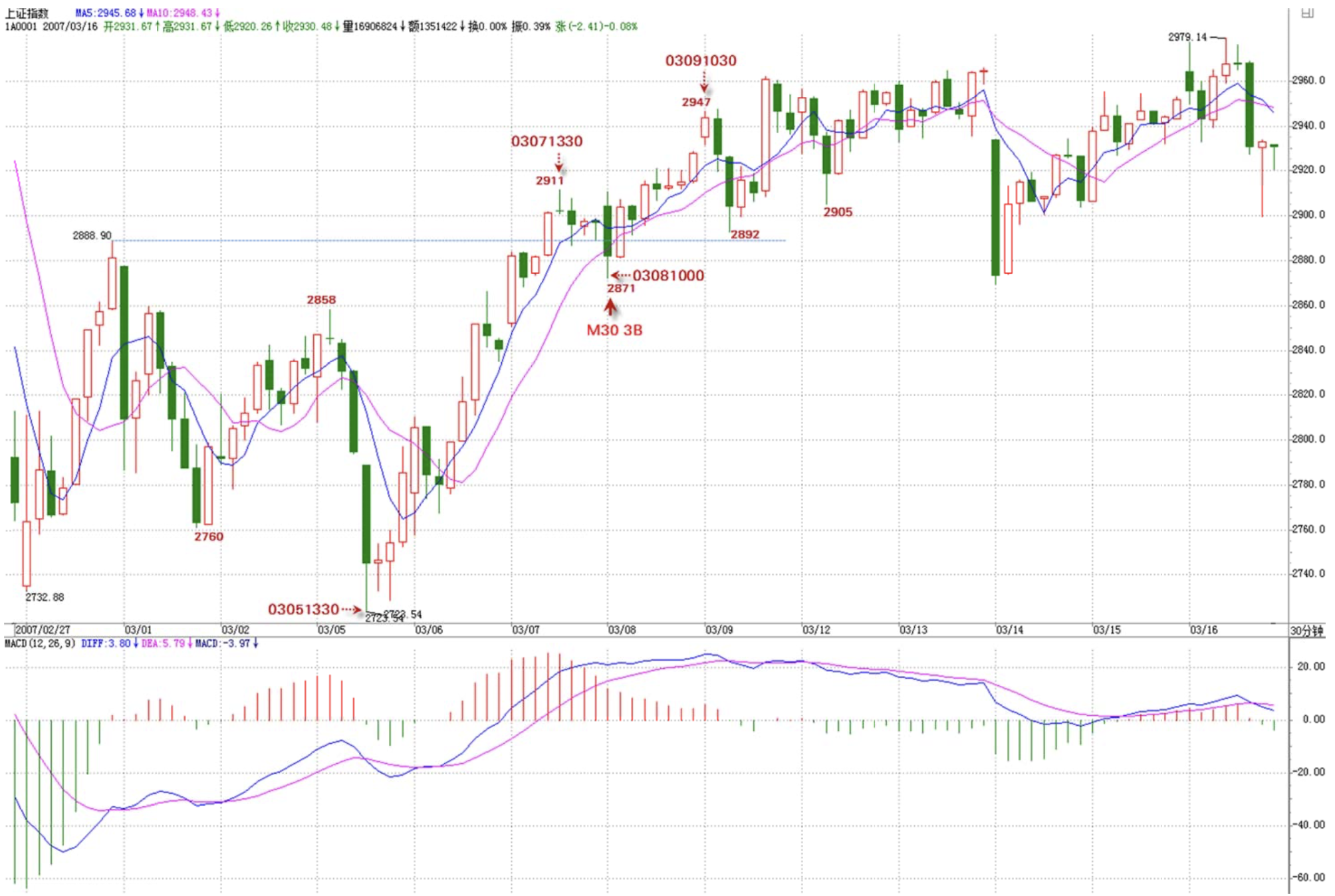
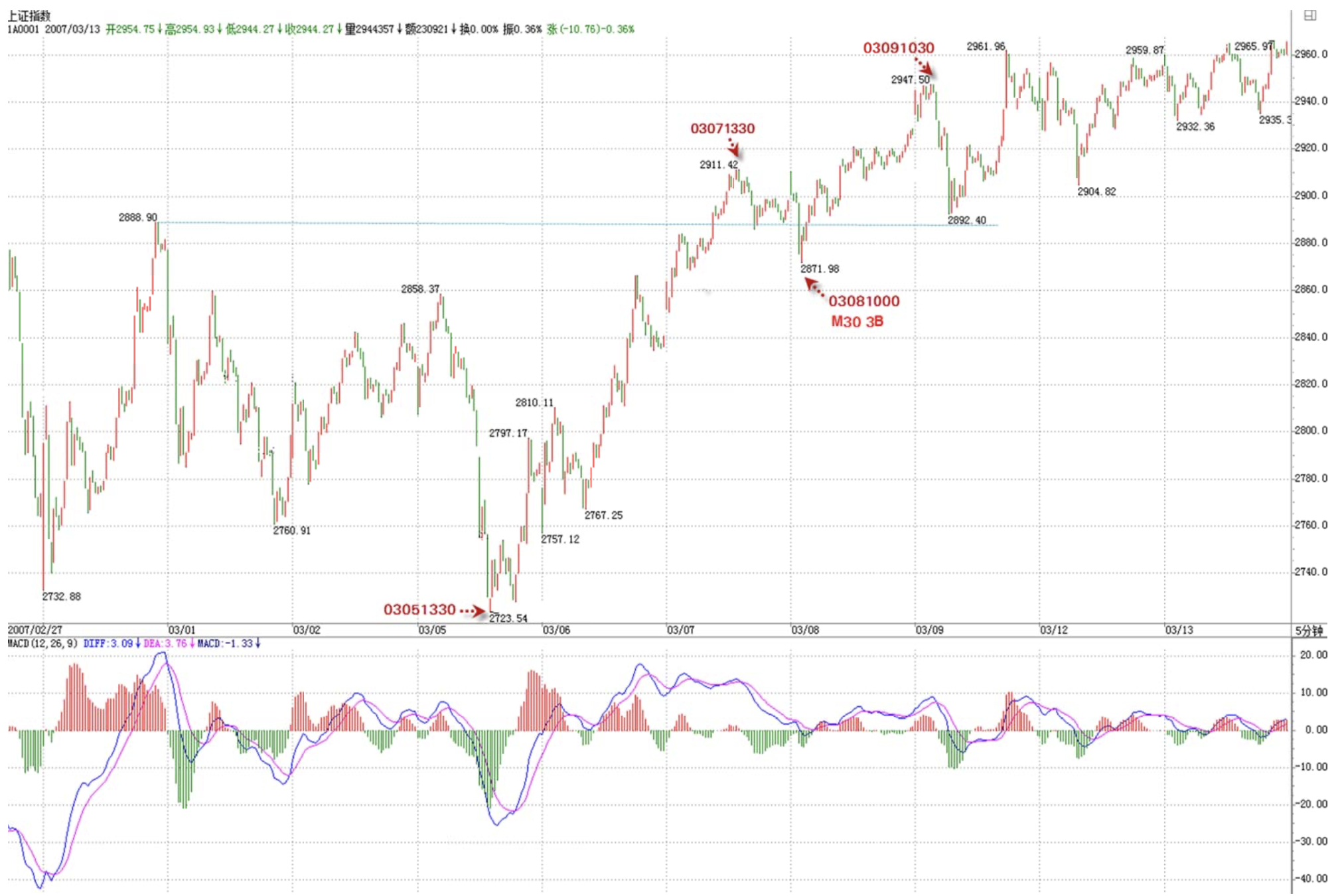
Note: this recombination involves no prediction. Someone might ask: why not incorporate the 5-minute pullback at 10:00 on 03/08 into the 5-minute movement starting from 13:30 on 03/05 right from the beginning? Because that combination wouldn't facilitate operations. Under that combination, the third-type buy point significance of the 10:00 on 03/08 5-minute pullback wouldn't be revealed — it would be confined within a small 5-minute movement range. Under that combination, one would anxiously await divergence. This happens because the understanding of trends isn't deep enough to see the meanings reflected by different combinations. Every combination's reflection is meaningful — fully grasping the meanings of all these combinations represents real advancement in skill. Furthermore, a key point in combining is to simplify whenever possible. Since hub expansion is complex, if there's a combination that avoids expansion, naturally that combination is more useful. Someone might ask: does the hub expansion definition not apply then? Of course it applies — hub expansion is defined under the condition that both hubs have fully played out. But in actual operations, the second hub often hasn't finished yet and is still extending. So unless a clear, definition-conforming violation occurs, one may, based on the principle of facilitating judgment and operations, combine the movement in the present moment. But it must be emphasized: whatever combination is adopted at present, judgment and operations must follow that specific combination's chart implications. For example, now taking 10:30 on 03/09 as the new 30-minute hub's starting point, the hub position becomes 2,947 to 2,905, so subsequent third-type buy point positions have a new standard. Of course, you can still keep the 30-minute hub starting from 13:30 on 03/07 — in which case the hub position is 2,911 to 2,892, giving different possible third-type buy point positions.
There's an even more important application: within hub oscillation. The oscillation around a hub isn't necessarily all at the sub-level. For example, for a daily hub, the oscillation around it can be any level below 30-minute, or even a gap — some stocks can go limit-up one day, limit-down the next, jumping around wildly. Most people get dizzy looking at this kind of movement. But if you understand the associativity of trend connections, you know that no matter how it jumps, eventually larger levels must form. As long as the daily hub isn't departed from, at minimum it will eventually form 30-minute-level movements. Any oscillation around a daily-level hub can ultimately be decomposed as follows: A30-1+A30-2+A30-3+…+A30-m30+a, where a is an incomplete 30-minute trend type. At least if a continues oscillating around the daily hub, a will eventually complete into a 30-minute trend type. Obviously, here m30 < 9, otherwise it would become a weekly hub, and the entire decomposition would need to use daily level — but the logic is the same.
However, what's more practically significant is: if the above a no longer oscillates around the daily hub — for example, suppose a is a 5-minute level, and the subsequent 5-minute level pullback also doesn't return to the hub. According to the daily hub, this doesn't constitute a third-type buy/sell point. But for A30-m30, it might constitute a 30-minute third-type buy/sell point. Since trends always progress from incomplete to complete, always accumulating from small levels, a true daily third-type buy/sell point must appear earlier in time as A30-m30's third-type buy/sell point. For A30-m30, this is absolutely safe. But for the daily level, it's uncertain — because the 30-minute movement completed after A30-m30's third-type buy/sell point could use another 30-minute movement to return to the daily hub and continue oscillation. Yet this A30-m30 third-type buy/sell point still has participation value, because if the subsequent 30-minute movement develops into a trend, and a daily third-type buy/sell point actually appears, it often forms around the 30-minute second hub, unable to reach back to the A30-m30 third-type buy/sell point position. Therefore, such buy/sell points, even if they don't match your operating level — for example, if you operate at the daily level — once such an A30-m30 third-type buy/sell point appears, you should at least give it serious attention and can appropriately participate. Once a trend movement follows, you should pay very close attention.
One should never predict trends, but all movements that have already occurred can be freely recombined according to level and the associative law. Under any combination, they necessarily conform to this ID's theory. And any final movement, across all combinations, completely conforms to this ID's theory — this is also the miraculous aspect of this ID's theory. No matter how you combine, no violation of this ID's theory will occur. But whether you can find the most suitable combination for operations, and conduct comprehensive analysis of trends based on different combinations — that depends on experience. These most suitable decompositions all have corresponding answers — the key is whether you can spot them. This involves absolutely no prediction, only the decomposition of existing movements, related to your grasp of theory and familiarity with chart patterns. These are the most basic skills, but they must be tempered through practice in present-moment trends to be truly mastered. If you can truly grasp the most rational present-moment combinations and use different combinations for comprehensive analysis, then you're ready to advance to the third year of middle school.
缠中说禅 2007/3/13 9:03:17
Very busy today — won't have time to come online. The lesson is posted below. Everyone study first.
Logging off. Bye.