Teaching You to Trade Stocks 94: Seize the Moment
2008/1/21 17:29:47
This ID has said before: to learn this ID's theory, you must first undergo a thorough transformation. Why? Because everything you previously knew about stocks could be poison to your subsequent learning. In this ID's framework, there are only strictly classified different operation types — none of that other nonsensical, impractical so-called prediction.
In a word, coming here to learn from this ID, the first level you must achieve is: seize the moment with decisive action.
Opportunities can be analyzed in advance, but this analysis is not prediction — it's boundary delineation built on the foundation of complete classification. This delineation comes entirely from the pure mathematical construction of this ID's theory, and the uniqueness and precision of this construction guarantee the real-time confirmability of this classification and its boundaries.
Actually, this has been said before, but it must be said again. Why? Because this is a completely different way of thinking, and if you can't grasp it, you'll forever be estranged from this ID's theory.
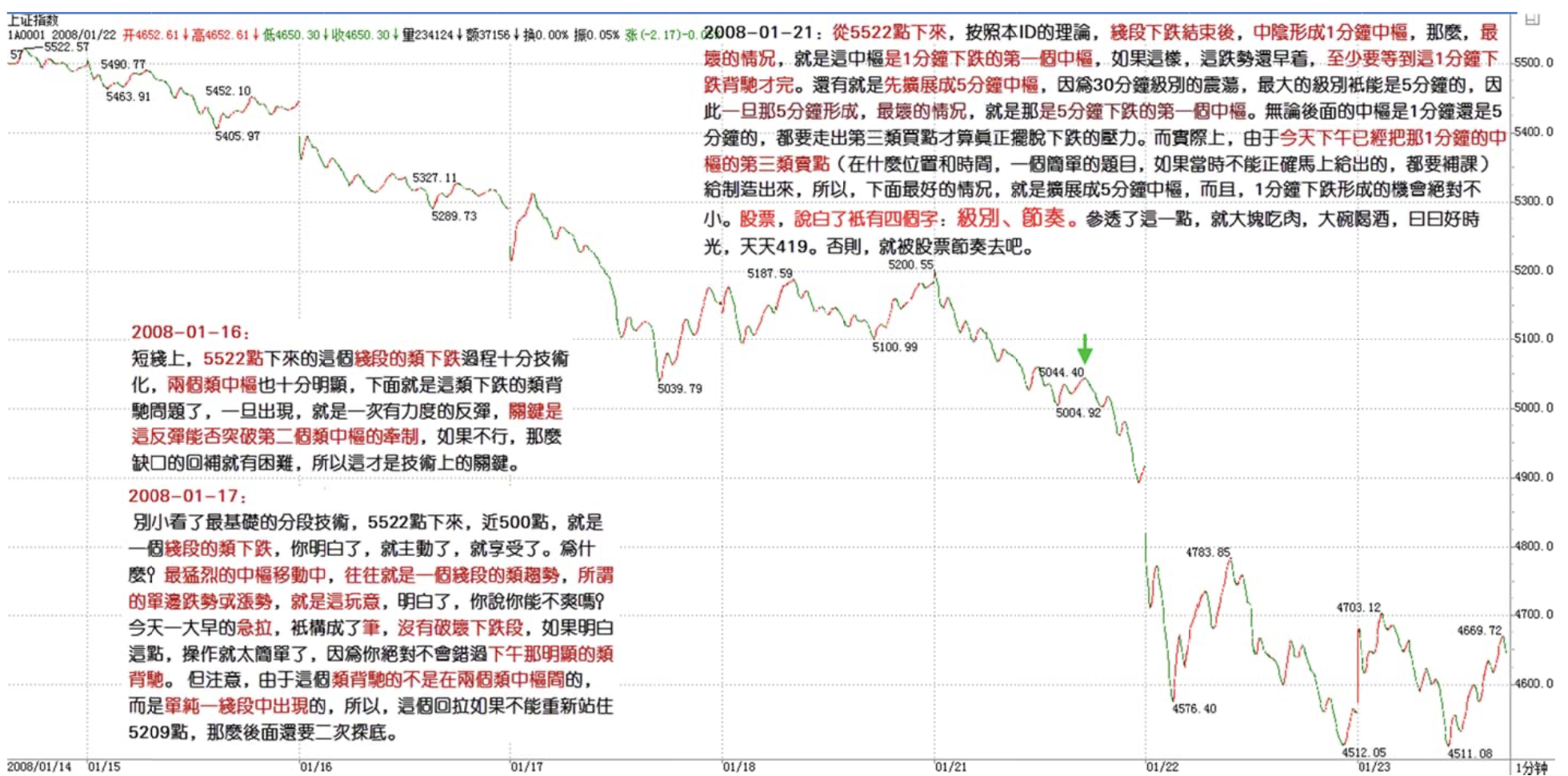
For example, right now, regarding the market's future trend, we can immediately analyze all opportunities that must inevitably appear: 1. The smallest opportunity is the line-segment-type divergence formed after the market's line segment moves downward. This corresponds to two targets: the best scenario is pulling back up to the 1-minute hub above, thereby forming a 5-minute hub; the remaining scenario is forming a second 1-minute downward hub.
- After the first opportunity appears, based on the real-time evolutionary choice, we can immediately identify the next inevitably occurring opportunity: if it's a 5-minute hub, then there's a hub oscillation opportunity; if it's a second 1-minute hub, then wait for subsequent bottom divergence, or wait for the oscillation opportunity after this hub expands into a 5-minute one.
Similarly, for any trend, we can immediately and rigorously provide all inevitably occurring opportunities based on the theory. The market is just that predictable — though it torments countless people, it has never once deviated from this ID's theory. So this ID can call the market a boy toy.
At any given moment, you can immediately identify the opportunities that must subsequently appear based on this ID's theory. The above discussed buy points; the situation for sell points is identical.
Good — based on the theory, you can enumerate a large pile of inevitably occurring opportunities. What follows is simply a matter of selection. For instance, the 1st opportunity — you might feel its level is too small and don't want to bother. Fine, don't bother then. It's like a boy toy — if you see one and aren't interested, do you really need a reason?
Once you truly understand this ID's theory, operation is really this simple. The only thing you need to ask yourself is: do I currently have the interest to act? This opportunity, this boy toy, at this moment — do you want to go for it?
If you do, then you need a series of preparations — execution channels, capital, all arrangements must be set up, and crucially, the exit boundary conditions must also be configured.
For example, for the 1st opportunity, the exit condition can be set as the previous last quasi-hub, or as the quasi-divergence or quasi-consolidation divergence within the upward line segment trend type.
Of course, based on such configured conditions, under T+1 rules, you may very well not be able to exit. Why? Because the buy and sell points might complete within the same day — you buy but can't sell. So when configuring, you may also need to consider the timing of the opportunity's appearance. If it's in the morning, you might want to think twice. If it's in the afternoon, you can be bolder.
Of course, this also depends on your own specific situation. For example, if a stock with an excellent medium-term trend drops 20% on a line segment decline and you exited at the top, then this buyback opportunity naturally warrants being bolder.
Even easier — just enlarge the level. If you operate on the weekly chart, buying from the second half of 2005 until now, you wouldn't have needed to make a single operation. Who told you this ID's theory is only for short-term trading? Was it Mr. Kong who told you that?
For each type of opportunity, you need to consider all possible scenarios clearly, which allows you to judge their momentum, thereby determining the capital amount for entries and exits. It's like a one-night stand — you've decided you want one tonight, but you still need to see the actual goods before deciding the level of commitment. Who told you a one-night stand means throwing yourself in recklessly? Can't you just bail after a look? From bailing at first sight to going all-in — there are infinite scenarios in between. Seize the moment — that's the only principle.
Having learned this ID's theory, your mind must always keep two words front and center: level. If you can't even figure out the level, you think you're ready for a one-night stand? You're more likely to be the one getting played. Once you have the level down, it's a matter of rhythm — a one-night stand means knowing when to quit while you're ahead, not seeking eternal commitment. If you can't even understand this, prepare for disaster after disaster.
Not knowing how to sell is the same as losing your next buying opportunity. The reason this rhythm is difficult, to put it bluntly, is greed, anger, delusion, doubt, and arrogance at work.
For beginners, you must mechanically impose some constraints — like putting a headband on that wild monkey. The constraint is the 5-week and 5-day moving averages — once a fractal effectively breaks them, you must exit. That's the constraint. Of course, for the experienced, these are unnecessary — strict trend classification automatically provides everything.
The first step of practice is very simple: at any point in time and price, you should be able to immediately map out all opportunities based on the theory as a first response.
Note: any opportunity must appear in the output of this ID's theory. Market opportunities and the output of this ID's theory are in strict one-to-one correspondence. This is one reason why this ID's theory is so powerful.
The second step: based on your current mood, capital situation, etc., choose which opportunities to engage with and which to pass on.
Then wait for the moment to manifest, seize it decisively — it's that simple. But this final step alone will take you N years to master.