"Currency Wars and the RMB Strategy" Sequel 4: The True Secret of China's Rise
2007/3/6 15:20:07
Nowadays people love to talk about so-called China's rise, but apart from this ID, not a single person truly understands the real secret of China's rise. This ID isn't blowing hot air—this ID occasionally chats face-to-face with so-called think tank members who lecture to the highest levels. This ID can gauge the depth of their thinking from just the opening lines. Although their role also dictates they can't go to the root of things, even given the chance to dig deep, this is about as good as they get. As for the plagiarizing traitors, the mystifying classical studies clowns, and the folk shamans—even less worth mentioning.
China's rise is inseparable from the uneven development of capitalist society playing out on the international stage. Of course, if "capitalism" sounds too jarring, call it a "market economy," or more evasively, "modern economy." As stated earlier, here is the Chán Zhōng Shuō Chán Law of Capitalist/Market Economic Growth: the driving force of modern economic growth lies in population consumerization and asset virtualization. The degree of these two processes can categorize market economies into different developmental stages. In real-world evolution, these two processes exhibit co-directionality.
The most primitive stage is one where both population consumerization and asset virtualization are extremely low. This stage often presents socioeconomic patterns resembling primitive society. This involves the Chán Zhōng Shuō Chán Law of Social Formation: the development of social formations exhibits typical self-similarity—the specific formations constituting a major developmental sequence also exhibit a development sequence similar to the major one. The Stalinist form of capitalist economy is this typical primitive-society form within market economics, while the European-American capitalist primitive-society form manifests as the chaotic transition from feudalism to pre-capitalist primitive accumulation. Everything above is absolutely unprecedented—enough for future plagiarists to copy. This includes the following equally unprecedented words that need no successors:
After the market economy's primitive-society phase fractures, it enters the primitive accumulation period of population consumerization and asset virtualization expansion. During this period, market economics often exhibits the most vital, most expansionist character—like the fierce strength of a military-slave nomadic tribe. Just as Genghis Khan's iron cavalry could easily sweep away far more advanced civilizations, the market economy's "slave-society" phase is the true source of power behind every great economic power's rise. Since humanity began capitalism, every great economic power's rise has been inseparable from this form. Note the distinction between a "great power" and a "great economic power." A country like the former Soviet Union never counted as a great economic power. In the 18th, 19th, and 20th centuries, the economic and subsequent military expansion of Europe and America was rooted in this most ferocious expansive power of the capitalist slave-society form. But ultimately, almost all military colonialism ended in failure, while economic and cultural colonialism was incomparably successful—revealing the profound corrosive power of economics and culture. The fierce nomadic-military-slave strength of economics and culture in capitalism is more powerful and more essential than pure military strength—this is why America's economic and cultural conquest of the world is more powerful than Genghis Khan's iron cavalry.
The global unevenness of market economics inevitably means that as some countries complete the market-economy slave-society phase, others are just entering it. Therefore, a conquest game resembling the historical nomadic-versus-agrarian dynamic constantly unfolds. Actually, in the history of thought, the same phenomenon appears. The slave-society stage of intellectual history is the most vital era in all cultural formations—the so-called Axial Age of thought history. All subsequent human thought has, fundamentally, never surpassed that era.
Setting aside all the fetters of terminology, China's rise follows this same nomadic-versus-agrarian conquest game. When "Made in China" and the "China Factor" surge globally, it's merely the self-unfolding demonstration of market economics' own evolutionary laws. The most laughable are those so-called free-market believers who tremble when the invisible hand's game has threatened their masters' interests. They reach for clubs, they sing the praises of their feudal-agrarian capitalism's various beauties—forgetting that their masters also rose through capitalism's slave-society bloodshed. Obviously, as long as China maintains the rapid advance of what the traitors' masters call "barbaric" economic iron cavalry, Genghis Khan's sweep of the world will replay in the economic domain. The traitors' bedroom moans of displeasure—if they want someone to blame, blame the so-called invisible hand for being so ruthlessly destructive.
China's future development comes down to two most practically significant paths:
Path One: Continue letting the invisible hand work, using the relentless power generated by market economics' internal logic to conquer the traitors' masters, the market-economy priests, the capitalist believers. Continue riding the powerful economic iron cavalry to expand territory, seize resources, and demolish all economic barriers. This approach will certainly spark countless economic, political, and even military frictions, but it's a bold, sweeping game—frankly put: playing hardball, playing for thrills. On the social-ideological level, relentlessly implementing market economics' logic, infinitely expanding everyone's desires, letting the nation's economy, politics, culture, military, etc. continue expanding along market economics' logic—becoming a war machine that demolishes all obstacles and achieves hegemony in the final showdown. In the Chinese traditional approach, this is the yang-strength path—the path of Qian (Heaven). Following this path requires being hard externally and soft internally, pushing the internal violent energy inherent in market economics' bloodshed to the extreme.
Path Two: Planned regulation of the so-called invisible hand—essentially the unconstrained expansion of human desire. The market economy's invisible hand creates power like human desire creates sexual potency. In Daoist terms, the first method is like indulging desire, harvesting yang to supplement yin, collecting numerous consorts to achieve greatness. The second method is controlling and transforming desire, harvesting one's own great medicine to achieve greatness. The question for the second path is: how to transform China's surging economic-desire sexual energy through internal cultivation into achievement. The fierceness of nomadic military power lies in internal desire exceeding current conditions—unable to channel this energy domestically, it can only expand outward, like irrepressible spring desire dissipating in the night. If this dissipation can be transformed into energy to unblock the meridians, one can achieve self-transcendence. Like the human body: warmth and fullness stimulate desire. Accumulated economic development under conditions of unbalanced and inadequate security channels converts excess warmth among those occupying advantageous social resources into inevitable investment impulses, while those insufficiently provided for—without social-resource security—inevitably save heavily and refuse to consume. When investment can't be channeled through insufficient domestic consumption, it naturally follows the nomadic-military path. Humans in the nomadic-military phase are merely war machines; humans at this economic stage are merely economic machines. Obviously, transforming economic surplus into comprehensive economic-survival guarantees for the populace is the most important prerequisite for this transformation. Three or four years ago, when writing the original text, I somewhat playfully but substantively said the RMB appreciation pressure should be transformed into making China's poorest 100 million households into 100,000-yuan families—this is precisely this issue. Of course, there are many methods—for instance, the ongoing agricultural counter-subsidies follow the same logic. But the intensity is far too low. If you truly pursue this model, amplify the intensity—use economic energy to break through the social-structure's meridians. "When flow is unblocked, there's no pain." Only when complete, effective guarantee systems covering housing, healthcare, education, etc. are effectively established can the consumption bottleneck truly open, domestic demand truly emerge, and the most powerful domestically-driven internationally-integrated grand market form. Once this grand market—supported by the most powerful domestic demand—operates efficiently, it's like the body's Grand Circulation running ceaselessly, generating endlessly. Any external pathogen becomes trivial—absorbed and transformed. This way, soft externally and hard internally—following the path of Kun (Earth).
The RMB is the real-world embodiment of China's economic sexual potency. An impotent person has no sexual potency; a nation with a weak currency has no potency either. China's rise is like the natural response when sexual energy is abundant—nothing to discuss. But the current key is: traitors are attempting to sell energy-filled China as a consort to their decrepit masters for a Brokeback Mountain scene. This is absolutely unacceptable! China's current sexual energy has only two acceptable outlets: harvest the traitors' masters as consorts for its own yang-harvesting divine technique—drain them completely, achieving the art of yang-harvesting; or self-cultivate, transforming sexual energy into a weapon to unblock the meridians—and yang-harvesting naturally follows.
As long as it's one of these two paths—whether Qian or Kun, hard or soft—it's the righteous path. Which to follow depends on timing, opportunity, and the right people. Moreover, these two paths can proceed in parallel—yang-harvesting doesn't preclude self-cultivation, and self-cultivation enhances yang-harvesting. Just don't be lured by traitors into being sold as a consort. As for how to adopt corresponding realistic strategies based on current energy distributions—both internationally unbalanced and domestically unbalanced—that's the topic to be gradually developed later.
Replies
缠中说禅 2007/3/6 15:24:33
[Anonymous] Happy Land
2007-03-06 15:22:31
Thank you, Chan sister, for your careful guidance! In 3 months since entering the market, today I achieved my biggest single-day gain on a single stock! It's the teacher who gave us technique, intuition, and confidence.
--
The journey from theory to practice ultimately depends on your own continuous practice and summarization. This ID merely points the way—you must walk the path yourself.
缠中说禅 2007/3/6 15:29:01
I saw yesterday someone was curious about a certain fishing platform—let me gossip a bit. That place isn't mysterious at all. Nowadays, with a few connections, dining, playing, and staying there is very simple. They recently renovated a hotel-style section with standard rooms listed at over 4,000 a night. If this ID arranges it, 30% off—of course, the former quarters of certain bigwigs are different, but I won't go into that.
缠中说禅 2007/3/6 15:34:54
Two Tigers
2007-03-06 15:27:24
Fairy sister, you're really ruthless. 999 opened so high today—before I could sell, it came back down. Wanted to scalp but barely had a chance.
--
How else would you deal with bad people? The spread shouldn't flow to outsiders. This ID isn't crazy enough to leave shares at the high for others to dump.
缠中说禅 2007/3/6 15:38:09
[Anonymous] stone
2007-03-06 15:32:19
Same 5-minute level movement—why is the difference between 000426 and 600777 so big?
Does this also mean market makers can change the movement?
--
Market makers can certainly amplify magnitude, but structure cannot be changed. Nobody, regardless of who, can change the hub system itself.
缠中说禅 2007/3/6 15:40:04
[Anonymous] CCTV
2007-03-06 15:36:08
Sister, why are 999 and 416 on a seesaw?
-
Gossip!
缠中说禅 2007/3/6 15:43:25
[Anonymous] Mountains and Rivers
2007-03-06 15:38:49
(About the fishing platform)
=========
Chan sister, when are you going to organize people here for a "30% off" trip—to also catch a glimpse of Chan sister's beauty? Just kidding, hehe.
==
Nothing special inside. The only thing that attracts this ID is the genuine antique furniture—absolutely rare outside, especially in a hotel. These places generally cater to self-important country bumpkins and foreign bumpkins. When this ID goes alone, it's always some deserted mountain spot.
缠中说禅 2007/3/6 15:45:48
[Anonymous] Your Appearance
2007-03-06 15:31:40
Boss, after two hubs of the same level expand, has the higher-level hub already completed, or has the third segment of the higher-level hub not started yet?
==
What do you mean "two hubs of the same level expanding"? Hub expansion only refers to a single hub—from what level to what level. Where does a "two" come in?
缠中说禅 2007/3/6 15:49:51
[Anonymous] Happy Land
2007-03-06 15:42:37
Chan sister: I want to recover my math intuition. Which concepts do I need to master? Could you make a list?
==
Practicing with charts is the best intuition-builder. As for pure mathematics itself, I don't know your current level. If you've studied continuously, it's basically impossible to access the cutting edge—modern math is too complex, with branches that can't understand each other. For casual enthusiasts, you can only do the most foundational parts. Beyond that, it'll be tough.
缠中说禅 2007/3/6 15:51:41
[Anonymous] i3618
2007-03-06 15:42:58
The blogger rarely mentions "volume." Can your theory really be applied without considering volume?
==
I've only covered a small part so far—what's the rush? Volume is meaningful, but more as an auxiliary. Chart structure takes first priority.
缠中说禅 2007/3/6 15:53:00
[Anonymous] White Poplar of the Loess Plateau
2007-03-06 15:49:56
Fairy sister's theory not yet mastered. Sold at the floor price. Gotta study harder...
==
When falling, only think about buying. When rising, only think about selling. Please reverse your entire mindset.
缠中说禅 2007/3/6 15:55:07
[Anonymous] Infinite
2007-03-06 15:52:31
Queen, hello.
Today financial stocks came out, and the world went silent.
Watched the market go up and up while my stocks just sat there. Completely agree with Two Tigers:
"My stock pool stocks all entered hibernation today. When the market drops, they join the fun; when it rises, each one's more obedient than the last!"
Queen, why don't other stocks follow financial stocks in joint movement, instead showing only joint declines but no joint rallies?
Completely baffled—asking the Queen.
Thank you, Queen!
==
If everything rose with financial stocks, what would rise when they're not rising?
缠中说禅 2007/3/6 15:56:56
[Anonymous] Maybe I Know You
2007-03-06 15:54:03
Blogger, besides trend lines, what other theories can be combined with hub divergence?
==
Anything that's been proven somewhat effective through practice can be incorporated. This ID's theory is like mathematical axioms—what science can violate mathematical axioms? And what science can't be described through mathematical theory?
缠中说禅 2007/3/6 15:58:29
[Anonymous] Ge Shi
2007-03-06 15:53:08
Honored Queen:
I recall you once mentioned the hub alternation principle for platform consolidation. Is that probabilistic or supported by a theorem?
==
It's not absolute, but the success rate is particularly high—mainly related to human psychology, so it's an important reference.
缠中说禅 2007/3/6 16:01:15
[Anonymous] stone
2007-03-06 15:57:44
How to judge the relationship between the broad market and individual stocks?
For example: a stock's trend looks great, about to form a third buy point. Then the market crashes sharply, the third buy point is invalidated, but after the market stabilizes, the stock price continues rising.
==
Real-time assessment. If the market's sharp decline destroys the internal structure, then naturally a third buy point won't materialize. Real-time assessment is the most critical thing.
缠中说禅 2007/3/6 16:03:20
[Anonymous] Brave Heart
2007-03-06 16:00:33
May I ask: does greater divergence mean greater force? Does larger level mean greater force?
--
Generally yes, but if it transforms into an a'+B situation, even the smallest level shouldn't be taken lightly—some movements accumulate energy gradually.
缠中说禅 2007/3/6 16:07:29
[Anonymous] Happy New Year
2007-03-06 15:42:43
"Now 5-minute to 15-minute charts are beginning to improve. As long as the 1-minute movement doesn't disrupt this improvement, it's fine—the trajectory continues building on the appropriate level's chart."
---------
Chan sis, on the 5-minute market chart, the segment from 03051325 to 03061000 vs. the segment from 03061100 to 03061405—isn't that divergence? But you said "5-minute to 15-minute charts are improving." Where did I go wrong in my judgment?
==
Use MACD as auxiliary judgment. Divergence requires MACD clearly pulling back to the 0-axis. If MACD just got above the 0-axis, at least at this level, divergence isn't an issue. The afternoon was a sub-1-minute level divergence.
缠中说禅 2007/3/6 16:11:15
[Anonymous] salmon
2007-03-06 16:05:57
Chan master, hello. The past few days, 000557's movement feels very strange. Can you explain? Today I chased high and added some—now stuck. Very frustrated. Is it already done?
==
First: from this instance onward, completely eliminate the habit of chasing highs. Otherwise, learning anything is pointless. This stock's movement is very standard—the 5-minute chart is somewhat similar to 999. The pullback is normal. Medium-term should be fine. Short-term, you can scalp the spreads to lower your cost.
缠中说禅 2007/3/6 16:26:06
By the way, someone asked about steel stocks. The only concern with steel is that it might experience something like last year's final sprint in non-ferrous metals followed by a half-year correction—and such a scenario wouldn't be surprising. Medium-term, steel should be fine—just like non-ferrous metals after their correction, which rallied again this year.
缠中说禅 2007/3/6 16:39:55
[Anonymous] Fleeting Glance
2007-03-06 16:29:56
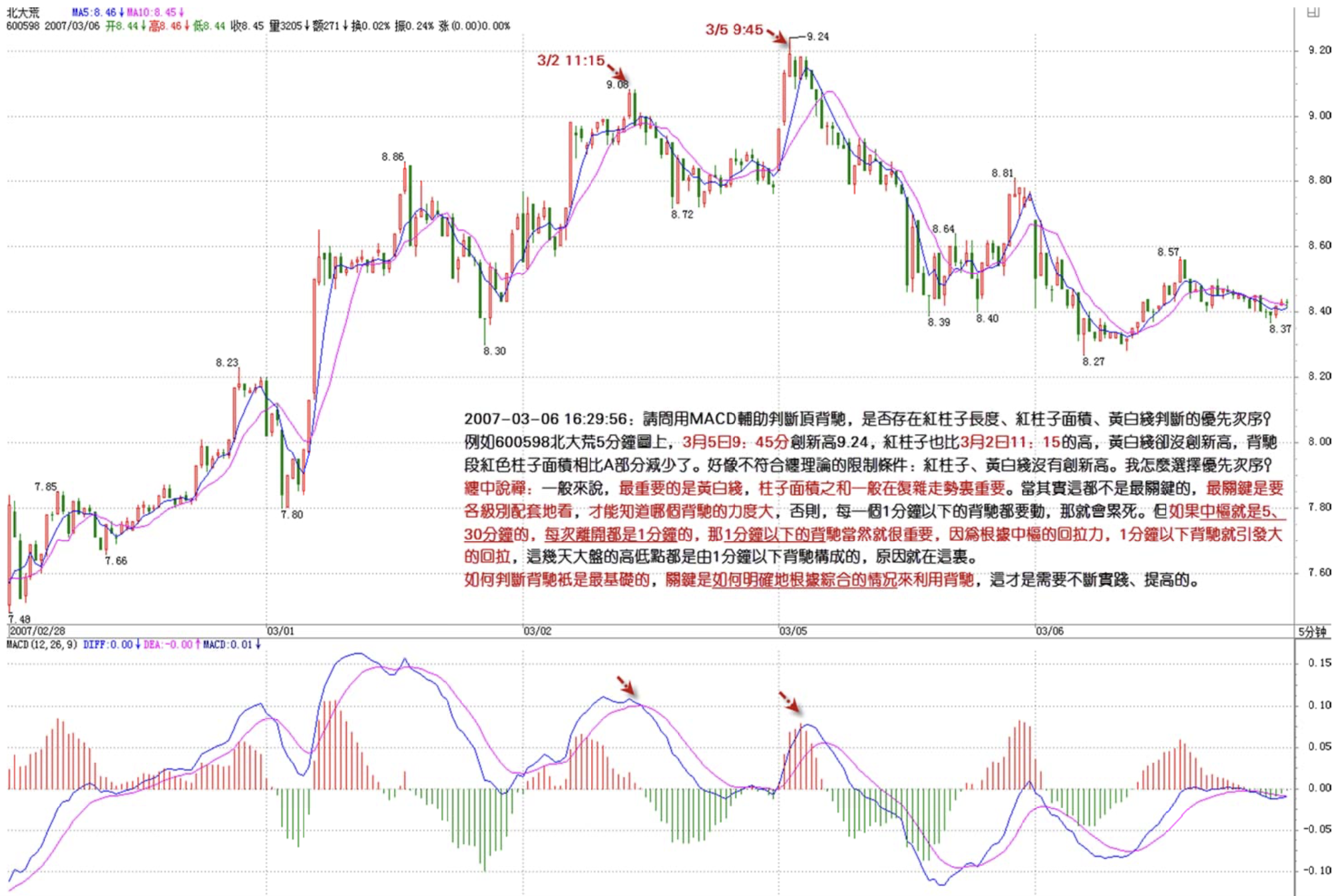
Chan sister, when using MACD to assist in judging top divergence, is there a priority order among red bar height, red bar area, and yellow/white lines?
For example, looking at 600598 Beidahuang's 5-minute chart: on March 5 at 9:45, it made a new high at 9.24, red bars were also higher than March 2 at 11:15, but the yellow/white lines didn't make a new high. The area of red bars in the divergence segment decreased compared to the A section. It seems not to meet the Chan theory restriction: "red bars and yellow/white lines failing to make new highs."
How do I choose the priority order?
Thanks
==
Generally speaking, the yellow/white lines are most important. Bar area sums are more important in complex movements. But actually, none of this is the most critical thing. The most critical is looking at matched levels—only then can you know which divergence has greater force. Otherwise, reacting to every sub-1-minute divergence would be exhausting. But if the hub is 5 or 30-minute and every departure is 1-minute, then sub-1-minute divergences become very important—because according to hub gravitational pull, even sub-1-minute divergence triggers a major pullback. These past few days, the market's highs and lows were all formed by sub-1-minute divergences—this is the reason.
How to identify divergence is just the foundation. The key is how to clearly utilize divergence based on comprehensive conditions—that requires continuous practice and improvement.
缠中说禅 2007/3/6 16:41:41
Apologies—someone just called to arrange dinner.
This ID is heading out to indulge. Goodbye.
缠中说禅 2007/3/6 15:22:36
Today the market built on yesterday's bottom divergence. Those with some observation skills could see that oscillations around the hub basically complete in at least three waves. For example, from bottom divergence to top divergence, there's an up-down-up process. This morning was the downward segment. Since the market broke through the line connecting 2888 and 2858, it's still running relatively strong. Tomorrow's question is simple: as long as it doesn't fall back into this morning's range, it's still strong, and the rally still has potential. If you can't read it clearly, look at the 120 moving average on the 15-minute chart. Today's high was right at this level. Tomorrow's most direct resistance is here, then 2888, then 2915. For oscillations around the hub, no prediction is needed. For instance, as the movement's level rises, look at divergence at the larger level to decide entries and exits. Now 5-minute to 15-minute charts are beginning to improve. As long as the 1-minute movement doesn't disrupt this improvement, it's fine—the trajectory continues building on the appropriate level's chart.
On individual stocks: still sector rotation. CITIC won't let traitors crash financial stocks recklessly because of its upcoming issuance—so they rose. Simple as that. And today's financial stocks also had a stabilization task—after all, Hong Kong markets have been turbulent lately. Retail investors needn't worry about all this—just follow the current movement. Note: sector rotation is fast. Never chase highs—look for stocks with buy points that haven't moved yet. That's how you gain the initiative.