One-Track Minds Are Not Suited for Playing Oscillating Markets
2007/6/28 15:53:15
Squeezing in a few words before heading out for social engagements.
Oscillating markets are the easiest to profit from, but they are absolutely not suited for people with one-track-mind thinking. The mid-term trend of the broader market was already clearly stated in the June 4th article: "The technical analysis given in early May remains valid. Currently the 1/2 line has risen to 4144 points, with the corresponding position for the Shenzhen Component Index at 13700 points. Whether the market can ultimately hold above this line effectively is the key to judging whether the medium-term trend is re-strengthening. Before that, the market trend will gradually digest technical and policy pressures in an oscillating pattern. Among these, the 5-month moving average currently near 3600 points will be key to judging whether the market correction is normal—as long as this line is not effectively broken, the market correction remains within a normal range; otherwise, the correction period will be significantly extended." This month's movement has basically oscillated between the 5-month moving average and the 1/2 line, and for July, this judgment still holds. But one must closely watch the breakout direction, because by July, the 5-month moving average will have risen, compressing the range, and by early August at the latest, a breakout direction must be chosen. Before that, it's all about playing the oscillation hard—pulling aggressively, dumping aggressively, washing out profits and creating price differentials.
Today's market: failing to break through yesterday's 4131 made a correction inevitable. Then it broke below 4025 points, so the correction intensified—this was easy to judge intraday. In actual operations, especially when dealing with oscillating markets, you must dare to sell and dare to buy. When it's time to sell, you absolutely must sell; buying, on the other hand, isn't always necessary—especially for those whose technique is a bit shaky, position size should be managed well. Of course, for those with solid technique, this is paradise. You must remember this ID's repeated advice: stocks are all waste paper, and only the price differentials you extract count as bleeding capital. Otherwise, rising and falling are just riding an elevator—what does it have to do with you? And to extract price differentials, the method of hub oscillation trading is the best, which requires diligent study and practice.
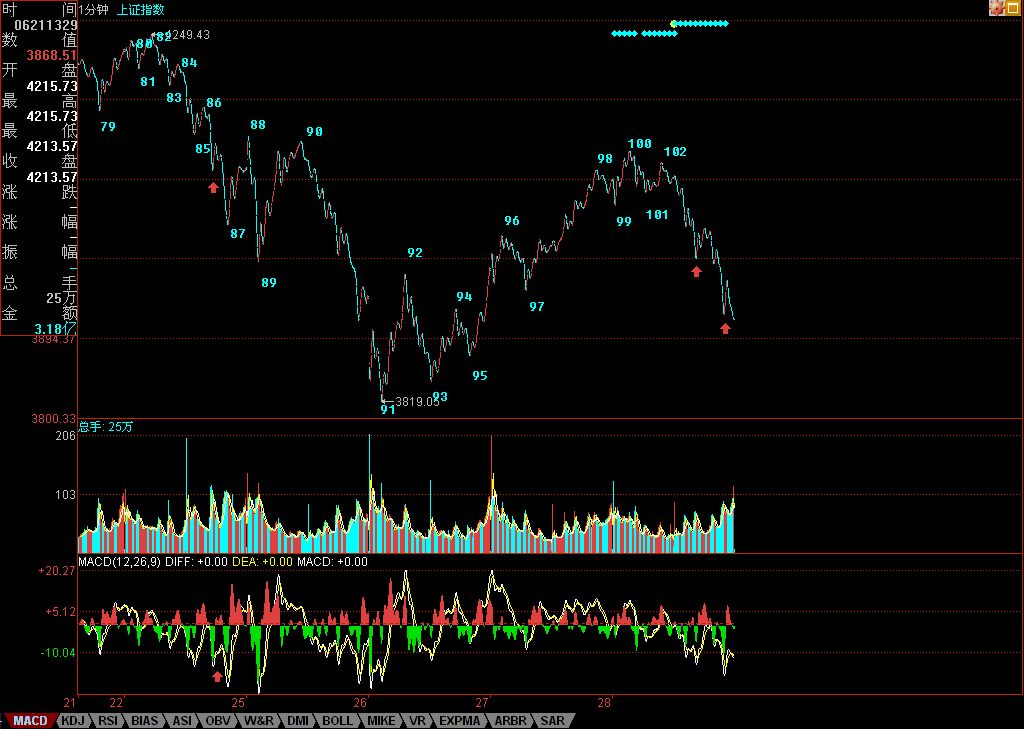
Posting the chart took some time. Those who can't see the top divergence at 100, or can't see the second-type sell point at 102—step up your studying. After 102, the 103 hadn't finished by market close. For 102 to complete, a bottom divergence within the line segment must appear. The arrow positions below indicate the short-term pressure levels for the broader market. In particular the lowest one must be held firmly; otherwise the market is in its weakest formation, and at the very least, a divergence of 1-minute level or above must appear before there is any entry value.
Busy. Social engagements tonight again. Won't be back in Beijing until next week. The quarterly K-line won't look too pretty. This mid-term major oscillation won't be short-lived. Learning oscillation trading will allow you to profit handsomely during this mid-term correction. Study hard.
One more digression: the first Chinese stock to trade on the German stock exchange will be listed in early July—this is the masterpiece of China's premier venture capital firm. By late July, there will be the first stock on the Korean exchange as well. Once these two shots are fired, private equity investment will probably heat up.
Signing off, see you next time.
Appendix:
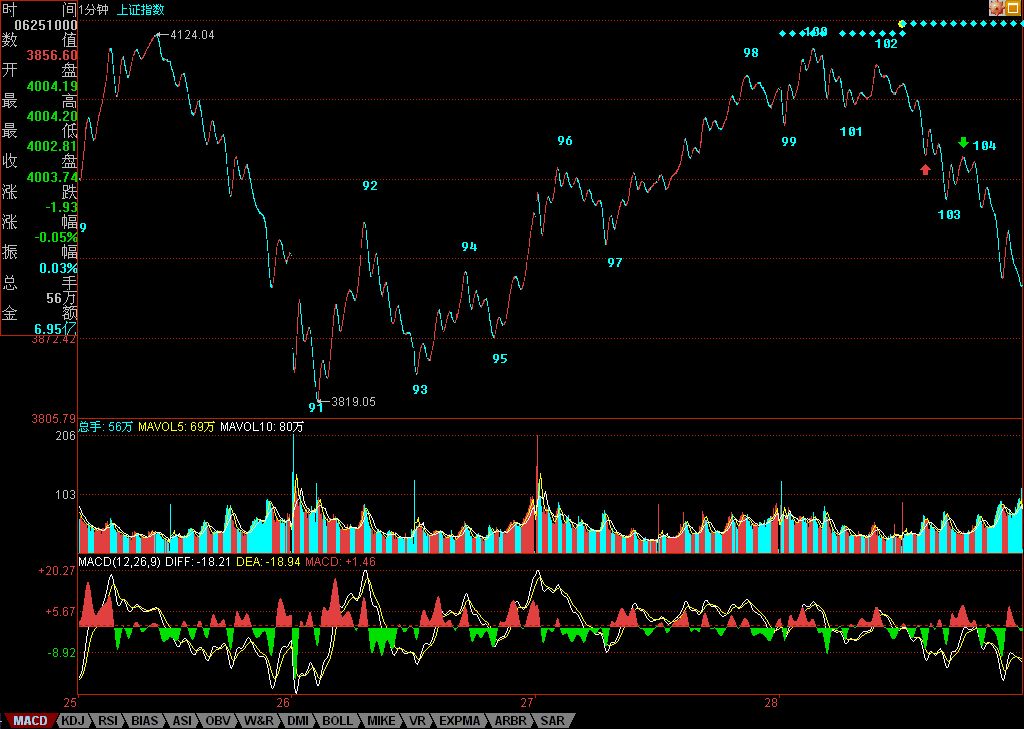
Just turned on the computer and came up to take a look. Found that some people had questions about yesterday's line segment division. This issue has been discussed before—the key is what level of precision you use. In the chart below, the red arrow is at 4022.69, and the green arrow is at 4022.42. By the strictest standard, precise to two decimal places, this does not break the original line segment, so it is not a new line segment. However, if you standardize to single digits of precision, truncating to whole numbers, then the two points overlap, and by that standard, a new line segment can be defined (as in the chart below). But if you use rounding (to the nearest integer), the first becomes 4023 and the second 4022, so by that definition, it cannot be classified this way.
The most important criterion for a new line segment is that it must break the structure of the old line segment. For example, in a declining line segment, the subsequent high must be lower than the previous low.
To accommodate everyone's habits and for simplicity, from now on we'll use a standardized approach: confirm using the truncation-to-integers method. So the line segment classification can use the chart below instead.
Signing off, see you after the afternoon close.
Replies
缠中说禅 2007/6/29 8:58:09
Appendix:
Just turned on the computer and came up to take a look. Found that some people had questions about yesterday's line segment division. This issue has been discussed before—the key is what level of precision you use. In the chart below, the red arrow is at 4022.69, and the green arrow is at 4022.42. By the strictest standard, precise to two decimal places, this does not break the original line segment, so it is not a new line segment. However, if you standardize to single digits of precision, truncating to whole numbers, then the two points overlap, and by that standard, a new line segment can be defined (as in the chart below). But if you use rounding (to the nearest integer), the first becomes 4023 and the second 4022, so by that definition, it cannot be classified this way.
The most important criterion for a new line segment is that it must break the structure of the old line segment. For example, in a declining line segment, the subsequent high must be lower than the previous low.
To accommodate everyone's habits and for simplicity, from now on we'll use a standardized approach: confirm using the truncation-to-integers method. So the line segment classification can use the chart below instead.
Signing off, see you after the afternoon close.
缠中说禅 2007/6/28 18:10:25
Shenzhen Innovation Investment invested in Suhao Yiming (Atomic Energy Pharmaceutical) (US$430,000)
Shenzhen Innovation Investment/Guangzhou Sci-Tech Venture Capital/Dachen Venture Capital invested in Kemi Braking
Shenzhen Innovation Investment invested in Dexin Wireless
Shenzhen Innovation Investment/China Ronghe International invested in Renhuang Pharmaceutical
Shenzhen Innovation Investment invested in Haotian Bio
Shenzhen Innovation Investment/Singapore UOB invested in Dongfang Jiyuan (US$2 million)
Shenzhen Innovation Investment invested in SMIC Venture Capital 2003-08
Shenzhen Innovation Investment invested in Invengo (US$1.21 million)
Shenzhen Innovation Investment and DigiCrypto invested in Erwan Venture Capital 2002-12
Shenzhen Innovation Investment invested in Weichai Power Venture Capital 2002-12
Shenzhen Innovation Investment invested in Shanghai Film Digital Venture Capital 2002-11-30
Shenzhen Innovation Investment and Zhejiang Venture Capital invested in Western Metal (US$2.07 million)
Shenzhen Innovation Investment invested in Fujing Venture Capital 2002-08-01
Shenzhen Innovation Investment/Zhangjiang Venture Capital invested in MicroPort Venture Capital 2002-05
Shenzhen Innovation Investment invested in Netac (RMB 30 million)
Shenzhen Innovation Investment and others invested in Taide Laser (US$970,000)
Shenzhen Innovation Investment invested in Sinoma Science & Technology Venture Capital 2001-12
Shenzhen Innovation Investment invested in OmniVision (8.4 million shares; RMB 21.58 million)
Dachen/Shenzhen Innovation Investment/Shenzhen-HK Industry-Academia-Research jointly invested in Tongzhou Electronics
Shenzhen Innovation Investment invested in Keliu Electronics Venture Capital 2000-10-31
Shenzhen Innovation Investment invested in Anke (US$230,000)
Shenzhen Innovation Investment/21st Century Technology invested in New Grand Software (US$1.21 million)
Shenzhen Innovation Investment and four other institutions jointly invested in Aoweixun (RMB 30 million)
Shenzhen Innovation Investment/Shenzhen-HK Industry-Academia-Research Venture Capital and others invested in Jingtian Communications
Shenzhen Innovation Investment invested in HuiShi Communications Venture Capital
Shenzhen Innovation Investment invested in Silicon Sensing Venture Capital
Shenzhen Innovation Investment invested in Luming Venture Capital
Shenzhen Innovation Investment invested in Jiucheng Customs & Trade Venture Capital
Shenzhen Innovation Investment invested in Shenzhen Securities Venture Capital
Shenzhen Innovation Investment invested in Zhengyou Wangtong Venture Capital
Shenzhen Innovation Investment invested in Yintai Technology Venture Capital
Shenzhen Innovation Investment invested in Sanchen Venture Capital
Shenzhen Innovation Investment invested in Hanfang Venture Capital
Shenzhen Innovation Investment invested in Taifu Venture Capital
Shenzhen Innovation Investment invested in Binhu Electromechanical Venture Capital
Shenzhen Innovation Investment invested in Shenxu Thermal Energy Venture Capital
Shenzhen Innovation Investment invested in Shidean Venture Capital
Shenzhen Innovation Investment invested in Huatuo Pharma Venture Capital
Shenzhen Innovation Investment invested in Sannuo Electronics Venture Capital
Shenzhen Innovation Investment/Shenzhen-HK Industry-Academia-Research invested in Dashi Intelligent Venture Capital
Don't be misled—why is there no mention of how many of the above investments failed? If they could achieve 100% profitability, it wouldn't be called venture capital. Then everyone wouldn't need to come play stocks. Keep your investment eyes wide open, raise your risk awareness, and don't dream of getting rich overnight.