"Currency Wars and the RMB Strategy" Sequel 2
2007/2/1 15:22:36
The rhetoric about excess liquidity is currently running rampant. Setting aside the fabricated absurdity of claims like "30 trillion in hot money," even if so-called excess liquidity truly existed, it would be a perfectly natural good thing. In Sequel 1, I stated that "population consumerization" and "asset virtualization" are the true secrets of capitalist economic development, and during the explosive phase of these two processes, excess liquidity is the most normal occurrence. China is currently at the initial stage of this explosive phase.
In the original text written three or four years ago, I said that China's rise would inevitably be reflected in the gradual formation of a massive new capital pool. Due to various reasons, the original pool was very small—completely unworthy of China's status. But a great power in the modern era must first be a capital superpower. Talking about being a "manufacturing power" now completely misses the point. A great power must first be a capital superpower—only then can true great-power status be claimed. And the primary prerequisite for a capital superpower is a gigantic capital pool where the world's capital converges. During the gradual formation of this pool, excess liquidity will naturally be the norm. Because water always expands faster than the pool, and often wherever water flows naturally becomes part of the pool—especially during the transition from a small pool to a large one, this is perfectly normal.
People often invoke 1997 Thailand as a cautionary tale—but is China the same as Thailand? Why doesn't America's far larger capital flow cause problems? Simple: America's pool is big enough. China will naturally develop a pool as large as America's—or even larger. From this perspective, the current so-called excess liquidity is merely an intermediate state as the pool expands outward. The problem isn't too much water, but why is the pool's expansion so slow? What's causing it to be so slow? And the capital market has always been the most critical component of a great capital pool. An extraordinary expansion of the capital market is both inevitable and natural—and the most important thing. Therefore, the capital market's extraordinary expansion since the RMB was liberalized is perfectly natural. Even if it were fully circulated, the total market capitalization would only be about half of GDP—what's America's ratio? And China's GDP growth rate remains astonishing. At the current pace, doubling again in 7 or 8 years means the current capital market expansion is merely catch-up—and not even catching up fast enough; it should be even better.
The "great-power premium" of "asset virtualization" is the most common phenomenon. The same asset is naturally priced differently in China versus Thailand—just like the same apartment is priced differently in Beijing versus Baoding. Never mind apartments—even donkey meat fire cakes can't be the same price. In fact, people are part of assets too. In the world of capital, people from rich countries and poor countries are simply priced differently—unfair as this is, quite "inhumane," yet it's reality. And the great-power premium on assets will ultimately be reflected in the capital market. More importantly, the capital market's scope for absorbing assets will inevitably expand rapidly. All of China's finest assets will inevitably converge in China's capital market through various channels. This is the most solid foundation supporting the capital market as the most important component of the great capital pool, and the greatest driving force for the capital market's future development. Without understanding this, one cannot understand the historical significance of China's current capital market development. This isn't merely a quantitative change—it's a fundamental structural change, becoming the most important marker of China's "asset virtualization" historical process.
The historical process of China's "asset virtualization" is unstoppable, just as capitalism is unstoppable before exhausting all its energy. Whoever obstructs this process will ultimately become a laughingstock and criminal of history.
Replies
缠中说禅 2007/2/1 15:33:38
[Anonymous] Mountains and Rivers
2007-02-01 15:30:31
Seems like Chan sister is too busy—even stopped discussing the Analerta.
==
These past few days I've had social engagements every day—absolutely no time to write. But today's topic is also very important.
I have to go now—a negotiation is waiting for this ID. I'll be back tonight to discuss more.
缠中说禅 2007/2/1 21:17:02
[Anonymous] Passerby
2007-02-01 15:31:42
Chan sis, could you analyze 600677?
==
This is the season when earnings traps are most common, so this stock is indeed tricky. Generally, when encountering this situation, if there's an escape opportunity, you must seize it—at minimum get half out, then add back lower and use a rebound to break even and exit. Looking at the chart, yesterday it didn't directly lock at limit-down—there was still an 8 yuan opportunity touching the 5-day line, a perfect escape point. Currently the key is your position size. If this stock doesn't take up much of your portfolio, you can leave it for now. I just checked—the company's loss this time was due to the former chairman being investigated and major liquidation of some controlled subsidiaries. So this type of loss is within acceptable range, but it's definitely a weapon for bears. There'll be pressure until earnings are finalized. However, from a medium-term perspective, money-losing stocks turning into dark horses is extremely common—so today's losing stock doesn't necessarily mean a bad thing medium-term.
Technically, the most important level below is the 250-week moving average—the most critical medium-term position, currently at 5.9 yuan. As long as this level isn't effectively broken, it won't enter a major bearish trend, and there's still potential for resurgence.
If your position is heavy, patiently wait for a rebound to reduce half your position, then gradually lower your cost through short-term trading. If your position isn't large, there's no need to exit—use short-term trading to lower your cost, practicing both technique and mentality simultaneously.
This ID doesn't recommend casual stop-losses. One stock is one destiny—conquering destiny is how you reach a new level. But you must learn from experience: don't buy stocks whose fundamentals you don't understand. For example, this stock's chairman getting arrested definitely didn't just happen—with such stocks, you must understand everything clearly, let the shock pass, then get in.
缠中说禅 2007/2/1 21:26:13
Attention everyone:
Back in late November of last year, someone asked this ID about 000100—they were stuck above 4 yuan and wanted to know what to do. This ID told them that at a 3.5 yuan cost, the probability of breaking even this year was extremely high. If they could add to their position and lower the cost, the probability of profiting was very high. If they could do some short-term trading, they'd make big money. At the time, TCL's price was just over 2 yuan.
Look—this ID didn't overstate things. Now, just over two months later, look at TCL's stock price. If that person held on and added positions, they've already profited and should be preparing for big gains.
This is the story of a stock with a 50% paper loss. In a bull market, don't carelessly cut losses. Where you fell, stand back up—unless the stock faces delisting. With the right technique, this is not hard to achieve.
缠中说禅 2007/2/1 21:31:13
[Anonymous] Good Savings
2007-02-01 16:06:29
Today I used the market's 1-minute divergence and an individual stock's 5-minute divergence to scalp. Not only did my cost decrease by 1%, I also freed up some capital, then used part of that capital on another stock's scalp and made a little more.
Same principle—practice more, summarize more, and you'll get proficient.
==
Good, but don't get too fixated on 1-minute scalps. If there are 15 or even 30-minute opportunities, those are more important. When those scalps work out, costs drop at least 10%. Do it a few times and your cost goes negative.
Also, you must be flexible—don't just buy first and sell later; learn to sell first and buy back later. And what proportions to use is also key—when not yet skilled, if your position isn't too large, 1/3 or 1/4 is reasonable.
More practice, more summary—that's how you keep improving. Selling wrong isn't scary, but never chase highs to buy back. Better to miss it than chase—only buy at buy points.
缠中说禅 2007/2/1 21:35:02
[Anonymous] Request
2007-02-01 21:27:39
Blogger:
000423 (Dong-E E-Jiao) is issuing Bermuda-style warrants, 5.5 yuan/share (10 shares get 2.5 warrants). What does this mean? How to operate? Is the plan too poor?
Please take a moment from your busy schedule, I'm waiting! Thank you!
==
This is normal—good stocks get smaller packages. With warrants, the eventual returns won't be less. Besides, current S-shares want nothing more than to fill rights immediately after resuming and then add another 50%. So if you can't make the plan better, just accept it—getting de-S'ed quickly is what matters.
缠中说禅 2007/2/1 21:46:51
[Anonymous] Qing
2007-02-01 16:03:56
Asking questions every day without getting answers! Sigh.
Asking again today.
What about the trends of China Merchants Bank and SDB financial stocks?
Shuijiu—today I did a buy-then-sell scalp. After several days of decline, it was frustrating. Didn't pay much attention to Guanzi.
Continuing from yesterday's question: a stock like CITIC Guoan that rose 100% from the 250-week line, met resistance at 30 yuan and pulled back to the current 24 yuan—how do you handle such a stock (setting aside personal preferences)?
Thanks in advance...
==
There'll be some pressure when Industrial Bank lists. Medium-term should still be fine—banking is the banner. If it falls, it's no longer a bull market, and anyway, how would financial reform proceed? Some up and down fluctuation is perfectly normal. For stocks like Shuijiu and Guoan, when they spike sharply, you must watch for sell points and get out first—otherwise a big pullback means all the up-and-down was for nothing. These stocks will gradually stabilize short-term, followed by a second-leg upward rebound, then pull back again, likely forming a large triangle pattern before choosing to break upward. Medium-term should be fine—it's just a pity such large short-term spreads weren't captured. Done well, a couple of round trips would nearly bring costs to zero.
For those with less operational skill, here's a method: if a stock suddenly rises 50%, first reduce your position by half. Then regardless of whether it goes up or down, you're fine. If it drops, you add back; when it goes up again, you exit. Your cost might be near zero—then it doesn't matter what happens. If it keeps rising—also fine, because your technique isn't good enough to control a wild horse, so this is the only way. Once you master the technique, none of this matters.
缠中说禅 2007/2/1 21:49:50
[Anonymous] Photography Friend
2007-02-01 21:32:14
Dear Blogger:
000932—I've held it continuously since last December until today. Both its weekly and daily charts show solid upward trends. But today it suddenly announced a trading halt, with no fixed timeline.
My analysis: there should be good news coming, because you said everything is reflected in the movement—it'll definitely show up here.
Am I right? Thank you!~~~~
==
No need to predict anything—just wait.
缠中说禅 2007/2/1 21:51:48
[Anonymous] Alternative Housing
2007-02-01 21:49:05
About TCL, I actually bought it around 2 yuan because of Chan MM's reply at the time.
Sold at 3.5-3.6. Hehe.
Also, with 999's restructuring, debt clearing, and share reform negotiations, could 999 be halted for a very long time? That would really waste time. Thanks!
==
Didn't Dushi Shares get halted for a long time too? For those who aren't good at daily short-term trading, a halt might actually be a good thing.
缠中说禅 2007/2/1 22:02:47
[Anonymous] Little Ball
2007-02-01 21:50:29
Chan sister, hello: Reading your theory was like finding a lighthouse—I finally found the direction for studying stocks. But there are still many parts I can't fully understand. Regarding divergence, I have these questions:
- When using MACD to judge, should I look at the height of the red/green bars, the height of the yellow/white lines, or the area formed by the red/green bars? In your explanations, sometimes you talk about the yellow/white lines, sometimes the red/green bars, and sometimes the bar areas. I'm confused.
===
When talking about the 0-axis pullback, that's of course about the yellow/white lines—nothing to do with bars. For divergence, if the yellow/white lines don't make new highs or lows, or if the area sum of the bars becomes smaller, both are signals. When either appears, pay attention. If both appear, pay even more attention.
- You said "no trend, no divergence"—this I understand. But which specific trend segments to compare is still very vague. At least two hubs are needed to form a trend. Does the hub formation always create a pullback to the 0-axis on MACD? In a divergent downtrend, do you need at least 8 downward moves before discussing divergence?
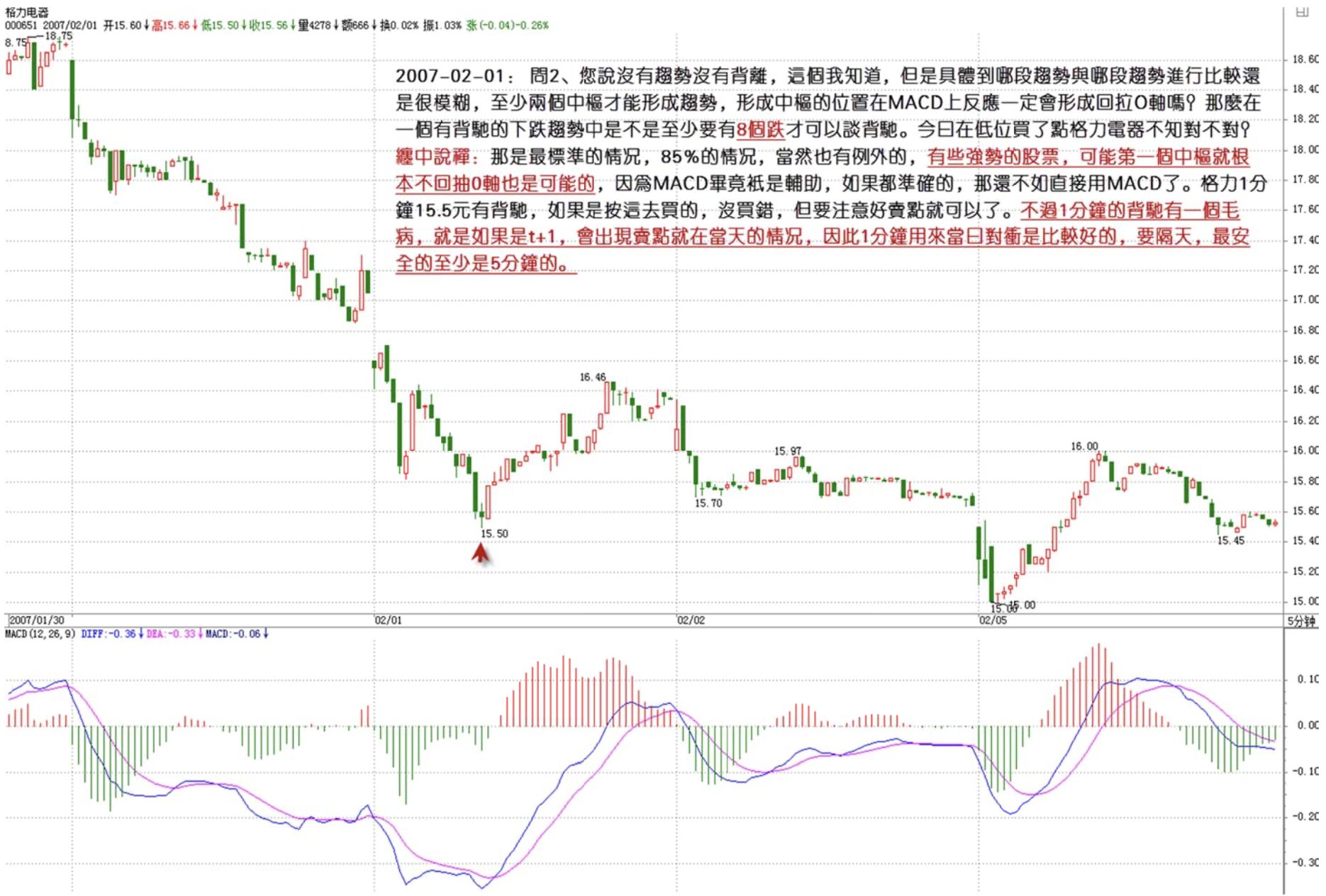
I bought some Gree Electric at a low today—wondering if that was right.
==
That's the most standard case, covering 85% of situations. Of course there are exceptions—some strong stocks might not pull back to the 0-axis even at the first hub, because MACD is only auxiliary after all. If it were always accurate, you'd just use MACD directly. For Gree, there's a 1-minute divergence at 15.5—if you bought based on that, you didn't buy wrong. But watch for the sell point. However, 1-minute divergence has one drawback: with T+1, the sell point might occur the same day. So 1-minute is better for intraday hedging—for overnight holds, at least use 5-minute.
Also, I bought some Saima Industrial the other day. Now I really regret it because I bought at a sell point. My view is it still needs to drop. Am I right? Could you please take a look? After reading your articles, I realized how ignorant I used to be.
==
Just reached the annual line—some turbulence is normal. Medium-term should be fine. For the short-term, you can go back and forth to lower costs.
缠中说禅 2007/2/1 22:08:55
[Anonymous] Brave Heart
2007-02-01 21:59:55
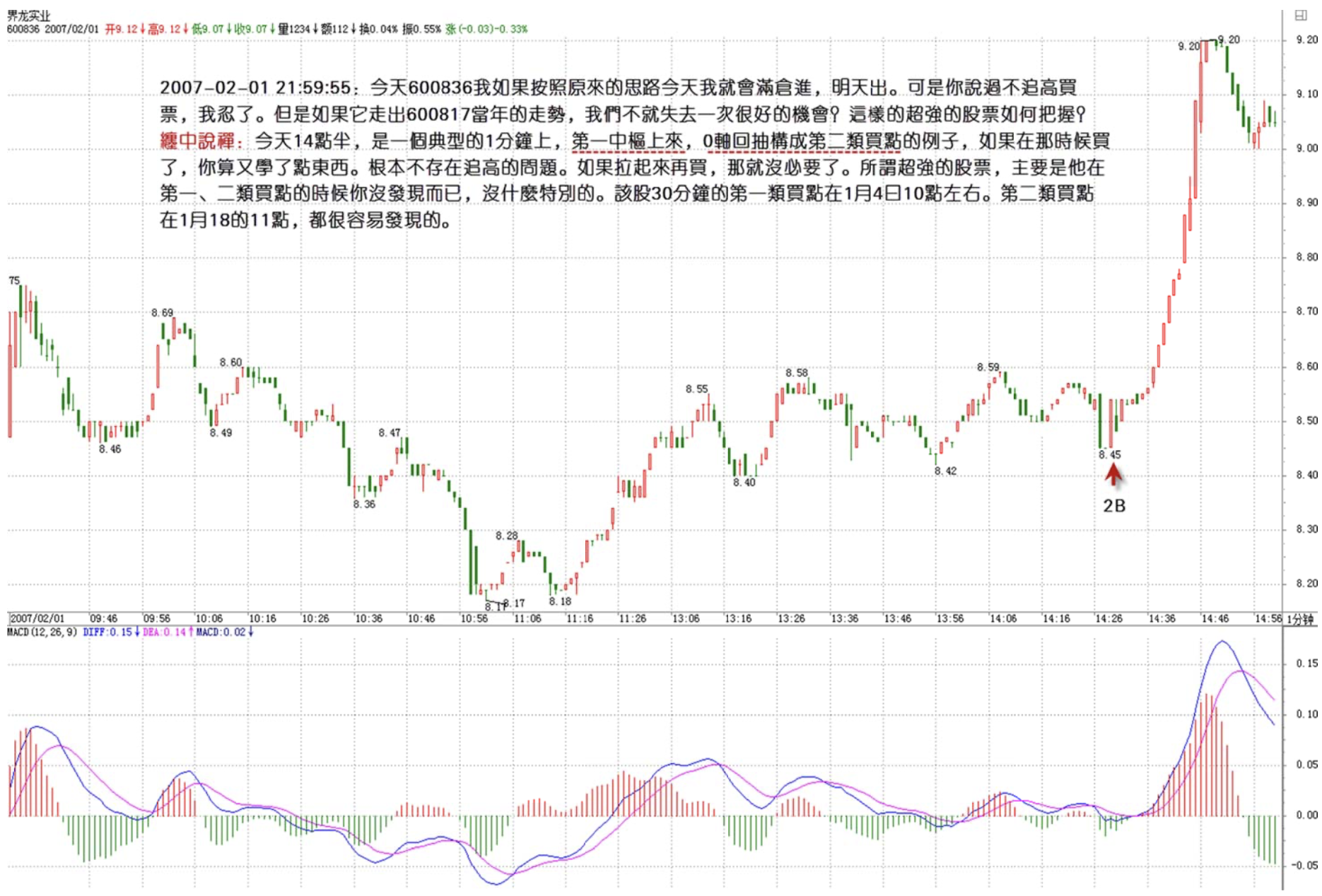
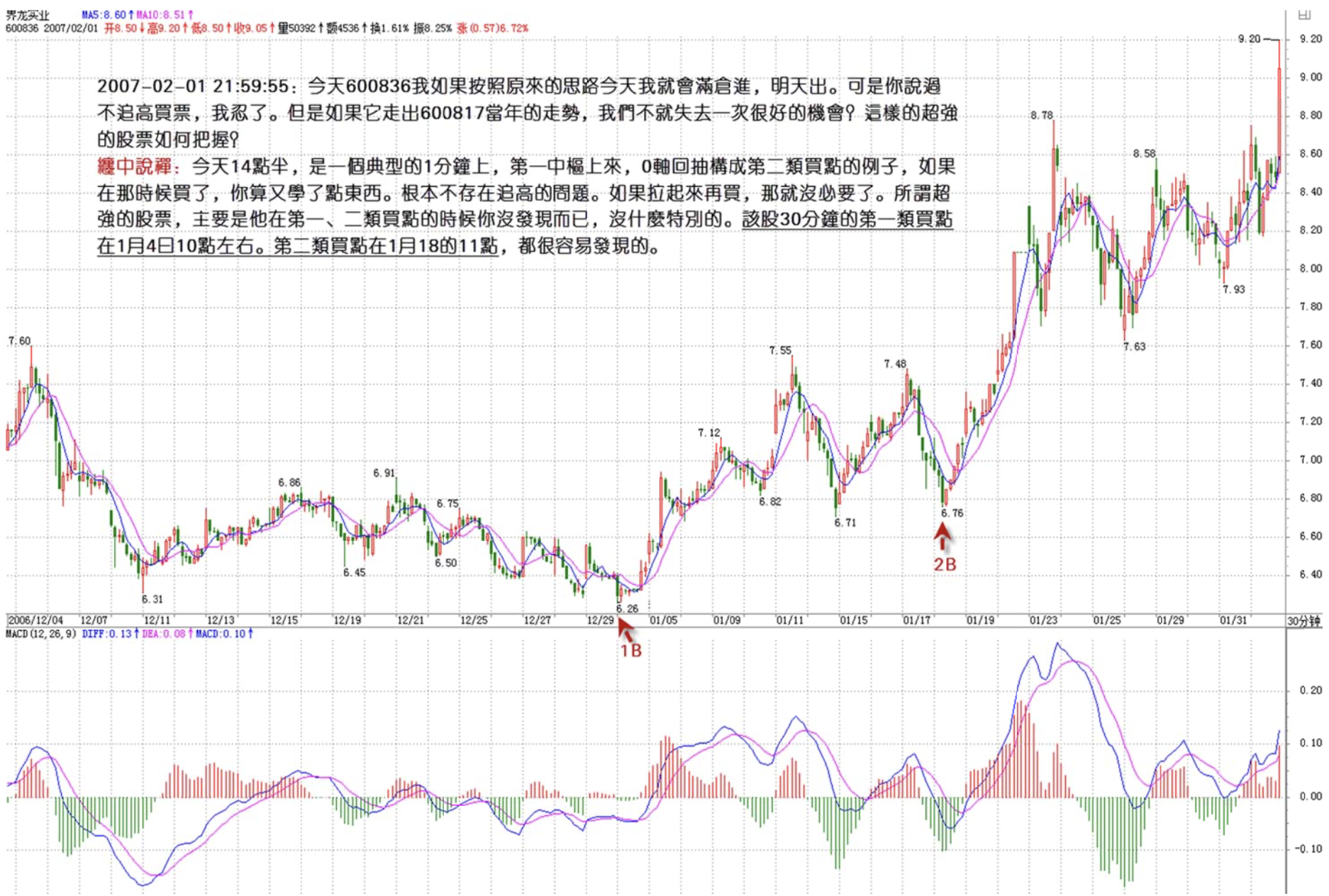
Chan master, hello: Today 600836—if I'd followed my original thinking, I would've gone full position today and sold tomorrow. But you said not to chase highs, so I held back. But if it traces out a pattern like 600817 back then, wouldn't we miss a great opportunity? How do you handle such ultra-strong stocks?
==
Today at 2:30 PM—a classic 1-minute upward from the first hub, 0-axis pullback constituting a second buy point. If you bought then, you just learned something new. There's absolutely no question of chasing highs. Buying after it's already rallied—that would be unnecessary.
So-called ultra-strong stocks—mainly you just didn't discover them at their first or second buy points. Nothing special.
This stock's 30-minute first buy point was around 10 AM on January 4th. The second buy point was at 11 AM on January 18th. Both were easy to spot.
缠中说禅 2007/2/1 22:11:14
[Anonymous] Passerby
2007-02-01 22:06:55
Tomorrow's market: open low, go lower. Market makers operate underwater all day. Second test of the low. Force applied in the afternoon. Shanghai volume exceeds 100 billion, big rally. Weekly candle turns red. Passerby here—couldn't help saying a few words. The technical stuff is simple; mentality is number one.
===
Mentality without technical backing is a fool's mentality—a fool's mentality is the best: no reaction to anything. Insight guided by wisdom is the only guarantee of good mentality. For this, read this ID's interpretation of the Analects.
缠中说禅 2007/2/1 22:14:14
[Anonymous] Qilin
2007-02-01 22:06:56
Chan MM, could you look at 600056 for the medium term?
==
Medium-term: blocked by the 250-week line, causing oscillation. Whether it can hold this line is the medium-term key—once it holds, upside opens naturally. For specific operations, no need to predict these things—just follow the technicals.
缠中说禅 2007/2/1 22:19:16
Attention everyone:
Coming here, you shouldn't just listen to this ID—you should also exchange ideas with each other. Especially share specific trading processes: a buy then sell, or a sell then buy then sell, etc. How did you judge it? If it failed, what went wrong? If it succeeded, why? You must be clear. Discuss with each other—this is how you improve faster.
This ID can't answer too many questions, but some questions this ID will answer in detail—like today's response about the stock loss situation. Many answers, even if they weren't your question, should be referenced; then gradually form your own understanding.
This ID needs no gods and believers here. Everyone is Buddha—don't sell yourself short. If you want to repay this ID, gaining wisdom is the best repayment for this ID.
Heading out. Goodbye.
缠中说禅 2007/2/1 22:23:18
One more thing: also think carefully about and answer other people's questions. This is also self-improvement. Exchange doesn't necessarily produce wisdom, but wisdom should be exchanged. What kind of so-called wisdom doesn't know how to exchange?
Heading out. Goodbye.
缠中说禅 2007/2/2 14:18:53
Luoguo: Practice mentality to achieve mastery. Share more with your classmates when you can.
缠中说禅 2007/2/1 15:32:19
Today the market rebounded on a 1-minute divergence, but the strength certainly can't match the last time—this is so-called non-repetition. If everyone could predict every movement, it wouldn't be a market.
Stocks like 000416, 000600, 000998 that made new highs or hit limit-up—don't chase. Not buying low and then chasing highs is the thing this ID detests most. Do your scalping wholeheartedly—that's how you get results. Of course, skilled traders can rotate constantly within a stock group, but that takes practice.
The weekly chart's medium-term structure is forming, so constant oscillation is normal. For example, today's tech sector got a boost from favorable news—such opportunities are plentiful during oscillation.
The market's current task is to first stabilize. When scalping under these conditions, if your skills aren't proficient, it's better to sell too early than too late. As long as there's profit, as long as there's a spread—realize it first. Of course, for those without these conditions, just hold medium-term positions. As long as it's not a junk stock and you didn't chase the high, there shouldn't be major problems.