Rate Hike Can't Stop the Spreading Hot Spots
2007/8/22 16:10:16
Yesterday I said that if the spreading of hot spots could persist a few more days, it would become a prairie blaze. But the new force introduced by last night's rate hike announcement caused the market to ultimately choose what was described this morning as the second, medium-intensity scenario. This is all a natural selection—no prediction needed. Anyone with a prediction addiction—go be a Martian stock commentator, because Earth is dangerous.
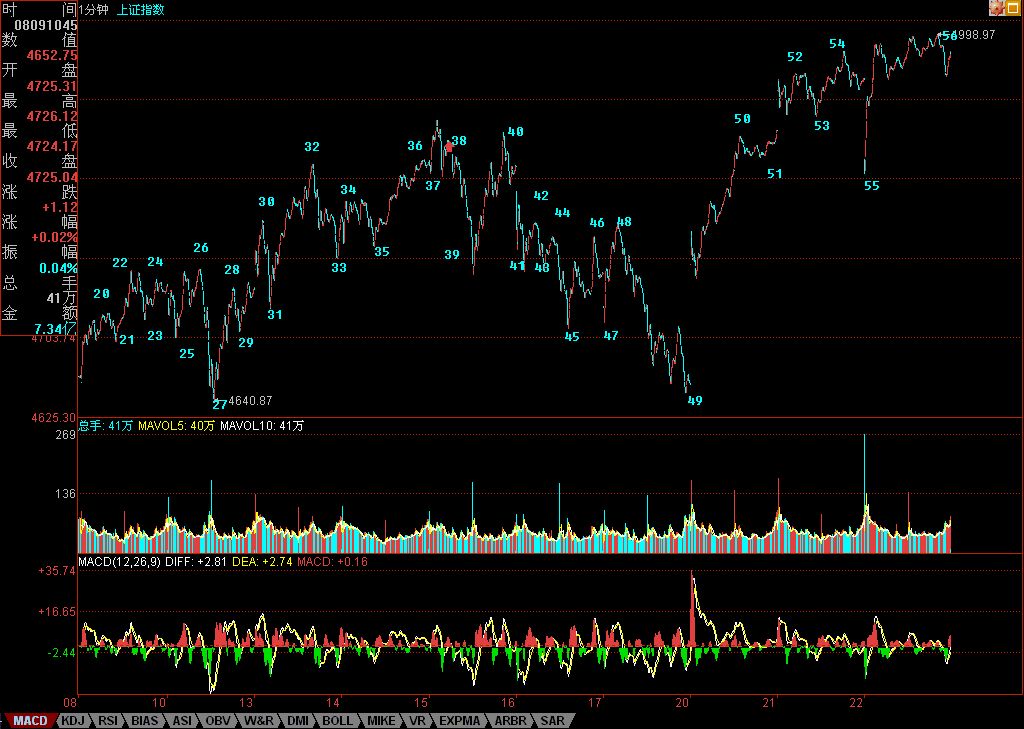
Today's price action, from a purely technical perspective, may not even 100% confirm that a single line segment has been completed. Why? Because the conditions for line segment completion haven't been 100% satisfied. The judgment for this line segment obviously belongs to the first situation, which is relatively simple. However, since the fractal of the characteristic sequence has never been ultimately completed—each upward thrust makes a new high, then comes back down in a single stroke—it forms what's called an upward-slanting triangle pattern. The characteristic of this pattern is that 99% of the time it falls back to the position where the triangle started. The end-of-day plunge satisfies this decline magnitude, but it's only a single stroke. So if tomorrow morning there's a gap up above 5,000 with a fierce upward attack that doesn't fall back below 5,000, then this line segment truly can't be completed for now. Of course, under normal circumstances, this line segment is already completed at today's high, so I've marked 56 up there, but whether this is ultimately confirmed depends on the above scenario not occurring.
Generally speaking, a 1-minute line segment won't extend for this long. The fact that it extended this long is actually an important technical signal, proving that the bulls' urge to push above 5,000 is quite strong—repeatedly trying. But above, someone is constantly suppressing it, which is why it traced out an upward-slanting triangle pattern. Then toward the close, missing 5,000 by barely a point, the bulls' fighting spirit suddenly deflated, dropping back to the starting position of the slanting triangle. Mainly, the post-traumatic stress from May 30—being suddenly startled during a state of euphoria—left lingering effects, so at critical moments this kind of thing always happens. The end-of-day recovery of half the ground simply indicates that the bulls' desire to attack hasn't been satisfied—that's all.
Tonight's news is very important. There's been news for two consecutive days now. If tonight there's yet another regulatory measure, the price action will face considerable uncertainty. Since the second scenario was chosen, short-term policy changes play an important role as a component force. If there's nothing special today and tomorrow, allowing speculation about policy combination punches to be temporarily shelved, then pushing above 5,000 to satisfy the bulls' desire is also perfectly natural.
This ID said long ago that 5,000 points is absolutely nothing. The key is the 2/3 line at 5,089. This line is just like the 1/2 line at 4,100-something below. That line was ground back and forth for three months, bouncing above and below. Whether the 2/3 line will see history repeat itself—that's where the technical focus should be.
On individual stocks, the rate hike has not slowed the spread of hot spots—if anything, it's accelerated it. With bank stocks being suppressed, it's actually beneficial for other stocks to perform. This ID has repeatedly emphasized that the gradual activation of second and third-tier stocks has become reality—just look at what kinds of stocks have been hitting the daily limit these past few days. Moreover, this spread has been gradually tilting toward third-tier stocks, especially low-priced ones. This is a sign of speculative capital becoming active again.
Here, a very practical issue emerges: the battle for dominance between bank stocks, real estate stocks, and other stocks played by funds and other formal forces on one hand, along with first and second-tier large-cap stocks played by more established large capital, versus the second and third-tier small-cap stocks played by speculative capital on the other. Going forward, what can cause major market fluctuations is, first, the policy front, and second, this battle for dominance.
Retail investors naturally prefer third-tier stocks flying. As for this ID's China Aluminum and other China-prefix stocks, retail participation enthusiasm isn't usually very high—especially now, when buying just 10,000 shares requires 400,000 yuan, while a 5-6 yuan stock requires only 50,000-60,000. Which one has the better grassroots base goes without saying.
This ID is indifferent to which type of stock flies. This ID's holdings naturally include first, second, and third-tier—covering all sizes. Since I'm not buying more now, just holding, all I can do is watch the show. However, what this ID actually likes most is third-tier stocks that transform into first-tier ones. Who told you third-tier can't become first-tier?
Got things to do. Was writing all the way just now while the phone kept ringing. Enough busy work for the whole evening ahead.
Might be back late tonight.
Signing off, goodbye.