Detailed Explanation of The Analects: For All Those Who Misinterpret Confucius (41)
2006/12/15 12:10:06
孔子曰∶生而知之者,上也;学而知之者,次也;困而学之,又其次也。困而不学,民斯为下矣!
Yang Bojun: Confucius said: "Those born knowing are the highest. Those who learn and then know are the next. Those who encounter difficulties in practice and then learn are yet another level down. Those who encounter difficulties and still don't learn — the common people are this lowest kind." Qian Mu: The Master said: "Those born knowing — they are the highest. Those who learn and then know — they are the next. Those who learn only after encountering difficulties — they are another level below. If after encountering difficulties one still does not learn, then one can only be counted as the lowest." Li Zehou: Confucius said: "Being born with knowledge is the highest class. Learning and then having knowledge is the next class. Encountering difficulties and then learning is yet lower. Encountering difficulties and still not learning — such people are truly the lowest class."
Detailed Explanation: People are born inseparable from "困" (predicament). The predicaments of survival, the predicaments of life and death — all such things. To resolve one's predicaments,
one can only rely on wisdom. Without wisdom, one is in a predicament without knowing it is a predicament, without knowing why it is a predicament, and even less knowing how to escape it. What is "困"? The original character of "梱" (threshold), meaning a door threshold, borrowed to mean "door." The so-called classification into categories — no doors yet there are doors, no ranks yet there are ranks — and because of this, there are "predicaments." But these predicaments include objective ones: for example, as soon as a person is born, they first enter the "door" of being "human." The contemporary social environment, one's physical and intellectual conditions, and so on all become "doors" that no individual can escape. There are also subjective predicaments: setting up one's own gates, drawing a circle on the ground as a prison, and trapping oneself. To break through these predicaments, these bindings, these doors — for human beings, the wisdom gained from practice and the practice guided by wisdom are the only things one can rely on.
And how does one obtain wisdom? In the preceding chapters, Confucius has already pointed out that wisdom comes from practice. For the individual, studying the crystallized wisdom of predecessors is the most fundamental practical process, and "好 (appreciate), 敏 (verify), 求 (select)" are the three great steps for learning from predecessors' wisdom. Confucius said of himself that he was "非生而知之者" (not one who was born knowing), yet here he says "生而知之者,上也" (being born knowing is the highest). Is there a contradiction? Actually, this precisely reflects the rigor of Confucius and The Analects. Confucius does not absolutely deny the possibility of "being born knowing," because if he did, that denial would itself become an a priori proposition — clearly contradicting Confucius's emphasis on practice and purposeful action. In fact, this kind of attitude from Confucius is similarly reflected in his stance on ghosts and spirits. Confucius does not absolutely deny the existence of ghosts and spirits, does not absolutely believe that "the absolute non-existence of ghosts and spirits is an unchangeable truth." Confucius only acknowledges that because "being born knowing," ghosts and spirits, and such things lie beyond the range of what current practice-derived wisdom can resolve, therefore he suspends judgment, rarely discusses them, and keeps a respectful distance — but does not rule out their existence, nor the possibility of resolving these questions with wisdom derived from future practice. Confucius's attitude is far more objective than that of those so-called materialists.
So, can "being born knowing" exist? Standing on a purely technical ground with a very simple example, without invoking any ghosts or spirits: say one day humanity finally grasps the secrets of thought, grasps the secrets of human brain memory — then it would be entirely possible to make a person "born knowing." For instance, by performing some procedure on a fertilized egg, stuffing in Chán Zhōng Shuō Chán's interpretation of The Analects, Chán Zhōng Shuō Chán's "Teaching You to Trade Stocks," and so on, all in one go, so the child comes out ready to trade stocks and discuss The Analects — that would hardly be surprising. For a situation like this, Confucius says it is "上也" (the highest). "上" (highest) is not a distinction in human rank, nor is it advocating any theory of innate genius. The character "者" here, also, is not — as the three people above and conventional readings understand it — referring to "people." Interpreting "者" here as "people" is just the game of so-called elites who fancy themselves elites. Dividing people a priori and innately into hierarchical grades is classic nonsense. Moreover, it cannot explain why the later phrases "困而学之" and "困而不学" do not include the character "者" — does that mean those phrases don't refer to "people"? The "者" here is actually just a modal particle. "生而知之," "学而知之者," "困而学之," "困而不学" are merely four possible conditions of human life, having nothing to do with hierarchical grades of humans. Subjectively dividing people into hierarchical grades is self-imposed "困" (predicament) — self-setting one's own gates. But in historical reality, people indeed have hierarchical grades — this is the objective "困" (predicament) of historical reality, one that must be resolved.
Obviously, the best possible condition for people is "生而知之" (born knowing). But for Confucius, "born knowing" lies beyond the present; "学而知之" (learning and then knowing) is what is most appropriate for the present. Learning first requires recognizing one's predicaments and further recognizing that overcoming them requires learning. Therefore, "困而学之" (encountering predicaments and then learning), which leads to "学而知之" (learning and then knowing), enables one to resolve predicaments through wisdom. "困而不学" (encountering predicaments without learning) will lead to "民斯为下矣" (the people thereby being made low). And "民斯为下矣" is precisely because of "困而不学." No one is born willing to fall into the state of "困而不学" and be unable to extricate themselves. "困而不学" is often not because of personal laziness, but because of the social environment. Especially in Confucius's era, "learning" was monopolized by the so-called elite aristocracy. "困而不学" is essentially "being trapped in predicaments and unable to learn." Historical reality divides people in society into hierarchical grades, preventing the "民" (common people) from obtaining the conditions for "学" (learning). Confucius does not discuss the question of how individuals obtain wisdom in an a priori, abstract manner. Individuals must live within real social structures. "学而知之" does not apply a priori to everyone, because the reality of an individual's circumstances often means one can only "困而学之" (learn only through predicament), or even "困而不学" (be unable to learn despite predicament).
In historical reality, people must obtain their "learning" to resolve their predicaments. This resolution of predicaments has two meanings: one is resolving a predicament created by objective conditions, and the other is resolving a predicament manufactured by ideology. Therefore, "learning" becomes the most important precondition for every person's real-world survival. A society that makes people "trapped in predicaments without access to learning" is ugly and contemptible and must be reformed. Confucius valued education and advocated "有教无类" (education without distinction of class) — this is closely related to the above. All those who treat "困而不学" as belonging to some type of person cannot explain this sentence that follows: "民斯为下矣" — why does the character "民" (people/masses) suddenly appear here? The above Qian and Li simply swallowed this "民" whole, not translating it at all. This is obviously not a serious attitude. If they can't even figure this out themselves, what right do they have to publish books? Most trash books today that deceive people are just like this. And Yang is even more shameless, actually twisting Confucius into claiming "those who encounter difficulties and don't learn — the common people are this lowest kind." All who attack Confucius through distortion are this despicable.
The Way of the Sage is to transform "people not knowing" into "people not resenting," and in reality, the most practical approach is "learning and then knowing." But the greatest characteristic of a "people not knowing" society is that it self-imposes predicaments, dividing people a priori and innately into hierarchical grades. Marx spoke of the comprehensive development of human beings — what is comprehensive development? First, it means eliminating predicaments, opposing the a priori and innate division of people into hierarchical grades, regardless of whether such classification is based on intelligence, birth, social division of labor, class status, and so on. Social division of labor is a "predicament." The distinction between officials and common people is also a "predicament." Class is a "predicament." Intellectual level is also a "predicament." In a "people not knowing" society, "predicament" is the fundamental characteristic. Where there are predicaments, there must be resentment. One must "not be attached to appearances" to possibly transform a "people not knowing" society into a "people not resenting" society. And the corresponding social transformation must first reform the "trapped without learning" social state into a "trapped yet learning" social state, before it can reach a "learning then knowing" social state. Only then is it possible for all people to develop comprehensively, for all people to have the possibility of "being born knowing," and for the possibility of a "people not resenting" society. Otherwise, even if science makes "being born knowing" possible, the structural predicaments of society would only cause such science to deepen society's structural predicaments. For human society, technology and science can only be means. To realize a "people not resenting" society, one must begin by transforming the predicaments.
Chán Zhōng Shuō Chán's Vernacular Translation
孔子曰∶生而知之者,上也;学而知之者,次也;困而学之,又其次也。困而不学,民斯为下矣!
Confucius said: For all people to innately possess wisdom by virtue of being born — that is the best. For all people to be free to learn and to gain wisdom through learning — that is slightly less ideal. For all people to be divided into different categories and to receive different categories of learning — that is even less ideal. For all people to be divided into different categories such that certain categories of people have no access to learning — this is precisely the reason why the masses are treated as lowly!
(To be continued)
Plagiarism is strictly prohibited; violators will be prosecuted.
Replies
缠中说禅 2006/12/15 12:21:21
Let me copy yesterday's homework over to the new post.
This ID has to leave. Let me list the most important points below — each one must be thoroughly understood before you can truly grasp them:
-
Without levels, there is no such thing as a trend.
-
Without a trend, there is no divergence. Divergence is a comparison between successive trends — that is, the prerequisite for divergence is the existence of two trend segments in the same direction on the same level chart.
-
Trends, consolidations, etc., must all have clear high and low points on the chart. Those without clear high and low points can only constitute a segment within a trend or consolidation.
Get these simplest issues clear first, then you can go deeper.
Because these are the most foundational things.
For example, first-type buy points occur after divergence. If you don't even understand what divergence is and go looking for first-type buy points in a consolidation, of course you'll run into problems.
Here's a question for everyone to think about. If you can answer it correctly, you'll have a rough understanding of the relationships between levels, trends, and consolidation.
How is the low point of a consolidation at a certain level formed?
The answer to this question also constitutes a Chán Zhōng Shuō Chán theorem.
缠中说禅 2006/12/15 12:22:52
Let me copy yesterday's homework over to the new post.
This ID has to leave. Let me list the most important points below — each one must be thoroughly understood before you can truly grasp them:
-
Without levels, there is no such thing as a trend.
-
Without a trend, there is no divergence. Divergence is a comparison between successive trends — that is, the prerequisite for divergence is the existence of two trend segments in the same direction on the same level chart.
-
Trends, consolidations, etc., must all have clear high and low points on the chart. Those without clear high and low points can only constitute a segment within a trend or consolidation.
Get these simplest issues clear first, then you can go deeper.
Because these are the most foundational things.
For example, first-type buy points occur after divergence. If you don't even understand what divergence is and go looking for first-type buy points in a consolidation, of course you'll run into problems.
Here's a question for everyone to think about. If you can answer it correctly, you'll have a rough understanding of the relationships between levels, trends, and consolidation.
How is the low point of a consolidation at a certain level formed?
The answer to this question also constitutes a Chán Zhōng Shuō Chán theorem.
缠中说禅 2006/12/15 12:26:08
Announcement
First, everyone can ask all kinds of questions — not just about stocks. Don't really turn this place into a stock forum. That's only one small aspect of this blog.
缠中说禅 2006/12/15 12:29:13
Regarding yesterday's question, the answer will be published Monday in a post format, because the relationship between levels, trends, consolidation, etc. is one of the most important and most easily confused issues. No one in the world has ever truly explained it clearly — of course, this ID is the first. So please give this question much thought. After thinking it through, when you then hear the explanation, you'll grasp it more precisely.
缠中说禅 2006/12/15 12:37:26
A hint for everyone
The biggest difficulty here lies in "levels." If market movements had only one level, there would be no problem whatsoever.
This ID has read everyone's explanations, and they're mostly wrong. Please think deeply about the question of "levels."
缠中说禅 2006/12/15 12:44:13
[Anonymous] 小小钱
2006-12-15 12:28:59
Hello sister, I only have a little over 10,000 in capital. With such a small amount, is it best to only trade one stock?
And look at 15-minute or lower-level charts for ultra-short-term trading, going all-in and all-out?
==========
If you've mastered the methods discussed here, then yes, that's what you should do. Before mastering them, it's best to hold blue-chip stocks that are sure to rise — that way, at minimum, you won't underperform the index.
Note: for small and medium capital, don't hold too many stocks. Too many and you become a mutual fund. You'd be better off just buying a fund.
缠中说禅 2006/12/15 12:45:34
[Anonymous] 善存
2006-12-15 12:41:56
Answering yesterday's question
How is the low point of a consolidation at a certain level formed?
It is formed by the first-type buy point produced after a sub-level decline-consolidation-decline.
Is this correct?
============
That's only one scenario. If the relationship were always this strict, stocks would be too simple. Please think deeply about the issue of levels — the relationship between different levels.
缠中说禅 2006/12/15 12:52:21
[Anonymous] 中间体
2006-12-15 12:41:35
How is the low point of a consolidation at a certain level formed????
Answer: In a wave of decline, there must ultimately be a rebound. The rebound high is the consolidation high. And because there's no divergence, the point where the MACD green bars are largest is the consolidation's lowest point.
===========
First get the most basic things clear. MACD is only one method for judging divergence — it's not the core issue. Once the core issue is resolved, MACD becomes a minor matter.
The core issue is: the relationship between consolidation and trends across different levels.
缠中说禅 2006/12/15 12:54:18
[Anonymous] 沙锅
===========
Your concepts are fuzzy. First figure out what "level" means clearly.
缠中说禅 2006/12/15 12:55:36
[Anonymous] 小小钱
2006-12-15 12:51:02
Thank you. Also, my computer screen — when I try to compare the charts with the ones you've explained, if I go back to look at much earlier price history, the visible range is very small and it's dizzying! How do I solve this? Sorry for such a basic question.
============
You can scroll forward. Different software systems use different keys — ask around.
缠中说禅 2006/12/15 12:56:16
[Anonymous] ruifeng0021
2006-12-15 12:55:19
Question: How is the low point of a consolidation at a certain level formed?
Answer: The low point of a consolidation at a certain level is formed by the decline after consolidation at the sub-level.
Correct?
=
Seems right but isn't.
缠中说禅 2006/12/15 13:02:42
Let me share a piece of gossip. This ID doesn't want to discuss specific stocks here, because although this ID has the most accurate and abundant information in the country, talking about tips would interfere with everyone's learning — that's not the fundamental thing.
This ID also very rarely hints at any stocks here, except for when Beichen was at 4-something, and when the Wuhan Steel call warrant was at 3-something cents — those times happened to coincide with similar topics being written, so this ID deliberately hinted.
Recently, both drinking and taking medicine.
The market maker of the liquor stock has another stock. In June 2005, it was a little over 3 yuan. Now the 3-something is the last digit — what comes before (1, 2, or 3), figure it out yourselves.
Won't say anything about the pharmaceutical stock.
To avoid suspicion.
No other hints exist whatsoever. Everyone, don't overthink things.
Market opening, signing off.
缠中说禅 2006/12/15 13:06:02
One addition: this ID's liquor and medicine positions are all old vintages. Don't play the same way as this ID. This ID never recommends anyone chase high prices. So for the one where the 3-something is now the last digit, this ID has never mentioned it either.
缠中说禅 2006/12/15 15:12:19
[Anonymous] 射男哥哥
2006-12-15 13:02:56
Three questions for the host:
- I see that all of the host's theorems, judgments, and homework are derived from already-formed chart patterns — this is like sealing the coffin after the fact. The key question is: can you predict accurately going forward under dynamic conditions?
- Is a "trend" merely the trend of a single stock? Without the global rally in non-ferrous metals, could Chihong Zinc-Germanium have today's chart pattern?
- For the Shuijingfang liquor and Sanjiu Pharmaceutical stocks that the host holds in large quantities — were the large positions built at the first buy point identified through chart analysis, or through ultra-secret inside information?
I'm an outsider. The questions may be naive. Please answer when convenient to resolve this brother's doubts.
============
If you can't even study well, how can you practice? Once you truly understand, you can naturally practice.
The second question is one that could only be raised by someone who completely doesn't understand. Go supplement the lesson on mathematical principles first. Without understanding that lesson, you won't have any idea what these chapters are discussing or where they fit.
The third question — of course the assault points are selected technically. What is there to say? Trends treat everyone equally — the key is whether you can grasp them.
缠中说禅 2006/12/15 15:26:46
[Anonymous] 沙锅
2006-12-15 14:53:21
Luzhou Laojiao? Not trading on tips is one of my trading rules — I don't do things that violate my principles.
Gossip in one ear, out the other.
=========
Right, which is why this ID also doesn't like to share tips. It's just that yesterday someone said this ID hints at things when writing, so today I must address anything that might be suspected as hints.
Note: for that liquor stock, after being heavily attacked by someone the past two days, it will need to rest for a while no matter what. Since we're gossiping, let's go all the way. First, pretend this ID doesn't exist — don't attribute everything to this ID. This ID is just relating a dream from last night. Don't take it seriously.
Last night, this ID dreamed there was a person called Market Maker who was having his way with someone called Stock at 3 or 4 yuan. And another person called Another Market Maker was also having his way together. One of them, rather promiscuous, also had his way with Stock's brother at basically the same price a few months earlier. A year and a half later, that brother had been pumped up 7-8 times, and thinking having liquor makes one invincible, was looking quite formidable.
Let's not talk about the brother. Stock kept getting worked on, growing bigger and bigger. When it reached 4x, Market Maker couldn't hold it anymore and started his premature ejaculation, leading to wild ups and downs. Suddenly some things called Funds came over, catching Market Maker's fluids and saying how delighted they were to feast.
An entity called The World's Biggest visited Stock's home, saying it wanted to divide his family property and then sell him worldwide. The Funds were quite happy hearing this story, so they continued feasting on Market Maker's fluids. Another Market Maker also went along thrashing about, in and out, but just wouldn't ejaculate.
This N-judgment game is really fun. What happened in the end, I didn't see — because the dream ended.
缠中说禅 2006/12/15 15:31:23
[Anonymous] 袖手旁观
2006-12-15 13:03:26
Strongly support this chapter. For a society currently in a stage of deep stratification, this is the chapter with the most urgent real-world significance.
Right now, the predicaments for the masses are forming stealthily across many dimensions, and the institutional predicament of learning is the most criminal and dangerous. Once caste-like divisions are formally crystallized, the chasm may not be easily bridged.
However, the subjective causes of "encountering predicaments without learning" are also common, not entirely cases of "being unable to learn despite predicament." But this is a minor detail that doesn't affect Chan mm's argumentative conclusion.
A joke to close: The more I read Chan mm's articles, the more I feel calling her "Chan mm" doesn't quite fit. How about "Master Chan" instead? Haha
[Anonymous] 戈石
2006-12-15 13:05:06
Esteemed host:
Reading today's Lesson 41, everything suddenly became clear: 'The Way of the Sage is to transform "people not knowing" into "people not resenting," and in reality, the most practical approach is "learning and then knowing."'
The host is a true gentleman. Teaching without distinction of class, we will certainly "appreciate, verify, and select" to not disappoint the host's sagely heart — to resolve our own predicaments, then resolve others' predicaments, transforming our society. To be in harmony with Heaven's timing so that Heaven grants its timing. The host is truly a talent of the ages. Continue, continue. Respectfully awaiting, respectfully awaiting. Thank you, thank you!!!!
[Anonymous] 南海明镜
2006-12-15 13:05:16
Chan mm, your level is so high — it's not that those masters are merely slightly inferior to you, but that they simply cannot be compared with you at all. That I had the fortune to read your articles is a major opportunity for me this year — encountering a brilliant teacher!
[Anonymous] nn
2006-12-15 13:06:15
Li Zehou: Confucius said: "Being born with knowledge is the highest class. Learning and then having knowledge is the next class..."
=====================
Being innately wise is understandable — everyone can agree on that. For example, the host is innately brilliant. But there has never been anyone with knowledge from birth. The difference between people is only in how fast or slow they learn and whether they can understand, not in somehow having knowledge without learning. So the host's interpretation is clearly superior to those big names.
===
You all flatter me. Let's learn together.
缠中说禅 2006/12/15 15:33:29
[Anonymous] tryrtytry
2006-12-15 13:09:27
Homework revision:
Within a certain level, two adjacent rising and falling wave segments with reverse and equal Chán Zhōng Shuō Chán trend forces form that wave's consolidation. When comparing different consolidation waves at the same level, the low point is formed when a certain wave's declining segment shows divergence and the price is the lowest. The high point is the reverse. During consolidation, the MACD pattern should be symmetrical.
Taking a deep breath — talking is so exhausting.
[Anonymous] 心易
2006-12-15 13:12:31
580991 homework: 30-minute chart analysis
September 22 at 11:30, the decline began, reaching the first decline completion on September 29 at 15:00.
October 17 at 14:30, the decline went to October 23 at 11:00, price 0.50 yuan. The trend force of this second decline was weaker than the first. And MACD green bars were shorter than the first decline, while DIFF and DFA lines were actually higher than in the first decline, forming divergence. Also, September 22 to October 23 is exactly one month in time.
Is the above analysis correct? Please correct, Chan m. Thank you!
==========
Please set aside all the MACD, divergence, etc. for now. If you had only the most basic concepts of levels, trends, and consolidation, how would you analyze it? That's the most fundamental thing.
缠中说禅 2006/12/15 15:38:04
[Anonymous] 在路上
2006-12-15 13:49:35
Sister Chan's question has kept me up all night. I thought I had understood before, but now I'm more confused than ever. Not only have my questions not decreased, they've multiplied. Let me try an answer to see what I can learn.
Question: How is the low point of a consolidation at a certain level formed?
Answer: The low point of a consolidation at a certain level is formed by the first-type buy point produced after a sub-sub-level decline + consolidation + decline.
=
Having questions proves that your previous understanding was flawed — that's why you have questions. Once you truly understand, no matter how others twist things, no matter how the market twists and turns, your mind is like a clear mirror. How would questions arise?
Please continue studying. If possible, study hard over the weekend. Look at different charts, compare your understanding against them, and see if everything is clear and comprehensible. Only this way is truly effective.
缠中说禅 2006/12/15 15:44:38
[Anonymous] 无言
2006-12-15 15:36:23
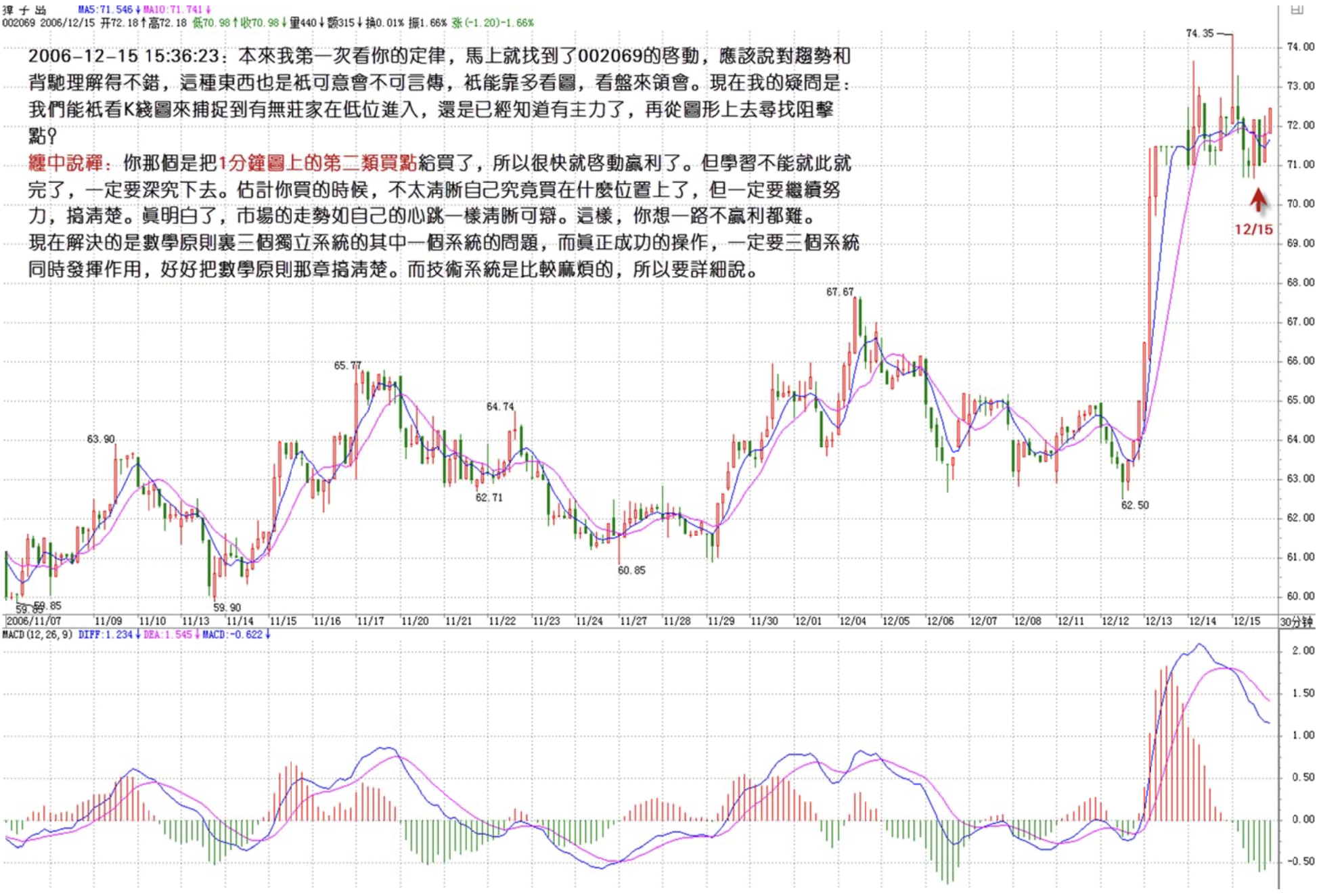
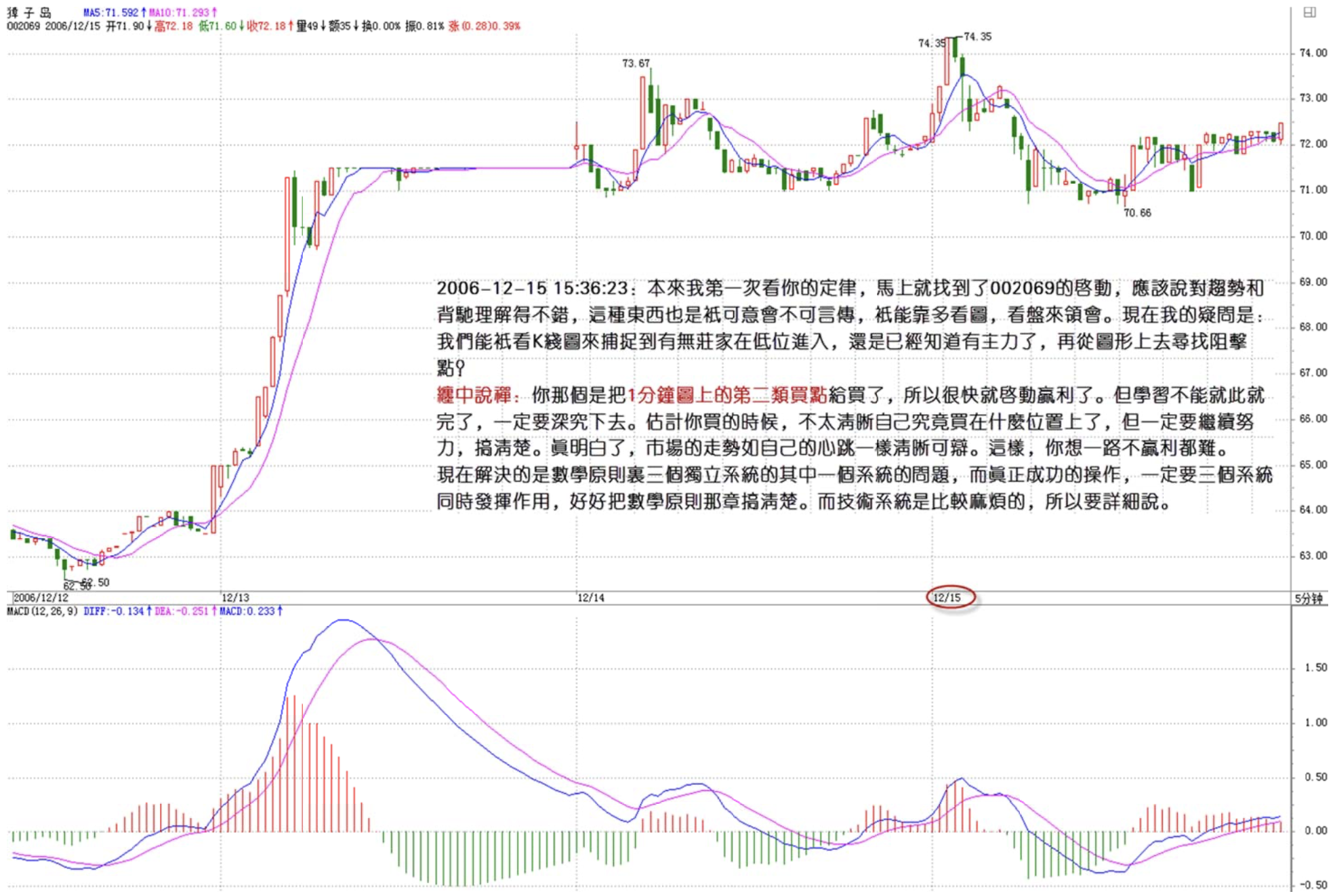
Sister Chan, the more I look at your questions, the more confused I get. Originally, the first time I read your theorem, I immediately found the launch point for 002069. I should say I understood trends and divergence fairly well — this kind of thing can only be grasped intuitively, not verbally explained. You can only develop the feeling by looking at many charts and watching the market. Now my question is: can we identify whether institutional money has entered at low levels just by looking at K-line charts, or do we already know institutional money is present and then look for the assault point on the chart?
=========
You bought the second-type buy point on the 1-minute chart, which is why the stock launched quickly and you profited quickly. But learning can't stop here — you must dig deeper. I reckon when you bought, you didn't clearly know exactly what position you were buying at. But you must continue to work hard and figure it out. Once you truly understand, market movements will be as clearly discernible as your own heartbeat. Then you'll find it hard NOT to profit continuously.
The current discussion addresses one of the three independent systems from the mathematical principles lesson. Truly successful trading requires all three systems working simultaneously. Study the mathematical principles chapter thoroughly. The technical system is the more complicated one, which is why it needs detailed explanation.
缠中说禅 2006/12/15 15:48:23
[Anonymous] 清
2006-12-15 13:44:06
Haven't come to ask questions for two or three days, mainly because my concepts were unclear, even fuzzy.
Just now when "this ID" was talking about liquor and medicine, I opened K-line charts and suddenly had a question.
600779, made a new high on the 12th. On the MACD chart, the fast line is pointing up, but the red candles are getting shorter, and even shorter than the high point of the previous day (previous segment — by the way: should comparisons be made against the high point of the previous trend, the previous segment?). Would this situation count as "divergence"?
Still hoping for a reply!
========
MACD alone can't completely solve the problem. From your description, I can tell you haven't thoroughly understood what trends and levels are. You must clearly and definitively establish the most foundational concepts of levels, trends, and consolidation — this is the starting point, the equivalent of points, lines, and planes in geometry. Only after distinguishing these clearly is there a need to talk about MACD and such.
缠中说禅 2006/12/15 15:52:29
[Anonymous] 炼铁设备
2006-12-15 13:50:05
At the brokerage office, too many people around the chart screens, can't get a turn. What charting software does the host use? Qianlong doesn't have 1-minute charts, the smallest is 5 minutes. Not familiar with Great Wisdom. Please recommend a system, thank you.
=======
If you can visit this blog, you can access the internet. There are many trading software options online — things like Tonghuashun, Great Wisdom. Find one that's comfortable and use it. This ID isn't too familiar with these things. For this ID, any software with charts at different levels is sufficient — you don't even need moving averages.
缠中说禅 2006/12/15 15:55:09
[Anonymous] Leisurely
2006-12-15 15:51:33
Those born with genius are the best. Learning proactively is very good. Learning after encountering confusion is also decent. Encountering confusion and being too lazy to learn — that's bad!
Last time my homework answer was wrong.
What does "level" refer to? 5-minute, 60-minute, daily chart?
Let me try again: On a baseline of a certain time-period chart, the formation of consolidation highs and lows in the absence of a trend.
Right? Hehe
===========
First, your Analects interpretation is the same thing as the above three scholars — unfortunately, it's wrong.
Actually, what are time-period charts? Don't bring non-foundational things into the most foundational concepts. Levels, trends, and consolidation are the most foundational — get these figured out first.
缠中说禅 2006/12/15 16:01:42
[Anonymous] 缠
2006-12-15 15:47:42
Seems like I half-understand, but I just can't pinpoint the exact moment. I'm getting anxious, Sister Chan!!!
=
Why the anxiety? The key is to learn. Once you truly learn, the market always has opportunities. Plenty of people lose heavily even in a bull market. Some people can still be bullish in a bear market. The key is to learn patiently. Look at more charts.
I suggest that everyone, after forming a certain understanding, look at lots of charts — especially look for charts that your understanding cannot explain. Find the flaws there.
Question: how is this expressed in The Analects? State it in three characters.
缠中说禅 2006/12/15 16:04:38
[Anonymous] 搜
2006-12-15 15:57:46
Which chapter does the "mathematical principles" chapter refer to?
=========
Teaching You to Trade Stocks 9: Mathematical Principles for Identifying "Premature Ejaculation" Males!
缠中说禅 2006/12/15 16:15:10
[Anonymous] 清
2006-12-15 16:03:32
Can't help but admire "this ID's" sharpness.
Actually, these past few days, I've been baffled by the line in "this ID's" article "Without a Trend, Without Divergence": "If a movement cannot even break through the short-term moving average, then the highs and lows appearing within that period are definitely only relevant on lower-level charts." Maybe my literary comprehension is poor. May I ask "this ID": the "movement" mentioned above, if converted into a mathematical curve form, what kind of connection line would it be? That is, on every level of K-line chart, there should be the short moving average, long moving average, and the stock price line, right?
I hope you won't tire of my pestering and point out where my concepts are wrong.
Thank you
===========
Levels are, in a sense, a filter. For instance, in those rapid declines — like the narrow channel-type declines on a daily chart — aren't there highs and lows within them? Of course there are, just as every daily K-line has upper and lower shadows. But at the daily level, these must all be filtered out. The entire channel-type decline can only count as one segment within a trend — it cannot count as a trend in itself.
But if you look at 5-minute or 30-minute charts, what cannot be counted as a trend on the daily chart will clearly display the basic characteristics of a trend pattern. At these lower levels, the trend is established.
Let me tell everyone a most fundamental Chán Zhōng Shuō Chán principle:
For charts at any level, both trends and consolidations must be completed.
Note: the importance of this principle to technical analysis is like the importance of the invariance of the speed of light to special relativity.
缠中说禅 2006/12/15 16:16:54
[Anonymous] 小小
2006-12-15 16:05:37
Sister Chan, we're so confused here!
[Anonymous] 中间体
2006-12-15 16:06:10
Looks like we'll just have to wait for Monday's answer. Sister Chan, please be sure to explain it clearly and accessibly.
We're a bunch of dim little kids, but quite lovable too.
=======
Without going through your own thinking, it's impossible to truly grasp it. This ID is doing this for everyone's benefit. I hope everyone can truly master it.
缠中说禅 2006/12/15 16:18:29
[Anonymous] 中间体
2006-12-15 16:10:42
Sometimes I find divergence on the 5-minute K-line, but the daily K-line hasn't diverged yet. Some fluids leak out, but then it gets pulled up during the session, and I can't chase back the fluids I released.
======
This is because you have no concept of levels. Once you truly understand, you'll know exactly how to operate.
缠中说禅 2006/12/15 16:24:22
It's the weekend, this ID is going out to feast. Tomorrow music can be played — what do you want to hear? Leave suggestions below.
This ID is signing off. See you.
缠中说禅 2006/12/15 12:19:51
Xiao Ming
2006-12-15 12:18:37
It should be 41!
=
Thanks, corrected.