The Market Continues Entering the Pre-530 Vicious Circle
2007/9/10 15:58:37
Right now, risk warnings are escalating to ever higher levels, yet the biggest conviction in the market is that policy won't create a sharp decline — therefore we can keep rising, and no matter how high we go, policy won't dare to play rough. The market continues entering the pre-530 vicious circle: on one hand, because the market's bullish energy hasn't been exhausted and many individual stocks are still hovering below their 530 highs, the impulse to keep rising can't be quelled; on the other hand, assessments of the current market and concerns about risk have been clearly expressed at increasingly high levels.
This unequivocally proves one of the most fundamental principles in this ID's theory: a trend is necessarily a composite force presentation of all contemporary component forces in the market. The current situation is precisely two equally powerful component forces colliding into each other.
Capital is betting that policy won't blow up — this is the biggest problem right now. What are the consequences of challenging policy's bottom line? Eighteen years of China's stock market have demonstrated this time and again. Every time, someone believes there'll be an exception, and every time, those people cease to exist. So, how will this time turn out? Let's wait and see.
For the component force of abundant capital, it will inevitably exploit gaps in policy to create market action, whether systemic or localized. But the result of gaming policy is often being gamed by policy. In this game of gaming and counter-gaming, only oscillation can be used to probe the tipping point of market collapse. And such market collapses often manifest in a non-systemic manner, placing extremely high demands on trading operations.
For the current market, specific operations have been stated multiple times:
First, for those with particularly poor skills, just reduce your position and hold some long-term holdings — that's it.
Second, for those with decent skills but who can't read hub oscillation, watch the 5-day or 5-week moving average. Generally speaking, as long as the 5-week line isn't broken, the level of any pullback is limited.
Third, for those who understand the rhythm of hub oscillation operations, operate according to hub oscillation requirements. Generally, the principle is sell first, buy later. At these levels, if your skill level has some issues, selling wrong is just selling wrong — consider it reducing your position.
Note: right now, you must not fear selling wrong — only fear buying wrong. Rather sell wrong than buy wrong.
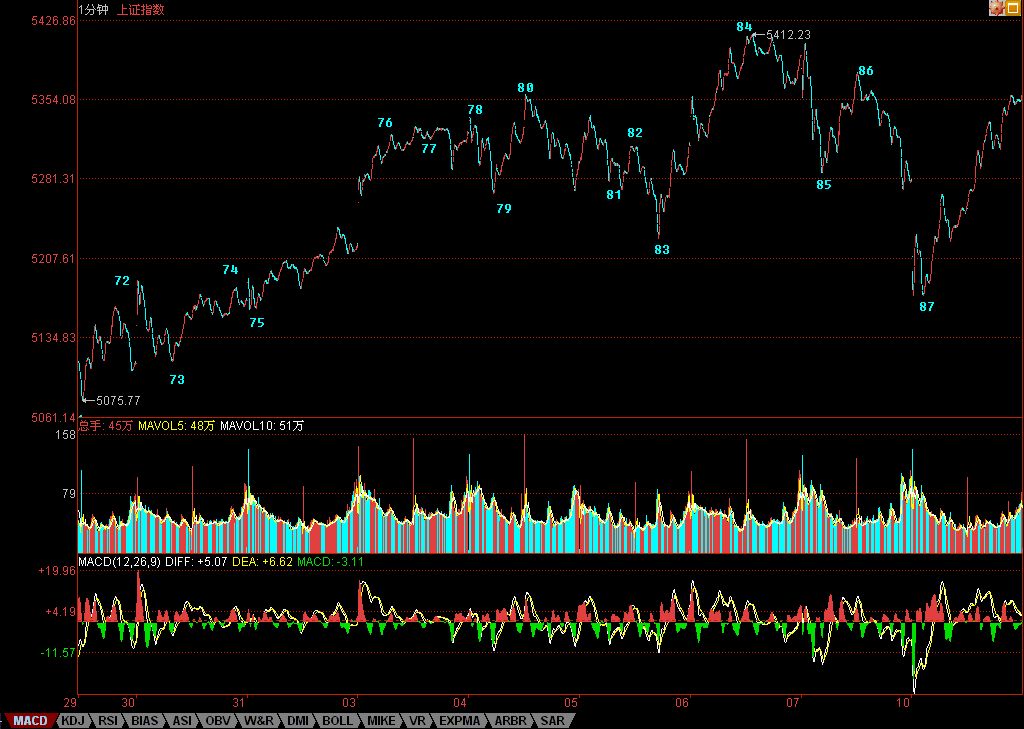
On the charts, the 5-minute hub starting from 76 is exceptionally clear. Before the third buy or sell point of that hub appears, hub oscillation will continue.
On the individual stock front, sectors that hadn't moved earlier are all starting catch-up rallies. This is a clear signal: if after this round of catch-up rallies, sectors that have been adjusting for a comparatively long time don't restart, then the market's pullback will inevitably escalate in level, with both duration and magnitude significantly increasing.
This week, pay close attention to whether last week's high can be broken. If it can, then the fractal structure on the weekly candlestick can't form. Otherwise, it will be the first clear warning signal on the weekly chart since 3600 points.
Today I can answer questions until 5 o'clock.
Replies
缠中说禅 2007/9/10 16:06:02
[Anonymous] Sina User Delete all comments by this person
2007-09-10 16:03:23
Is the bull market about to end?
==
The bull market needs to run at least 20 years — end what? But there are pullbacks within a bull market too; it doesn't go up in a straight line.
缠中说禅 2007/9/10 16:10:11
[Anonymous] Sina User Delete all comments by this person
2007-09-10 16:06:34
Is 601600 really dead?
==
Short-term: dead but not yet stiff. Long-term: alive and kicking.
缠中说禅 2007/9/10 16:12:00
[Anonymous] Sina User Delete all comments by this person
2007-09-10 16:07:05
Chan sister said a few days ago that some stocks have a cleanliness obsession, washing and washing until the whole rally is washed away — does that include tech turtle-head Tongfang Co.?
==
That was about bottom formations. Tongfang is at most a continuation pattern — that's different from bottom formation situations.
缠中说禅 2007/9/10 16:13:36
[Anonymous] Sina User Delete all comments by this person
2007-09-10 16:09:40
Happy holiday, teacher! May I ask about the future trend of 600569 Anyang Steel — can it be held? Thank you!!!
==
For a company of 569's scale, its ultimate fate is acquisition. Short-term, it can only follow the broader market.
缠中说禅 2007/9/10 16:14:49
Paste Delete all comments by this person
2007-09-10 16:08:11
Could Chan sister please comment on the meaning of 600737's latest announcement? Thank you
==
Nothing special. 737's future main business won't be tomatoes anyway.
缠中说禅 2007/9/10 16:21:24
[Anonymous] 蝉蝉 Delete all comments by this person
2007-09-10 16:05:32
Can funds be held long-term?
==
Honestly, this ID has zero confidence in funds. If you invest in funds, the best approach is to dollar-cost-average into index funds — you're guaranteed not to underperform the market. Some funds that specialize in growth companies are also worth paying attention to, but that depends on the fund manager's ability, which is essentially a matter of luck.
As for those large, unfocused comprehensive funds, trouble is just a matter of time. One major-level pullback is enough to cause trouble.
In the future, there will definitely be N crashes caused by some big fund blowing up. Banks, securities firms, etc. have all had major incidents — do you really believe funds will be the exception?
缠中说禅 2007/9/10 16:23:39
[Anonymous] 天眼 Delete all comments by this person
2007-09-10 16:16:44
......................4
....................../\...................8
...................../..\................../\
..................../....\..........6...../..\.
\0......2........../......\......../\..../....\
.\....../\......../........\....../..\../......\
..\..../..\....../..........\..../....\/........\.....10
...\../....\..../............\../.....7..........\..../\
...1\/......\../..............\/..................\../..\
.............\/................5...................\/....\
.............3......................................9.....\
...........................................................\
............................................................\11
Boss, how many line segments does the above chart divide into, and how should they be divided?
==
If there's prior price action, this simply can't be segmented — you need to see what came before. If there's no prior price action at all, then it's three line segments.
缠中说禅 2007/9/10 16:26:20
[Anonymous] Sina User Delete all comments by this person
2007-09-10 16:22:54
Chan master is deeply trapped in Chalco. With the market adjusting due to policy factors, will it be affected? Will Chalco reach 100 by year-end?
==
This kind of thinking will get you killed. Never set a predicted price target for stocks — prediction is nonsense.
You only need to choose your operating level, then enter based on buy points at that level. If you entered above 50 yuan, you're definitely operating at an ultra-short-term level — so operate according to that ultra-short-term level.
Know what the biggest flaw in stock trading is?
It's using an ultra-short-term buy point while expecting an ultra-long-term sell point.
缠中说禅 2007/9/10 16:29:19
[Anonymous] 一个网友 Delete all comments by this person
2007-09-10 16:22:31
I'm being tormented to despair in 600779. Could Chan master please advise what the main force is trying to do in there? Many thanks!
==
The players in this stock are too chaotic. Someone holds too many shares, and someone else wants to shake them out — that's basically it. The stock's fundamentals have no issues at all.
缠中说禅 2007/9/10 16:31:02
[Anonymous] 天眼 Delete all comments by this person
2007-09-10 16:28:19
[Anonymous] 天眼 Delete all comments by this person
2007-09-10 16:16:44
......................4
....................../\...................8
...................../..\................../\
..................../....\..........6...../..\.
\0......2........../......\......../\..../....\
.\....../\......../........\....../..\../......\
..\..../..\....../..........\..../....\/........\.....10
...\../....
Boss, how many line segments does the above chart divide into, and how should they be divided?
==
If there's prior price action, this simply can't be segmented — you need to see what came before. If there's no prior price action at all, then it's three line segments
---------
Thank you boss. Is it 0-3, 3-8, 8-11? Or the 2nd way: 0-5, 5-8, 8-11?
==
When a stroke is broken and extends into a line segment break, so of course it's 0-3, 3-8, 8-11.
缠中说禅 2007/9/10 16:32:10
[Anonymous] Sina User Delete all comments by this person
2007-09-10 16:30:59
Using an ultra-short-term buy point to wait for an ultra-long-term sell point — that's indeed the crux of the problem. But how can you tell if a buy point is worth holding for the long term?
==
Then you need to understand this ID's lessons. All that talk — wasn't it about telling you how to find buy and sell points at various levels?
缠中说禅 2007/9/10 16:32:11
[Anonymous] Sina User Delete all comments by this person
2007-09-10 16:30:59
Using an ultra-short-term buy point to wait for an ultra-long-term sell point — that's indeed the crux of the problem. But how can you tell if a buy point is worth holding for the long term?
==
Then you need to understand this ID's lessons. All that talk — wasn't it about telling you how to find buy and sell points at various levels?
缠中说禅 2007/9/10 16:37:26
[Anonymous] Sina User Delete all comments by this person
2007-09-10 16:24:45
Boss, can 000915 be a long-term holding?
==
Not a big issue, but the premise is that when this ID mentioned it, it was at 3 yuan, right near the long-term buy point. Now the stock is at most in a mid-to-short-term buy-sell range. So if the broader market has violent moves, a mid-to-short-term pullback carries some risk.
So when buying stocks, you must distinguish buy and sell points clearly. Enter at long-term buy points, then use medium-term oscillation to reduce your cost to zero and continue accumulating shares. That way, you won't have these worries.
Entering now means you need to accept the consequences. If you have the determination to ignore all mid-to-short-term oscillation, then there's no problem. Or, if your technical skills are decent, even less of a problem — get your shares first, then use oscillation to reduce cost. That way, it doesn't really matter when you enter.
缠中说禅 2007/9/10 16:41:41
[Anonymous] Sina User Delete all comments by this person
2007-09-10 16:29:49
Has 600737 already formed a sell point? Can't figure it out
==
The short-term sell point passed long ago. Even using the crudest daily chart top fractal analysis, any rally on Friday, as long as it didn't exceed 14.28 yuan, would constitute a top fractal.
After a top fractal, a decline is simply the natural order of things.
This stock's main problem is that too many people bought it recently. Someone went crazy, buying provocatively at 13.99 and 13.49 with 4,000- and 5,000-lot orders to taunt the market maker. The market maker would've been sick not to release news to shake things out.
The stock has absolutely no problems from a mid-to-long-term perspective. The biggest issue right now is that the order book is a mess.
缠中说禅 2007/9/10 16:47:11
[Anonymous] Sina User Delete all comments by this person
2007-09-10 16:41:05
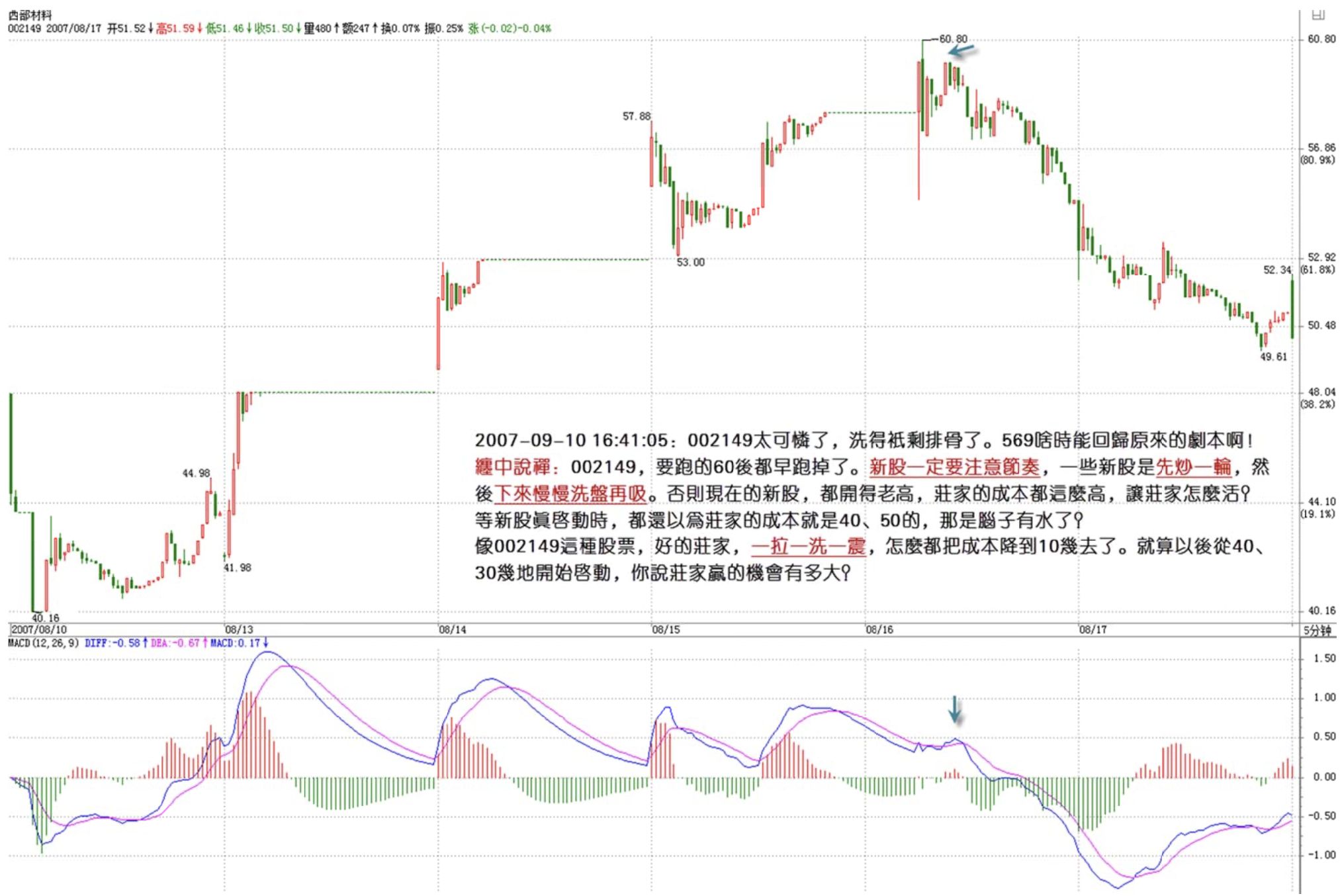
Fairy Sister, 002149 is so pitiful — it's been washed down to nothing but bones.
When will 569 get back to its original script?!
==
002149 — whoever wanted out after the 60 already left long ago. With new stocks, you must pay attention to rhythm. Some new stocks get pumped for one round, then come back down for slow shakeout and accumulation. Otherwise, with today's IPOs opening at sky-high prices, the market maker's cost is that high — how are they supposed to survive? When the new stock truly launches, people will still think the market maker's cost is at 40 or 50 — that's having water in their brains.
For a stock like 002149, a good market maker, through one pump, one shakeout, and one oscillation, can easily get their cost down to the teens. Even if they start the real move from 40 or 30-something, just imagine how good the market maker's odds are.
缠中说禅 2007/9/10 16:47:53
[Anonymous] 天眼 Delete all comments by this person
2007-09-10 16:34:36
Boss, within a single stroke, is it allowed for the highest point to not be the endpoint of the stroke?
==
Of course. If there's still a higher top above the top, then that first top isn't the real top.
缠中说禅 2007/9/10 16:49:03
[Anonymous] 新手无知 Delete all comments by this person
2007-09-10 16:43:04
I've read some of the lessons, and half-understand them.
A question for Chan:
- Is it true that all buy/sell point discoveries have a lag? And can't be determined in the moment (in real-time)? --- My understanding: buy/sell points appear at line segment endpoints, and confirming a line segment endpoint requires the next line segment's disruption. So once the disruption is confirmed, the buy/sell point has surely passed some time ago. (Is this understanding correct?)
- You've always said your theory doesn't involve prediction, only focuses on the present moment. If it doesn't involve prediction, how can it guide operations? For example, "after a buy point there must be a rise, after a sell point there must be a fall" — isn't that prediction? Or, as in the 1st question, buy/sell points are only discovered after the fact, which would make sense.
I'm a newbie so inevitably slow-witted — truly puzzled and confused. Please enlighten me, Chan.
==
Please go study the Nested Interval Theorem first. Once you understand it, this problem will disappear.
缠中说禅 2007/9/10 16:57:34
[Anonymous] 想弄明白 Delete all comments by this person
2007-09-10 16:17:51
Chan, last time you said we should do everything possible to extend the bubble rally, giving the impression you want it to go up. This time you're saying the risk is too great and we should sell first then buy. So which is it?
==
One is a mid-to-long-term issue, the other is a short-term issue — how can you mix them up? Mid-to-long-term, the goal is to let this bubble rally extend at least two more years. This requires the market to advance steadily without triggering large-scale policy intervention. Even without policy intervention, this ID will naturally do what needs to be done at the right time. The goal is singular: extend the rally as long as possible.
Short-term, during hub oscillation, of course it's sell first, buy later. What's the problem with that?
缠中说禅 2007/9/10 17:03:22
[Anonymous] Sina User Delete all comments by this person
2007-09-10 16:23:28
Blogger.
I've been holding 636 all along. But why did it turn out like this?
I'm a new investor. The towering ambition that was ignited by your medicine when I first entered the market has been completely doused. In a stock market at new highs, I feel more like a self-pitying child... ...
Not complaining, just helpless
==
If you entered the stock with a mid-to-long-term mindset, then there's no need to ask these questions. You only need to study whether the fundamentals are still worth holding.
If it was a short-term entry, then for a stock that hasn't even held the half-year moving average, why are you even watching it?
When this ID enters a stock, it's with the intention of holding for at least two years or more, even forever. So if you don't have this ID's objectives and only have short-term goals, operate according to your own level, and naturally none of these problems arise.
This ID has said many times: if you want speed, master the third-type buy point — that's the fastest. In practice, just grasp two things: First, the level can't be too small. Second, once an upward consolidation divergence appears, you must exit immediately. Don't get involved in situations that evolve into large-level oscillation. Only hold when the hub is shifting upward. Once a new hub is established, leave immediately.
When leaving: first sell point — watch for divergence. If you miss it, you must leave at the second sell point.
Master this technique, and no so-called short-term master will be your match.
缠中说禅 2007/9/10 17:09:40
[Anonymous] Sina User Delete all comments by this person
2007-09-10 16:57:17
Looks like 600569 has already been abandoned by Chan — no more value. Better run
==
Look at 569's daily fractal on Friday. This ID won't exit any stock that's been entered, but will definitely use oscillation to reduce the cost to zero and then continue accumulating shares.
Note: for retail investors, there's absolutely no need to hold a single stock long-term. That's something big capital has to do because it has no choice. If this market would let capital of this ID's size trade in and out short-term, then this ID would do things differently. But in reality, that's impossible.
So for retail investors, if your channels are clear, the fastest method is to operate using third-type buy points. Finish one stock, move on to the next, keep going non-stop. Don't participate in any hub oscillation — only go for the strongest momentum.
This is what retail investors should be doing.
Of course, if you don't have the skills for that, don't play at high difficulty. Keep it simple: expand your operating level. If you can't handle hub oscillation, just watch the 5-day and 5-week moving averages. Hold until the divergence sell point, then leave decisively. Wait for the new buy point.
缠中说禅 2007/9/10 17:10:26
Past 5 o'clock. Sorry, there are things to attend to.
Signing off, goodbye.
缠中说禅 2007/9/10 18:39:35
Chan MM, ever since I started trying your mindful breathing technique, within less than a week I came down with a cold and cough, which was quite uncomfortable. Later the cough got better, but these past few days bumps suddenly appeared all over my body, like mosquito bites, red and itchy, not going away for days. Could the root illness have been triggered this quickly? I actually rarely stand and meditate — it's mostly when I'm lying in bed at noon or night that I do the mindful breathing you described. But I usually can't persist for more than a few minutes before falling asleep. Could there really be results this fast? What should I do next? What should I watch out for?
-------------------------------
Next you can head out to the countryside and dance around like a shaman to collect money
缠中说禅 2007/9/10 18:55:34
[Anonymous] Sina User Delete all comments by this person
2007-09-10 16:58:26
This blogger is truly shameless. Slut!!!!!!!!!!!!
==============
Die, you brat! Get the hell out!!!
==================
I didn't even say anything. Mind your own damn business.
缠中说禅 2007/9/10 18:59:41
Suddenly free again. Continuing to answer everyone's questions.
缠中说禅 2007/9/10 23:16:43
Burn Burn Magu Trade Stocks
2007-09-10 20:30:51
To clarify, I'm not asking friends to watch China Shipbuilding — it's already high-risk. Rather, it's other listed companies related to the "iron-blooded industry." Hope everyone can hit the jackpot. If I have more precise information, I'll continue posting.
~~~~~
Thank you Magu for the tip!
Let me go check what related industries there are!
-------------------
Apart from warships, it's aircraft — 000768 Xi'an Aircraft (AVIC)
============================
Are you idiots? 600677 already publicly announced its secondary offering for new weapons systems. You've been studying my theory all this time — was it all for nothing?
缠中说禅 2007/9/11 9:18:59
888
缠中说禅 2007/9/10 16:05:08
[Anonymous] Sina User Delete all comments by this person
2007-09-10 16:01:19
Hello Chan sister!
In lesson 70, it's mentioned that 17–38 forms a perfect 1f uptrend, with the 2nd hub being 32–35. The follow-up comments also mention the 1st hub being 22–27. So the entire trend is segmented as:
a+A+b+B+c = (17-22)+(22-27)+(27-32)+(32-35)+(35-38)
The problem with this segmentation is that both a and b contain a 1f hub, namely 18-21 and 28-31 respectively. This means a and b are both 1f trend types, the same level as hubs A and B. Can such a combination be valid? Weren't a and b supposed to be a lower level than A and B?
==
Why must there be a and b? A+b+B is also a 1-minute uptrend. The key is that the two hubs don't overlap. Whether there's a trend segment before or after the hub doesn't matter.