Teaching You to Trade Stocks 67: The Standard for Line Segment Division
2007/8/1 22:31:55
Today I heard that among the former marshals, one has always been missing. This ID only knows there were ten grand marshals, and history only knows there were ten grand marshals. History is history and cannot be changed. As for what happens in the future, that's a matter for the future. But history must be respected. Moreover, this overlooked one commanded the first great victory against the Japanese invasion, a true anti-Japanese hero, and his contributions in the Liberation War go without saying. If the name of such a hero remains taboo decades later, that can only be history's sorrow.
An old-style poem, commemorating the true marshal, the true god of war, on August 1st:
Ten thousand li across the divine land, flags fill every grove
The Milky Way carries ghostly wails from afar
The red-faced elder squints with suspicious eyes
The yellow-haired youngster's heart knows no peace
Once a hundred battles shook heaven and earth
One night's solitary march bewilders past and present
Over the vast desert, smoke disperses yet gathers
The north wind carries naught but the moan of bloodied souls
The standard for stroke division has already been strictly given previously. Therefore, the next key issue is how to divide line segments. Below, a division standard similar to stroke division but with significant differences is provided. Let S represent an upward stroke, and X represent a downward stroke. Then all line segments are nothing more than two types: first, starting from an upward stroke; second, starting from a downward stroke. For simplicity, let's use a line segment starting from an upward stroke as an example to explain the division standard.
A line segment starting from an upward stroke can be represented by the stroke sequence: S1X1S2X2S3X3…SnXn. It is easy to prove that between any Si and Si+1, there must be an overlapping interval. Now examine the sequence X1X2…Xn. In this sequence, there is not necessarily an overlapping interval between Xi and Xi+1, and therefore this sequence better represents the nature of the line segment.
Definition: The sequence X1X2…Xn is called the characteristic sequence of a line segment starting with an upward stroke; the sequence S1S2…Sn is called the characteristic sequence of a line segment starting with a downward stroke. When two adjacent elements in the characteristic sequence have no overlapping interval, this is called a gap in the sequence.
Regarding the characteristic sequence, if each element is treated as a candlestick, then just like the method of finding fractals in ordinary candlestick charts, there also exists the so-called inclusion relationship, and non-inclusion processing can be applied. A characteristic sequence that has undergone non-inclusion processing becomes the standard characteristic sequence. Unless otherwise specified, characteristic sequences hereafter refer to standard characteristic sequences.
Referring to the definitions of top fractals and bottom fractals in ordinary candlestick charts, the tops and bottoms of the characteristic sequence can be determined. Note that for a line segment starting with an upward stroke, only top fractals of the characteristic sequence are examined; for a line segment starting with a downward stroke, only bottom fractals are examined.
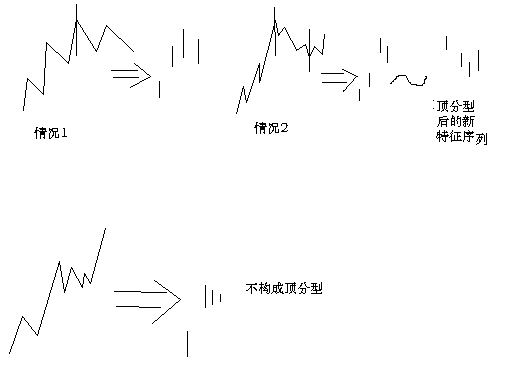
In the standard characteristic sequence, there are only two possible situations for the three adjacent elements forming a fractal:
First situation:
In the top fractal of the characteristic sequence, if there is no gap in the characteristic sequence between the first and second elements, then the line segment ends at the high point of this top fractal, and this high point is the endpoint of the line segment. In the bottom fractal of the characteristic sequence, if there is no gap in the characteristic sequence between the first and second elements, then the line segment ends at the low point of this bottom fractal, and this low point is the endpoint of the line segment.
Second situation:
In the top fractal of the characteristic sequence, if there is a gap in the characteristic sequence between the first and second elements, and if the characteristic sequence of the sequence starting from the first downward stroke from the highest point of this fractal produces a bottom fractal, then the line segment ends at the high point of this top fractal, and this high point is the endpoint of the line segment. In the bottom fractal of the characteristic sequence, if there is a gap in the characteristic sequence between the first and second elements, and if the characteristic sequence of the sequence starting from the first upward stroke from the lowest point of this fractal produces a top fractal, then the line segment ends at the low point of this bottom fractal, and this low point is the endpoint of the line segment.
It must be emphasized that in the second situation, the latter characteristic sequence does not necessarily close the corresponding gap of the former characteristic sequence. Moreover, the fractal in the second sequence is not classified into first or second situations—as long as there is a fractal, it qualifies.
The above two situations provide the standard for all line segment division. Obviously, the appearance of a fractal in the characteristic sequence is the prerequisite for a line segment to end. This lesson has precisely formalized what was previously stated as "the necessary and sufficient condition for a line segment to be destroyed is that it is destroyed by another line segment." Therefore, all future line segment division will be based on this precise definition.
This definition is somewhat complex. First, please understand the characteristic sequence, then the standard characteristic sequence, then the top fractals and bottom fractals of the standard characteristic sequence. And fractals are further divided into two situations based on whether there is a gap between the first and second elements of the fractal. You must clarify these logical relationships, otherwise you will certainly get confused.
Obviously, according to this division, all trends on the same level chart can be uniquely divided into connections of line segments, just as all trends on the same level chart can be uniquely divided into connections of strokes. With these two foundations, the entire recursive system of hubs and trend types can be established. This is the foundation of foundations—please make sure you understand it clearly, otherwise you definitely won't learn this well.
Finally, I'll try to draw some diagrams to help you distinguish the concepts above, but it's best to read the definitions carefully—that is the path to true understanding. Diagrams are merely supplementary. The first two diagrams show the division of line segments.