"The Analects" in Detail: For All Those Who Misinterpret Confucius (65)
2007/5/22 8:48:56
Meng Wubo asked about filial piety. The Master said: "Parents—only worrying about their illness."
Yang Bojun: Meng Wubo asked Confucius about filial piety. Confucius said: "Parents only worry about their filial child's illness."
Qian Mu: Meng Wubo asked: "What constitutes filial piety?" The Master said: "Let your parents' only worry be about your illness."
Li Zehou: Meng Wubo asked what filial piety is. Confucius said: "Make parents worry only about their children's illness."
Detailed Explanation: Among the three interpretations above, Yang's turns the answer into a non-sequitur — clearly a major error. Qian's and Li's interpretations are largely similar, but both turn filial piety into a behavioral norm divorced from the present-moment emotional foundation.
Meng Wubo was the son of Meng Yizi from the previous chapter. "父母唯其疾之忧" is an inversion and abbreviation of "唯其疾之忧父母者." "唯" means "even if"; "其" refers to the children; "之" is a structural particle. What Confucius says here is very plain and practical. What is filial piety? Confucius gives a criterion for discernment: "the kind of emotion where even when one is ill, one still worries about one's parents." Why? Because one's own illness causes parents to worry, and further means parents don't receive proper care — feeling uneasy about this naturally produces concern. This emotion arises spontaneously in the present moment, from the depths of the heart, requiring no moral code to enforce.
This chapter, like the previous one, examines the present-moment quality of "filial piety" as a concrete individual behavior from the standpoint of the specific individual. Filial piety is not some vague, ethereal moral concept, but a genuine, present-moment emotion. Even when you are ill, the emotion of worrying about your parents arises spontaneously in the present — that is filial piety. Naturally, even when not ill, spontaneously feeling concern for one's parents is also filial piety. But the ability to naturally and spontaneously produce concern for one's parents even in extreme situations like illness — only such filial piety can be considered truly tested. Some so-called filial children are sweeter than honey in normal times, but when push comes to shove, they only think of themselves. The old saying goes "there are no filial children by a long sickbed" — not to mention when they themselves fall ill. None of these can be considered true filial piety.
Note that the "疾" (illness) here refers only to sickness, not to troubles caused by improper behavior. The greatest misfortune in the world is white-haired parents burying their black-haired children. Anyone who doesn't cherish their own life, who encounters disaster due to bad habits, is the most unfilial person in the world. Similarly, those who suffer injury, imprisonment, and so forth due to their own conduct follow the same principle. Why? A person who gets injured, imprisoned, or even dies because of their own improper behavior can never truly feel concern for their parents in the present moment. If these people truly worried about their parents in their hearts, they would never allow themselves to engage in any improper behavior that puts themselves in danger.
Chán Zhōng Shuō Chán's Vernacular Translation
Meng Wubo asked about filial piety. The Master said: "Parents—only worrying about their illness."
Meng Wubo asked about filial piety. Confucius said: "(Filial piety is) the kind of present-moment emotion where even when one is ill, one still worries about one's parents."
Zixia asked about filial piety. The Master said: The strained expression is the difficulty. When there are troubles, the young shoulder the labor; when there is food and wine, the elders eat and drink—can this really be considered filial piety?
Yang Bojun: Zixia asked about filial piety. Confucius said: "It is difficult for children to always maintain a pleasant expression before their parents. When there are tasks, the young do the work; when there is wine and food, the elders eat — can this really be considered filial piety?"
Qian Mu: Zixia asked: "What constitutes filial piety?" The Master said: "The difficulty lies in the children's facial expression. When something happens, the young take on the labor; when there's wine and food, the elders eat first — is that really filial piety?"
Li Zehou: Zixia asked what filial piety is. Confucius said: "Not giving parents a good look. When there are matters, the young serve; when there's wine and food, the elders eat first — is this really filial piety?"
Detailed Explanation: "色" (sè), original meaning: facial expression. "难" (nán), difficulty, feeling reluctant. "事" (shì), incident, trouble. "服" (fú), to bear, shoulder. "其" (qí), referring to "事." "劳" (láo), toil, trouble. "弟子" (dìzǐ), young people. "先生" (xiānshēng), elders. "馔" (zhuàn), to eat and drink. "曾" (zēng), originally an adverb, emphasizing tone.
This chapter continues to discuss "filial piety" from the standpoint of present-moment emotion. "When there are matters, the young handle the trouble; when there is food and wine, the elders eat" — in most people's eyes, this would be "filial piety." But Confucius did not think so. Because this kind of so-called filial behavior could entirely be unwilling, performed under the pressure of moral norms. Such behavior doesn't come from genuine, present-moment emotion. When it shows outwardly, it becomes "色难" (a reluctant, strained expression) — and this cannot be called "filial piety."
Chán Zhōng Shuō Chán's Vernacular Translation
Zixia asked about filial piety. The Master said: The strained expression is the difficulty. When there are troubles, the young shoulder the labor; when there is food and wine, the elders eat and drink—can this really be considered filial piety?
Zixia asked about filial piety. Confucius said: "When there are troubles, letting the young shoulder the burden; when there is food and wine, letting the elders eat and drink — but if these actions don't come from genuine present-moment emotion, if they are merely performed under the force of moral norms, with inner reluctance and even outward signs of a strained expression — can one really call this filial piety?"
Appendix:
As mentioned yesterday, as long as the market didn't fall below yesterday's single-direction range of 4050, it would continue expanding upward. Today the market moved in a very technical fashion, essentially grinding all day around that most important 1/2 resistance line. In the morning it first surged to 4129 at that line's level, then set a small bull trap above it, then came all the way down to test gap support, and rallied back at the close — can you feel the beauty in it? Tomorrow, it will still be oscillating between that line and today's gap, then choosing the short-term breakout direction. Refer specifically to the oscillation and third-type buy/sell point selection from the small hub that began forming today.
From the big picture, regarding the oscillation pattern around this 1/2 line, the selection process continues. Although today was the first time in history that it broke through this 1/2 line, one cannot absolutely deny the possibility of the first oscillation pattern. Of course, operationally there's no need to predict — just watch the short-term breakout direction. If you can't read it, just use the 5- and 10-day moving averages. Don't sell unless they're broken. You don't even need to consider short-term oscillations. Those with good technique can continue using short-term divergence to trade oscillations, but must target specific individual stocks. As long as the broad market is stable, individual stock action will continue.
As for individual stocks, this ID really can't say anything more. Anyway, this ID didn't say anything yesterday either — just talked in my sleep. If because of a few words from this ID's sleep-talking, everyone figured something out, then everyone is clever enough, and it has nothing to do with this ID. This kind of sleep-talking — even the most extreme regulators probably can't come after this ID. This ID speaks while not speaking, doesn't speak while speaking. If they want to catch this ID, they'll need evidence.
Replies
缠中说禅 2007/5/22 15:28:48
As mentioned yesterday, as long as the market didn't fall below yesterday's single-direction range of 4050, it would continue expanding upward. Today the market moved in a very technical fashion, essentially grinding all day around that most important 1/2 resistance line. In the morning it first surged to 4129 at that line's level, then set a small bull trap above it, then came all the way down to test gap support, and rallied back at the close — can you feel the beauty in it? Tomorrow, it will still be oscillating between that line and today's gap, then choosing the short-term breakout direction. Refer specifically to the oscillation and third-type buy/sell point selection from the small hub that began forming today.
From the big picture, regarding the oscillation pattern around this 1/2 line, the selection process continues. Although today was the first time in history that it broke through this 1/2 line, one cannot absolutely deny the possibility of the first oscillation pattern. Of course, operationally there's no need to predict — just watch the short-term breakout direction. If you can't read it, just use the 5- and 10-day moving averages. Don't sell unless they're broken. You don't even need to consider short-term oscillations. Those with good technique can continue using short-term divergence to trade oscillations, but must target specific individual stocks. As long as the broad market is stable, individual stock action will continue.
As for individual stocks, this ID really can't say anything more. Anyway, this ID didn't say anything yesterday either — just talked in my sleep. If because of a few words from this ID's sleep-talking, everyone figured something out, then everyone is clever enough, and it has nothing to do with this ID. This kind of sleep-talking — even the most extreme regulators probably can't come after this ID. This ID speaks while not speaking, doesn't speak while speaking. If they want to catch this ID, they'll need evidence.
缠中说禅 2007/5/22 15:44:06
[Anonymous] stone
2007-05-22 15:35:31
That 13-yuan bear stock — I'm still holding it. But lately the blood I've been sucking has gotten less. For a stock like this, how should I operate? How can you tell when a limit-up will unlock? When will it hit limit-up again?
Thank you!!
--
This ID deliberately emphasized 13 yuan those few days. Why? Don't think this ID was showing off. This ID has said N times: this ID likes to make moves at the double position. Where's the double of 13? Haven't exited — mid-term, no problem. This ID still has a lot too, though at zero cost. This ID's method was shared long ago: for this bear stock, this ID is now at the stage of maintaining zero cost while accumulating more shares. This way this ID's portfolio keeps growing, which doesn't mean this stock tops out at the double. This ID also mentioned the method before — find opportunities to reduce cost to zero, take the extra money to do other mischief.
缠中说禅 2007/5/22 15:45:26
[Anonymous] Sina User
2007-05-22 15:40:37
Strongly requesting again that the blogger give specialized lectures on applying Chan Theory to futures. In futures and forex, you can trade both directions — even better suited for Chan Theory to suck blood.
==
First master it in stocks. Otherwise, going half-baked into futures is asking to get beaten.
缠中说禅 2007/5/22 15:51:26
[Anonymous] 小迷糊
2007-05-22 15:25:32
May I ask — what do "oracle bones" and "geometric sequence" refer to?
Or
which date's article are they from?
Please, senior classmates, reveal a little.
--
Small-cap stocks require even better buy points — you can't chase too aggressively, otherwise you'll suffer the pain of getting washed. Large-caps — even less need to chase. If you bought, you bought; if you didn't, let it go. As the saying goes, eyes meet and souls connect in the present moment — N moments later, the spark is gone.
缠中说禅 2007/5/22 15:58:20
[Anonymous] 我
2007-05-22 15:46:56
Sister, the definition of the third type buy/sell point is: one sub-level movement leaves, then another sub-level movement pulls back without re-entering the hub at this level. That means you need at least two hubs to form a third type buy/sell point.
Sister also said that the prerequisite for a hub being broken is the appearance of a third type buy point for that hub, meaning one sub-level hub above the hub breaks it.
One says one sub-level hub, the other says two sub-level hubs — so is it one or two sub-level hubs?
I feel there's a contradiction. Is my understanding wrong?
Also, according to this definition, the first type sell point and the third type buy point are very close in position.
Please clear up my confusion, sister.
--
Leaving the hub must be sub-level, and the pullback test must also be sub-level. Simply having one sub-level hub above the hub doesn't absolutely guarantee safety — for example, many gap-and-reverse island patterns work this way. After a third type buy/sell point, it can evolve into larger-level consolidation. Of course, the two positions can be very close. So choose to operate at a larger level — this way you have enough room to maneuver. Of course, if your technique is better, you can precisely grasp the situation as it unfolds where a third type buy point transforms into larger-level consolidation. Once this appears, leave immediately — meaning only select the pattern where the hub continues to migrate upward. This improves capital utilization. As long as the level isn't too small, even in the case of transformation into larger-level consolidation, there's still enough profit margin to exit gracefully.
缠中说禅 2007/5/22 16:00:35
[Anonymous] 走失的爱犬
2007-05-22 15:56:14
Sister Chan, let me gossip a bit. When you were accumulating that rice stock, was it in your personal name or a company name? So much rice going in — how come nothing shows up in the F10 data? :)
==
This ID has been in the market for N years. If I could still be caught by F10, then this ID would truly have lived in vain. Even the dumbest market maker wouldn't be that careless, let alone this ID, who stopped doing that sort of thing long ago.
缠中说禅 2007/5/22 16:09:13
[Anonymous] 手中无股
2007-05-22 15:55:05
LZ, truly well-intentioned — everyone should deeply appreciate her goodwill. Recently Sherlock Holmes' friend has been very active, becoming a university president and making grand pronouncements about the stock market, always using "3x gains" as the talking point. I only have an elementary school education. Once I scored 40 on a test — up 3x from my previous 10. The teacher's comment was just "keep trying for a passing grade" — not "you're the best student in the school." I was very unhappy — the teacher didn't praise me, but lavished praise on a classmate who only gained 1 point (because gaining 2 was impossible). I was really angry. If Sherlock's friend had been my elementary school principal, he'd definitely praise me at every meeting, because my grades improved the fastest.
--
Different people are in different positions, so naturally they say different things. Learn to understand — that person does have some brains. And what one says isn't always brain-related.
缠中说禅 2007/5/22 16:16:50
[Anonymous] Sina User
2007-05-22 15:53:52
Everyone, the blogger's 419 place is in Beijing, you know — how did you all say it was in Henan? 000959 Shougang is the steel stock the blogger was talking about — full listing plus Olympics theme. Everyone should pay attention to 000959 Shougang!!!!
--
This ID can only be in Beijing for 419? That's really underestimating this ID. Shougang is being looked after by an acquaintance — mid-term, no issues.
One last thing regarding yesterday's sleep-talking — this ID doesn't want to bring it up again. This ID said nothing. End of story.
缠中说禅 2007/5/22 16:19:32
[Anonymous] JESSIE
2007-05-22 16:14:28
Sister Chan, since I started studying with you, I've truly become a different person — more confident, open, and wise. I believe this is fate. Thank you, heavens, for letting me meet you. I hope this fate can continue forever. In the future, wherever you go, please give us advance notice so we can follow your footsteps and continue to follow you. Of course, regardless of what happens in the future, we will master your theory — that is the greatest treasure you've given us. Based on your theory, I've been practicing in my operations. Though my returns aren't as great as some classmates', they're enough to thrill me, and I no longer panic like before. All thanks to you — your theory is truly great, and your character makes me admire you even more.
I'd like to ask a question: when do stocks generally hit limit-up? Why do some stocks hit consecutive limit-ups while others never do? Thank you, sister.
--
Rising movements basically come in two types: channel-style rising generally doesn't tend to hit limit-up. The specifics will be covered in future lessons.
缠中说禅 2007/5/22 16:30:17
[Anonymous] Sina User
2007-05-22 16:12:09
Asking for guidance:
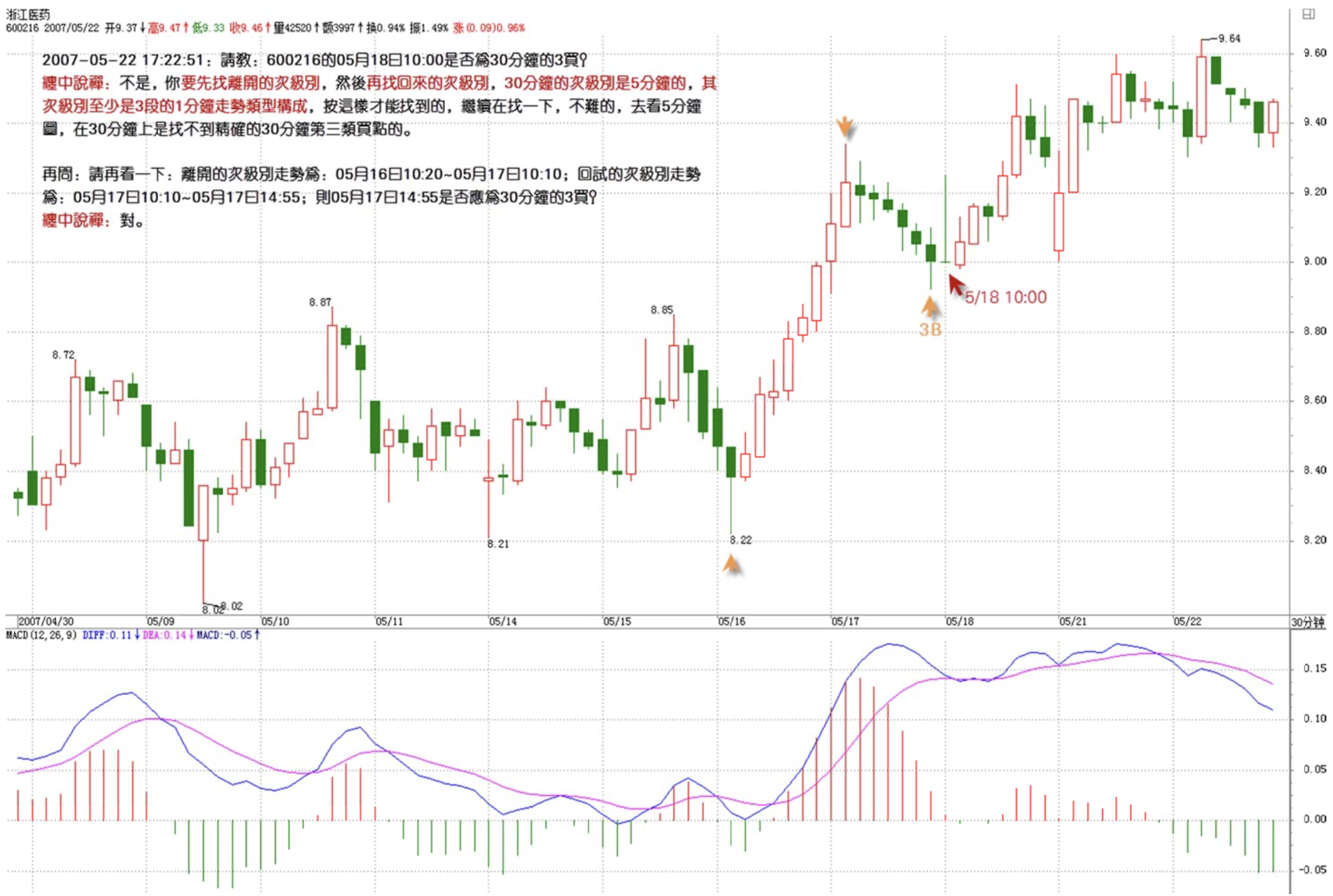
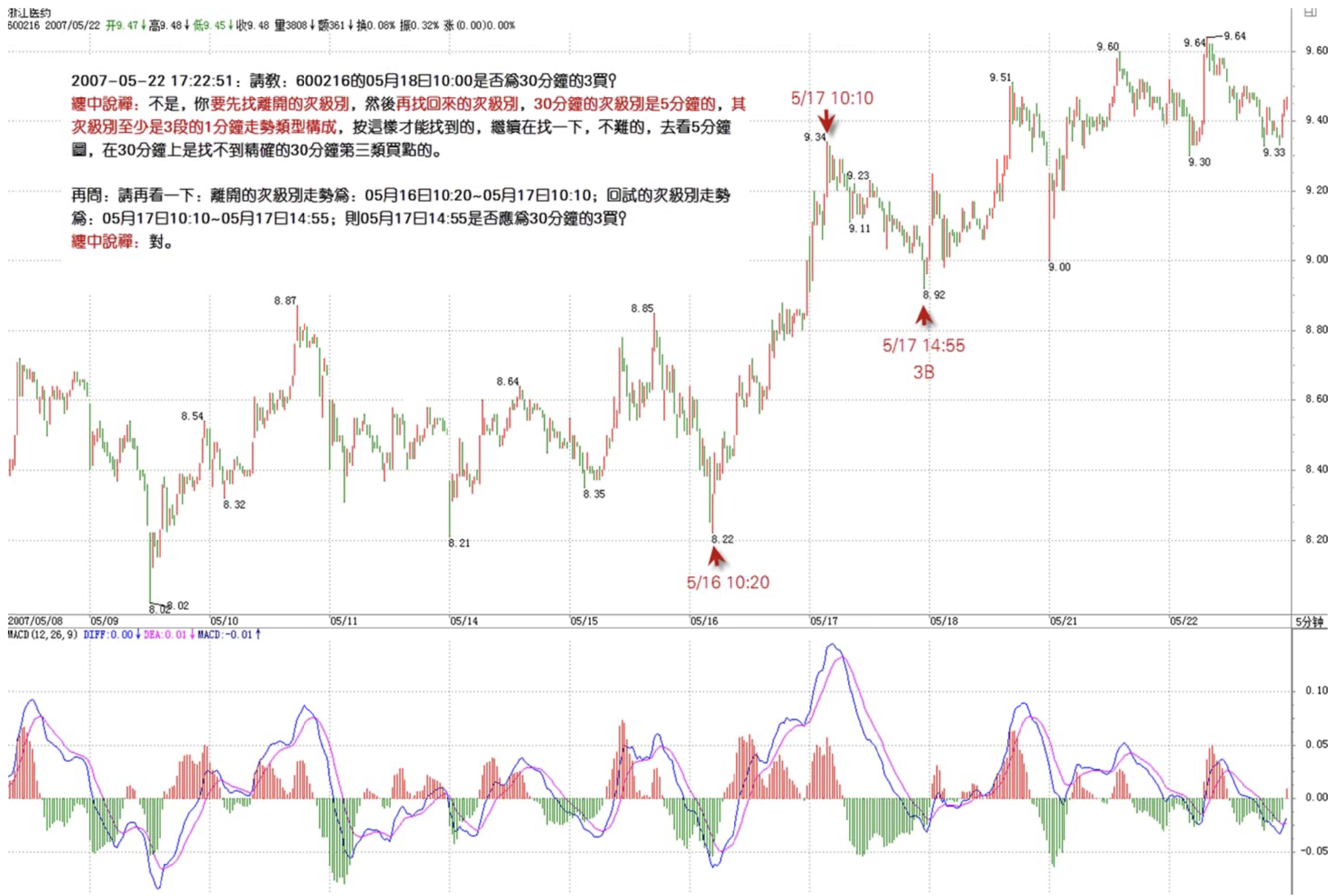
Is 600216's 05181000 a 30-minute third buy point?
I've asked this question N times!!!
Please teacher and senior classmates help me answer!
=
No. You need to first find the leaving sub-level movement, then find the returning sub-level movement. The sub-level of 30-minute is 5-minute, and its sub-level must consist of at least 3 segments of 1-minute trend types. Only then can you find it. Keep looking — it's not difficult. Look at the 5-minute chart. You can't find the precise 30-minute third type buy point on the 30-minute chart.
缠中说禅 2007/5/22 16:33:11
[Anonymous] Sina User
2007-05-22 16:05:49
No matter how the blogger puts it, I think most retail investors still won't make money. This seems to be the iron law of the stock market. But I appreciate the blogger's kind heart.
While studying the blogger's theory, I have a question: what are the strict definitions of the start and end of a "kiss," and "male-on-top" and "female-on-top" positions? These are basic concepts that need strict definitions. I don't seem to have seen these definitions in the blog.
-
These concepts don't have much significance. The key is to start from the hub perspective. The definition of female-on-top is in the lessons — it's when the short-term moving average is above the long-term one. A "kiss" is when the short-term line turns back and approaches the long-term one — just terminology coined for easy memory, no great significance. Still, start from the hub and work hard from there.
缠中说禅 2007/5/22 16:35:58
[Anonymous] Sina User
2007-05-22 16:21:43
"Leaving the hub must be sub-level, and the pullback test must also be sub-level. Simply having one sub-level hub above the hub doesn't absolutely guarantee safety..."
--
Boss, may I ask —
The sub-level hub leaving can be within the original hub, right? It's the returning sub-level hub that can't go back into the original hub, correct?
--
Of course it can, and most of the time that's exactly the case.
缠中说禅 2007/5/22 16:37:59
[Anonymous] 新股手
2007-05-22 16:31:11
[Anonymous] 心脏病突发
2007-05-22 16:24:59
Boss, today that "no gifts accepted" stock bounced up and down several times — is that you, sister, tossing it around? Is there any issue with holding this stock?
Don't talk nonsense. It's not the boss — it's Shi Yuzhu playing around. Haha.
--
Exactly. If the regulators want to arrest someone, go arrest him. It has nothing to do with this ID. This ID invests legally, drains blood vigorously — don't lump this ID together with those big fools.
缠中说禅 2007/5/22 16:39:21
It's raining in Beijing today. Even lost interest in going out for indulgences. Might as well chat more with everyone.
缠中说禅 2007/5/22 16:49:11
[Anonymous] 我
2007-05-22 16:40:50
Chán Zhōng Shuō Chán
2007-05-22 16:35:58
[Anonymous] Sina User
2007-05-22 16:21:43
"Leaving the hub must be sub-level, and the pullback test must also be sub-level. Simply having one sub-level hub above the hub doesn't absolutely guarantee safety..."
--
Boss, may I ask —
The sub-level hub leaving can be within the original hub, right? It's the returning sub-level hub that can't go back into the original hub, correct?
--
Of course it can, and most of the time that's exactly the case.
===========
Sister, I'm confused again. Why can the leaving sub-level hub be within the original hub? Doesn't "leaving" mean it's not in the original hub? Shouldn't both the leaving and the returning not be in the original hub?
---
You're talking about the hub. The hub isn't the entirety of the movement. If the price is above the hub, that's already leaving. Oscillation around a hub — as long as the price isn't within the hub — counts as leaving. It's just that this kind of leaving usually gets pulled back. The reason the third type buy/sell point is important is precisely that after leaving, it can't be pulled back.
缠中说禅 2007/5/22 16:56:07
[Anonymous] Sina User
2007-05-22 16:47:19
Boss, since you're in such a good mood today, could you say a few words about B-shares?
==
Those buying B-shares — unless you've been holding from the bottom up — may find the money earned doesn't even cover the USD depreciation. Of course, if you already had USD and didn't want to convert to RMB, then naturally you can participate. B-shares need a good consolidation at this level, but the trend isn't over.
缠中说禅 2007/5/22 16:59:01
[Anonymous] Sina User
2007-05-22 16:53:27
Christianity has been very popular in China recently. What's your take on this, boss?
==
This has been discussed before. On this issue, the state should strictly regulate — this is more important than regulating the stock market.
缠中说禅 2007/5/22 17:04:18
[Anonymous] 中间体
2007-05-22 16:58:32
White Magnolia
I know you have 343, Beijing people — me too!! Haha,
Sister Chan is about to make her move.
--
578 broke through its all-time high, and just happens to be at the double — a consolidation is very natural. 343 will be the same around 15 after breaking its all-time high. 802 — the chart is very standard; isn't it okay to have some adjustment after a 60-minute top divergence? Generally, with large-level divergence, you need a longer time to digest — that's a very natural issue. Mid-term, all Beijing stocks are fine. As for the very specific stuff like what happens tomorrow, definitely don't ask this ID — this ID doesn't want to be regulated.
缠中说禅 2007/5/22 17:06:22
[Anonymous] 新股手
2007-05-22 17:00:19
Boss, I've read the lessons twice.
It seems there's no precise definition for first and second type buy/sell points.
Only the third buy/sell point has a precise definition.
=
All buy/sell points ultimately trace back to the first type. The first type ultimately relates to divergence. This has been said repeatedly.
缠中说禅 2007/5/22 17:11:38
[Anonymous] 7NT
2007-05-22 17:06:20
Depressed. You can answer so many gossip questions, but my little technical question Sister Chan never sees?
This is my last time asking. If there's no answer, I'll just figure it out myself. No more begging for candy.
Indefinitely depressed ING...
2007-05-22 16:45:03
Is my question too elementary? Sister Chan won't deign to answer? Please other senior classmates also help.
7NT
2007-05-22 15:33:07
Hello Sister Chan!
Question:
Below is previous reply content:
If composed of at minimum 5 segments, i.e. a+(A1+A2+A3)+b, then is the second type buy/sell point at the end of A1 or the end of A3?
==
Please take a good look at the associative law analysis.
Sister Chan, could you elaborate? I've looked at the associative law lesson but still can't figure it out.
==
Sorry, this ID answers questions in order going down, so earlier questions may get missed.
The definition of the second type buy point is very clear. For example, a 30-minute first type buy point: after one 5-minute sub-level segment goes up, one 5-minute segment tests back without breaking the low — that's the second type buy point. You tell me which segment it should be in? Using the associative law for sub-level decomposition, it can only be in the second segment.
缠中说禅 2007/5/22 17:14:24
[Anonymous] 墨香小老虎
2007-05-22 17:10:06
Two Tigers
====
Fairy Sister, talk about Beijing stocks! I entered around 16 yuan, started with 2,000 shares, and now I've bought more on every dip up to 20,000 shares.
====
Envious of you. So rich...
I need to study technique well and become someone who breaks free from financial constraints.
Blogger, I just bought 600780 (Tongbao Energy), cost basis 9.98 yuan, 2,400 shares.
Think it's okay?
Thanks.
=
This stock is very easy to operate. It never breaks the 5-week moving average — just hold based on that. Of course, if your technique is better, you can use hub oscillation for short-term trading, but if you have issues with time or proficiency, then skip that.
缠中说禅 2007/5/22 17:19:23
[Anonymous] 路漫漫
2007-05-22 17:11:25
Hello teacher!!!
Could you discuss the overall B-share market? Also, why were there so many limit-downs today?
Thanks
==
What's the problem with limit-downs? February 27 had even more. Technically, look at the 15-minute chart and use the interval nesting theorem — it's not hard to spot today's high. Those with time, go analyze it.
缠中说禅 2007/5/22 17:20:51
[Anonymous] 酒吧心情
2007-05-22 17:18:00
Hello Sister Chan!
Beijing stocks — I've already made two short swings.
Once from 16.3 to 17.2
Once from 16.5 to 17.1
Still holding now, because the 60-minute chart clearly shows something is going to happen...
Now just honing skills, preparing for stock index futures' impact on stocks.
I imagine by then we'll need even more precise study.
--
Very good, keep it up.
缠中说禅 2007/5/22 17:23:17
[Anonymous] 白玉兰
2007-05-22 17:19:43
It's nice that it's raining in Beijing — we get to chat more with sister.
People generally talk about "mid-term" and "long-term."
In market parlance, does that mean several months or a year?
==
Outside concepts of long-term are all imprecise. Here, the annual line is the largest level — the longest term. The longest hold means buying at the annual line's buy point and selling at its sell point. So Buffett and his ilk just do stuff at this level — nothing impressive. For shorter terms: quarterly, monthly, weekly, daily, etc. Dividing by these gives precise classification.
缠中说禅 2007/5/22 17:25:15
[Anonymous] 戈石
2007-05-22 17:15:30
Dear Your Majesty:
This weekend's music session "Hero" — why isn't it on the music blog?
==
It's there. Probably too many pinned posts pushed it down.
缠中说禅 2007/5/22 17:27:08
[Anonymous] Night雨
2007-05-22 17:08:06
Sold 600597 yesterday. Looks like the right call today. This time I must remember to find a good buy point to get back in. Beautiful sister, reporting in: my accuracy has improved a lot recently. Thank you, teacher. As you said, use it a few more times and you'll get familiar. My real-time feel is also better than before.
==
Keep going. Skill comes from practice, not from talking. This ID is at most a sparring partner — the real skill depends on yourself.
缠中说禅 2007/5/22 17:36:49
[Anonymous] Sina User
2007-05-22 17:22:51
Chán Zhōng Shuō Chán
2007-05-22 16:30:17
[Anonymous] Sina User
2007-05-22 16:12:09
Asking for guidance:
Is 600216's 05181000 a 30-minute third buy point?
I've asked this question N times!!!
Please teacher and senior classmates help me answer!
=
No. You need to first find the leaving sub-level movement, then find the returning sub-level movement. The sub-level of 30-minute is 5-minute, and its sub-level must consist of at least 3 segments of 1-minute trend types. Only then can you find it. Keep looking — it's not difficult. Look at the 5-minute chart. You can't find the precise 30-minute third type buy point on the 30-minute chart.
====
Thank you for replying!
Please look again:
The leaving sub-level movement is from 05161020~05171010
The returning sub-level movement is from 05171010~05171455
Then should 05171455 be the 30-minute third buy point?
--
Correct.
缠中说禅 2007/5/22 17:38:35
[Anonymous] 虚心学习
2007-05-22 17:36:35
Very happy to have discovered your blog. I wanted to read through all the articles from the beginning, but then saw they started in '06. I'd like to start learning from you today, but how can I quickly catch up on the earlier material? Please advise — hoping for a reply! Thanks!
--
Start from the hub concept and work forward. Learn well first, then apply. Keep a good mentality — once you truly learn it, opportunities abound. Don't rush to apply it half-learned, or it'll be a mess.
缠中说禅 2007/5/22 17:40:54
[Anonymous] 乐土
2007-05-22 17:38:30
I have a bad habit in actual trading: at small-level divergence I go all-in then all-out. Because I'm fickle, I always forget to buy back. Missed many major rally segments. Teacher, can you prescribe a remedy? :)
==
Only look at larger-level charts. Or repeatedly trade just a few stocks.
缠中说禅 2007/5/22 17:44:07
Sorry, this ID needs to go take a sauna, then go find something good to eat.
See you tomorrow morning.
缠中说禅 2007/5/22 8:49:55
Everyone please note: the stocks this ID mentioned yesterday were just examples. Since some have very small floats — for instance, this ID has been playing with a stock whose content is the same as that zinc-germanium one, but the float is truly too small. There's no way to mention it — once mentioned, it gets chaotic. We're not at 2,000 points anymore. For any stock, you must first pay attention to risk and must enter based on larger-level buy points. Small-float stocks can't be bought randomly, otherwise the float gets disrupted and needs to be washed. Everyone should ideally follow the thinking to select stocks — best to continue holding stocks that already have rich profits and still have great potential. This way you can reduce oscillation risk. Otherwise, if everyone swarms to rotate stocks, it'll be a mess.
Note: you come here to learn technique. With technique, you can operate any stock — no need to develop the bad habit of relying on tips. If we're talking tips, this ID's place is absolutely the biggest tip clearinghouse in all of China, but this ID doesn't want to talk because it might harm everyone by creating bad habits.
Market analysis will be appended after market close. Signing off, goodbye.