Relative Liquidity Surplus and Economic Transformation with Financial Restructuring
2007/4/2 15:12:44
Whether for media or experts, the liquidity in "liquidity surplus" has itself become excessive. Every economic phenomenon, once slapped with the "liquidity surplus" label, gets painted as a terrifying flood. Yet no one dares ask: is this liquidity surplus—used to condemn everything—truly the root of the contradiction? Using water as a metaphor: if the Yellow River God's waters pour into a small marsh, liquidity surplus overflows into catastrophic floods; but if poured into the ocean, how can there be a liquidity surplus? The key isn't how fierce the flood is, but whether it flows into a marsh or the sea.
Liquidity surplus is only relative, never absolute—it's related to the current capital absorption capacity constructed by corresponding economic, financial, and other structures. Floodwaters can only be channeled, never dammed. Anyone who tries to dam liquidity surplus through administrative or financial measures shares the fate of Gun. Only by channeling the waterways to guide flows into the ocean can liquidity surplus be fundamentally addressed. Capital is like water, existing in various forms. The reason Earth's water cycle can maintain stable operation is precisely because various forms can smoothly transform into one another—and the relationship between financial structure and the economy is similar. Savings and bonds are like the ocean; stocks and futures are like glaciers; production and consumption are like rivers and clouds. Whether various forms of capital can smoothly transform depends on whether there exists a capital market capable of absorbing massive funds on a long-term, effective basis. A strong, multi-layered capital market is not the chief culprit of liquidity surplus—on the contrary, only extraordinary, aggressive development of capital markets is the proper path to resolving relative liquidity surplus.
Currently, China faces a profound transformation in its social and economic development model, requiring effective allocation of vast economic and social resources. All of this urgently demands the establishment of a strong, multi-layered capital market. The relative liquidity surplus existing within China's current financial structure provides the most fundamental prerequisite for this. Those who blame liquidity surplus on the capital market not only reverse cause and effect, but put the cart before the horse. The current liquidity surplus is not only far from being a highly dangerous economic phenomenon—it is actually a necessary prerequisite for China's completion of its profound transformation in social and economic development models. Without a perfected financial structure and a strong capital market to provide powerful and effective resource allocation for the transformation of social and economic development models, it can only remain empty talk.
In the foreseeable future, particularly against the backdrop of the RMB still having broad appreciation potential while China's trade surplus trend continues expanding, relative liquidity surplus will inevitably be the norm for China's economy, thereby providing the opportunity and impetus for upgrading China's capital structure, financing structure, and wealth structure. In the irreversible historical tide of capital globalization, the hallmark of China's inevitable rise is not becoming a manufacturing power, but becoming a capital power. Only by becoming a capital power can there be a true economic power. The primary prerequisite for becoming a capital power is having a financial market capable of accommodating massive capital and sufficient liquidity. An extraordinarily developed capital market is the most important aspect of this.
The current relative liquidity surplus is ultimately caused by prior periods' economic transformation and financial restructuring having proceeded at too slow a pace, the capital market's expansion speed being too slow, and the speed of China becoming a capital power being underestimated. When China's foreign exchange reserves rapidly grew from $286.4 billion to $1.0663 trillion between 2002 and 2006, the pace of financial market construction lagged severely behind. To this day, the scale of foundational markets like government bonds and corporate bonds remains seriously inadequate, while the ChiNext board continues in its endless venture of design, the establishment of multi-layered capital markets remains as always just talk, and the financial derivatives market brings nothing but one water-cooler debate about risk after another. Meanwhile, claims that foreign capital inflows are creating liquidity surplus are rampant, yet they ignore the most basic premise: in the historical process of China inevitably becoming the world's largest capital power, Chinese financial markets will absorb global capital on an extraordinarily massive scale, and the capital flowing in now is but a drop in the ocean compared to what's to come.
The greatest risk to China's economy is not liquidity surplus, not inflation, not any other possible economic phenomenon—but missing the development opportunity in the current greatest historical tide of capital globalization, making China's dream of becoming a capital power forever remain just a dream. Every economic phenomenon has its corresponding solution, but historical opportunities are rare and serendipitous—once missed, they are missed forever. This is the most fundamental perspective that must be maintained when facing all current economic phenomena. Standing within the historical process of China becoming the world's largest capital power, restructuring financial markets according to corresponding scale and standards, developing multi-layered capital markets at an extraordinary pace, thereby harnessing liquidity surplus and directing all streams into the sea, providing powerful yet controllable driving force for the thorough transformation of economic development models—this is the fundamental path to solving current problems.
Replies
缠中说禅 2007/4/2 15:15:20
There's a meeting at 4 o'clock, must leave first. Will return at 9 PM.
Goodbye.
缠中说禅 2007/4/2 20:53:24
[Anonymous] 经济
2007-04-02 15:34:40
Hello host,
I study economics, but I'm always puzzled by whether economics can exist independently of political science as a purely theoretical discipline.
The scope of economics and political science currently seem to lack consistent definitions, both inevitably colored by ideological perspectives.
Given your admiration for Marx, his definitions on both fronts must be quite advanced.
I also read your "Overthrowing Eastern and Western Economics"—the first 15 chapters seem to explore philosophical issues, perhaps as the origin and premise.
I'd love to hear your insights, and hope to see "Overthrowing Eastern and Western Economics" continue, to enlighten us.
=
I'll write about it when I have time.
缠中说禅 2007/4/2 20:58:49
[Anonymous] Sina Netizen
2007-04-02 15:48:57
The dollar's dominant position will be overturned.
And after the dollar is overturned, how will the RMB develop?
=
Not "will be"—it "is being." The RMB's development isn't on a fixed trajectory—it's the result of present combined forces. If a bunch of idiots strategize for the RMB, can the RMB still win? The world hasn't degenerated to the point where such shameless things can happen.
When heaven's timing and geographical advantage both give you the opportunity and you still can't make it work—who can you blame? Better fix your own problems first. This ID doesn't think the RMB has been handled all that well. It's just that China's national fortune is there—as long as you're not a super-idiot, things won't be too bad.
缠中说禅 2007/4/2 20:59:54
Leisurely
2007-04-02 16:24:21
Is market rhythm referring to capital flows? Sector rotation?
How to listen, how to feel it?
Is there a beginner's class?
=
First understand the buy/sell rhythm of individual stocks—that's the foundation.
缠中说禅 2007/4/2 21:00:42
[Anonymous] 水房姑娘
2007-04-02 17:05:23
Chan M, the foreign exchange reserves in the article are missing the unit "billion."
=
Thank you, corrected.
缠中说禅 2007/4/2 21:06:05
[Anonymous] 午佗
2007-04-02 19:58:22
May I ask: Chán Zhōng Shuō Chán's explanation of "trend force"—"the area formed between the short-term and long-term moving averages from the end of the previous kiss to the beginning of the next kiss"—could you show me a specific example chart? Thank you!
=
Any chart is an example. Also, this is supplementary—looking at MACD is more intuitive.
缠中说禅 2007/4/2 21:09:34
[Anonymous] 头大也得看
2007-04-02 20:35:05
Asking the host or fellow students who understand:
Regarding hub extension example—three or more 5-minute hubs extending into one 30-minute hub.
Question 1: Must all three 5-minute hubs be complete before they can form a 30-minute hub?
=
Conceptual error. It's not three hubs extending—if three 5-minute hubs are within the same trend, they're just a single 5-minute level trend. There's no possibility of forming a 30-minute hub. Note that "hub" and "trend" are not the same concept. First understand the recursive definition of hubs clearly.
Question 2: In a 5-minute uptrend, the second 5-minute hub should be an up-down-up hub. If it extends, where does this second 5-minute hub sit within the 30-minute hub?
==
This question is also the result of the conceptual confusion above. Please first get the fundamental concepts straight.
缠中说禅 2007/4/2 21:11:05
Cold Wind Clear Autumn
2007-04-02 20:55:09
Good evening, Sister!
[Anonymous] mmhh
2007-04-02 20:58:02
Good evening, Chan MM!
=
Good evening.
缠中说禅 2007/4/2 21:14:26
[Anonymous] 炒汉奸
2007-04-02 20:59:07
I expect the host is about to start the lesson, so let me raise my hand first:
-
"Particularly against the backdrop of the RMB still having broad appreciation potential while China's trade surplus trend continues expanding, relative liquidity surplus will inevitably be the norm for China's economy, thereby providing the opportunity and impetus for upgrading China's capital structure, financing structure, and wealth structure."
--20 years ago, the yen appreciation ended with America winning. Who do you think wins with RMB appreciation?
--What do you think the wealth structure trend and form for China and ordinary citizens will look like over the next 10 years?
=
Predicting these things is meaningless. The key question is: now that all favorable factors are in place, if you still can't win—then what! -
In the mechanical operating method, is there a distinction between first, second, and third type buy/sell points? If so, how to distinguish?
=
This is the same. Buy/sell points have nothing to do with chart decomposition—it's just that some larger-level buy/sell points get treated as the decomposition level for decomposed operations. A buy point is still a buy point—it won't become a sell point just because it was decomposed.
缠中说禅 2007/4/2 21:15:55
[Anonymous] abc
2007-04-02 21:05:17
May I ask the host about your mid-term outlook for 600010 Baogang Steel?
==
No need to ask about steel stocks. Since the end of last year, I've been saying repeatedly that steel is this year's version of non-ferrous metals. That view hasn't changed. As for individual stocks, there's no big difference.
缠中说禅 2007/4/2 21:20:06
[Anonymous] 人参果
2007-04-02 21:06:10
Master Chan, China's national fortune will grow ever stronger, dominating the world. Being born in this initial phase is our good fortune, and you, Master Chan, are a direct participant and leader in the financial domain of this process. I'd like to ask—what kind of end do you hope for in your life?
=
If you hope life has an end destination, you really underestimate people. Humans—coming from nowhere, going to nowhere. If you take what comes and goes is truly yourself, you're selling yourself too short. And if you don't take that as yourself, instead fantasizing about some so-called eternal soul, you're selling yourself even shorter. Before humanity, what does eternity even count for?
缠中说禅 2007/4/2 21:22:12
[Anonymous] 钱龙
2007-04-02 21:11:58
Hello Sister Chan,
I still have some doubt about the formation of the third buy point. Why do you say that a sub-level pullback only needs to pull back twice in the sub-level chart? I think even if this sub-level pullback is a consolidation trend, it should have at least five segments, meaning three pullbacks to be complete. How should I understand this?
==
The two pullbacks are at the sub-sub-level, which has been discussed before. Three sub-sub-level movements constitute one sub-level—think about that and it'll be clear.
缠中说禅 2007/4/2 21:24:23
[Anonymous] 球球
2007-04-02 21:13:02
Chan MM, I bought some SME stocks. How's the sector outlook? Thanks.
=
This is a relatively independent mid-to-long-term sector. Selecting small-cap stocks with growth potential for repeated trading produces better practical results than randomly jumping around.
缠中说禅 2007/4/2 21:26:08
[Anonymous] AAA
2007-04-02 21:13:56
According to the host's theory, it seems like currently the vast majority of stocks have no buy point at the daily level. How does the host view this?
==
Finding one with a daily-level buy point is indeed a bit difficult right now, but it's not completely impossible. Especially third-type buy points at the daily level—those can still be found.
缠中说禅 2007/4/2 21:32:15
[Anonymous] 也许认识你
2007-04-02 21:17:23
Host, regarding hub definitions.
Recently while discussing with everyone, I found that hubs still cannot be uniformly defined.
A hub at this level is formed by the overlap of three consecutive sub-level trend types.
For an uptrend hub, the sub-level trend types are: down + up + down
So must the direction of the three sub-level hubs always be (up-down-up) + (down-up-down) + (up-down-up)?
Is this the only sequence, or can they be swapped? Like (up-down-up) + (up-down-up) + (down-up-down)?
Can three sub-level hubs (up-down-up) constitute a hub at this level?
==
Still conceptual confusion. Both uptrends and downtrends have at least two or more sub-level hubs. A hub is formed by the overlapping portion of three sub-level trend types—not by the overlap of three sub-level hubs. The sub-level trend types forming a hub are obviously complete, while sub-level hubs may not necessarily be complete relative to the sub-level trend. Please get the recursive definitions of hubs, trend types, and their mutual construction clarified.
缠中说禅 2007/4/2 21:35:12
[Anonymous] 阿Q
2007-04-02 21:22:36
Why is Hangxiao Steel Structure still at the daily limit after coming out today? Extremely puzzling.
==
The market doesn't care about your understanding. The market only has real-time buying and selling.
缠中说禅 2007/4/2 21:37:42
[Anonymous] Sina Netizen
2007-04-02 21:25:48
A suggestion for the boss:
For safety's sake, you should stay behind the scenes and offer advice from the back. Because there are too many fools and petty people, and you know what kind of people run today's society. Plus Chinese people are so obsessed with the golden mean—those who walk too fast are easily purged and plotted against. You must be clear about this.
With your wisdom, you should handle it well—just don't neglect this point.
You're still young, with a long road ahead.
=
Empty-flower Buddha works, illusory-mirror demon armies.
缠中说禅 2007/4/2 21:43:21
[Anonymous] IBM
2007-04-02 21:28:26
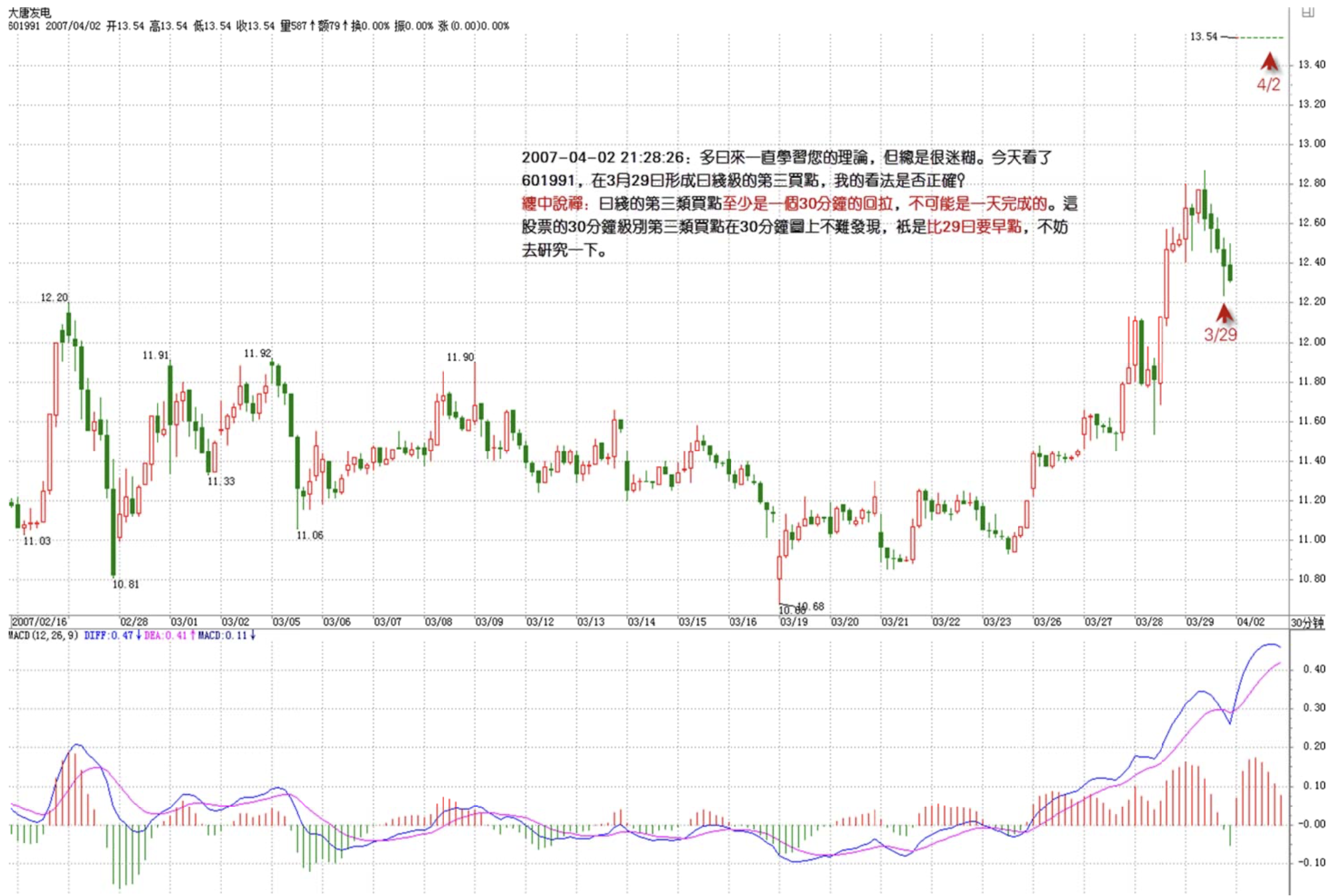
I've been studying the host's theory for many days, but always feel confused. Today looking at 601991, on March 29th it formed a daily-level third buy point. Is my view correct? Please critique, fellow experts.
==
A daily-level third buy point requires at least a 30-minute pullback and cannot be completed in one day. This stock's 30-minute level third buy point isn't hard to find on the 30-minute chart—just a bit earlier than the 29th. You might want to study it.
缠中说禅 2007/4/2 21:44:56
[Anonymous] 剑十三
2007-04-02 21:35:27
Master Chan:
Today Jim Rogers said he'll start selling stocks at 6000 points. What do you think?
==
Discussing what to do at 6000 points before 6000 is even reached is a pointless question.
缠中说禅 2007/4/2 21:47:44
[Anonymous] 乐土
2007-04-02 21:42:40
Master Chan, greetings!
It's almost midnight, so asking quickly :)
- On Shanghai's 15-minute K-line chart, if tomorrow morning breaks through the previous high of 3272.41, the probability of a top divergence is very high. Does this mean tomorrow will be another exciting day?
- How do you view low-P/E electric power and coal sectors? The pharmaceutical sector seems to have been weaker than the broader market these past few days?
Thank you!
==
It would be abnormal if the market rallied one-directionally without oscillating. Sectors rotate—when too many people are bullish on certain sectors, they naturally can't be pulled up. When everyone's in the sedan chair, who's carrying it?
缠中说禅 2007/4/2 21:53:32
Star
2007-04-02 21:44:33
As long as there's consolidation divergence, sell when i+2 is even, buy when odd. If there isn't, when i is even and Ai+3 doesn't break below Ai's high, continue holding until Ai+k+3 breaks below Ai+k's high, then sell at Ai+k+4 which doesn't make a new high or has consolidation top divergence, where k is even.
================================================
A few points I don't understand, please explain:
-
If there's no consolidation divergence, when i is even and Ai+3 breaks below Ai's high, should I exit? Should I exit as soon as it breaks?
==
Unless there's a small-level-becomes-large-level a+B' situation, breaking below and consolidation divergence are the same thing. -
When i is even, if I buy at Ai's low, and Ai+3 doesn't break Ai's high, continue holding until Ai+k+3 breaks Ai+k's high, then sell at Ai+k+4 which doesn't make new high or has consolidation top divergence, where k is even. But is it possible that Ai+k+3 directly breaks below Ai's low, causing a loss?
==
This question is the same as the above.
缠中说禅 2007/4/2 21:54:21
Snow Wolf
2007-04-02 21:53:23
Teacher,
I really want to listen to your music.
But it's too slow and I can never listen to it.
Can you provide downloads?
==
It's available in the music podcast. Please check the friendly links.
缠中说禅 2007/4/2 21:55:57
[Anonymous] touchnet
2007-04-02 21:53:30
[Anonymous] touchnet
2007-04-02 21:49:04
Boss, in same-level decomposition, for "consolidation + consolidation + consolidation + ---," according to the associative law, they should be combinable in any way, right?
So how many segments can each consolidation in this have at most? 5? 8?
----
Sorry, the combinations and segments above refer to the sub-level.
==
In same-level decomposition, hub extension within consolidation is not allowed, so it's 3 sub-level segments. There's no question of being arbitrary.
缠中说禅 2007/4/2 21:57:50
[Anonymous] 绝对黑色
2007-04-02 21:53:21
Also want to ask the host: regarding "A's level must be larger than B's level"—does this mean A's hub range contains B's hub range, such that B oscillates around A and can be viewed as consolidation? Not sure if this understanding is correct.
==
Not necessarily. A and B can have absolutely no overlap whatsoever.
缠中说禅 2007/4/2 22:01:26
[Anonymous] 禅迷胡
2007-04-02 21:50:14
Sister Chan, when would you abandon a stock you've been continuously trading?
==
Actually, you can keep playing a single stock until it grows old and faded. Generally speaking, when a super-large-level sell point appears—for example at the quarterly or even monthly chart level—it's basically announcing the stock has been drained to exhaustion.
缠中说禅 2007/4/2 22:07:12
Wei Wei Guo Er
2007-04-02 21:59:11
May I discuss life development with you, Sister Chan? I went to a decent university but studied a terrible major—tourism management. Worked two years after graduating, at a bank doing grassroots work, quit last year, then lost my direction and still don't know what to do.
Don't want to work, but first I'm afraid of worrying my parents, and second I haven't found a way to survive independently. Sometimes I think I'd have been better off not going to university—then I wouldn't have so many constraints now.
How does Sister Chan view career development?
==
If you constrain yourself purely for survival, then the world is already a tomb—doesn't matter where you are or what you do. If that's not the case, then every day is a good day, every moment blooms with flowers—why would you distinguish between heaven and hell?
Choosing which stock actually doesn't matter—the key is choosing the right buy point. Understanding the way of stocks and the way of work are actually the same principle. Wait for your buy point or your stock-switching opportunity—don't sell a stock at a buy point to swap for one at a sell point. A person can operate a single stock to extract maximum profit—the key is the rhythm of buy and sell points, not the stock itself.
You trade the stock—not the stock trading you. Work is the same. Life is the same.
缠中说禅 2007/4/2 22:08:50
[Anonymous] 绝对黑色
2007-04-02 22:02:24
[Anonymous] 绝对黑色
2007-04-02 21:53:21
Also want to ask the host: regarding "A's level must be larger than B's level"—does this mean A's hub range contains B's hub range, such that B oscillates around A and can be viewed as consolidation? Not sure if this understanding is correct.
==
Not necessarily. A and B can have absolutely no overlap whatsoever.
==
Then how do you determine its level is larger? Confused here. Larger hub range? Larger extension?
==
Please first understand the recursive definition clearly. Level has no necessary relationship with range size.
缠中说禅 2007/4/2 22:14:02
[Anonymous] 酒吧心情
2007-04-02 21:26:53
Sister Chan,
Currently the situation is that many stocks are in an "uptrend + consolidation" pattern.
So judging consolidation divergence strength is very important.
Could Sister Chan emphasize the key points again?
For the current general trend of stocks, how can we accurately grasp the strength of divergence, especially consolidation divergence? How can it transform into a trend, or a counter-trend?
==
This question contains many conceptual misunderstandings. Strength is a real-time concept. Divergence and consolidation divergence only mean a reversal. As for strength, it's related to the distribution of the hub planetary system and real-time buying/selling force—it's a present-moment concept. Of course, there are many auxiliary tools to estimate strength, but that's too complex—there will be dedicated lessons in the future.
缠中说禅 2007/4/2 22:16:22
[Anonymous] 九头鸟
2007-04-02 22:14:02
"Before a trend hub is complete, its oscillation touches a certain instantaneous fluctuation range of the previous trend hub or extension, thereby producing a larger-level trend hub."
Sister Chan, does this sentence mean that only when the first three segments of the second hub overlap with any segment of the first hub is it hub expansion? If the overlap occurs after the first three segments of the second hub, it doesn't count?
==
The concept is problematic. A hub's completion is related to the third-type buy/sell point. If a hub extends, it proves it's not complete.
缠中说禅 2007/4/2 22:18:01
Sorry, it's too late. Tomorrow I still need to wait and see what new tricks the traitor has. This ID mustn't stay up too late.
Signing off, goodbye.
缠中说禅 2007/4/2 15:14:44
As said before, if you can't understand the Shanghai index, look at Shenzhen's. Shenzhen's movement today shows only one thing: quality second-tier stocks continue gaining broader recognition. The Shenzhen Component Index is basically all quality second-tier stocks. Actually, today's closing result was forged through fierce battle. This morning, Traitor Zeng deployed his usual trick of pumping financial stocks, but it was disrupted and had no effect, which then led to the overall strengthening of second-tier stocks.
On individual stocks, look at the stocks that hit the daily limit in Shanghai and Shenzhen today—basically all second-tier stocks and third-tier stocks with genuine themes. In Shanghai especially, many are around 10 yuan, which tells you that the stocks that can truly generate profits going forward are still those this ID explicitly identified some time ago. I won't go into specifics—under the current regulatory storm, saying less won't be wrong.
If you can't pick stocks, just look at the CSI 300 or Shenzhen Component stocks—those stocks. Of course, financial stocks and ultra-large caps will also have their moments, but these stocks are mainly about fighting. If your capital is large enough, including some in a portfolio is fine too.
The current trend is definitely "advance two, retreat one" or even "advance three, retreat two," so grasping the rhythm is very important. Quick rallies only benefit the traitors. If you really can't see clearly, just watch the 5-day moving average. Look at all the turmoil during this period—it actually never broke below the 5-day line. Nothing to worry about watching that.