Detailed Explanation of The Analects: For All Those Who Misinterpret Confucius (42)
2006/12/19 11:55:41
The Master said: There probably exist those who create without knowledge—I am not like that. Hear much, select the good and follow it; see much and discern—these are but temporary lodgings of wisdom.
Yang Bojun: Confucius said: "There are probably those who create without knowledge. I have no such fault. Hear much, select what is good and adopt it; see much and remember it all — this is second only to 'being born knowing.'" Qian Mu: The Master said: "There are probably those who act without knowledge. I have no such thing as that. Hear much and select the good to follow; see much and remember — this is the second tier of knowing." Li Zehou: Confucius said: "There are those who are ignorant yet fabricate — I don't do this. Hear much, select the good and follow it; see much and remember — this is the order and process of knowing."
Detailed Explanation: This chapter follows from the preceding chapters. The difficulty lies in the character "次." The interpretations above and the conventional ones are all wrong. "次" originally means to temporarily camp and lodge. In ancient times, when an army stopped at a place for three or more nights, it was called "次." "知之次" — directly interpreted, means the temporary encampment and lodging of wisdom. Here, the pursuit of wisdom is likened to a military march, and "多闻,择其善者而从之;多见而识之" (hearing much, selecting the good to follow; seeing much and discerning) are like temporary camps and lodgings along the march — but none of them are the ultimate destination of wisdom. The ultimate destination of wisdom in reality is only one: to transform "people not knowing" into "people not resenting." This is true from the level of social development, and equally true from the level of personal cultivation. A person who "does not know" cannot possibly "not resent." Even for the individual, "not resenting" is a very high state of life.
But wisdom is like a raft for crossing a river — without wisdom one cannot proceed, but clinging to wisdom as something possessed or relied upon won't do either. And a truly wise person would not cling to wisdom as something possessed or relied upon, and even less would they treat the surface of wisdom — what's usually called "knowledge" — as something to be possessed or relied upon. However, in both history and reality, there exists a species called "pedantic Confucians" — now more commonly called "intellectuals" — who gnaw on the corpses of predecessors, thinking that having chewed through a few books like bookworms, they now possess wisdom, and even thinking they can lord it over others because of it. That's even more laughable and pitiable.
"盖有不知而作之者" — "盖有" means "there probably exists." This is the same attitude as Confucius's approach to "生而知之者" (those born knowing) — not absolutely denying its existence. "不知而作之者" means a person who, without wisdom, achieves things through their lack of wisdom. Confucius says that such people probably exist, but do they actually? In reality, the possibility of this is so small it can be virtually ignored. Someone might counter: well, what about Wei Xiaobao (a fictional rogue)? From the intellectuals' or pedantic Confucians' perspective, Wei Xiaobao would of course only be a rogue — how could he have wisdom? But from another angle, was Wei Xiaobao ever truly without wisdom? In reality, those who accomplish anything, if you look without bias, which one doesn't have a bit of street smarts? Certainly, one can say cleverness doesn't equal wisdom, but if one can't even manage cleverness, then wisdom is out of the question. "Great wisdom appears foolish" describes the surface appearance, not the inner mind, and it certainly doesn't mean the more foolish one appears, the wiser one is. The so-called righteous gentlemen love to say those are all heterodox paths, but plenty of people walk heterodox paths — why are only a few successful? Without "knowing," you can't even do heterodox paths well. And without "knowing," the so-called righteous path cannot defeat the heterodox either. Using the pallid reassurance that "justice must prevail over evil" to bolster one's own courage or to con others into sacrificing themselves is useless. Historical experience has repeatedly proven that many former heterodox paths eventually became broad boulevards, and all so-called righteous paths have their own heterodox histories. What explanation can the righteous gentlemen offer for this?
"我无是也" — Confucius says he himself is not like that, not the kind of "不知而作之者." Then what is he like? "多闻,择其善者而从之;多见而识之" — this is the same as the "好 (appreciate), 敏 (verify), 求 (select)" discussed above. "多闻, 多见" (hearing much, seeing much) encompasses "好" and "敏." Without "好" (appreciation), one cannot achieve "多" (abundance), and "闻" (hearing) and "见" (seeing) both involve verification — they are inseparable from "敏." "择" (selecting) and "识" (discerning) represent "求" (selection). The result of discerning and selecting must lead to "从之" (following it) — adopting a certain method or principle based on the selection. True "从之" means analyzing and solving problems from the logic of reality, ultimately realizing the transformation and revolution of reality and its logical relationships. It must be emphasized that "善者" (the good) should not be understood from a moralistic perspective. A "善者" is not necessarily a "good person," and a "good person" is not necessarily a "善者." What is a "善者"? Anyone who surpasses oneself in any aspect of insight or ability is a "善者." From this perspective, everyone in the world is a "善者." But no one is omnipotent, no one is the so-called God — everyone has their "不善" (not-good) aspects. Therefore, one should follow insights rather than the person — this is "从之," which means "following the good path of the good."
The previous chapter said "学而知之" (learning and then knowing), and "多闻" is the most important prerequisite for "learning." Without "多闻," one can only be a frog viewing the sky from a well. But more importantly, society must provide an environment that enables "多闻." If the whole of society has only one viewpoint, one thought system, how can there be "多闻"? The diversification of viewpoints and thoughts, rather than making people feel adrift, is actually the most basic starting point for people to ultimately attain wisdom. Note: the pluralization of viewpoints and thoughts does not necessarily mean the conditions for "多闻" exist. For example, in capitalist society, behind all viewpoints and thoughts there is an invisible hand controlling things. Any discourse that goes against capital can hardly be amplified through channels entirely controlled by capital. This kind of so-called pluralism is in fact just the emperor's new clothes. In a "people not knowing" society, one of the most fundamental issues is the "insufficiency of hearing." To change a "people not knowing" society, one must start from "多闻" — not only "not being attached to" all visible controls on "多闻," but also "not being attached to" all invisible controls on "多闻." Otherwise, in a society controlled by capital and the market, all "多闻" is nothing but a sham.
With "多闻," there is the possibility of "择其善者而从之" (selecting the good and following it). And only through this can there be "多见" (much seeing). "见" (seeing) is not superficial hearsay but insight formed through one's own thinking, comparison, research, and practice. A clamorous era may be one of "多闻," but it is unlikely to be one of "多见," because the so-called "见" (views) are all parroting others, all plagiarized here and there. A society or era that is "not much seeing" has no creativity and even less possibility of escaping "not knowing." Having views does not equal having insight. Only when one's views penetrate deeply can there be true "识" (discernment). Otherwise, it's just the blind men describing an elephant — sheer nonsense.
And having developed one's own insight, further deepening it through "多" (abundance), only after one's insight becomes profound can one "识" (discern). The "识" here doesn't refer merely to one's personal insight — that is just the book kind, the static kind. True "识" requires going out, confronting real tests, and more importantly, engaging in real debate and correction. Only through being tempered in "engagement with the world" can one develop true "识." Otherwise, the so-called insights of pedantic Confucians and intellectuals are all good-looking but useless playthings — no matter how much they accumulate, they remain blind despite open eyes.
Chán Zhōng Shuō Chán's Vernacular Translation
The Master said: There probably exist those who create without knowledge—I am not like that. Hear much, select the good and follow it; see much and discern—these are but temporary lodgings of wisdom.
Confucius said: There probably exist people who achieve things without wisdom by relying on their absence of wisdom — I am not like that. In a society where every person can freely hear and see, one should expand one's range of hearing and seeing as much as possible, select insights that surpass one's own, and follow the insight rather than the person or group who holds the insight, investigating and studying in depth and absorbing the learning. Then let one's own insight gradually deepen, so that one can more clearly discern and debate the authenticity and depth of various kinds of knowledge. But all of these are merely temporary resting places for wisdom — not where wisdom truly resides.
(To be continued)
Plagiarism is strictly prohibited; violators will be prosecuted.
Replies
缠中说禅 2006/12/19 12:12:29
Please think carefully about those homework problems. You must approach them from the concept of the Chán Zhōng Shuō Chán hub, because once you have the concept of the hub, consolidation and trends are both encompassed within it — the hub is a more fundamental concept than consolidation or trends.
The market movement has nothing special today. It's still using the old tricks — whenever the two markets diverge there will be fluctuations, and Shenzhen's movement is clearer. All of this has been repeatedly discussed before — you can continue to apply it flexibly in the future.
Also, there's the gap issue. Once a gap is left below, it tests the short term. Not filling it is of course bullish, but the test is inevitable. Like Shanghai yesterday and today with consecutive gaps — fluctuations are only natural.
The market's movement for this month has basically followed the advice this ID gave earlier. The only thing that was slightly uncooperative is that Shanghai made new highs before Shenzhen. Currently it's the momentum following the breakout. Once this momentum is exhausted, there must be a confirmation process of retesting the previous historical highs — this constitutes the biggest short-term pressure.
For the medium to long term, there's nothing to discuss. The first phase of the bull market hasn't even ended yet — there's nothing to talk about for the medium to long term. As for someone asking what a component stock is — this ID truly doesn't know how to answer. This ID doesn't like children and isn't well-suited for kindergarten teaching. So for similar questions, everyone please help each other out.
缠中说禅 2006/12/19 12:21:20
Regarding the fourth homework problem, let me rephrase it. For Beichen, this ID once said there would be a strong pullback. A couple of days ago, people were still questioning why this ID's predicted pullback hadn't materialized. I wonder if the pullback of the past two days counts as "strong." Whether it's strong or not aside, the key is for everyone to learn.
Use the logical relationship of "all movements must complete" to explain the inevitability of Beichen's movement these past two days at the corresponding movement level.
Note: this is purely for study purposes — no one is telling you to chase high now. Actually, if you truly understand, you don't need to consult this ID for these opportunities — you can grasp them yourself.
缠中说禅 2006/12/19 12:23:12
[Anonymous] 学习
2006-12-19 12:02:26
Attempting to answer: How are consolidation highs and lows formed?
Based on the definition of consolidation:
Consolidation high: After divergence in the decline among three consecutive sub-level movements of the lowest order, the completion of the first upward movement is the high point.
The low point is the reverse.
Please correct.
========
What does "completion" mean? Don't use vague concepts to think about problems. Classification must be clear, logic must be precise, and the system must be coherent.
Hint: approach it from the Chán Zhōng Shuō Chán hub.
缠中说禅 2006/12/19 12:35:38
[Anonymous] 戈石
==
Your entry point for thinking is correct — you do need to start from the Chán Zhōng Shuō Chán hub. But for each question, you haven't thought through the special cases. A particular kind of special case is often the biggest enemy in actual trading. Whether you can think through all the special cases is very critical.
Please continue working hard. Challenge yourself with more difficult scenarios. Think through all the special cases that your current answers don't cover.
缠中说禅 2006/12/19 12:36:10
[Anonymous] 大洋
2006-12-19 12:25:05
Greetings to Sister Chan
=
Good
缠中说禅 2006/12/19 12:45:36
[Anonymous] 快
2006-12-19 12:36:33
LZ, will the market exhibit a pattern similar to July/August this year again?
=====
Of course it will — it's just a matter of how long. The last major one was platform-type. This time, it's more likely to be zigzag-type. The possibility of forming a triangle is not zero, but it's smaller. However, for a real correction to appear, the momentum generated by this breakout above the historical high must be exhausted first. Because of the year-end factor of funds window-dressing their performance, and since funds' performance now has a huge relationship with new capital raising — it's become a marketing tool — the market's impact from this cannot be underestimated.
缠中说禅 2006/12/19 12:46:40
[Anonymous] nn
2006-12-19 12:39:42
Checking in first, will study carefully. Thanks!
May I ask the host: could the I Ching be interpreted alongside The Analects in alternation? Stocks can take a back seat. I'm really looking forward to your I Ching lectures.
=====
Whoever truly understands The Analects will naturally understand the I Ching.
缠中说禅 2006/12/19 12:48:27
[Anonymous] 小溪
2006-12-19 12:40:20
Hello Sister Chan! Thank you for your hard work! My 600196 has 5 overlaps already — what's that called? Is that still a single hub?
========
What does "at least" mean? If something stays in the same range for ten thousand years, it's still one hub.
缠中说禅 2006/12/19 12:49:18
[Anonymous] 快
2006-12-19 12:44:25
Seems like I shouldn't have asked!
Also
CCTV Channel 2's "The Rise of Great Powers" — what does Numbers Lady think?
===
An occasion-driven production.
缠中说禅 2006/12/19 12:51:37
[Anonymous] Heart Zen
2006-12-19 12:49:05
"Master Chan," good afternoon
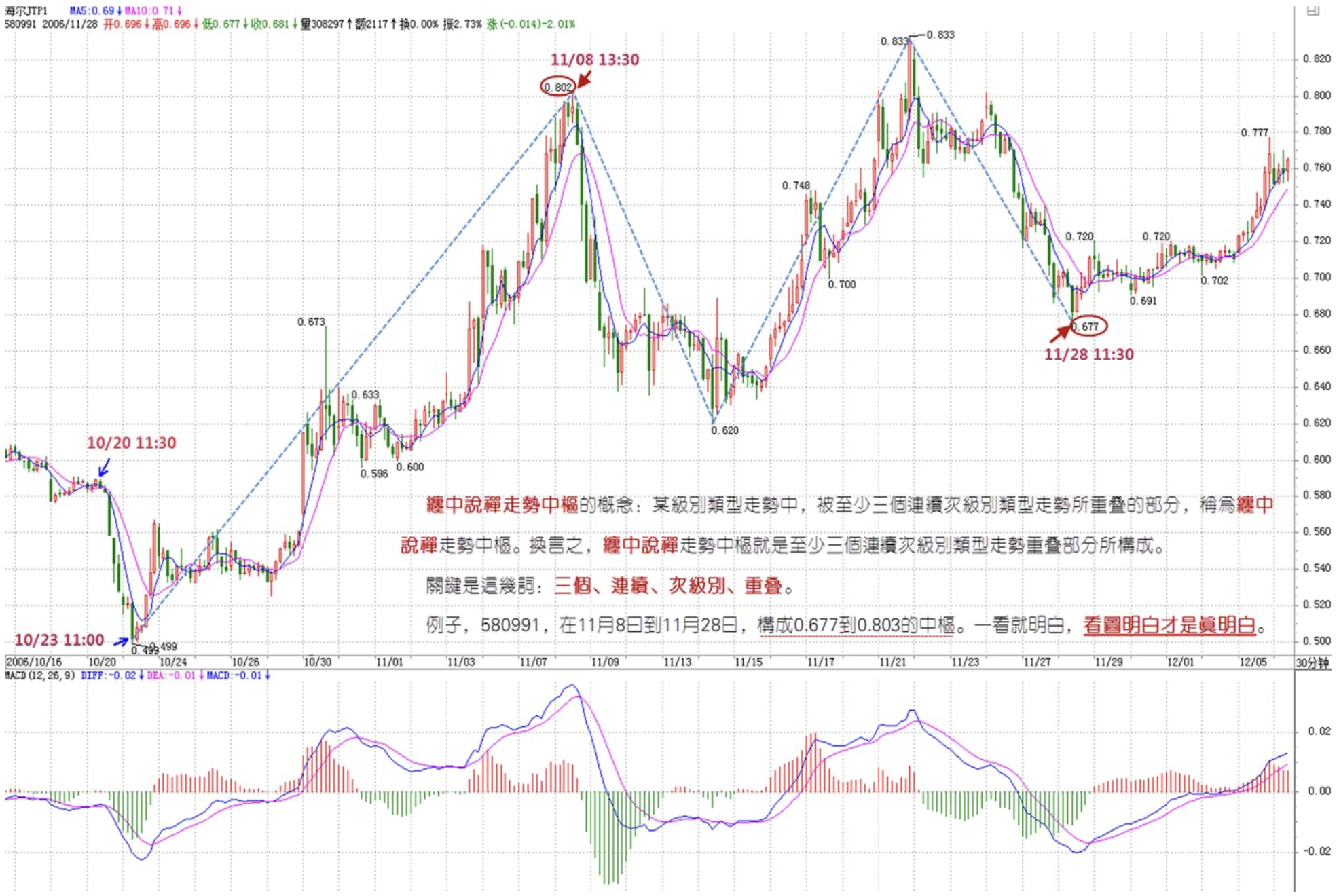
Last night I repeatedly studied your repeated statement: "The portion overlapped by at least three consecutive sub-level movement types is called the Chán Zhōng Shuō Chán movement hub." I finally found and understood the hub formed by the 0.607-0.803 overlap — it's the overlap of the line segment between the highest and lowest points of the downtrend + uptrend + downtrend, correct?
One hub followed by movement is "consolidation." Two upward hubs followed by movement is "rising." Two downward hubs followed by movement is "falling," correct?
But I still can't clearly distinguish between "upward hub" and "downward hub"!
Please correct!!
==
Good that you understand. But "one hub followed by movement is consolidation" is wrong. First discard the deterministic way of thinking.
缠中说禅 2006/12/19 12:53:31
[Anonymous] 中间体
2006-12-19 12:51:04
Sister Chan.
The movement hub occurs at the sub-level. Then must the first segment's movement that counts toward it necessarily be opposite to the main level??
===========
Why would it necessarily be opposite? What if it's within a consolidation?
缠中说禅 2006/12/19 12:57:05
yahwang
2006-12-19 12:52:31
I asked a question a few days ago that the host may not have seen. Now let me ask another. Half-position operation, consistently doing intraday spreads — is this feasible? From what you know, for market makers, what proportion of final profits does the intraday spread income constitute?
======
It's possible for those with smaller capital. The longer the consolidation period, the lower the cost. Consolidation is for lowering your own cost and raising others' costs.
When there's time, I'll teach everyone how to be a market maker.
Market opening, signing off first.
缠中说禅 2006/12/19 15:02:08
Have to leave early. For questions, leave them tonight — I'll address them in the evening.
See you.
缠中说禅 2006/12/19 21:24:03
[Anonymous] 想飞
2006-12-19 15:09:25
LZ, good afternoon!
A question: on the Shanghai Composite weekly chart, since bottoming on 2005/6/10, is the first movement hub 10771213, the second movement hub 15201747, and up to now an upward trend? Is this correct?
I'm uncertain about the second hub judgment. It feels like consolidation too, because it looks very similar to 580991's (daily) movement. But since that segment on the daily chart is consolidation, I judged that the same segment on the weekly chart should be a segment of the original trend. Not sure if this reasoning is correct?
=======
After the weekly chart bottomed, it hasn't even formed a single hub yet, because there hasn't been a typical overlap of three consecutive daily-level movement types. Those are all daily-level hubs.
What does this mean? It means that on the weekly level, we are currently only in the first segment of a large movement type. This is consistent with this ID's consistent judgment that we're still in the first wave of the bull market.
缠中说禅 2006/12/19 21:25:45
[Anonymous] 缠禅
2006-12-19 20:57:02
Chan mm, what's the difference between "movement," "movement type," and "trend"? I don't quite understand these two concepts!
=========
This should be very clear. There are three movement types: rising, falling, and consolidation. Rising and falling together are called "trend."
缠中说禅 2006/12/19 21:27:49
[Anonymous] 南海明镜
2006-12-19 17:04:48
"In a certain level's movement type, the portion overlapped by at least three consecutive sub-level movement types is called the Chán Zhōng Shuō Chán movement hub."
May I ask, Chan mm: is it "in a certain level, within a movement type" or "a certain level-type, within a movement"?
=========
"In a certain level, within a movement type." This ID had a bit of a typo — "movement type" should be written as "trend type."
缠中说禅 2006/12/19 21:31:56
[Anonymous] 中间体
2006-12-19 16:30:15
---------------
And a similar chart pattern does not apply to 580991. The sole reason is that the latter, within the daily decline, does not constitute a daily-level Chán Zhōng Shuō Chán movement hub. On the 30-minute chart, however, this hub is clearly present. So 580991 only constitutes a "decline + consolidation + decline" at the 30-minute level.
==================================
From 2006.7.14 to 7.28, there's one movement hub, but no second one. Doesn't this contradict "all movements must complete"???
=======
Who told you a movement hub must always have two? How many does consolidation have?
缠中说禅 2006/12/19 21:34:06
[Anonymous] 管他是谁
2006-12-19 19:19:49
I wonder when the master will lecture on Eastern and Western painting and sculpture arts — for example, Eastern temple murals versus Western church murals, Wei-Jin era sculpture versus European medieval carving, and the history of Eastern versus Western art development? Looking at the categories, there seems to be a gap.
==========
Let's first settle this endless debt about stocks.
缠中说禅 2006/12/19 21:43:03
[Anonymous] 在路上
2006-12-19 21:33:25
Is Sister Chan still out feasting? We've been waiting anxiously...
The Chán Zhōng Shuō Chán theorems are fairly clear. There's just one point that keeps us plunged in endless confusion: the distinction between trends and consolidation. Once these two concepts are completely clear, the rest — levels, divergence, etc. — follows naturally. We're just that one step short...
Sister Chan said on the 580991 daily chart, from June 2 to October 23, it doesn't form a complete decline+consolidation+decline. Only on the 30-minute chart does it. Then she said November 8 to November 28 is the overlap of three consecutive sub-level movement types, constituting a Chán Zhōng Shuō Chán movement hub — I understand that. But then the question is: what trend is October 23 to November 8? What's its relationship to this hub? And what trend is November 28 to today? Is it because there's only one hub that the entire movement from October 23 to today counts as consolidation? If the price keeps rising after tomorrow and forms a second hub, where does that second hub start? From November 28? Why doesn't October 23 to November 8 count as one of the three consecutive sub-level movements?
Can someone who knows please tell me? At Sister Chan's place, you really need wisdom. There's no standard chart for reference, no chart marking every point so we can understand them, and then understand the whole — even just one would help. Unfortunately, every stock example has aspects the questioner doesn't understand...
========
Your problem is that you're confusing "decline+consolidation+decline" with "a decline."
580991, from IPO to October 23, constitutes "a decline" on the daily chart. What follows is an uncompleted movement type that has temporarily formed only one hub.
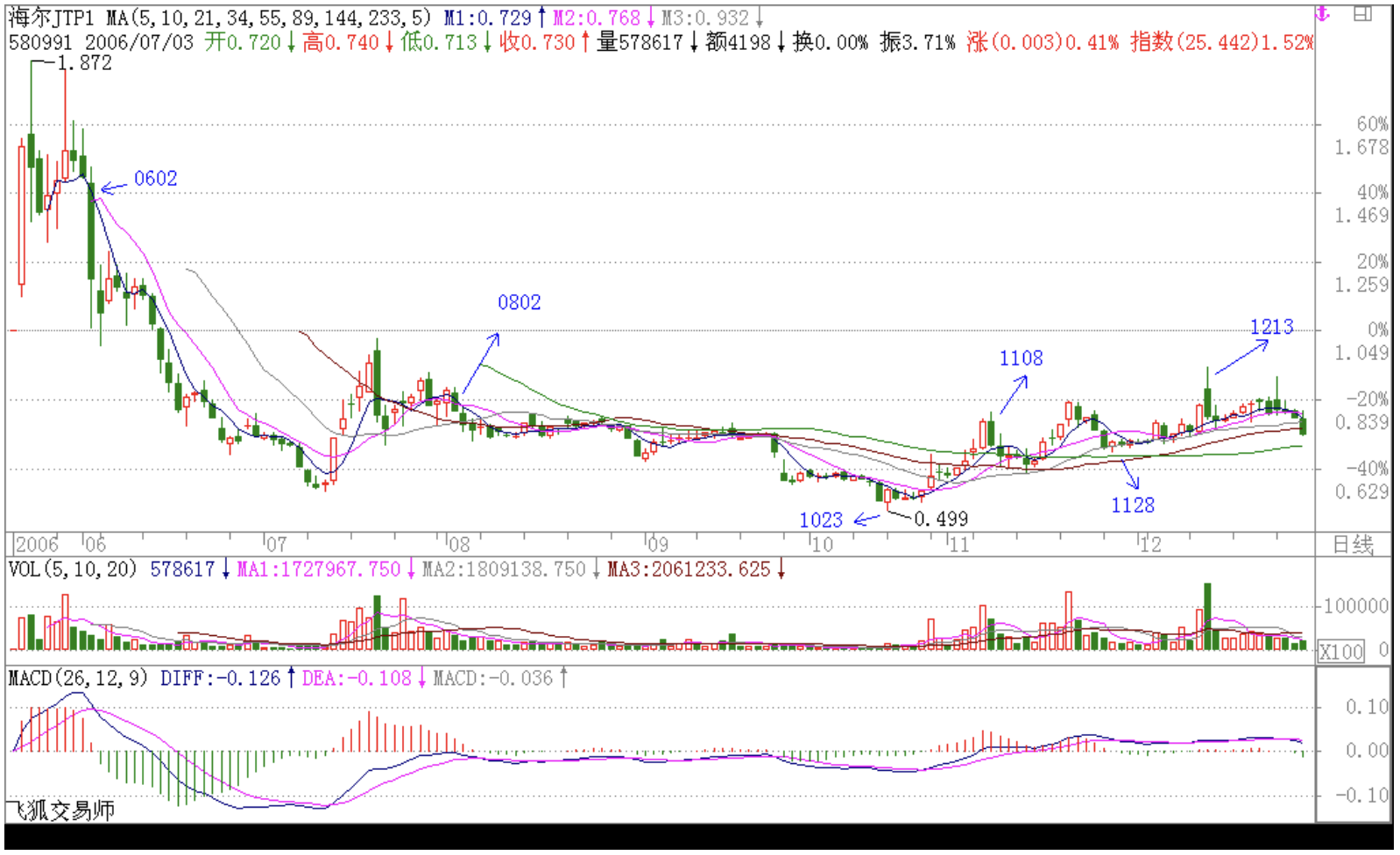
On the 30-minute chart, from June 2 to October 23, it's a typical "decline+consolidation+decline" — three completed movement types connected together. Understand the difference between these two well — only then will you have some real understanding.
缠中说禅 2006/12/19 21:43:41
[Anonymous] 炼铁设备
2006-12-19 21:39:12
Chán Zhōng Shuō Chán movement hub
============
Is it the same as a medium-term trend?
=======
Completely unrelated.
缠中说禅 2006/12/19 22:07:50
[Anonymous] 勇敢的心
2006-12-19 21:53:57
May I ask, teacher: for the sub-level movement types of the daily chart, does it refer to 60-minute or 30-minute movements?
======
Generally, 30-minute is used.
缠中说禅 2006/12/19 22:09:38
[Anonymous] 在路上
2006-12-19 22:05:03
May I ask Sister Chan: on the 30-minute chart of 580991, for the "decline+consolidation+decline" from June 2 to October 23, does the second decline start from the high point before the September 1, 10:00 low point?
===
No, August 2.
缠中说禅 2006/12/19 22:15:21
[Anonymous] 想飞
2006-12-19 22:04:43
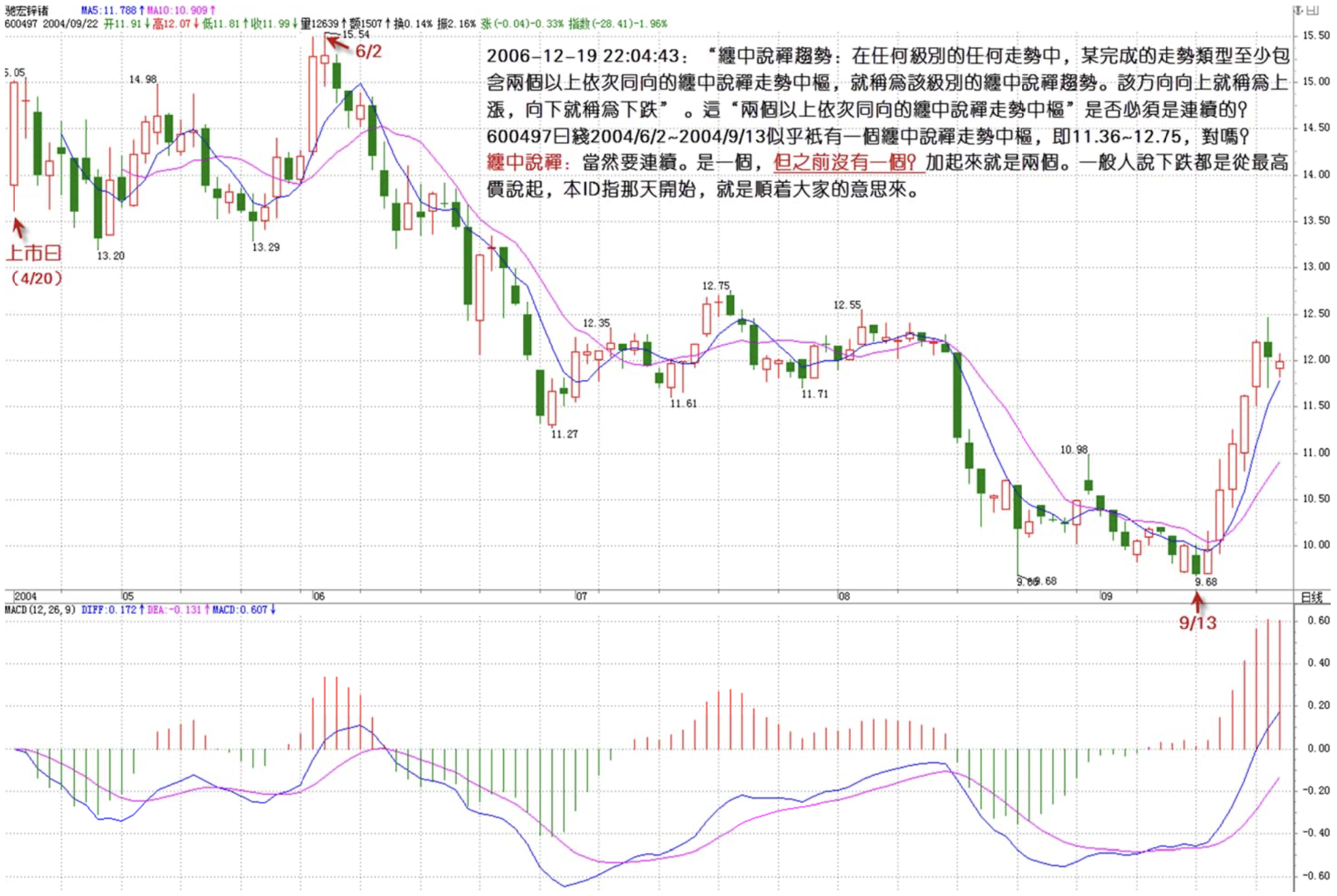
"Chán Zhōng Shuō Chán trend: in any movement at any level, if a completed movement type contains at least two sequentially co-directional Chán Zhōng Shuō Chán movement hubs, it is called a Chán Zhōng Shuō Chán trend at that level. If the direction is upward, it's called a rise; if downward, a decline."
LZ, must these "two or more sequentially co-directional Chán Zhōng Shuō Chán movement hubs" be consecutive?
On 600497's daily chart from 2004/6/2 to 2004/9/13, there seems to be only one Chán Zhōng Shuō Chán movement hub, namely 11.36~12.75. Is that correct?
=====
Of course they must be consecutive.
Yes, there's one, but wasn't there one before it? Add them together and that makes two. Most people talk about a decline starting from the highest price. This ID points to that date just following convention.
缠中说禅 2006/12/19 22:17:19
[Anonymous] 无言
2006-12-19 22:11:13
Sister Chan, I thought I understood, but the more I look the more confused I get. I'll skip this lesson. How can one predict the force and magnitude of a move when a buy/sell point appears? When will this lesson be taught? Could you give me a hint here so I can look at charts and develop my own understanding? Thanks!
===========
You don't even understand the basics — how can you judge force? Get the fundamentals clear first. If they're not clear, the more you study the more chaotic things become. Lesson 17 is written in completely standard mathematical textbook style — just short of pure mathematical symbols. Study it like learning geometry, and you'll learn it.
缠中说禅 2006/12/19 22:17:55
Signing off. See you in two days — check the announcement outside for the reason. See you.
缠中说禅 2006/12/19 11:59:51
Everyone, don't just ask about stocks. Questions about The Analects and other topics can all be discussed here. This ID doesn't like making everything one single color.