Teaching You to Trade Stocks 80: The Market Has No Sympathy, Doesn't Believe in Tears
2007/9/11 21:38:07
Today I should have discussed something else, but whenever the market drops, most people have no mood to read about other things, so let's talk about stocks again. And yet, when have stocks ever been just about stocks? If you treat stocks as merely stocks, then of course you'll be ensnared by stocks. Stocks have never been just stocks — they are your greed, anger, delusion, doubt, and arrogance. No failure is related to stocks; rather, it's only related to your greed, anger, delusion, doubt, and arrogance. Stocks are merely a front, a prop.
In the West, those who have truly achieved success in capital markets have basically all become philosophers. Without insight into the market, relying on this piece of news or that theme to hustle around, you'll forever oscillate within the retail investor's range. Having this vision doesn't guarantee reaching such heights — after all, having high aspirations but poor execution is a common ailment. But without this vision, it's absolutely impossible to reach such heights.
This ID sometimes likes to use provocative language. Why? It's like the Zen master's staff strike — it's meant to sting you, to provoke your greed, anger, delusion, doubt, and arrogance, so that one day you may awaken. Anyone hoping to find warmth, sympathy, or tears in the market can go home and make tofu — when has the market ever had any of that?
To succeed in the market, there is no other way than being even more formidable than the market itself. If a sell point appears and you're still fantasizing about Mars, then go back to Mars — Earth demands the decisiveness of a swift blade.
This time provides a perfect example. So let's see what mistakes all those who lacked this ferocity have made. Note: this isn't a criticism session but a serious dissection — regardless of how you actually operated, the dissection is necessary.
The market has no logic; this ID's theory gave the market its logic.
I. All tops must necessarily be top fractals.
This is one of the simplest conclusions from this ID's theory. What can be rigorously derived from this? That once a top fractal appears, leaving is the only choice. As for whether a stroke forms after the top fractal, that's something to judge after you've left. After a top fractal, there are only two possibilities: 1. A stroke forms — meaning a bottom fractal with non-shared K-lines between it and the top fractal is established. 2. No stroke forms — meaning any bottom fractal that forms shares K-lines with the top fractal.
But regardless of which scenario, there's sufficient space for your reaction. If it's the first scenario, the adjustment is large; if it's the second, the adjustment is small. This was explained yesterday with many examples in the lesson this ID specifically wrote. Why? Because this week, for the first time since 3,600 points, there's an extremely high probability of a top fractal appearing on the weekly chart — this isn't something being said only today.
So, knowing this so clearly, following the market's logic, just as yesterday's lesson repeatedly emphasized: "Note, when a top fractal appears, you sell on the surge of the day the top fractal forms, not at the close when the top fractal is already clearly established" — for weekly K-lines, this principle is exactly the same.
On the daily chart, the top fractal on September 7 was crystal clear beyond doubt.
II. The sell points in hub oscillations always appear during upward departures from the hub.
This is also one of the simplest conclusions in this ID's theory. So, in the recently formed 5-minute hub, any upward oscillation away from 5,333 points will ultimately form a sell point. Of course, if the pullback after that sell point doesn't return to 5,333 points, it might form a third-type buy point — but that's something after the sell point. Nothing can possibly be more important than the current sell point. Moreover, stock trading rules don't stipulate that once you sell, you can't buy again.
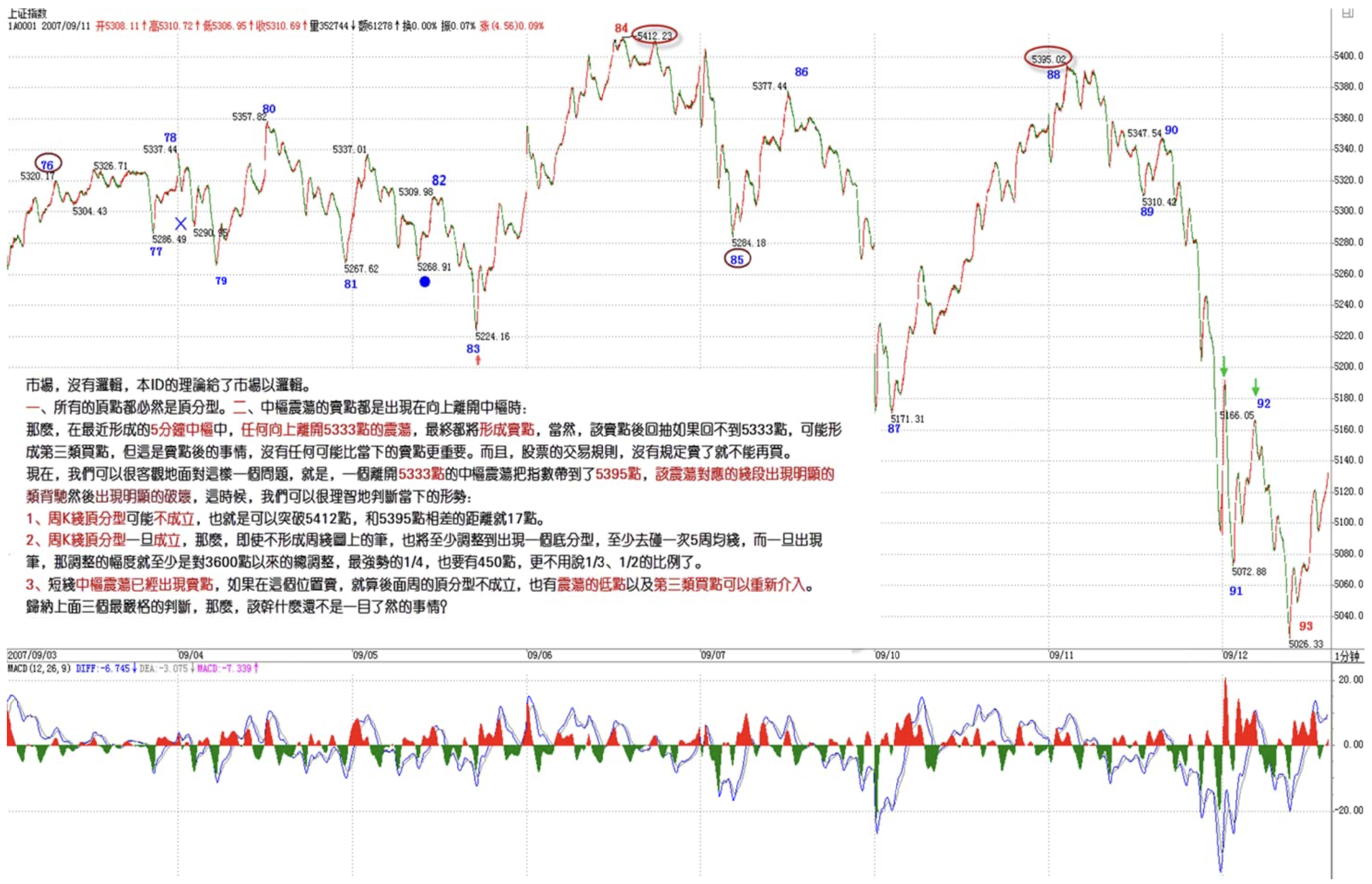
Now, we can very objectively face this question: an oscillation departing from the 5,333-point hub brought the index to 5,395 points, and the line segment corresponding to this oscillation showed obvious quasi-divergence followed by obvious destruction. At this point, we can very rationally assess the current situation:
-
The weekly K-line top fractal might not materialize — meaning a breakthrough above 5,412 points is possible, with only 17 points separating it from 5,395.
-
Once the weekly K-line top fractal is confirmed, even without forming a stroke on the weekly chart, there will be at least an adjustment to produce a bottom fractal, at minimum touching the 5-week moving average once. If a stroke does form, the adjustment magnitude would be at least 1/4 of the total adjustment since 3,600 points — that's 450 points — not to mention 1/3 or 1/2 proportions.
-
A short-term hub oscillation sell point has already appeared. If you sell at this position, even if the weekly top fractal doesn't materialize, there will be the oscillation's low point and a third-type buy point available for re-entry.
Summarizing these three most rigorous judgments — isn't it abundantly clear what should be done?
This ID specifically emphasized yesterday: at this point, you'd rather sell in error than buy in error. Why emphasize this? Because this ID knows that many people, blinded by their greed, anger, delusion, doubt, and arrogance, would rather gamble a few dozen points against several hundred points, gamble a 1% possibility against a 99% possibility. If 1% could yield 100 times the return, then of course no problem — but the reality is nothing like that. So why persist? In plain words, it's just five characters: greed, anger, delusion, doubt, and arrogance.
For retail investors, there's essentially no such thing as selling in error — only buying in error. Why? Selling in error doesn't lose you money; buying in error is a different story. After selling in error, you have cash, and with so many stocks available as your playthings, why hang yourself on one tree?
And in reality, as long as you're not swayed by your greed, anger, delusion, doubt, and arrogance, the issue of selling in error doesn't even exist. Many people sell when not even the embryonic form of a daily top fractal has appeared. Why? Nothing but greed, anger, delusion, doubt, and arrogance — they feel it's too high, feel panic, feel fear. Yet when the real top fractal appears, they assume it's false, that after a small adjustment it'll break through — suddenly it's not too high anymore, no more panic, no more fear. Human perversity is often precisely like this.
If you come to this ID's place truly wanting to turn over a new leaf, you must first master this ID's theory, then use it to operate, and through operations cultivate yourself into a steel warrior. What is the most basic standard for a steel warrior?
I. Buy points always form amid panicked declines — but once a buy point appears, you must buy without hesitation.
II. Rallies always unfold amid a tapestry of conflicting emotions — resist the interference of all emotions, hold your stocks with iron will, and absolutely do not get shaken off the train midway.
III. Sell points always form amid frenzied rallies — once a sell point appears, the blade falls swiftly. Let the stock go to hell.
IV. Any operational mistake is just one fall. Someone who can't get up after falling can never be a steel warrior. From mistakes, you must learn lessons — never make the same mistake twice.
V. Buying wrong is worse than selling wrong. Once you confirm you've bought wrong, you must act decisively — let the stock go to hell. If the market gives you one chance to correct your error (the second-type buy/sell point) and you don't seize it, go home and make tofu. If the market gives you a second chance to correct your error (the third-type buy/sell point) and you still don't seize it, go home and grind the walls.
VI. In the market, only you can help yourself. The one destroyed by the market is you; the one who conquers the market is also you. If you're more ferocious than the market, the market is yours. Otherwise, you're just the market's snack.
VII. Find the rhythm of the market, and you can wander freely through mountains of knives and seas of fire.
At this ID's place, the fewer people the better — grass three zhang deep is just fine. If you don't want to become a steel warrior, there's no need to come here and read anything about stocks. There are other things to read and other places to go — why come here and get upset?
If one day you become a steel warrior, you also needn't feel that this ID taught you anything. At this ID's place, nothing is conferred and nothing is received. This ID has not given a single teaching to anyone. You are simply you — once you become steel, you naturally become a warrior. It has nothing to do with this ID.
But before you become a steel warrior, it's best to have some self-awareness. This ID has repeatedly emphasized: if your technique isn't there, if you don't have the cultivation for decisive blade-falls, reduce your position first. So, many who didn't reduce, and don't have the cultivation for decisive execution — isn't that, once again, greed, anger, delusion, doubt, and arrogance?
Without reaching that level, without reaching the level where you can dance on the blade's edge, don't try anything risky — do things within your capability. One of the biggest problems in the market is using a chicken's knife to butcher cattle, using a duck's knife to slay dragons — and in the end, you get done in by the chickens and ducks.
Not every dollar of profit in the market is suitable for everyone to earn. When facing market opportunities, having less greed, anger, delusion, doubt, and arrogance, and recognizing your own capabilities — this is more important than anything.
The market is continuous — exiting at highs is not heaven, and staying at highs is not hell. A big drop is merely the foreplay for the big rebound that follows the next buy point. All of this cannot escape this ID's theory, and whether to participate depends on your operating level and your operating capability.
No one is born a winner, and no one is born a companion of failure. Everyone is a Buddha — there's no one to save, no one that needs saving. Everyone possesses a luminous pearl that illuminates mountains, rivers, and the great earth. Why torment yourself?