Teaching You to Trade Stocks 31: The Most Solid Foundation for Capital Management
2007/2/15 15:16:12
For small capital, capital management is not a particularly significant issue, but as profits accumulate and capital grows larger, capital management becomes the most important thing. Generally speaking, with good technique, growing from the ten-thousand level to the ten-million level is not difficult. But beyond ten million, very few people can sustain stable growth. All short-term traders, once their capital develops to a certain point, enter a stagnation state, and once a large-level adjustment comes, they get reset to square one. This ID has seen this happen too many times. Therefore, developing good capital management habits from the very beginning is extremely important. Investing is a lifelong game, and being reset to square one is a tragic thing. Good capital management is what ensures long-term stability of capital accumulation. In a sense, this is more important than any technique, and increasingly so. For large capital, what ultimately determines the competition is the level of capital management.
Capital must be free of pressure over the long term — this is the most important thing. Some people borrow money to invest, then after profiting, continue to increase leverage, and it all ends up being a fleeting dream. In 1996, this ID knew a friend from the Northeast who started with less than 100,000 yuan. At that time, high-ratio margin lending was available — 1:2 or 1:3 was normal, 1:10 was also common. The craziness of that era is beyond the imagination of people today. During the 1996 bull market, he quickly grew from less than 100,000 to over 20 million. By then, the margin ratio had dropped to about 1:1 plus. If he had paid off all the margin loans at that point, the tragedy that followed would never have happened. For him, the last three weeks of 1996 must have been the most devastating — the stock plunged from 12 yuan to below 6 yuan within three weeks. Some might ask, why didn't he close his position first? Veterans know that drop was a sudden reversal, crashing down like a waterfall. If you hadn't already exited, there was no chance to get out. When he finally could exit, because he was close to the margin call threshold, his positions were liquidated from just above 6 yuan all the way down — there was no way to refuse. The brokerage had to collect the money. In the end, after repaying the margin, he was left with less than 200,000 — truly a fleeting dream, back to the starting point. But that's not even the most dramatic part. The most devastating thing was that from the very day his position was fully liquidated until May 1997, in less than 5 months, the stock rose from below 6 yuan all the way to over 30 yuan, becoming the biggest dark horse. This was a Shenzhen local stock. It then gradually declined from over 30 yuan, reaching below 3 yuan in 2005. Its current price is around where his forced liquidation started — just over 6 yuan.
Pressure-free capital is the first essential of investing. Though mentioned repeatedly before, after telling the story above, it must be emphasized once more. Another important point is that you must never hand your capital over to someone else to manage. Your own portfolio must be your own responsibility — you cannot entrust your fate to others. Here's another story, going back 4 or 5 years to 1992. This friend had tens of millions in capital by 1992, which was quite considerable at that time. However, because of a family matter, he handed his portfolio over to a friend to manage — someone who later became quite famous. If I mentioned the name, market veterans would all recognize it. At the time, the market had already dropped significantly from over 1,400 points, and they thought the bottom had been reached. This fellow took it upon himself to go on margin to bottom-fish, but the market kept falling. By the time the friend returned two or three weeks later, everything had already turned to ashes. That time the market fell all the way below 400 points before bottoming, dropping over 1,000 points in half a year. Then from below 400, in less than 4 months it reached a new historical high of 1,558 — the market is just that cruel. When you entrust your fate to others, that's what happens.
You must never put yourself in a dangerous position. The mentality of "fighting with your back to the river" or "planting yourself in a deadly situation to find survival" is not an attitude that should be adopted in capital markets. Such an attitude may succeed temporarily but will inevitably fail in the end. The most important significance of technical analysis is that it lets you know what the market is actually doing, what should be done at what position in the market. It lets you know how to hold an established position, how to gradually transform a small-level holding into a large-level holding, and how to exit. All of this ultimately serves capital management. The ultimate goal of investing is not the stocks themselves, but the capital. Without recovering capital, nothing has meaning. Stocks are all just waste paper. Any carelessness with capital will cause irreparable losses. Everyone must understand clearly: no matter how large your capital is, it means nothing in the market. Moreover, capital is lost proportionally — one trillion and ten thousand, lost proportionally, reach zero at the same speed. No matter how large the capital, it can be annihilated in the blink of an eye. Therefore, always maintain the highest vigilance — this is the single most important point of capital management. Without this, all management is useless.
The simplest yet most effective management approach: before your cost reaches zero, work to make the cost zero; after the cost becomes zero, start earning more shares, until the stock reaches a major historical top — meaning at least a sell point appears on the monthly chart or above. One of the worst habits is continuously adding to positions as stocks keep rising — this will inevitably cause problems. When buying stocks, it's far better to keep buying as prices drop than to add on the way up. When committing capital to buy a stock, there must be careful, thorough preparation — just like an army going to war, how can you win without preparation? After thoroughly researching fundamentals, technicals, and other aspects, your entry should be decisive — buy in one shot. If you don't even have the confidence for a one-time purchase, it proves you haven't prepared at all, and you shouldn't buy a single share. After buying, if your technique is good, an immediate rise is perfectly normal. But if you don't have that level yet and it drops, unless it's proven that your reason for buying no longer holds and serious technical patterns have appeared, you shouldn't sell a single share. Moreover, you can use some reserve capital for short-term trades (note: for each stock purchased, keep some reserve capital, such as 1/10) to bring the cost down. But each short-term trade must not increase the number of shares — only then can the cost truly come down. Some people like to buy more and more, which is actually not a good habit. How much of this stock to buy and what proportion of total capital it should occupy should be researched from the beginning, and once invested, should not be increased.
After the stock starts rising, you must find opportunities to bring the stock's cost to zero. Besides continuously making short-term trades at smaller levels during the rise, you should also find a large-level sell point around the time the stock doubles and sell part of the position to reduce the cost to zero. This way, the originally invested capital is fully recovered. Someone might ask: what if this stock goes on to rise 10 times more? No problem. After the cost becomes zero, you start earning shares. That is, after each short-term trade where you sell at the top, you buy back the full amount, so your share count keeps growing while the cost remains zero. This way, even if the stock rises another 100 times, the more it rises the more shares you accumulate, while your cost is forever zero. This is the most terrifying kind of bloodsucking — no matter how the market maker or fund shakes out positions, your share count only grows while your cost stays at zero. Then, wait for an ultra-large-level sell point, dump everything at once, and destroy that market maker or fund. Just think — dumping zero-cost shares at a historic top is the most satisfying thing.
This is the overarching principle for managing each individual stock in your capital management. Following this principle, you can achieve not only the safest operations but also the greatest profits. Especially during the share-earning phase — generally, a stock spends more than half its time in consolidation. If a stock enters a large consolidation after rising, as long as the ultra-large-level sell point hasn't appeared, this consolidation will let you earn back not only all the shares you sold, but even more than you had at the bottom — possibly much more. Once the stock launches again, you'll own more shares than at the bottom, all at zero cost — this is truly the greatest dark horse and the greatest weapon. A reasonable holding structure is one where you accumulate more and more zero-cost shares, playing this game until the end of the large-level uptrend. For example, in this great bull market, you don't clear all positions until just before the bull market ends. Meanwhile, capital can continuously expand into more stock varieties, repeating this process endlessly. This way, operating capital doesn't increase — especially important for large capital, which won't be forced into becoming a market maker or having so much money that nobody dares to enter. This prevents increasing operational difficulty, while stock varieties keep growing, all at zero cost. This is how you build the most solid foundation for capital management.
Putting this in the main text so everyone can see clearly.
A word once spoken, even four horses cannot retract it. Since this ID promised everyone that China Unicom would reach 5 yuan and the market would hit 3,000 before the Spring Festival, it must be accomplished no matter what. Of course, this isn't something this ID can do alone, but in Beijing, what can't be accomplished? The center of China is Beijing, and Beijingers despise traitors the most. Since the traitors are stirring up trouble before 3,000 points, the red flag must be planted at 3,000 for the New Year. In China's century, where do traitors get to have their say?
A bloody battle, swift and satisfying vengeance — it's that simple. What should be seen, everyone has seen. What can't be seen doesn't need to be said. Of the 10-plus stocks this ID previously mentioned, except for some with excessive prior gains, they've all hit new highs. Of course, some rose faster and some slower, but the medium-term outlook is certainly fine for all.
However, this ID publicly announcing interception targets here has indeed greatly increased operational difficulty for this ID. There are certainly plenty of traitor spies here now. Currently, the stocks this ID mentions seem to move only when this ID acts — this isn't good. This ID isn't a market maker; carrying on like this is pointless. So the market makers inside should stop being so lazy. Though you're certainly this ID's juniors, your ages are probably older than this ID's. Respecting elders shouldn't be done this way — figure it out yourselves.
Speaking as a market veteran to teach these lazy people a lesson: the market requires reputation. Take a small loss, establish a golden reputation — what's wrong with that? Let me give an example of the smallest thing this ID did N years ago: pushed a stock from 14 yuan up to 25 yuan in just over two weeks, sold everything, also around Spring Festival, without spending a penny. How? Think about it yourselves.
Tomorrow, the traitors may still launch an attack, so everyone still needs to make an effort.
Replies
缠中说禅 2007/2/15 15:28:44
[Anonymous] Little Bird
2007-02-15 15:24:35
I remembered
Consolidation only forms one hub, so if I sold during a consolidation divergence at a certain level, does that mean I only need to wait for one hub to form during the decline before buying back?
==
Buy back after a sub-level divergence, but you must consider the larger level. Once there's a tendency of not being able to hold, don't buy back — wait for a breakdown first. The precise solution to this problem will come in future lessons.
缠中说禅 2007/2/15 15:29:43
[Anonymous] 满目山河
2007-02-15 15:24:56
Without spending a penny? Then did you make money? Haha.
Dear Chan sister, today's lesson is too important, thank you!
==
Of course selling the shares made money. It's just that the push up didn't cost any money.
缠中说禅 2007/2/15 15:34:46
[Anonymous] 如初见
2007-02-15 15:29:17
My heavy position stock 000533 resumed trading today. Neither the 5-min nor 30-min charts show sell points, but it's already up over 50%. I'm really scared. Can Chan JJ give some guidance? Otherwise, I have no confidence.
=
Generally, stocks resuming trading now will fluctuate for a few days then continue rising. If your technique is proficient, you can refer to the methods described in this lesson. Additionally, the most important question is: if you sell, can you find a better stock? If not, don't sell. Of course, short-term trading is fine — sell at the top, pick it back up at the bottom. This kind of activity can be done whenever there are short-term buy/sell points. Just control the amount for each trade. For instance, those particularly unpracticed can operate with 1/10, which is also a very good way to practice.
Technique is something you must train yourself.
缠中说禅 2007/2/15 15:40:33
[Anonymous] 外科医生
2007-02-15 15:31:59
Congratulations to Chan sister on another victorious battle.
I'm worried about you though. The target is too visible now.
Added to Unicom position at 5.03.
==
There's no need to buy Unicom now. The day this ID mentioned it, the very next day there was a buy point — why didn't you buy then?
Note, everyone can see the pressure on Unicom. Retail investors absolutely should not buy.
Retail investors absolutely should not buy Unicom, otherwise you bear the consequences yourself.
Unless you have a very medium-to-long-term mindset and can wait until the day China Mobile returns, there's fundamentally no need to buy Unicom.
缠中说禅 2007/2/15 15:44:46
[Anonymous] 无限
2007-02-15 15:34:07
Today I saw the Queen battling in Unicom, together with the efforts of the bulls in the broader market. Let me say — you've worked hard! Thank you for letting us have a happy New Year! Thanks to you, several of my stocks have also launched (I only bought the Queen's Thunis Holley, the others I selected myself).
Regarding Thunis Holley, I strongly protest this lazy market maker — truly moving one day, resting a week, atypical senile dementia. I had even harsher words but I'm too embarrassed to say more. I hope you'll seize the last opportunity before the holiday and establish a golden reputation! After the holiday there's still time for an upward push. Don't wait until everyone turns bearish to come out, getting cursed by everyone!
Another question — how will today's gap up in the market be filled?
Thank you Queen! Wishing you a happy New Year and all the best! And to all classmates — Happy New Year! Wishing prosperity, let's soar together in 2007!
Wuxian
==
Even if we break through 3,000, the pressure from oscillation is still significant. There will be plenty of opportunities to fill the gap during future oscillations. Tomorrow actually still has pressure, especially since this time the rally has squeezed quite a few shorts. Those people, even if they don't strike tomorrow, will strike after the New Year. There's currently no absolute certainty of destroying them, and of course they also have no certainty of succeeding. This is a major battle, and it's still hard to say who will win.
缠中说禅 2007/2/15 15:46:01
[Anonymous] 外科医生
2007-02-15 15:44:28
I bought Unicom at the buy point the day after you mentioned it.
Bought more today.
Thank you Chan sister for the guidance.
==
No need to buy — you must look at the technical chart. Without a buy point, don't buy.
缠中说禅 2007/2/15 15:48:31
Little Muddled Little Dance
2007-02-15 15:41:01
Blogger, I have another question: how exactly do you bring the cost to zero in actual operations? Will there be a lesson on this? It shouldn't be that you must wait for the stock to double and then sell half, right?
==
If you continuously make short-term trades during oscillations, generally you won't need to wait for a doubling before selling half brings your cost to zero. Actually, the timing of selling mainly depends on the 30-minute or daily sell points — when they appear, act. If the stock is in a continuous rally, even past a 100% gain there's no need to sell — wait for the sell point to appear. You need to be flexible about this.
缠中说禅 2007/2/15 15:51:55
[Anonymous] Night雨
2007-02-15 15:39:00
Teacher is impressive! Happy Spring Festival! Let me congratulate you in advance. 000999 showed another 5-minute buy point at 14:50 today. Classmates, pay attention! Teacher, does 600080 have a sell point today? I can't see clearly, but I sold anyway. Learning from your words — better to sell too early than too late, opportunities are plenty.
==
Do you think S-shares will have problems in the medium term? Isn't 999 an S-share?
缠中说禅 2007/2/15 15:57:15
[Anonymous] 看聊
2007-02-15 15:50:34
Counting sister, 0938's movement is way too conservative. It and Dazhong Public Utilities both have venture capital concepts, yet their trends are worlds apart. Although I believe it can reach 16, seeing others soar makes me quite frustrated. It seems I still need to contemplate Chan.
==
938's main issue is its earnings uncertainty, so everyone is cautious. But once earnings become clear, they'll go all out. Think about it — the top leadership are all Tsinghua grads. Can a Tsinghua stock have problems? In such a huge bull market, can a stock that fell from 100 yuan not even reach 20? The current issue is mainly that the float is getting thin, not whether it can be pushed up. For retail investors, you can watch long-term, then make short-term trades based on technical patterns — sell high, then follow other stocks, and when there's a big buy point on the pullback, buy back in. This way capital efficiency is high. Once the shares are sufficiently concentrated, there will naturally be a sustained rally.
Have you noticed 416? Why did the stock resume strong upward movement just two days after bad earnings were announced? Simple — the float was clean.
缠中说禅 2007/2/15 16:13:53
[Anonymous] 红运当头
2007-02-15 16:07:36
Blogger, for retail investors like us, what if the reserve capital gets trapped during a declining market? Doesn't that mean handing the initiative over to others?
Thank you!
==
Why are you buying in a declining market? You must wait for a buy point to appear. Moreover, a medium-term position should at least be entered at a daily-level buy point — only then does it have medium-term value.
Of course, if your technique isn't proficient, you might identify the wrong buy point. This can only be ultimately resolved by improving your technique. Otherwise, these problems will always persist with imperfect technique. The only solution is: if your technique isn't good, control your entry size. For example, a skilled trader with 10,000 yuan can buy 8,000 first; an unskilled one should buy only 3,000 first. If it rises, don't chase; if it drops and the medium-term pattern holds, add at the sub-level buy point.
Of course, if you can't even distinguish between uptrends and downtrends, then study technique first and don't make any trades at all.
缠中说禅 2007/2/15 16:16:43
[Anonymous] 兰兰
2007-02-15 16:07:26
Chan sister:
After the stock doubles and you sell half so the cost becomes zero, when making short-term trades, do you use all the recovered principal to buy/sell the corresponding number of shares, or buy/sell the same number of shares as originally sold? Thank you for replying!!!
==
Before cost reaches zero, only buy back the same quantity — don't increase the position. After cost reaches zero, when you sell and it drops back, reinvest all the proceeds from the sale. This way the quantity bought back is certainly more, and shares will keep growing.
缠中说禅 2007/2/15 16:17:25
[Anonymous] 侯长老
2007-02-15 16:15:30
Starting Saturday I have 4 weeks of vacation. Taking the evening train to Shanghai, should arrive home after midnight on the 30th.
Wishing the blogger and all fellow students an early Happy New Year.
May everyone have a wonderful and happy Spring Festival!
==
Same to you, have a safe journey.
缠中说禅 2007/2/15 16:20:30
[Anonymous] 清
2007-02-15 15:46:55
Help!!!
Can you look at stock 000690 and tell me where today's buy and sell points were? I sold most of my position this morning, and since I couldn't find a buy point afterward, even though there was a big rebound in the afternoon, I didn't re-enter. For this high-bonus stock's movement, I'm worried the K-line chart will be hard to read tomorrow due to the ex-rights adjustment. Could you spare a moment to analyze?
Thank you! Hoping for a reply!!!
==
There was a buy point. 11:10 was a buy point at an even lower level than 1-minute — how to identify these was discussed before. During hedging, if the larger trend hasn't broken down, you can gradually buy back after a significant pullback. You can't expect that in the middle of a medium-term uptrend, a 1-minute divergence will cause a 20% pullback — that's unrealistic.
缠中说禅 2007/2/15 16:22:22
[Anonymous] Xiao Ming
2007-02-15 16:10:04
Let me tell everyone — I'm giving up on short-term trading. I'll hold one stock and do medium-to-long-term investing.
Short-term trading is too exhausting and often thankless. After all, we're not market makers who can actively exploit various divergences to create price differentials. So why not be like Lin Yuan — how relaxed!
Of course I can't hold as long as him. My "medium-to-long-term" is roughly a few months.
The rest of the time I won't stare at the screen all day. I'll just casually check the closing price when browsing online in the evening.
Then spend the remaining time on other things — studying the Analerta, chatting with girls on QQ, etc.
Please correct me, Chan mm!
==
You can raise your operating level — this way the frequency decreases and it becomes much more relaxed.
缠中说禅 2007/2/15 16:26:57
[Anonymous] 白玉兰
2007-02-15 16:23:58
Sister, why won't you answer my question?
Shandong Ren is the worst performer among the old 8 stocks. They were selected by the same program, yet they're so different. Should I exit first or what?
==
This stock still has too many hands inside — it's not clean. But it's already much better than before. Now it can only be slowly pushed up. If you pull hard, wouldn't everyone else sell out? Moving slowly isn't necessarily a bad thing, especially at the beginning. Look at 777 — it was troublesome before too, even hitting the daily down limit, but didn't it eventually break free? If you don't have patience, just exit and use technical analysis to find other stocks — it's the same.
缠中说禅 2007/2/15 16:28:11
[Anonymous] NN
2007-02-15 16:23:44
From the blogger's replies, I can feel that the blogger is in cahoots with many fund managers. May I ask if this kind of coordinated operation is illegal? It feels like market manipulation! Haha
==
This ID is intercepting them — who knows them? Are they worthy of knowing this ID? Are they worthy of being in cahoots with this ID?
缠中说禅 2007/2/15 16:31:46
[Anonymous] 外科医生
2007-02-15 16:23:36
May I ask Chan sister:
In an uptrend, if there's no divergence on the 1-minute level, can divergence occur on the 5-minute level?
Is it possible for divergence to appear on a larger level before appearing on the sub-level?
Thanks
===
In a standard trend, that's impossible. The large level enters the divergence segment first, then progressively narrows down to smaller levels — that's the most standard state. Unless a sudden event breaks a small level abruptly.
缠中说禅 2007/2/15 16:33:16
[Anonymous] 新学生
2007-02-15 16:20:40
[Anonymous] 新学生
2007-02-15 16:09:10
Hello Teacher Chan. First, wishing you a happy Spring Festival in advance.
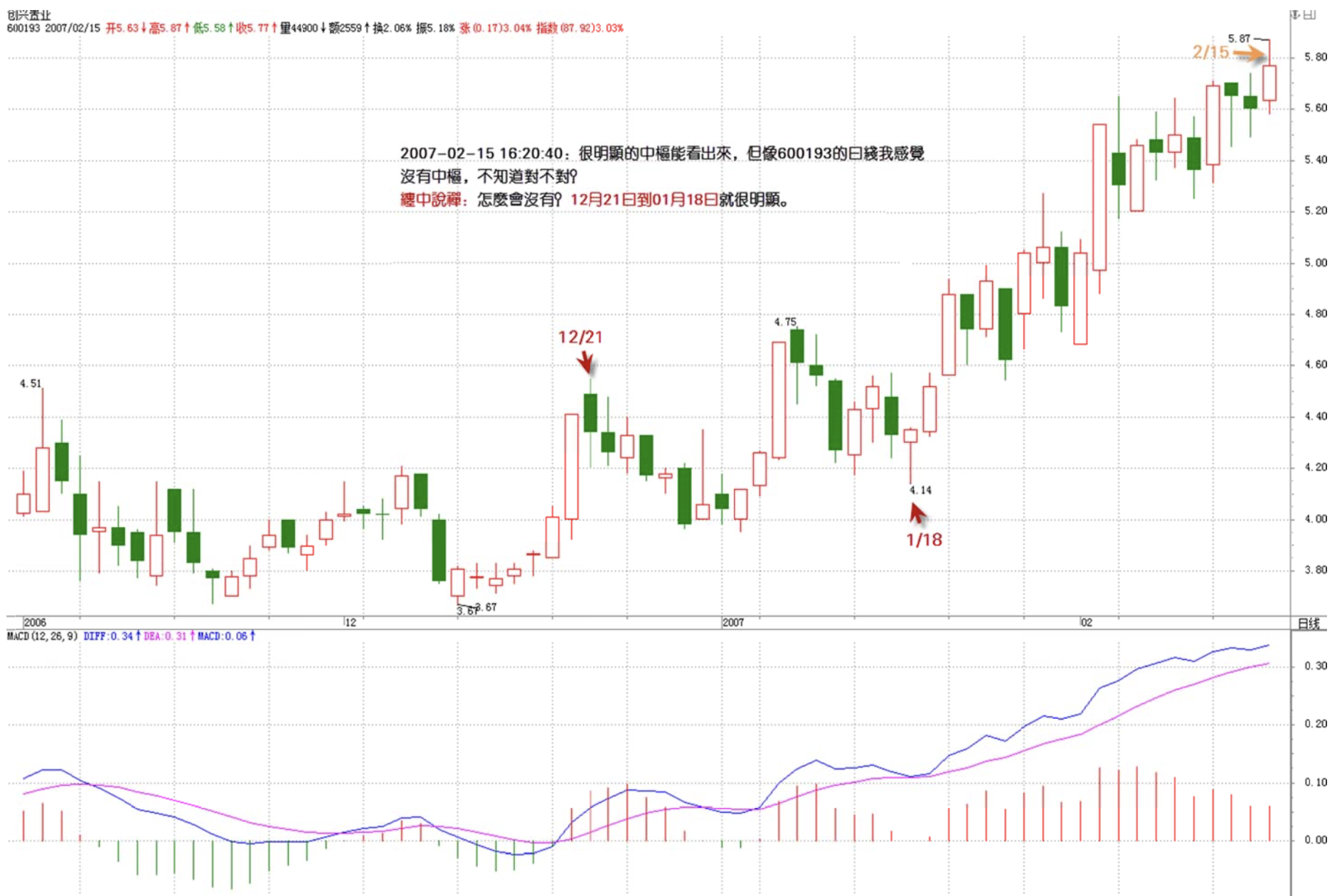
I want to ask a question. Obvious hubs are easy to spot, but for something like 600193's daily chart, I feel there's no hub — am I right?
-
Teacher, can you answer?
==
How could there be none? From 12/21 to 01/18, it's very obvious.
缠中说禅 2007/2/15 16:34:31
[Anonymous] 炼铁设备
2007-02-15 16:29:06
"Have you noticed 416? Why did the stock resume strong upward movement just two days after bad earnings were announced? Simple — the float was clean."
----------------------------
I held firm during 416's pullback. Yesterday I sold it at 4.58. Today I wanted to buy back but couldn't find a buy point.
May I ask the blogger, can I buy back 416 tomorrow morning? Thank you.
==
Why did you sell when there was no sell point? Once sold, don't buy it back. First reflect on this kind of operation — it must not happen again.
缠中说禅 2007/2/15 16:37:37
[Anonymous] 白玉兰
2007-02-15 16:34:11
Chán Zhōng Shuō Chán
2007-02-15 16:26:57
[Anonymous] 白玉兰
2007-02-15 16:23:58
Sister, why won't you answer my question?
Shandong Ren is the worst performer among the old 8 stocks. They were selected by the same program, yet they're so different. Should I exit first or what?
==
This stock still has too many hands inside — it's not clean. But it's already much better than before. Now it can only be slowly pushed up. If you pull hard, wouldn't everyone else sell out? Moving slowly isn't necessarily a bad thing, especially at the beginning. Look at 777 — it was troublesome before too, even hitting the daily limit down, but didn't it eventually break free? If you don't have patience, just exit and use technical analysis to find other stocks — it's the same.
+++++++++++++++++++++++++
I do have patience, I was just inquiring. Many people here hold Shandong Ren — they were afraid of angering you and didn't dare ask..
I made money on 777 — sold the day before the limit down, then switched to 999. I especially thank you.
==
600777 has been continuously making new highs. You can't expect every stock to go up in consecutive limit-up moves. Each stock's float dynamics are different, so their trends naturally differ. Moreover, this stock originally had strong resistance below 5 yuan — moving slowly below 5 is perfectly normal.
缠中说禅 2007/2/15 16:41:46
[Anonymous] 兰兰
2007-02-15 16:34:46
Chan sister:
Regarding your answer to Xiaoniao about the market hub, I think the three segments run from 10:48 to 13:37. From 10:48 to 13:29 doesn't seem to have three segments? Please advise, thank you!
==
The third segment is from 11:14 to 11:29. The first three segments must be at the same level. Under your interpretation, they wouldn't be. Actually, what follows is all hub extension.
缠中说禅 2007/2/15 16:43:16
Little Bird
Sorry, I typed a number wrong earlier — it's 11:29 not 13:29.
缠中说禅 2007/2/15 16:44:42
Everyone, here is the correction
[Anonymous] Little Bird
2007-02-15 15:45:26
Sorry to ask another question about finding hubs:
Sister said to look for obvious high and low points on the chart. For example, on today's market 1-minute chart, from 11:10 to 14:08, how should we identify the high and low points?
Is it 11:10 up to 11:15, down to 13:00, then up to 13:26, down to 13:36, up to 14:08;
Or 11:10 up to 13:26, down to 13:36, then up to 14:08?
==
From 10:48 to 11:29, an obvious hub formed during an upward adjustment — the three segments are very clear. What follows is the hub's extension. 14:13 is a third-type buy point, confirming the hub's completion.
缠中说禅 2007/2/15 16:46:35
[Anonymous] 中间体
2007-02-15 16:42:18
2007-02-15 16:20:40
[Anonymous] 新学生
2007-02-15 16:09:10
Hello Teacher Chan. First, wishing you a happy Spring Festival in advance.
I want to ask a question. Obvious hubs are easy to spot, but for something like 600193's daily chart, I feel there's no hub — am I right?
-
Teacher, can you answer?
==
How could there be none? From 12/21 to 01/18, it's very obvious.
-------------------------------
May I ask Chan sister, shouldn't 12/21 to 01/18 be a weekly hub?
==
For a weekly hub, each segment must contain a daily hub — this doesn't meet that requirement.
缠中说禅 2007/2/15 16:48:00
[Anonymous] Little Bird
2007-02-15 16:43:10
[Anonymous] 兰兰
2007-02-15 16:34:46
Chan sister:
Regarding your answer to Xiaoniao about the market hub, I think the three segments run from 10:48 to 13:37. From 10:48 to 13:29 doesn't seem to have three segments? Please advise, thank you!
Combining with MACD, I also concluded this, but sister's meaning seems to be that 11:16 and 13:00 are also high/low points.
Sister, is that right?
==
Above I wrote 11:29 as 13:29. Corrected now.
缠中说禅 2007/2/15 16:53:33
[Anonymous] 大盘
2007-02-15 16:01:01
Blogger, one type of third-type buy point is formed by consolidation divergence that doesn't break below the hub's high point. Is there also a third-type buy point that isn't formed by consolidation divergence? For example, the first sub-level downward segment forming the second hub in a trend.
Also, for continuously forming new hubs — say 3 or more in the upward direction — starting from the third hub, for each newly born hub, why can't the first sub-level downward segment be called a third-type buy point? And what buy point is the third sub-level downward segment of each newly born hub?
Additionally, I'm still not entirely clear on the difference between consolidation divergence and trend divergence. Is trend divergence the divergence occurring in the upward segment after at least 2 hubs have formed (compared with the sub-level upward segment after the first same-level hub)? And is consolidation divergence the divergence in the upward segment leaving the first hub (compared with the sub-level upward segment before the first same-level hub)?
Please enlighten me! Thank you.
==
That's also possible. For example, a very strong rally, then a quick pullback, then continued rise. The key for a third-type buy point is: sub-level goes up, sub-level pullback doesn't return inside the hub.
Consolidation divergence generally occurs during hub oscillation, while trend divergence is the comparison between c and b in a+A+b+B+c.
缠中说禅 2007/2/15 16:54:39
Correcting the error above here to avoid misunderstanding.
Chán Zhōng Shuō Chán
2007-02-15 16:09:22
[Anonymous] Little Bird
2007-02-15 15:45:26
Sorry to ask another question about finding hubs:
Sister said to look for obvious high and low points on the chart. For example, on today's market 1-minute chart, from 11:10 to 14:08, how should we identify the high and low points?
Is it 11:10 up to 11:15, down to 13:00, then up to 13:26, down to 13:36, up to 14:08;
Or 11:10 up to 13:26, down to 13:36, then up to 14:08?
==
From 10:48 to 11:29, an obvious hub formed during an upward adjustment — the three segments are very clear. What follows is the hub's extension. 14:13 is a third-type buy point, confirming the hub's completion.
I mainly wasn't sure about the high/low points. So you're saying 11:16 and 11:21 and 13:00 should all be counted as high/low points?
缠中说禅 2007/2/15 16:56:04
[Anonymous] Chu Kuangren
2007-02-15 16:54:03
Does the blogger use this exact theory for trading futures and forex as well?
==
Didn't the previous lesson mention two preconditions? Do you think they don't meet those conditions?
缠中说禅 2007/2/15 16:59:07
[Anonymous] 巴索林
2007-02-15 16:53:29
Happy New Year to the blogger!
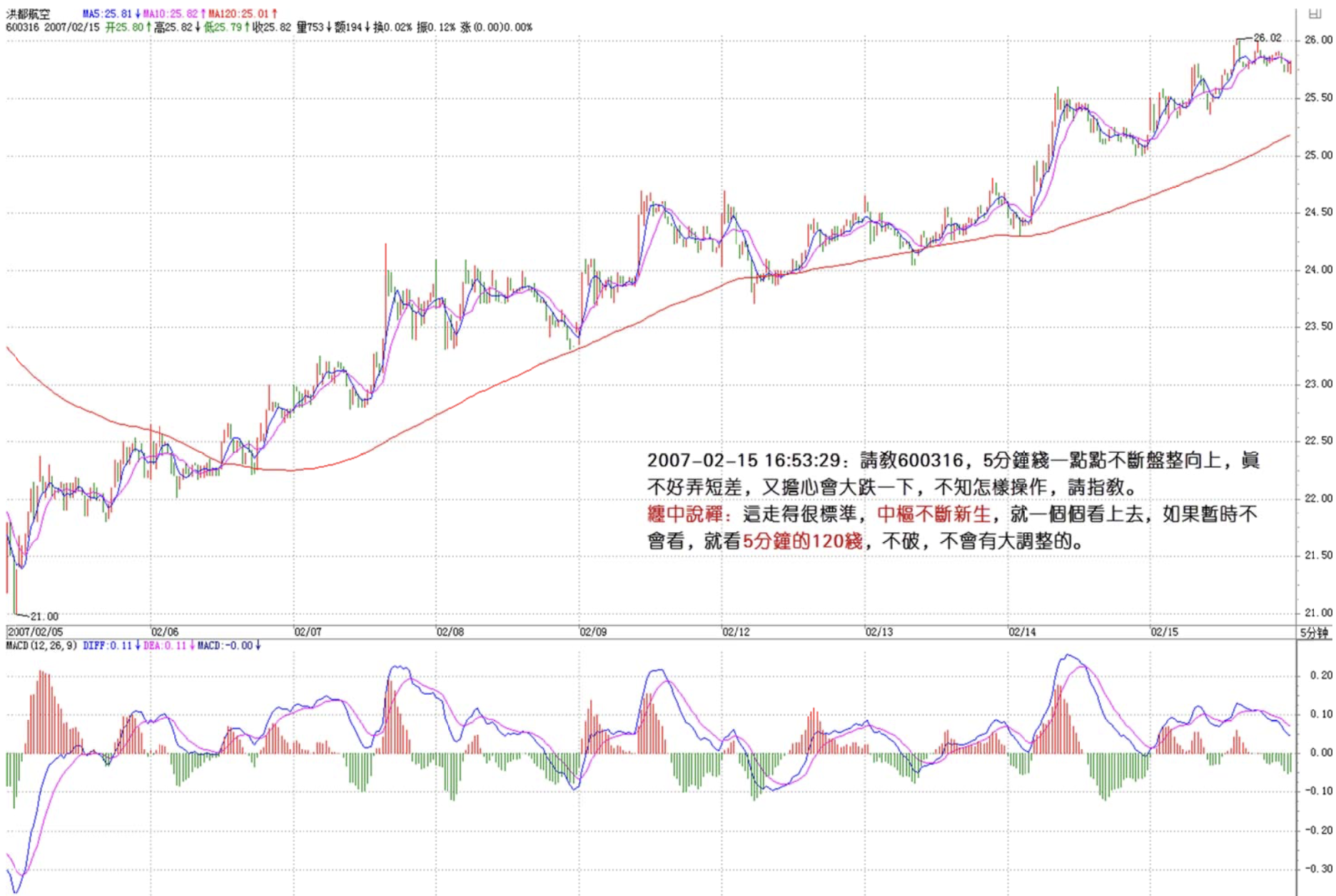
I'd like to ask about 600316. On the 5-minute chart it keeps slowly consolidating upward — really hard to make short-term trades. I'm also worried about a big drop. How should I operate? Please advise.
==
This is moving very standard — hubs continuously generating new ones. Just follow them up one by one. If you can't read them yet, look at the 120-period moving average on the 5-minute chart. As long as it doesn't break, there won't be major pullbacks.
缠中说禅 2007/2/15 17:01:16
[Anonymous] 兰兰
2007-02-15 16:57:11
[Anonymous] 兰兰
2007-02-15 16:34:46
Chan sister:
Regarding your answer to Xiaoniao about the market hub, I think the three segments run from 10:48 to 13:37. From 10:48 to 13:29 doesn't seem to have three segments? Please advise, thank you!
Combining with MACD, I also concluded this, but sister's meaning seems to be that 11:16 and 13:00 are also high/low points.
Sister, is that right?
======
Chan sister was correct this time: 10:48-11:09-11:17-11:29, three segments.
==
Above I wrote 11:29 as 13:29. That you caught it proves you truly learned — that's very good. The key is to start from theory. Sometimes this ID also makes typos.
缠中说禅 2007/2/15 17:03:12
[Anonymous] 炼铁设备
2007-02-15 16:48:59
[Anonymous] 白玉兰
I do have patience, I was just inquiring. Many people here hold Shandong Ren — they were afraid of angering you and didn't dare ask..
777 I made money — sold the day before the limit down, then switched to 999. I especially thank you.
======================
Congrats to you.
777 feels dangerous tomorrow.
As for the pharma stock, I chased high and lost badly during the subsequent adjustment.
==
No problem for the medium term.
缠中说禅 2007/2/15 17:06:00
[Anonymous] Little Bird
2007-02-15 17:02:29
Does 10:11 to 10:33 count as a hub?
==
Of course, and then there's a divergence that triggers the subsequent decline.
缠中说禅 2007/2/15 17:07:20
Got to go now. Goodbye.
缠中说禅 2007/2/15 17:08:46
[Anonymous] 越看越迷糊
2007-02-15 17:06:10
Hello Chan mm!
After reading to the end, I'm actually confused about the most basic question. Still about the hub — you've said that a hub in an uptrend is formed by the overlap of three down-up-down segments. But what if the "up" segment is very long and the two "down" segments are very short, so the three segments don't overlap — how do you find the hub? If in an uptrend you take up-down-up three segments, this problem doesn't exist?
==
Before I leave, let me answer you: then no hub is formed. Who told you down-up-down must form a hub? Without overlap, where's the hub?
Logging off. Goodbye.
缠中说禅 2007/2/15 15:18:31
A word once spoken, even four horses cannot retract it. Since this ID promised everyone that China Unicom would reach 5 yuan and the market would hit 3,000 before the Spring Festival, it must be accomplished no matter what. Of course, this isn't something this ID can do alone, but in Beijing, what can't be accomplished? The center of China is Beijing, and Beijingers despise traitors the most. Since the traitors are stirring up trouble before 3,000 points, the red flag must be planted at 3,000 for the New Year. In China's century, where do traitors get to have their say?
A bloody battle, swift and satisfying vengeance — it's that simple. What should be seen, everyone has seen. What can't be seen doesn't need to be said. Of the 10-plus stocks this ID previously mentioned, except for some with excessive prior gains, they've all hit new highs. Of course, some rose faster and some slower, but the medium-term outlook is certainly fine for all.
However, this ID publicly announcing interception targets here has indeed greatly increased operational difficulty for this ID. There are certainly plenty of traitor spies here now. Currently, the stocks this ID mentions seem to move only when this ID acts — this isn't good. This ID isn't a market maker; carrying on like this is pointless. So the market makers inside should stop being so lazy. Though you're certainly this ID's juniors, your ages are probably older than this ID's. Respecting elders shouldn't be done this way — figure it out yourselves.
Speaking as a market veteran to teach these lazy people a lesson: the market requires reputation. Take a small loss, establish a golden reputation — what's wrong with that? Let me give an example of the smallest thing this ID did N years ago: pushed a stock from 14 yuan up to 25 yuan in just over two weeks, sold everything, also around Spring Festival, without spending a penny. How? Think about it yourselves.
Tomorrow, the traitors may still launch an attack, so everyone still needs to make an effort.