Globalization — No Market Can Exist in Isolation
2007/8/16 15:41:56
"In a globalized world, no stock market can exist in isolation." This was written in Monday's The Unsustainability of Public Fund Managers' "Super Boy" Development Model, primarily as part of the August stock market analysis. The current issue is already very clear — as that article stated, one must watch out for the destructive power of the monthly candlestick's upper shadow.
Of course, there's no need to predict this issue, and this ID has always believed that America's impact on China is always strategic in nature. The China-US game — only the final result matters; everything in between is just gameplay. Like the former Generalissimo Chiang, who ultimately earned only the title "Chiang bandit" and spent his final days watching the blue of the sea. Whoever can turn America into "American bandits" would obviously be even more impressive than turning Generalissimo Chiang into "Chiang bandit."
America's storm, the whole world shivers alongside — but at least today's Chinese retail investors, many don't feel this way. Why? Because second and third-tier stocks have been swept up in the hotspot spreading. Since last week, the word this ID has repeatedly used is "spreading" — and this is indeed a good way to weather stormy times. Those playing ICBC got hammered by America and are currently in pain. Those who QDII'd to Hong Kong have finally learned that crows everywhere are equally black. Whether the fire in second and third-tier stocks can warm this stormy night depends on tomorrow and Monday.
Globalization — no market can exist in isolation. But you can create sectors that exist in isolation. Second and third-tier stocks inherently can shine with just a candle's light. The key is — if even candlelight can't be given, if any flicker of movement gets slapped with the "speculation" label, then it's all a mess. Those who cry "speculation" the moment second and third-tier stocks budge clearly have too much water in their brains. Of course, things are different from the first half of the year — whether this fire in second and third-tier stocks can truly spread like wildfire remains to be seen. Let's wait and watch.
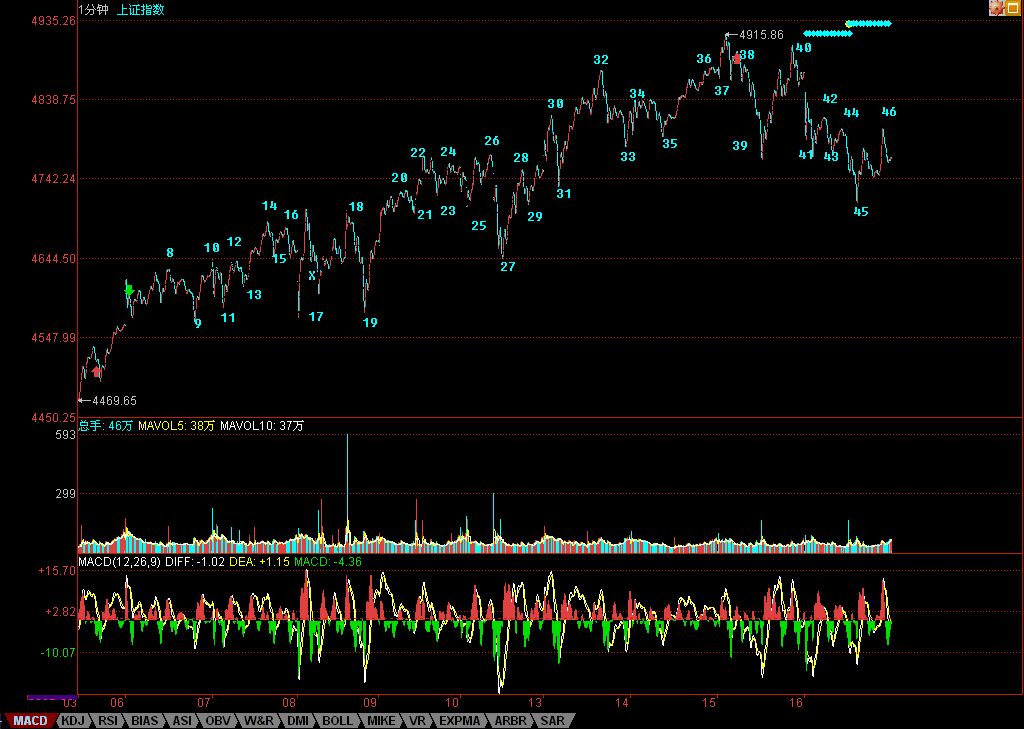
On the market trend, if point 16 is broken, then forming a 30-minute hub oscillation becomes the only option. In other words, if 4700 points isn't breached, there's still the possibility of forming a new 5-minute oscillation at the current position — meaning the original 5-minute uptrend could still be maintained. Therefore, the magnitude of the short-term pullback depends on this 4700-point level.
The key still depends on how many more days America, the sick man, continues its wailing. Honestly, this ID would rather see a 30-minute or even daily-level oscillation on the Chinese side if it means watching America cry for 368 days straight. For those who died in Afghanistan and Iraq — wouldn't more American bankruptcies be deserved?
This ID is in a great mood today. Seeing America plunge brings joy. Although it may displease the traitors, things that displease traitors are exactly what this ID loves doing most.
Questions will be answered until 5 o'clock today, because this ID is in a good mood.
Note: Point 46 in the chart below is not 100% certain, because if there's a significant gap-up opening tomorrow, it would need to be changed. This is only a rough marking.
Replies
缠中说禅 2007/8/16 15:51:35
[Anonymous] Sina Netizen Delete all comments by this person
2007-08-16 15:47:57
Blogger, you made a typo, right? It should be 4700.
==
Correct, 4700.
缠中说禅 2007/8/16 15:58:06
[Anonymous] 蓝羽 Delete all comments by this person
2007-08-16 15:48:44
2007-07-31 16:10:56
Chan JJ, can a single stroke also have triangle patterns or running patterns similar to line segments?
Or put another way, can non-top/bottom K-lines within a stroke exceed the range of the top and bottom? Must the top or bottom necessarily be the highest or lowest point of a stroke?
--
A stroke has one top and one bottom — how can it have a triangle? The top and bottom are of course necessarily the highest and lowest points of that stroke. If they're not, there must be more than one stroke within.
37-38 doesn't conform to "the top and bottom are of course necessarily the highest and lowest points"
Is this understanding correct????
==
How doesn't it conform? Top and bottom are defined for strokes. Line segments are composed of strokes — please don't mix them up.
Within a line segment, the various strokes can form triangles, expanding platforms, and other patterns.
Please get the concepts clear. Fractal patterns correspond to strokes, while the fractal patterns of elements in the characteristic sequence correspond to the judgment of line segment destruction. Please don't confuse different concepts.
缠中说禅 2007/8/16 16:04:18
Note:
I've noticed some people are still confusing fractal patterns within a single stroke with the various strokes within a line segment.
A stroke has only one top and one bottom. If one top follows another, then one of them is definitely not a true top. This is said within the scope of strokes.
Within a stroke, there are of course no triangles or such formations — a stroke is a single line segment with two endpoints.
But among the various strokes within a line segment, all kinds of patterns are possible, as long as these patterns don't destroy the line segment itself.
Please get the concepts clear.
缠中说禅 2007/8/16 16:08:05
[Anonymous] Sina Netizen Delete all comments by this person
2007-08-16 16:04:18
Can the blogger reveal the telecom industry restructuring plan? Thanks.
==
China Unicom focuses exclusively on GSM, China Mobile focuses exclusively on Datang's technology, and China Telecom focuses exclusively on CDMA. This is the general principle and the final plan. However, with things in China, until the final lid is lifted, there may still be changes — only heaven knows.
缠中说禅 2007/8/16 16:10:34
[Anonymous] Sina Netizen Delete all comments by this person
2007-08-16 16:05:45
I don't know why your charts are blurry. Can you make one that can be enlarged?
==
Glad there's a computer question this ID can actually answer. Right-click on the image, then copy it, and you'll get the full-size image. It seems newer browsers all have zoom functionality, in the lower right corner.
缠中说禅 2007/8/16 16:16:47
[Anonymous] 听风 Delete all comments by this person
2007-08-16 16:06:32
Sister:
I have a question. It seems like the third type of buy point just appeared the day before yesterday. Taking China Unicom as an example, at that time it was 7.16. So why have there been even lower prices these past two days? Is it due to systemic influence?
==
Setting aside whether this buy point exists, even if it does, it has a level. Does a 1-minute third type of buy point guarantee eternal upward movement? Obviously not. So first clarify the level. After a third type of buy point, there are two options — expanding to a larger level or continuing the uptrend. How to distinguish between these was covered in previous lessons: look at whether the corresponding movement shows consolidation-type top divergence.
Consolidation-type top divergence corresponds to the situation of expanding to a larger level, and the subsequent decline is perfectly natural.
But even in the case of expanding to a larger level, from the third type of buy point to the consolidation-type top divergence, theory necessarily guarantees an upward movement in between — not to mention the case of continuing the uptrend. However, theory never guarantees that after going up, it won't come back down.
缠中说禅 2007/8/16 16:24:08
[Anonymous] Sina Netizen Delete all comments by this person
2007-08-16 16:12:13
Teacher, would you honor us with a visit to the technical forum?!!!
There are already 1,200 members now!!!!!!!!!!
And replies are more convenient to save on the forum!!!
Unlike Sina which is so terrible!!!!!!!!!!
We hope the teacher can grace the forum with your presence!!!!!!!!!
==
This ID doesn't oppose such forums. After all, they make it convenient for everyone to study together, and not just this ID's theory — anything can be studied. Without comparison, how would you know what's best?
But this ID truly cannot go there, because it would create unfavorable suspicions. When this ID does things, there can be no handles for the traitors to exploit. If this ID were to visit a forum about this ID, countless stories would surely be fabricated — the traitors are just waiting for it.
For any questions, let's keep answering them here. Everyone can consolidate their questions, which would be more efficient.
缠中说禅 2007/8/16 16:25:02
Stone Three Delete all comments by this person
2007-08-16 16:17:45
Boss, good day.
You've previously mentioned that gaps are treated as regular K-lines. So how do you handle the containment relationship between a gap and its adjacent K-lines? Can gaps serve as components of top or bottom fractal patterns?
==
Of course they can — the key is that they satisfy the definition.
缠中说禅 2007/8/16 16:29:29
[Anonymous] 沙滩 Delete all comments by this person
2007-08-16 16:23:14
Chan mm, you're in a great mood, and we're all happy too!
But I really lack tactical skill — just bought China Bank and it drops like this. Long-term investment will definitely be fine though, right??
==
This ID opposes any operational mistake being covered up by "long-term investment." Long-term investment means entering at major level buy points — for example, yearly, quarterly, or monthly buy points — then holding all the way until a major level sell point before selling. That's true long-term investment.
Of course, China Bank ultimately won't trap anyone permanently. The key is that your operational thinking must have the right methodology. For any trade, you must know what you got right and what you got wrong. If you originally intended a 1-minute operation, got it wrong, and then used "long-term investment" as an excuse — that makes it very hard to improve.
Using this ID's theory is completely different from everything else, so you must have a complete change of heart and mind.
In this ID's framework, everything has a precise definition, including long-term investment.
缠中说禅 2007/8/16 16:34:13
[Anonymous] christine Delete all comments by this person
2007-08-16 16:28:41
Now I've found that another problem I have is some confusion regarding top divergence versus bottom divergence. I can catch bottom divergence fairly accurately, but I often miss top divergence, as if I were nearsighted.
==
This isn't a technical problem — it's a mindset problem. Most people have always found it easy to buy right but can never sell right, resulting in riding the elevator. Put bluntly, it's caused by greed.
Better to sell early than to sell late. Selling early means you have cash, and with cash you have new opportunities to seize. Selling late means not only do you ride the elevator, but you also rack up opportunity costs.
As for precision in sell points, that's a process of practice and refinement. The more you sell, the higher your precision naturally becomes, and the better your grasp of the theory. A good knife never used once — what's the point?
缠中说禅 2007/8/16 16:35:57
[Anonymous] Sina Netizen Delete all comments by this person
2007-08-16 16:30:22
Chán Zhōng Shuō Chán blogger, may I ask —
What's going on with 36-37? Can you explain? Looking at it, 36-37 doesn't seem to have 3 strokes — down, up, down — the last down stroke can't form a complete stroke. Is it because of the gap?
Also, I've noticed the blog is back to normal now.
==
Why can't it? Doesn't the 9:25 one-minute candlestick count?
缠中说禅 2007/8/16 16:40:06
Chán Zhōng Shuō Chán Delete all comments by this person
2007-08-16 16:35:57
[Anonymous] Sina Netizen Delete all comments by this person
2007-08-16 16:30:22
Chán Zhōng Shuō Chán blogger, may I ask —
What's going on with 36-37? Can you explain? Looking at it, 36-37 doesn't seem to have 3 strokes — down, up, down — the last down stroke can't form a complete stroke. Is it because of the gap?
Also, I've noticed the blog is back to normal now.
==
Why can't it? Doesn't the 9:25 one-minute candlestick count?
==
Of course, if you insist that the 9:25 auction candlestick doesn't count, then naturally it wouldn't form a stroke. In that case, just move point 36 to the 4915 high point.
But in reality, 9:25 must be counted. The auction is one of the most important moments — its significance is major. Moreover, this happens to form the third type of buy point for the hub below, making the subsequent upward push even more technically meaningful.
缠中说禅 2007/8/16 16:41:04
Murmuring Chan Zen Delete all comments by this person
2007-08-16 16:39:26
555 Boss won't respond to me
In yesterday's lesson, is the first 1-minute hub of the 1-minute trend at 18-27? If so, at position 27, how do you determine whether the subsequent rebound is a trend continuation or a reversal? Or can it only be handled through strategy?
Thanks!!
==
No, it's 22-27.
缠中说禅 2007/8/16 16:44:08
[Anonymous] 大盘 Delete all comments by this person
2007-08-16 16:40:09
Urgent question for the blogger:
Today's Shanghai Composite index — point 44 here, according to the line segment definition, doesn't seem to be a top fractal pattern, because the immediately following stroke drops sharply and creates a containment relationship.
This confusion definitely needs clarification, because this issue is very common. Without getting it clear, it's very hard to properly classify line segments.
==
This is the first type of situation — where the characteristic sequence gap is closed by the very first stroke. There's no need to explore the question of the second characteristic sequence fractal pattern — that's a matter for the second type of situation.
缠中说禅 2007/8/16 16:46:08
This ID will copy the exposition of the two situations from the lessons for everyone to study carefully:
In a standard characteristic sequence, three adjacent elements forming a fractal pattern have only two possibilities:
First situation:
In a characteristic sequence top fractal, if there is no characteristic sequence gap between the first and second elements, then the line segment ends at the high point of that top fractal — that high point is the endpoint of the line segment. In a characteristic sequence bottom fractal, if there is no characteristic sequence gap between the first and second elements, then the line segment ends at the low point of that bottom fractal — that low point is the endpoint of the line segment.
Second situation:
In a characteristic sequence top fractal, if there exists a characteristic sequence gap between the first and second elements, and the characteristic sequence of the series starting from the first downward stroke from the fractal's highest point shows a bottom fractal, then the line segment ends at the high point of that top fractal — that high point is the endpoint of the line segment. In a characteristic sequence bottom fractal, if there exists a characteristic sequence gap between the first and second elements, and the characteristic sequence of the series starting from the first upward stroke from the fractal's lowest point shows a top fractal, then the line segment ends at the low point of that bottom fractal — that low point is the endpoint of the line segment.
缠中说禅 2007/8/16 16:54:24
Stone Three Delete all comments by this person
2007-08-16 16:45:56
Boss, I have a question about today's classification. The point around 11:20 doesn't seem to form a stroke, so point 44 can't be a top fractal, right?
==
You still haven't understood. This is the first type of situation — there is no characteristic sequence gap. In this situation, any three strokes actually constitute a destruction of the preceding line segment.
The tricky case is the second situation. In that case, not just any three strokes can constitute destruction, even if the characteristic sequence gap between elements is eventually closed. Note that in the second situation, even if it's closed, it's definitely not closed by the first element — because that would turn it into the first situation.
缠中说禅 2007/8/16 16:57:47
Stone Three Delete all comments by this person
2007-08-16 16:54:21
"This is the first type of situation — where the characteristic sequence gap is closed by the very first stroke. There's no need to explore the question of the second characteristic sequence fractal pattern — that's a matter for the second type of situation."
========
Boss, are you still here? I still have doubts. The characteristic sequence should first account for containment relationships and be converted to a standard characteristic sequence before examining fractal patterns, right?
==
Of course that's correct. But note — the characteristic sequence is opposite to the actual movement.
缠中说禅 2007/8/16 16:59:27
[Anonymous] Night雨 Delete all comments by this person
2007-08-16 16:53:50
Sister, I think yesterday's comment of mine captured some of what you've said about long-term investing.
Let me paste yesterday's comment here:
Shills tell people to buy at highs. I buy at lows. Same reasoning, two different outcomes. When others are enthusiastic, we should step aside; when others abandon, we should pick up. This is the most important operational strategy.
Fundamentals aren't wrong — only fundamentals can determine a stock's long-term trend. It's just that the timing of entry is crucial.
At the 416 level, at 18 yuan, telling people to buy based on restructuring fundamentals is a scam. At the 416 level, at 7-8 yuan a while back, telling people to buy based on the same fundamentals — that's bottom fishing. So in the stock market, the most important thing is overcoming your own fear and greed.
==
Correct — the key is the level of the buy point. Buying at a 1-minute buy point and then claiming it's a long-term investment is self-deception.
缠中说禅 2007/8/16 17:02:37
The link from the netizen "Big Market" above can't be opened, so the follow-up question can't be answered.
Please provide a working link, and the question will be answered next time.
Signing off for now. Goodbye.
缠中说禅 2007/8/16 15:50:48
[Anonymous] Sina Netizen Delete all comments by this person
2007-08-16 15:45:17
Looking at the MACD chart, for the segment from last August to May 29, the yellow and white lines stayed very close together — the area formed by their crossovers is small, and the red histogram bars below are also short. It clearly feels like the area of the red/white line crossovers and histogram bars from July to now is much larger than that earlier segment. So why hasn't the divergence segment been resolved?
Awaiting reply.
==
Please get the concepts straight first. 32-35 is a 1-minute hub. How can 32-33, 33-34, 34-35 be strokes rather than line segments? Can three strokes constitute a 1-minute hub?
MACD is only an auxiliary tool. The key is to find the hub, and correctly identify the movements being compared before and after. It's not that any MACD pullback indicates divergence — if it were that simple, you could just study the MACD alone. What would be the point of anything else?