Teaching You to Trade Stocks 60: Chart Analysis Demonstration Five
2007/6/19 8:04:06
In fact, dry chart patterns contain very deep psychological significance. Movements are essentially the combined force of expectations. And expectations are fundamentally at the psychological level. It's just that for the market, only expectations that are externalized into actual market buying and selling behavior can be treated as component forces forming the market's combined force. Your fear, if it merely stays as fear without any actual action, does not constitute market trading behavior. Therefore, all market behavior is already filtered through such a psychological model.
Take a simple example: a same-level movement drops from B0 to A1, bounces to B1, breaks down again to A2, then bounces to B2. This can be divided into two cases: 1) B2 is lower than A1; 2) B2 is not lower than A1. Clearly, the second case would form a hub at some larger level, while the first case would not — so the two situations are fundamentally different. On the psychological level, A1 — the starting point of this first rebound — has very strong psychological suggestion significance. The subsequent breakdown makes A1's price an important psychological level, and since trading is essentially based on expectations, this price level forms a real classification of expectations: 1) expecting to get back above A1 and actually trading on it; 2) expecting not to get back above A1 and actually trading on it; 3) watching from the sidelines. The third type doesn't produce actual trades in the real movement, so the first and second psychological expectations constitute the market's combined force. The market's movement is the real-time trace of this combined force, so the relative magnitude of these two psychological expectations doesn't need actual measurement — the market's movement reflects it. For instance, if it actually can't get back up, producing the first case where B2 is lower than A1, then clearly under current conditions, the second psychological expectation is greater than the first.
News, policies, capital flows — this front and that front — ultimately all act on the human heart. Hearts trade on expectations, and what's involved here is human greed and fear, the Buddhist five poisons of greed, anger, delusion, doubt, and arrogance. This ID's theory never predicts, has no expectations — it only follows the market's combined force, the market's movement. Here there's no need for greed or fear: look at the chart, do the work, that's all. But merely knowing this is far from sufficient, because having no expectations may itself be the greatest expectation; having no greed or fear may itself be the greatest greed and fear. Not predicting, not expecting — this isn't about being unable to predict or expect, but about not predicting or expecting out of greed and fear. It's about following the movement's own patterns.
Movements have patterns, and these patterns are unchanging. The root of this unchangeableness lies in the unchangeableness of human greed, anger, delusion, doubt, and arrogance. Why does this ID emphasize the multiplicity of real-time decomposition? Because movements themselves are being formed in the present moment — drawn by the combined force of the market's various expectations in real-time. Every way of drawing is unchanging, all rooted in human greed, anger, delusion, doubt, and arrogance. Therefore every decomposition in the multiplicity conforms to the theory. Multiplicity is not ambiguity — it's examining from multiple angles to let the market itself draw its own prison, so that the market's movement, in all its myriad changes, never escapes the control of this ID's theory. And this is precisely one of the market's own patterns.
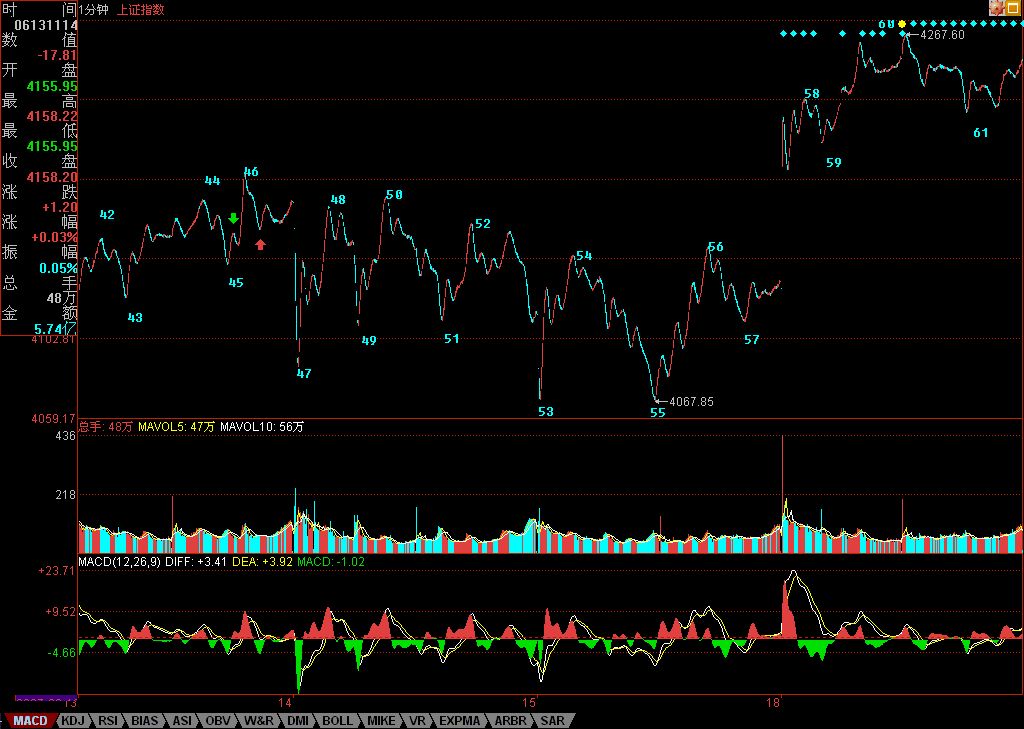
Let's look at the chart above. The last lesson just mentioned "the red arrow point is higher than the green arrow point, so it cannot be confirmed that the line segment is complete — subsequent movement must be watched, from which you can understand how to grasp the end of a line segment." Someone might ask: why can't we predict or expect at this position? Because the market itself hasn't completed. But this incompleteness is stated from the level at which humans observe, because so-called movements are first and foremost the movements you observe — movements don't exist apart from your observation. The world under different magnification microscopes is different, but the costs of market operations, trading channels, capital scale, and other limitations mean the microscope magnification for observing and actually operating movements cannot be infinitely small. So a minimum level of line segments must be determined, smoothing out all fluctuations below it. Of course, according to strict theory, using each individual transaction as the minimum level and building line segments from there could rigorously distinguish movements at any level, but this is completely impractical. Especially now with increased transaction costs, the operable level must necessarily increase. Therefore, fluctuations below the operable level must be ignored.
In the strictest sense, line segment 45-46 constitutes a consolidation divergence against line segment 43-44 (note: the strength comparison is of the total area of all red bars below). And examining the sub-line-segment level carefully, 45-46 is actually a small-level-to-large-level transition. When the first rally after the red arrow fails to make a new high, you can exit — why? Because what follows must form a down-up-down overlapping structure, meaning a small hub forms. And operating at the same level below line segments means not participating in this type of hub. Of course, this is the most rigorous analysis and doesn't have much practical operational significance. In actual operations, meaningful operations are at least at the sub-1-minute line segment level. Therefore, in this chart, if you're operating at the 30-minute level, you can ignore the 46-47 fluctuation. Starting from 3404, the rebound is a standard 5-minute level uptrend, so your holding should at minimum wait until this 5-minute uptrend shows divergence or sudden disruption.
Clearly, 46-55 is a 5-minute hub. After 55 breaks below 53, the consolidation divergence is obvious. You can also easily see that if 55 is treated as a first-type buy point (strictly speaking, consolidation divergence doesn't have a first-type buy point per se, but we use this analogy), then 57 is a second-type buy point. Segments 55-60 represent a standard line-segment-level uptrend. The divergence at 59-60 is perfectly standard — look at the textbook MACD DIFF/DEA pullback to the zero axis, then 60 makes a new high while both the bar area and DIFF/DEA height fall short of the previous ones. From this you know: after 60, there must be an adjustment pulling back below 58. In fact, 61 is lower than 58, meaning 58-61 forms a new 1-minute hub. Whether this hub expands into a 5-minute one, and whether the previous 5-minute hub's highest point — specifically point 46 — gets broken again, are both key for future movements. If 46 is no longer touched, that's an ultra-strong movement, meaning the 5-minute uptrend starting from 3404 continues.
Here it must be emphasized that the impact of sudden news on market movements and operations needn't be overly worried about. Fundamentally, any sudden news merely adds a present-moment component force to market expectations. Ultimately, it still comes down to the combined force itself — or rather, the market's movement itself. Under normal circumstances, since the precise positioning of divergence requires the interval nesting method, the most unfortunate scenario for sudden news is when it appears during this precise positioning period. For example, the 530 event was exactly this. Of course, this is a low-probability event. More often, sudden news appears after the precise positioning of divergence is complete, in which case the impact on operations is zero. For that most unfortunate scenario, a second-type sell point is sufficient to handle it. Therefore, after sudden news drops, you cannot miss this second-type sell point in actual operations. But note: not every second-type sell point requires a reaction — this depends on the level. For instance, if you operate at the monthly level, this so-called major crash doesn't even need a glance — let it drop all it wants. Even if you operate at the 5-minute level, if some sudden news doesn't even disrupt a single 1-minute hub and only creates sub-1-minute oscillations, then the so-called second-type sell point can be ignored. The principle is simple: any news is merely a component force. What matters is its impact on the combined force — seeing what level of movement it disrupts. All of this is reflected in the actual movement. Just look at the charts and do your work.
Note: the larger the level disrupted by sudden news, the less you should wait for the corresponding level's second-type sell point. For example, if a downward gap destroys a daily-level uptrend, then on the day the news comes out, a 1-minute or even line-segment-level second-type sell point during the session is already a good exit opportunity. If you wait for the daily-level second-type sell point, you might have to wait a very long time — and the price level might not even be as good, because movements grow level by level over time. Furthermore, levels are just for distinguishing operable space. Why use levels? Because larger levels normally mean more operational space. But in rapidly moving markets, a single 5-minute trend type can drop 50% — as in this crash. Therefore, a 5-minute bottom divergence in such a scenario would have rebound space greater than a typical 30-minute level move. In such cases, even if you normally operate at the 30-minute level, you can enter on a 5-minute signal without having to sit and wait for a 30-minute buy point.
Appendix:
Today's movement was already described very clearly yesterday: no third-type sell point below 4224, and it's a strong oscillation. Today's movement clearly meets this requirement. 4224 points corresponds to position 61 on the chart above. Starting from 60, the 1-minute hub [4224, 4254] — the next two days are about watching for this hub's third-type buy or sell point. In other words, same as yesterday: as long as no 1-minute level third-type sell point appears below 4224, then it's strong. For the market to launch a new offensive, a 1-minute level third-type buy point must appear above 4254. Otherwise, the market will continue oscillating within this range as extended hub oscillation.
The script for the broader market remains unchanged, but individual stocks will obviously diverge. So you can't just watch the index. Currently, stocks fall into several technical categories: 1) Those that made new highs and are pulling back — these can be grasped using the third-type buy point; 2) Those consolidating below previous highs — these can be grasped using small-level third-type buy points for breakouts, or entering at oscillation lows; 3) Those with rebounds stalled further from previous highs and now building platforms — handle these the same as category two, just at different price levels; 4) Those still building double bottoms, head-and-shoulders bottoms, and similar patterns at the base — these can be grasped using first and second-type buy points.
Specific individual stocks won't be discussed — if you come here hoping not to use your brain at all, that won't work. What you gain through thinking becomes your own. Otherwise, you'll never get there.
Replies
缠中说禅 2007/6/19 15:48:00
Today's movement was already described very clearly yesterday: no third-type sell point below 4224, and it's a strong oscillation. Today's movement clearly meets this requirement. 4224 points corresponds to position 61 on the chart above. Starting from 60, the 1-minute hub [4224, 4254] — the next two days are about watching for this hub's third-type buy or sell point. In other words, same as yesterday: as long as no 1-minute level third-type sell point appears below 4224, then it's strong. For the market to launch a new offensive, a 1-minute level third-type buy point must appear above 4254. Otherwise, the market will continue oscillating within this range as extended hub oscillation.
The script for the broader market remains unchanged, but individual stocks will obviously diverge. So you can't just watch the index. Currently, stocks fall into several technical categories: 1) Those that made new highs and are pulling back — these can be grasped using the third-type buy point; 2) Those consolidating below previous highs — these can be grasped using small-level third-type buy points for breakouts, or entering at oscillation lows; 3) Those with rebounds stalled further from previous highs and now building platforms — handle these the same as category two, just at different price levels; 4) Those still building double bottoms, head-and-shoulders bottoms, and similar patterns at the base — these can be grasped using first and second-type buy points.
Specific individual stocks won't be discussed — if you come here hoping not to use your brain at all, that won't work. What you gain through thinking becomes your own. Otherwise, you'll never get there.
缠中说禅 2007/6/19 15:58:26
[Anonymous] 洗晕了的大道
2007-06-19 15:50:33
Hello Miss Chan, I've been holding onto Anyang Steel stubbornly for the past two days and found this stock is really garbage. The ten-thousand-lot buy orders appearing these past two days — are you the one lighting the fuse? The market maker is really strong; even so, it still can't be pushed up. After such a long washout, I wonder if it's been cleaned out yet.
Also, today I managed to catch the daily limit on the biotech stock — thank you, Miss Chan.
=
This ID already said a few days ago that the steel stock's script needs to change — let those who want to leave get out first. Did you really think this ID was just joking? This ID's 16 stocks, plus the steel one, 139, 338, 636, total just 20. Finding a suitable buy point shouldn't be hard — so why not wait until there's a buy point before entering? If you don't dare to buy 000777 or 000416, didn't this ID make 600635 clear enough? During the washout at the beginning of last week, wasn't there an opportunity to buy?
Enough said. This ID has things to do this afternoon and evening — need to go to a street west of the Third Ring Road. Signing off first, see you tomorrow morning.
缠中说禅 2007/6/19 8:05:47
Today's market commentary will be appended to this post after 3 PM.
Signing off first, goodbye.