Detailed Analysis of "The Analects": For All Who Have Misinterpreted Confucius (58)
2007/3/20 15:23:18
Zixia said: The various craftsmen dwell in their workshops to complete their work; the gentleman dwells in learning to accomplish his Way.
Yang Bojun: Zixia said: "Various craftsmen reside in their workshops to complete their work; the gentleman uses learning to attain the Way."
Qian Mu: Zixia said: "The hundred artisans dwell long in their workshops to craft their wares; the gentleman dwells his whole life in learning to seek to attain the Way."
Li Zehou: Zixia said: "Workers of all trades complete their work at their production sites; the gentleman should study hard to accomplish his undertaking."
Detailed Explanation: Qian's interpretation basically captures this chapter's grammatical structure; the other two didn't even get the basic grammar right. "百工居肆以成其事;君子学以致其道" is actually an abbreviation of "百工居肆以成其事;君子居学以致其道" — this is a classic parallel metaphorical sentence structure. The most laughable part is Li Zehou, who in his "notes" launches into a tirade about intellectuals and the laboring masses, even dragging in the sent-down-to-the-countryside reeducation of intellectuals — such intellectuals indeed "waste grain for nothing."
The meaning of this chapter is simple. A rough direct translation is: just as various craftsmen are in their workshops to complete their work, the gentleman is in learning to accomplish his undertaking. Here, Zixia transforms Confucius's vivid, living "learning" into a workshop-like "learning" with specific goals, procedures, and norms — much like what happened in Greek philosophy when, after Plato, Heraclitus's "Logos" was turned into "Logic." From that point on, everything became structured, proceduralized, foundationalized, and all of this corresponds to the tricks of all ideologies. The so-called Confucianism of later generations sank into this ideologification — the harm wrought by Zixia and his ilk is immense.
Confucius had special foresight regarding this dangerous tendency, which is why we have the following chapter:
The Master said to Zixia: Be a gentleman Ru! Do not be a petty-person Ru!
Yang Bojun: Confucius said to Zixia: "You should become a gentleman-type scholar, not a petty-person-type scholar."
Qian Mu: The Master said to Zixia: "You should be a gentleman Ru, not a petty person Ru."
Li Zehou: Confucius said to Zixia: "You should be a scholar-official Ru, not a common people's shaman."
Detailed Explanation: "女" (nǚ), that is, "汝" (rǔ), "you." The literal meaning of this chapter is extremely simple — the key question is what constitutes a "gentleman Ru" versus a "petty person Ru." Later generations slapped the label "Confucianism" (Ru-ism) on Confucius, but in all of The Analects, only this one chapter mentions "Ru." "Ru" (儒) originally meant "practitioner of arts/techniques." During the Zhou dynasty, it specifically referred to tutors for aristocratic children, among other roles. Confucius's students were almost all non-aristocratic, and at least in The Analects, there is no record of anyone calling Confucius a "Ru," nor is there any record of Confucius taking pride in being called "Ru," nor even a single quotation in which Confucius calls himself "Ru." The emergence of the so-called "Ru school" (Confucianism) is entirely thanks to Zixia and his ilk. "Confucianism" attributed to Confucius is merely conventional, an error perpetuated for convenience.
The "Ru" here has nothing to do with later-era scholars, literati, or bookish types — such usages and meanings simply didn't exist in Confucius's time. The Rites of Zhou has the phrase "Fourth is Ru, using the Way to win the people." But this text was compiled by Liu Xin during the Han dynasty, and whether it represents historical truth is questionable — at least Kang Youwei was adamantly opposed to its authenticity. Hu Shi treated "Ru" as originating from the Shang dynasty as some kind of priestly figure similar to Christian pastors, but this is nothing but the ravings of someone brainwashed by Western paradigms. As for the chapter "Conduct of the Ru" in the Book of Rites, since the Book of Rites was written by Warring States and later scholars, it is rather evidence of the distortion and remodeling of Confucius's thought, and not worth serious attention. Setting aside all these debates about "Ru," looking at The Analects itself, it is absolutely clear that Confucius did not regard "Ru" as a label that could represent himself — the sole appearance of "Ru" in The Analects is sufficient proof.
Here, we adopt the standard interpretation from the Shuowen Jiezi: "Ru means gentle/yielding (柔), a term for practitioners of techniques. From 人 (person), with 需 (need) as the phonetic component." Whether it's a tutor for aristocratic children or later-era scholars and literati, all can be regarded as "practitioners of techniques" in one sense or another. Confucius walked the path of the firm and the yang — though with firmness containing yielding, it was fundamentally different from the "yielding of the practitioner." This ID puts forward here an unprecedented thesis: Laozi (Lao Tzu) was actually the great culmination of the ancient "Ru"; Confucius went a step further beyond, to heights that Laozi and his kind could never even dream of. Laozi's "Way" is essentially "Ru" — the Daoist school should actually be called the "Ru school" — while Confucius's learning, after Yan Hui's early departure, had no successor. Those who later borrowed Confucius's name to mislead the world were nothing more than petty-person Ru like Zixia.
In Confucius's view, all the so-called "Ru" of his time, including Laozi, operated within the realm of the petty person — lacking wisdom and thus diminishing themselves — all "petty-person Ru." But the "Ru," the various practitioners and technique-masters, had broad influence in society, so Confucius coined a new term, "gentleman Ru," to highlight how his own position was different. What is a "gentleman Ru"? Moving freely across heaven and earth while never departing from the present moment; never departing from the present moment while moving freely across heaven and earth; transforming a world where "people do not understand" into a world where "people are not resentful"; shouldering responsibility for all under heaven while bearing no burden, bearing no burden while shouldering responsibility for all under heaven; "hearing, seeing, learning, and practicing" the "Way of the Sage" and bringing it to fruition. Confucius already saw that Zixia and his ilk were incapable of bearing this responsibility, hence this chapter's direct warning — also leaving a topic for later generations to contemplate. Regarding Confucius's assessment of his disciples, the following chapter is the most direct.
Duke Ai asked: "Among your disciples, who loved learning?" Confucius replied: "There was Yan Hui who loved learning—he did not deviate in excess, nor depart in transgression. Unfortunately he died young. Now there is no one; I have not heard of anyone who loves learning."
Yang Bojun: Duke Ai asked: "Among your students, who is fond of learning?" Confucius replied: "There was one named Yan Hui who was fond of learning. He did not vent his anger on others, nor did he repeat the same mistake twice. Unfortunately he died young. Now there is no such person; I have not heard of anyone fond of learning."
Qian Mu: Duke Ai of Lu asked Confucius: "Among your students, which one was fond of learning?" Confucius replied: "Yan Hui was fond of learning. When angry, he could refrain from redirecting it elsewhere; when he erred, he would not err again. Unfortunately he died young. Now there is no one, and I have not heard of anyone fond of learning."
Li Zehou: Duke Ai asked Confucius: "Among your students, who loves to learn?" Confucius answered: "There was one named Yan Hui who loved learning. He didn't take his anger out on others, and didn't repeat the same mistake. Unfortunately he died young. Now there is no one; I haven't heard of anyone who loves learning."
Detailed Explanation: Regardless of what "不迁怒,不贰过" means, in this chapter Confucius explicitly states that apart from Yan Hui, none of his other disciples met his standard of "love of learning" — this point is beyond doubt. This also confirms that the earlier assertion that Zixia's learning is not Confucius's learning was not an injustice.
However, all three scholars above have problems with their interpretation of "不迁怒,不贰过." "怒" (nù) is not the commonly understood anger or rage, but means "to exceed/surpass." In Xunzi's The Gentleman chapter, we find "punishments do not exceed (怒) the offense, honors and rewards do not surpass virtue," which uses precisely this interpretation; "迁" (qiān), to alter/change; "贰" (èr), to deviate from; "过" (guò), to exceed/surpass. Classical Chinese favors parallelism, often using similar yet slightly different terms to form parallel phrases. In "不迁怒,不贰过": "迁" is paired with "贰," and "怒" with "过" — the differences in meaning between counterpart words are not particularly great.
Confucius's learning stands in the present reality and investigates to the very root. Were one to "迁" (deviate) or "贰" (depart), that would violate it. And "怒" (exceeding) and "过" (surpassing) — going beyond present reality — would likewise violate the fundamental principles of Confucius's learning. Only Yan Hui could grasp the essence of Confucius's learning and achieve "不迁怒,不贰过," which is why Confucius praised him so highly. Everyone else, like Zixia, transformed the vivid present-moment manifestation of wisdom through "deviation and departure" into a day-by-day accumulation of knowledge — how could they possibly gain Confucius's approval?
(To be continued)
Strict prohibition on plagiarism — violators will be prosecuted
Replies
缠中说禅 2007/3/20 15:33:58
Anytime
2007-03-20 15:29:29
Can I chase 000999 higher?
==
No stock is worth chasing up or panic-selling. Please go read the lessons first. Treating this ID as a stock commentator is really not right.
缠中说禅 2007/3/20 15:40:55
2007-03-20 15:31:39
Another confusing question:
A hub consists of the overlapping portions of at least three consecutive sub-level trend types.
These three consecutive sub-level trend types are constructed somewhat like the letter "N." At the same time, this N-shaped price action itself can be viewed as a consolidation. Also, W-shaped or M-shaped price actions also have only one hub, meaning they can all be viewed as consolidation.
So three same-level consolidation types, say "M+N+W," according to the hub definition, as long as they're consecutive and overlapping, they constitute a higher-level hub. But the 1st and 2nd Z-segments of this hub have no direction at all, right? And the hub itself has no direction either? M-type consolidation or W-type consolidation themselves also can't be discussed in terms of direction, right?
=
Please go review the associativity of the connection operation.
缠中说禅 2007/3/20 15:44:17
[Anonymous] ED男猿
2007-03-20 15:37:34
I had only one stock today that I couldn't hold steady — sold it and then it soared.
Restless mentality. Being too close to the market isn't necessarily a good thing.
--
It's not being too close to the market — it's being too far from it. What is "close"? Having complete clarity about the market's present moment. What is "far"? Having no clue about the market's movements, just blindly guessing. When you know what the market is doing, your mind is naturally liberated and won't be confused by market fluctuations.
缠中说禅 2007/3/20 15:44:24
[Anonymous] ED男猿
2007-03-20 15:37:34
I had only one stock today that I couldn't hold steady — sold it and then it soared.
Restless mentality. Being too close to the market isn't necessarily a good thing.
--
It's not being too close to the market — it's being too far from it. What is "close"? Having complete clarity about the market's present moment. What is "far"? Having no clue about the market's movements, just blindly guessing. When you know what the market is doing, your mind is naturally liberated and won't be confused by market fluctuations.
缠中说禅 2007/3/20 15:46:50
A Grain of Rice
2007-03-20 15:41:57
Hello Miss Chan!
Technology innovation stocks (those with proprietary intellectual property) should be one of the main threads of 2007's market rally, right?
--
Right. Also agriculture, environmental protection, military industry, and tertiary industries like tourism.
缠中说禅 2007/3/20 15:54:24
[Anonymous] 百思不解
2007-03-20 15:30:51
Hello Miss Chan! A question:
Typically when discussing divergence or consolidation divergence, we refer to a three-segment structure like a+A+b, where A is a hub at the current level, and a and b are sub-level or lower trend types. We compare b with a to check for divergence or consolidation divergence.
Now, with three consecutive sub-level trends a+b+c forming a hub at the current level (or a consolidation with three sub-level segments), a and c can also be considered oscillations around the hub, right? Can a and c then be compared for consolidation divergence?
=
As long as relative force can be compared, the consolidation divergence method can be used. But divergence proper must occur within a trend, because divergence signifies the end of a trend, whereas consolidation divergence doesn't necessarily — it might still be within the same trend type.
缠中说禅 2007/3/20 15:57:17
A Grain of Rice
2007-03-20 15:53:14
A Grain of Rice
2007-03-20 15:41:57
Hello Miss Chan!
Technology innovation stocks (those with proprietary intellectual property) should be one of the main threads of 2007's market rally, right?
--
Right. Also agriculture, environmental protection, military industry, and tertiary industries like tourism.
========
Hello Miss Chan!
I think biotech/pharmaceuticals should also be included, right? Thanks!
==
Pharma was emphasized continuously since last year — pharma is this year's liquor. You should remember that saying.
缠中说禅 2007/3/20 15:59:13
[Anonymous] 中间体
2007-03-20 15:53:55
National policy supports agriculture, but agricultural stocks generally have mediocre earnings. Is there potential?
Sis.
-
The moves toward agriculture are massive — everything hasn't even started yet. New countryside construction is the cornerstone of China's stability. If you don't understand this, you don't understand agriculture.
缠中说禅 2007/3/20 16:00:45
Got something to do, leaving first. Will come back tonight.
缠中说禅 2007/3/20 17:22:22
Just had a meeting. There's a social engagement tonight, but it's not until 7 PM. Making the most of the time to answer a few questions. Too busy lately — this is the only way.
缠中说禅 2007/3/20 17:39:28
[Anonymous] 一头雾水
2007-03-20 16:02:35
-
Must a hub definitely exist? At the smallest level of tick-by-tick transactions, there isn't necessarily a situation where three consecutive ticks at the same price cause a reversal. I believe this is an uncertainty in the theory.
==
Misunderstanding. Who said three consecutive ticks cause a reversal? Actually, this definition has no absolute nature to it. Those who understand the essence of recursive definitions in mathematics know that how a₀ is defined does not affect the function definition of aₙ₊₁=f(aₙ). It's like a piecewise function where the definitions of different sections can be completely unrelated to each other. Reviewing the mathematical definition of recursion will be helpful. -
The issue of shared hubs. If we take 1-minute as the lowest level, hub-sharing situations exist. Suppose a 1-minute uptrend has only a high point and a low point forming a hub, and the immediately following 1-minute downtrend is similar — then two trend segments share the high-point hub.
=
You need to carefully study the associativity of trend connections. Where is there a sharing problem? -
In a+A+b+B+c, B is not necessarily the same level as A. My understanding is that such a trend type's second hub exists within B, but the actual situation isn't necessarily so.
When I can't operate beyond logic, I need logical definitions. I hope precise mathematical definitions will come soon.
==
Still, study associativity carefully. In associativity, what's grouped in the front brackets within the same expression cannot be grouped in the rear brackets — A+(B+C) ≠ (A+B)+(B+C).
The precise definitions regarding hubs, expansion, extension, etc. all exist already. To understand them, study the corresponding formulas carefully.
缠中说禅 2007/3/20 17:40:56
[Anonymous] 小学生
2007-03-20 17:37:11
Checking in first.
I've read some of Sister Chan's stock trading articles and feel a bit dizzy. Which chapter should I start with?
==
Start from the beginning, but once the hub concept appears, everything before it about moving averages can only serve as supplementary — just don't mix them together.
缠中说禅 2007/3/20 17:51:11
[Anonymous] 努力学习
2007-03-20 17:33:57
Hello blogger. I have a question about a theorem in Lesson 18:
Theorem Three: The destruction of a Chan Theory hub of a certain level occurs if and only if a sub-level trend departs from said hub, and the subsequent sub-level pullback does not return to within the hub. The two sub-level trend combinations in this Theorem Three have only three possibilities: trend + consolidation, trend + counter-trend, consolidation + counter-trend.
The two sub-level trend combinations mentioned in Theorem Three — for example "trend + consolidation" — are they the same level? Is this about connecting two same-level trends, or from a trend combination perspective, is the consolidation hub one level higher than the trend hub?
=
This relates to the associativity of connections. Simply put, as long as two sub-level trend segments can be decomposed out, that's sufficient. The detailed situations will be covered in the next few lessons — please wait patiently. Tomorrow I'll continue discussing these different decomposition issues.
缠中说禅 2007/3/20 17:54:17
[Anonymous] 树叶红了
2007-03-20 17:47:27
Reading Miss Chan's articles, gradually grasping the essence.
I hope to be Chan's Yan Hui.
Rarely get an opportunity to ask questions — fortunately today I have one.
From the adjustment starting January 4 to now, on the 30-minute K-line chart there are clearly 16 segments. According to the blogger's theory, 3 segments of 30-minute form a daily hub, 9 overlapping segments form a weekly hub — so a weekly hub should have already formed.
Is this correct? But why hasn't anyone mentioned the formation of a weekly hub?
Reading Miss Chan's articles has been greatly rewarding. Thank you!
=
Many of those are actually 5-minute level. If it can go straight up from here, the level here is the same as after May last year — it can only be counted as a daily-level hub. That's why this ID said before: the traitors might not even get face from a weekly-level hub.
缠中说禅 2007/3/20 18:02:22
[Anonymous] 白玉兰
2007-03-20 17:45:27
Sister Chan:
I've looked at agriculture — there's cotton, live pigs, mushrooms, seeds, and more...
Are there any key focuses?
==
Actually, the current agricultural models are all wrong. The potential of agricultural stocks lies in discovering a truly suitable model. This ID is currently doing something even bigger than the stock market — pushing out a new model constructed for China's new countryside building, involving very broad aspects. People today simply don't know how agriculture should be done.
But national resources will tilt entirely toward agriculture — this trend is irreversible. For agriculture, everyone's starting line is basically the same. Currently it's still concept-driven, but substantive developments will gradually emerge. Who says agricultural companies can't outperform baijiu or nonferrous metals? This is a long-term play. As for which stocks the substantive content gets loaded into, that's another question. The cake is so big — as long as you work at it, everyone gets a share.
缠中说禅 2007/3/20 18:07:03
[Anonymous] 大盘
2007-03-20 17:57:52
Blogger:
Compared to stocks, is there anything particularly different about forex trading, or what should one pay special attention to when using the blogger's hub theory? If the methods are identical, forex trading seems to offer more time to manage, since it's 24-hour trading. And now Bank of Communications has also launched forex margin trading with 5–15x leverage — calculated out, daily fluctuations are comparable to stocks.
==
In futures, trend extension is particularly strong. So if you're not proficient, using the second-type buy/sell point is safer. The fear is misjudging: during trend extension, treating it as a first-type buy/sell point would be a major problem. There are many other differences too, which will be discussed later.
However, if you can't even judge stock price action well, then don't play futures. Learn to walk before you run.
缠中说禅 2007/3/20 18:07:54
[Anonymous] 善存
2007-03-20 17:17:24
Support!
Will pharmaceuticals continue to be like last year's liquor?
=
Already is, and will continue to be.
缠中说禅 2007/3/20 18:16:44
[Anonymous] 缠文观止
2007-03-20 17:35:58
The blogger is back and still remembers to answer our questions — deeply moved...
Let me repost my afternoon question:
"Chan Theory Buy/Sell Point Theorem One": Any second-type buy/sell point of any level is constituted by the first-type buy/sell point of the corresponding sub-level trend.
-----------------
Can the above "Chan Theory Buy/Sell Point Theorem One" be briefly proven? Having a proof would greatly help in truly understanding the second buy point. Otherwise in practice it remains fuzzy — hard to pinpoint the ending of the corresponding sub-level trend. After the hub concept appeared, the first and second type buy/sell points don't seem to have particularly precise definitions in the blog posts, making practical details hard to grasp. Could you give formula-style definitions like for the third buy point?
Additionally, is the third-type buy/sell point similar to the second type — also constituted by "sub-level" corresponding trend first-type buy/sell points? Or "sub-sub-level" first-type buy/sell points?
Also a question about the third buy point: for example a "down-up-down" 30-minute hub — after the third "down" segment completes, a 5-minute upward trend breaks through, then another downward 5-minute pullback doesn't break the 30-minute hub. If this 5-minute pullback is consolidation, it could keep extending — how do you determine its ending point? Looking at sub-sub-level first-type buy points also doesn't seem to solve this sub-level consolidation extension problem.
==
All buy/sell points ultimately reduce to first-type buy/sell points — just at different levels. There is no absolute rule that can pre-distinguish consolidation from trend. After a third-type buy point, you inevitably face two possibilities: large-level consolidation or a trend. The question is not to predict which one ultimately plays out — that kind of thinking is problematic. Rather, whatever situation emerges in the present moment, immediately adopt the corresponding operational strategy. For consolidation, formulate the appropriate strategy to bring down your cost basis, continuing until a third-type buy/sell point appears.
For the consolidation extension problem, there's absolutely no need to predict. Once a third-type buy/sell point emerges, it naturally ends. When that happens involves prediction, and anything involving prediction is probabilistic. Of course, there are many complementary methods that can push accuracy above 90%, but that's a separate matter.
缠中说禅 2007/3/20 18:20:10
[Anonymous] 朗月无花
2007-03-20 18:12:35
I'm reading your theory and feeling confused. You repeatedly emphasize buying at buy points and selling at sell points. But for small retail investors there's a problem — every example you give has buy/sell points spread over 1–2 years. That's way too long. How do you do short-term operations?
=
How are you still asking this kind of question? You should re-read the lessons. If you need 10 buy/sell points in a day, that's simple — look at the tick chart. If you look at the 1-minute chart, you can get at least 1 or 2 buy/sell points per day — use warrants for that.
The operational model at any level is the same. Once you understand the daily level, you can naturally operate at the 1-minute and 5-minute levels. The question is whether your capital size and reaction speed are suitable for 1-minute operations.
缠中说禅 2007/3/20 18:25:40
[Anonymous] 刻股铭心
2007-03-20 18:12:15
Here they're also doing the "new countryside building" — they demolished all the old residents' houses, new and old alike, then unified planning and built identical houses. And they call that new countryside!
==
The new model for the new countryside is already mature here. The specifics can't be discussed too much. In short, it surpasses all currently visible models. The new model has already received the most authoritative endorsement, though the lower levels don't know yet. Promotion will be fully rolled out — specifics can't be elaborated further.
缠中说禅 2007/3/20 18:26:47
[Anonymous] sn
2007-03-20 18:24:05
Blogger Chan, you work so hard. We deeply thank you here.
=
No problem. When I have time I'll answer a few more questions, but I definitely have to leave at 7 — there's a social engagement at 8.
缠中说禅 2007/3/20 18:30:44
[Anonymous] 业余小散户
2007-03-20 18:19:07
"Actually, the current agricultural models are all wrong. The potential of agricultural stocks lies in discovering a truly suitable model. This ID is currently doing something even bigger than the stock market — pushing out a new model constructed for China's new countryside building, involving very broad aspects. People today simply don't know how agriculture should be done.
But national resources will tilt entirely toward agriculture — this trend is irreversible. For agriculture, everyone's starting line is basically the same. Currently it's still concept-driven, but substantive developments will gradually emerge. Who says agricultural companies can't outperform baijiu or nonferrous metals? This is a long-term play. As for which stocks the substantive content gets loaded into, that's another question. The cake is so big — as long as you work at it, everyone gets a share."
::::::::::::::::::::::::::::
If China fails, it'll ultimately be in agriculture. Bush has already laid his trap: this September, agricultural subsidies will be drastically cut, and more importantly, there's the new energy subsidy (encouraging corn-to-ethanol) legislation. I estimate America's final attack will come when China faces natural disasters, driving agricultural commodity prices sharply higher, coordinated with massive interest rate hikes. Of course, before raising rates, they'll first build short positions in A-shares, Hong Kong stock index, and even Japanese yen. This way, if China doesn't raise rates, it can't handle inflation; if China follows with massive rate hikes, foreign capital will flee China en masse, return to the US, and America can use another Asian financial crisis to solve its own problems. Corrections welcome.
==
You're giving America way too much credit. America is a sick patient — staying alive is already quite an achievement. As long as China manages its own affairs well, no one has the ability to do anything to China. Regarding the rural issue, the new countryside model has already factored in all these considerations.
缠中说禅 2007/3/20 18:36:26
[Anonymous] aaaaa
2007-03-20 18:10:05
Boss:
Will the launch of stock index futures cause a major crash?
Please comment on the impact of stock index futures on the broader market.
==
From a pure price-action perspective, these questions are false questions. The launch of stock index futures will have zero impact on the medium-to-long-term market trend — it's just an excuse and a theme. But after stock index futures appear, the extension of price action will intensify — that's what needs attention.
With stock index futures, future index consolidation extensions will strengthen, but once a breakout forms a trend, trend extension will also strengthen. But the overall major direction will be completely unaffected.
缠中说禅 2007/3/20 18:39:22
[Anonymous] sn
2007-03-20 18:33:10
Blogger Chan, please open your door to accept disciples! The blog is full of people who admire you, from your knowledge to your character, like whales crossing a river in number. Among them are certainly talented individuals! Wouldn't having a few helpers be even better?
==
Every person is a Buddha — don't stifle yourself. Even being this ID's disciple would be stifling yourself. Heaven and earth are all yours — the key is to first open your own eyes. Under the same sky and same wind, why open the door to take disciples?
缠中说禅 2007/3/20 18:44:19
[Anonymous] ED男猿
2007-03-20 18:34:24
Good timing with the boss here — let me ask a question:
About upper and lower shadow lines.
For overlapping upper/lower shadows between two hubs, sometimes this is just a very brief fluctuation, and treating it as hub expansion seems inappropriate. How should this be handled? For example,
the 0.001 of the Haier put warrant — this lower shadow should be ignorable, right?
I remember the boss answered a similar question before, saying look at whether 3 candlesticks (minute-level) overlap — if not, it's invalid. Are these 3 consecutive candlesticks, or do they just need to belong to the same hub?
==
Hubs calculate the overlapping portion. Since that's the case, an accidental fluctuation won't be counted into the hub. Oscillation around a hub can theoretically reach any price level, but this doesn't constitute any substantive impact.
缠中说禅 2007/3/20 18:44:24
[Anonymous] ED男猿
2007-03-20 18:34:24
Good timing with the boss here — let me ask a question:
About upper and lower shadow lines.
For overlapping upper/lower shadows between two hubs, sometimes this is just a very brief fluctuation, and treating it as hub expansion seems inappropriate. How should this be handled? For example,
the 0.001 of the Haier put warrant — this lower shadow should be ignorable, right?
I remember the boss answered a similar question before, saying look at whether 3 candlesticks (minute-level) overlap — if not, it's invalid. Are these 3 consecutive candlesticks, or do they just need to belong to the same hub?
==
Hubs calculate the overlapping portion. Since that's the case, an accidental fluctuation won't be counted into the hub. Oscillation around a hub can theoretically reach any price level, but this doesn't constitute any substantive impact.
缠中说禅 2007/3/20 18:49:04
[Anonymous] 麒麟
2007-03-20 17:35:06
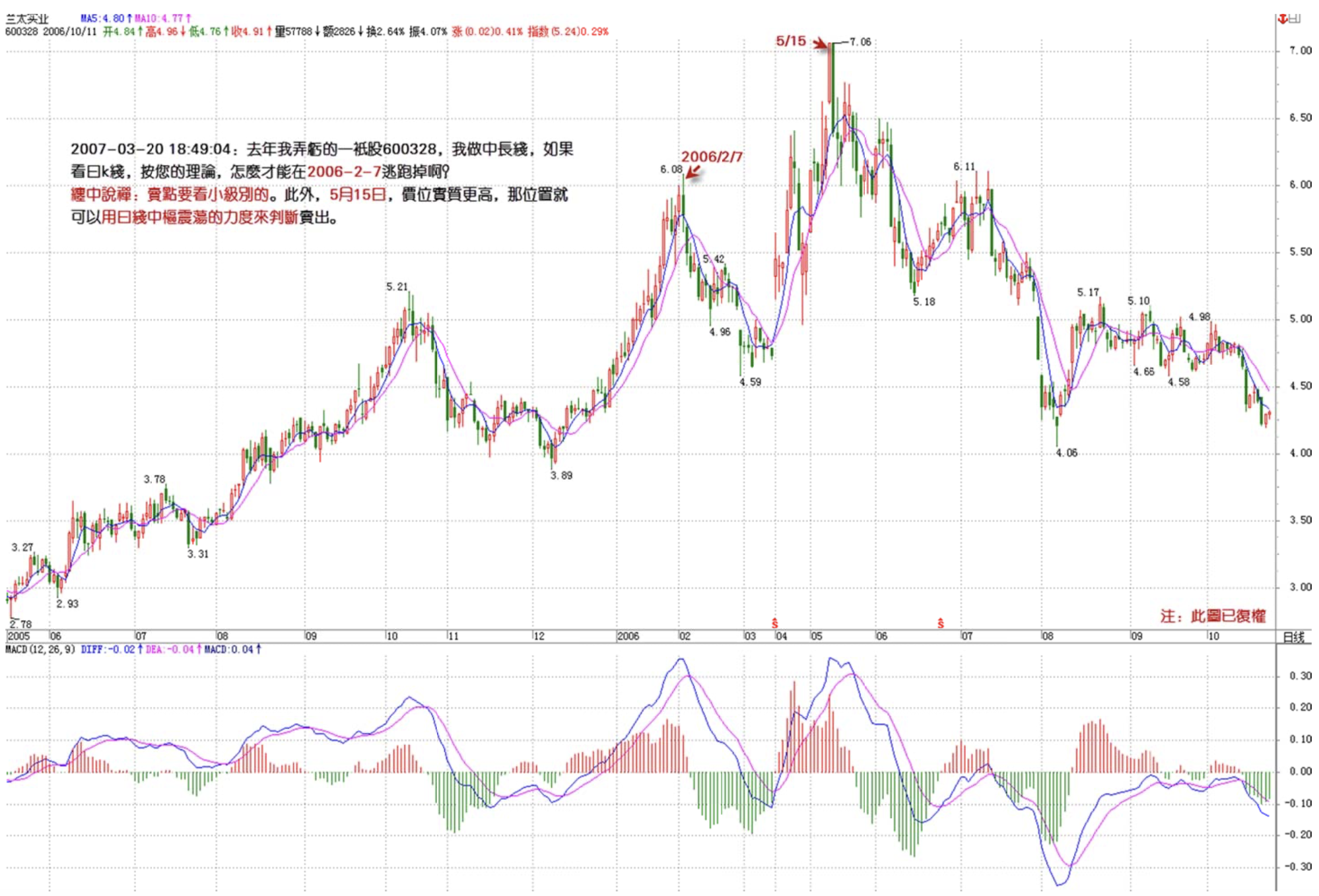
Hello Sister Chan. I lost money last year on 600328. I hold for the medium-to-long term. Looking at the daily K-line, using your theory, how could I have escaped on 2006-2-7? (It seems like there was no sell point visible at that time!)
==
Sell points need to be identified at smaller levels. Additionally, on May 15, the price was substantively higher — at that position you could use the daily-level hub oscillation force to determine the sell.
缠中说禅 2007/3/20 18:49:29
Must leave now. Goodbye.
缠中说禅 2007/3/20 18:55:11
[Anonymous] 勇敢的心
2007-03-20 18:49:09
May I ask Master Chan: regarding third buy points, on the daily level, does the sub-level necessarily have to be a 30-minute trend? And does this trend need to be "perfect"?
==
Let me answer this before I leave. The key is how your levels are arranged. For example, if you arrange levels as 5-minute, 15-minute, 60-minute, daily, weekly, etc., then the sub-level would be 15-minute. The point of arranging levels is to avoid the hassle of looking all the way up from the smallest level — this introduces some margin of error but doesn't affect any operations, making it a practical approach.
Of course the trend needs to be perfect. The essence of "perfect trend" is that the corresponding level's hub must form. If you don't even have a 30-minute hub, how can you call it a 30-minute trend? Once the hub forms, the trend is "perfect" and can end at any time. Whether it extends is another question entirely.
缠中说禅 2007/3/20 18:56:30
Must leave now. Goodbye.
缠中说禅 2007/3/20 15:24:15
Today's market action was the most appropriate. Last time it hit 3000, it was a one-day trip. Now at least it's a two-day trip. Consolidating on lower volume here to stabilize before seeking another upward push is the most prudent approach. Actually, 3000 is nothing — just a psychological issue, for both retail investors and regulators. The regulators' competence, frankly, is often worse than even retail investors'.
The traitors will definitely be working hard here. Previous times they liked to coordinate with verbal attacks, but doing the same this time would be too boring. Could the traitors really reach satisfaction just with their mouths? In any case, we wait here to see what tricks the traitors can pull — best if they use all their tricks so retail investors can gain more experience and psychological resilience.
Nothing much to say about individual stocks. BOC and others are resting, while other stocks are active — this is the best scenario. But a reminder: if you're holding medium-term, apart from using partial positions for short-term swings, you need to hold steady. Just because a stock can hit the daily limit doesn't necessarily make it a good stock. What does a daily limit mean? What matters is how much it ultimately rises. Like the stock a certain uncle couldn't hold onto, 600195 Zhongmu, which went from just over 3 yuan in April last year to 11 yuan — it never once hit the daily limit, yet that didn't stop it from quintupling in less than a year. If a stock has doubled and never once hit the daily limit, there's only one possibility: it's going to quintuple or even tenfold, and therefore doesn't deign to show off with daily limits.
Stocks that repeatedly oscillate and climb are the crème de la crème — you can extract countless short-term swings. The question isn't whether this stock has hit the daily limit, but: does this stock have big oscillations? And does it have great ultimate potential? You must get these questions clear. Those who chase daily limits every day will forever be retail investors — any sizable fund simply cannot operate that way.