Teaching You to Trade Stocks 38: Same-Level Decomposition of Trend Type Connections
2007/3/21 15:23:21
From a purely operational perspective, since all buy/sell points ultimately boil down to first-type buy/sell points of some level, as long as you understand how to identify divergence, then choose an appropriate level, buying at bottom divergence and selling at top divergence — this single trick alone is enough to do well in the market. However, one should always trace things to their roots. It's like practicing sprints — at the end, improving by even 0.01 seconds becomes difficult. So the further you go, the greater the difficulty and complexity. If you can't digest something at the moment, choose what you can grasp, first select your operating model based on what you understand, and after gaining more market experience and discovering more problems that need solving, once you have intuitive feel, then come back and review — this is also a valid learning approach. Of course, if you can understand everything and immediately put it into practice, that's best.
Previously, we discussed the multiple interpretations issue of trend type connection and combination. Although I've repeatedly emphasized that multiple interpretations is not ambiguity, many people still misunderstand and think trends can be decomposed randomly — this is incorrect. Multiple interpretations is closely related to the real-time nature of trends, but when performing corresponding decomposition of completed trend type connections, it's like setting different parameters for a problem — while parameter setting has some arbitrariness, a good parameter setting often makes the problem much simpler to solve. According to the associative law, choosing an appropriate trend decomposition is crucial for grasping the current trend. Obviously, a good decomposition must guarantee uniqueness of decomposition under its rules; otherwise, this decomposition can absolutely never be a good one. The simplest approach is same-level decomposition. So-called same-level decomposition means decomposing all trends into trend types of a fixed level. According to the "Chan Theory Trend Decomposition Theorem," same-level decomposition has uniqueness — there is no possibility of ambiguous random decomposition.
The application of same-level decomposition has been extensively discussed before. For example, if you use 30-minute level as your operating standard, you can use 30-minute level decomposition for operations. For any chart, decompose it into consecutive segments of 30-minute trend types, and in your operations, only select uptrend and consolidation types while avoiding all downtrend types. Under this same-level decomposition perspective, you always focus on only one same-level hub being completed at any given time. Once that hub is complete, you move on to the next same-level hub. Note that in this type of same-level decomposition, the concepts of hub extension or expansion are not needed. For the 30-minute level, as long as three segments of 5-minute level up-down-up or down-up-down types have overlapping price ranges, they form a hub. If these 5-minute sub-level segments extend to 6 segments, then treat it as a connection of two 30-minute consolidation types. In this type of decomposition, consolidation + consolidation is allowed. Note that the previous statement about not allowing "consolidation + consolidation" was under non-same-level decomposition rules, which will be covered in later lessons, so don't confuse them.
Some may immediately ask: does the sub-level decomposition of a same-level decomposition also have to be same-level? The answer is: it doesn't need to be. This might be hard to wrap your mind around, because most people like to uniformly apply one principle across all levels. But in practice, you can adopt this form of decomposition: only use same-level decomposition at a certain level, while continuing to use hub expansion, extension, etc. to determine its sub-levels. This only involves a question of combination rules, and the rules of combination are meant to facilitate operation and judgment — as long as they don't violate the associative law of connections and the uniqueness of decomposition, they are permissible. The key question is whether they are clear and easy to operate.
Going deeper, the difficulty in trend decomposition and combination lies in the fact that trends have levels, and higher-level trends are composed of lower levels. There are two most fundamental methods for handling trends: one is purely based on hubs, the other purely based on trend types. But the more effective approach is to combine them across different levels. Therefore, it is completely reasonable and doesn't violate any theoretical principles to formulate such a same-level decomposition rule: at a certain level, hub extension is not defined, and consolidation + consolidation connections are allowed at that level; simultaneously, for all levels below that level, hub extension is allowed and consolidation + consolidation connections are not allowed; as for levels above that level, they are completely disregarded, since all trends are decomposed at the designated level.
Following the above same-level decomposition rules, using the associative law, it's easy to prove that the decomposition under these rules is also unique. This type of decomposition is very advantageous for mechanized operations. Here, there's no such thing as bull or bear markets. For example, if the decomposition level is set at 30 minutes, then as long as 30-minute moves are upward, it's a bull market; otherwise, it's a bear market. The actual market trend doesn't matter at all — under this decomposition perspective, the market is effectively dismembered into consecutive segments of 30-minute trend type connections. Decompose like this, operate like this, and that's all there is to it.
Note that this method or decomposition can be incorporated into a larger operating system. For example, if your capital is of a certain scale, you can designate a certain amount of positions to operate according to one level's decomposition, and another amount according to a larger level's decomposition. This way, it's like running a partitioned money-making machine, mechanically sucking blood from the market according to a prescribed rhythm. With such continuous mechanical operations, costs will keep decreasing, and the power of such mechanized operations is tremendous.
In fact, there's absolutely no need to worry about how much any individual stock goes up — as long as it's sufficiently active with large up-and-down oscillations, the profit from such mechanized operations is proportional to time. Given enough time, it will generate greater profits than any one-directional rising stock. You can even perform data analysis on all stocks' movements at a certain level, calculate all historical movements, and select a group of stocks with the historically largest average oscillation amplitude at that level, then continuously operate on them — the results will be even better. This decomposition method is particularly suitable for small capital with ample time doing full-position operations, also suitable for large capital doing a certain amount of spread trading, and even more suitable for market makers doing washout operations to reduce costs. Of course, the specific application methods differ for each, but the principle is the same.
The specific operating procedure, listed for the most general situation, is as follows — note, this is a mechanized operation, just follow the procedure: Let's start from a downward divergence, using a 30-minute level decomposition as an example. Under 30-minute same-level decomposition, the first segment must be an upward trend type. Based on its internal structure, you can determine the end point of its divergence or consolidation divergence, sell first, then the second segment must go downward. Here there are two situations: 1. It doesn't break below the first segment's low — buy again; 2. It breaks below the first segment's low — if it forms a consolidation divergence with the downward segment before the first segment, also buy again; otherwise, continue observing until a new downward divergence appears. In the case where you've re-bought during the second segment, the third upward segment then appears, facing two situations: 1. It exceeds the first segment's high; 2. It stays below the first segment's high. For the second situation, you must sell first; for the first situation, there are again two sub-cases: 1. The third segment forms consolidation divergence against the first segment — sell; 2. The third segment doesn't form consolidation divergence against the first — continue holding. This process can continue indefinitely until the next upward 30-minute trend type fails to make a new high or forms consolidation divergence relative to the previous upward trend type — this ends the upward segment operation. Upward segment operations are always buy-first-sell-later. Once the upward segment operation ends, you enter the downward segment operation. The downward segment operation is exactly the opposite — sell-first-buy-later, starting from the divergence point where the upward segment ended, with all operations reversed.
Replies
缠中说禅 2007/3/21 15:30:14
Anytime
2007-03-21 15:26:33
Some pharma stocks have poor performance and continuous losses — can they still be worth watching?
==
Every sector has first, second, and third-tier stocks. Think back to the liquor movement last year — first-tier moved first, then second-tier, and finally even third-tier ones like Tuopai started moving. By then, the big correction was about due. After the big correction, liquor will rise again — just like last year's non-ferrous metals, still performing this year.
缠中说禅 2007/3/21 15:32:10
[Anonymous] 新手
2007-03-21 15:28:43
Boss:
600343 is moving too weakly — is there still hope?
==
A traitor fund holds an especially large position in 343. What's wrong with making them spit out some shares at low prices? There's no medium-term problem. If that traitor fund hadn't been forced to spit out tens of millions of shares above 10 yuan in 999, could it have developed into this kind of move?
缠中说禅 2007/3/21 15:44:04
[Anonymous] 草草
2007-03-21 15:41:09
I finally understand! Teacher, today's theory got simpler again. Before, I always missed short-term spread opportunities because I was fixated on buy points. Now I know — when a stock breaks above the hub, if there's no divergence you can continue holding, and when divergence appears you sell. When it comes back without breaking the hub's high point you buy again, then when it goes up without exceeding segment b of the hub extension you can sell again, and just keep going back and forth, right?
=
No divergence means the trend type hasn't ended and can still continue, so naturally there's no need to operate.
缠中说禅 2007/3/21 15:50:15
[Anonymous] 漂泊
2007-03-21 15:44:15
Master Chan, why haven't blue-chip power stocks started their move this year? Do they come after financial stocks?
-
Power stocks are being handled by another group of people. This ID was in charge of drinking liquor last year, and this year in charge of taking medicine, while also stocking up some environmental protection, military, agriculture, tourism, and tech stocks for the future. Power, automobiles, and such — this ID simply can't cover everything. The state hasn't given this ID tens of billions to work with, so it's impossible to handle every sector.
缠中说禅 2007/3/21 15:53:20
[Anonymous] 荷塘
2007-03-21 15:47:53
915 seems to have diverged at 13:25 today on the 5-minute chart. I wanted to do a short-term trade but couldn't decide. Please advise.
=
This ID has a rule here: those 14 stocks that this ID has mentioned will not be specifically analyzed, because one can't be both a player and a referee, and also take the job of commentators like Huang Jianxiang — that would be too improper. For specific questions about those dozen or so stocks, you can ask others, and others can answer.
缠中说禅 2007/3/21 15:59:04
[Anonymous] 钢股份
2007-03-21 15:45:21
Your Majesty! Will auto stocks still have potential going forward? 000800 doubled today and I sold everything.
Yesterday on Ping'an Avenue I saw a beautiful girl driving an Audi Q7 SUV, and suddenly I thought of Your Majesty......
-
Actually it would've been better to sell only half, making the rest zero-cost, which would yield even greater profits. After all, many auto stocks are just getting started.
缠中说禅 2007/3/21 16:05:15
[Anonymous] 白玉兰
2007-03-21 15:57:30
Could I ask, dear sister, how is the outlook for zinc in non-ferrous metals?
-
The great bull market in non-ferrous metals will continue for a long time — short-term oscillations won't change the big trend. Domestic zinc futures will be available soon, so a frenzy is inevitable. However, futures risk is bigger than stocks — without sufficient time and experience, it's better to stay away.
缠中说禅 2007/3/21 16:07:12
[Anonymous] 草草
2007-03-21 15:59:41
Teacher, are you in the chat group? I feel like you're in the group — it's like you know what we're thinking!!!
-
Sorry, this ID doesn't have QQ and normally doesn't have time for online chatting, so I can't be in the group.
缠中说禅 2007/3/21 16:13:10
[Anonymous] 勤学好问
2007-03-21 16:05:19
Maybe you missed it, so I'll post again.
From the daily chart of the Shanghai index, hasn't the MACD already had a double zero-axis pullback? There seems to be a possibility of daily uptrend divergence forming, correct?
=
The possibility exists, of course. The line connecting the Jan 24 and Feb 27 highs still hasn't been broken, so technically the traitors do have conditions to make their move. Counting from last year's rally, including the daily hub after May last year, there have already been two. An uptrend showing divergence would be perfectly reasonable, unless another daily hub can be extended above. Patterns are walked out — there's no need to predict anything, and besides, the index isn't that important. From New Year to now, the index hasn't risen much, but why have all 8 stocks this ID mentioned around New Year's basically doubled?
缠中说禅 2007/3/21 16:15:40
[Anonymous] 白玉兰
2007-03-21 16:12:59
Chán Zhōng Shuō Chán
2007-03-21 16:05:15
[Anonymous] 白玉兰
2007-03-21 15:57:30
Could I ask, dear sister, how is the outlook for zinc in non-ferrous metals?
-
The great bull market in non-ferrous metals will continue for a long time — short-term oscillations won't change the big trend. Domestic zinc futures will be available soon, so a frenzy is inevitable. However, futures risk is bigger than stocks — without sufficient time and experience, it's better to stay away.
+++++++++++++
Thank you, dear sister.
A friend recommended Zinc Industry shares — I certainly don't have the means for futures.
-
All non-ferrous are fine. That stock is good too, but the good buy points have already passed. Entering now carries some short-term risk, though medium-term should be fine.
缠中说禅 2007/3/21 16:19:02
[Anonymous] stone
2007-03-21 16:14:10
Can you please explain things one issue at a time?
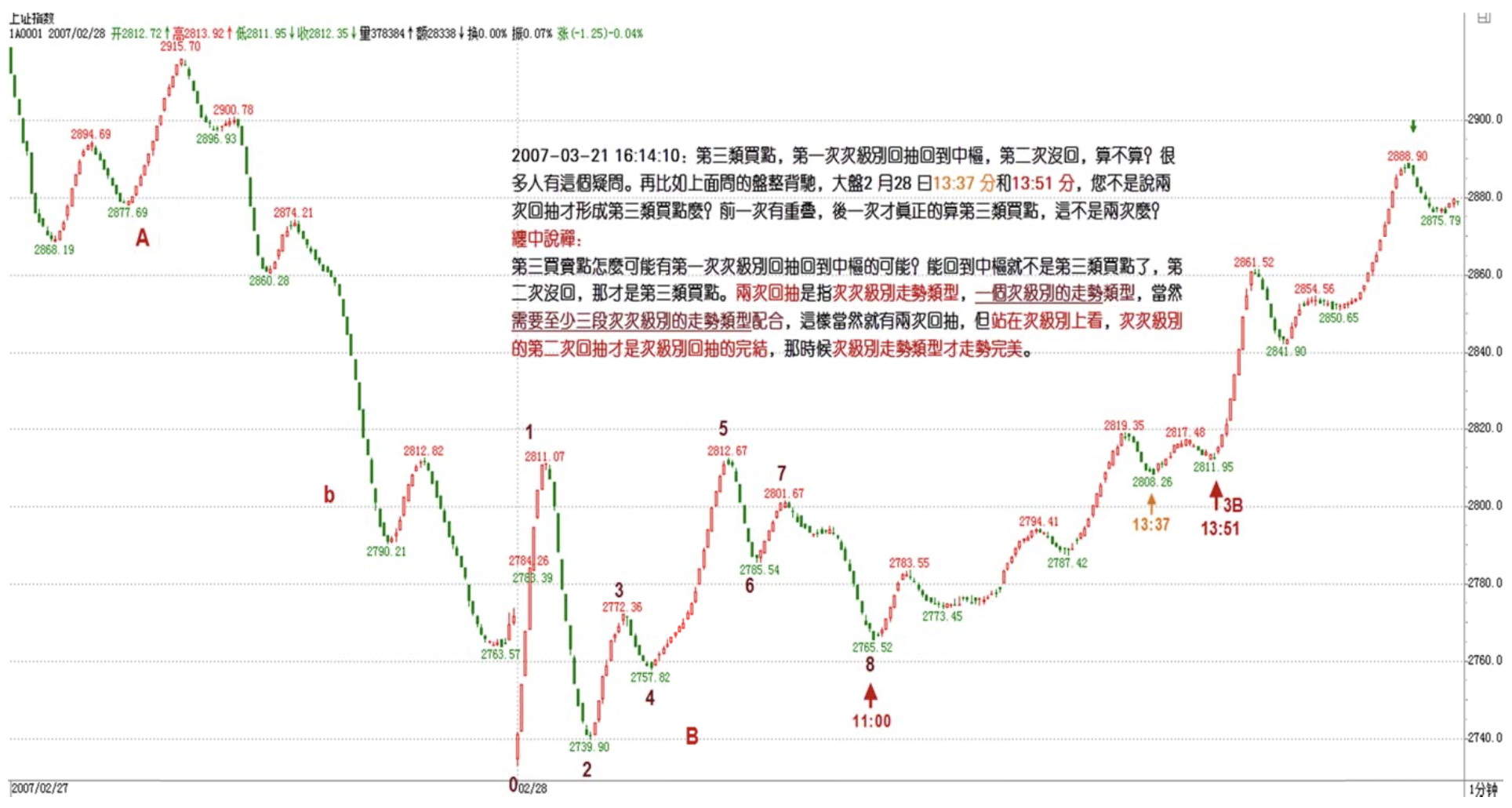
For example, the third-type buy point — if the first sub-level pullback returns to the hub, and the second doesn't, does that count? Many people have this question.
Also regarding the consolidation divergence mentioned above, based on your articles, is it analyzing the consolidation divergence of one segment within the 30-minute consolidation of the March 12 Shanghai chart?
=
How could there be a first sub-level pullback returning to the hub for a third-type buy point? If it returns to the hub, it's not a third-type buy point. The second one that doesn't return — that's the third-type buy point.
缠中说禅 2007/3/21 16:24:40
[Anonymous] stone
2007-03-21 15:41:18
For example, a 30-minute consolidation (forming one 30-minute hub) consists of three 5-minute trend segments A, B, C, where segment C is currently in progress. My questions:
- For judging consolidation divergence, should I look at the 5-minute or 30-minute chart? If looking at the 5-minute chart, is it analyzing segment C internally? How do I compare segments A and C?
- I recall you said that when the yellow and white lines have just crossed above the zero axis, divergence cannot be determined — is this specifically for consolidation divergence?
=
If using MACD to judge, looking at the 5-minute chart is generally clearer. The comparison is of course between A and C, and you can also reference C's internal structure to determine the precise position — the principle is the same as the nested interval method for divergence segments.
缠中说禅 2007/3/21 16:29:42
[Anonymous] stone
2007-03-21 16:23:48
------The issue is you defined the third-type buy point as requiring the first pullback.
Also, could you answer my consolidation divergence question? Thanks.
=
Your understanding has a problem. If it falls back into the hub, that doesn't even count as a pullback — it's still oscillation around the hub. The first pullback that doesn't return to the hub is the third-type buy/sell point. Going up and pulling back again, if it similarly doesn't return to the hub, that's no longer a third-type buy/sell point. The third-type buy/sell point is the same thing as the end of hub extension — there are strict mathematical definitions regarding hub extension ending in previous lessons, which you can reference.
缠中说禅 2007/3/21 16:38:40
[Anonymous] stone
2007-03-21 16:29:03
From the article: "Taking the upward case in consolidation as an example (the downward case is the reverse). If segment C doesn't break the hub, once the MACD histogram area of segment C is less than segment A's area, a pullback must follow. More complex is when segment C breaks above the hub but the MACD histogram area is less than segment A's — the principle then is to exit first. Afterward, there are two scenarios: if the pullback doesn't fall back into the hub, buy back at the sub-level first-type buy point — this actually constitutes a third-type buy point at that level; otherwise, the consolidation continues."
If segment C has to make a new high, how can it possibly not break the hub? How should this be understood?
-
Segment C doesn't necessarily make a new high — there's no rule that in three segments A, B, C, C must be higher than A. Whether it's consolidation divergence or divergence, what's being compared is the force. If it can't even make a new high, that's the weakest force, which naturally won't work either. In this case, you don't even need MACD as an auxiliary tool. MACD is mainly for assisting with cases where new highs are made.
缠中说禅 2007/3/21 16:54:06
[Anonymous] 大毛
2007-03-21 16:46:43
Chan Chan:
I've been following closely. You once mentioned "steel is last year's liquor" and it made sense. But my theoretical understanding is still lacking. I felt 580010 diverged and bought in, but I've been stuck since. Should I hold on?
-
Steel is last year's non-ferrous metals, and pharma is last year's liquor. The Masteel warrant shouldn't be a problem — with this kind of amplitude, one day's rally can easily get you unstuck.
缠中说禅 2007/3/21 16:56:34
[Anonymous] 新手
2007-03-21 16:49:31
[Anonymous] stone
2007-03-21 16:14:10
Can you please explain things one issue at a time?
For example, the third-type buy point — if the first sub-level pullback returns to the hub, and the second doesn't, does that count? Many people have this question.
Master Chan: On Feb 28, at 13:37 and 13:51, didn't you say two pullbacks were needed to form the third-type buy point? The first one had overlap, and the second was the real third-type buy point — isn't that two times?
==
The two pullbacks refer to the sub-sub-level. A sub-level trend naturally requires at least three sub-sub-level segments, which means there will be two pullbacks. But from the sub-level perspective, the sub-sub-level's second pullback is only the completion of the sub-level pullback — that's when the sub-level movement is complete.
缠中说禅 2007/3/21 17:00:23
It's 5 o'clock. Signing off, goodbye.
缠中说禅 2007/3/21 15:24:07
Nothing much to say about the market. If you can't read it, just watch the 5-day moving average — as long as it isn't broken, there's no problem. Of course, the traitors will still make moves. They especially like to strike on Thursdays. This ID very much welcomes the traitors to make their move — best if they dump all their shares below 3000 points and then leave China to be lackeys in America.
Bank of China continues to rest today, waiting for the 5-day moving average to catch up. This kind of large-cap stock can't stray too far from the 5-day MA. After all, financial stocks are the traitors' home base — if the attack is too aggressive, the traitors will go mad, and vomiting all over the place would disgust everyone.
Nothing much to say about individual stocks — same sectors, same stocks. Of course, besides those 14 stocks, along with China Unicom and BOC, this ID has recently been sneaking off to dabble in a few more, using this ID's cost-reduction method. The end result is more and more money while the position sizes don't shrink, so one must oversee more accounts to satisfy things. I won't go into specifics — they're basically all Beijing local stocks, with many acquaintances and reliable information.
Those 14 stocks — the first 8 mentioned around New Year's have basically all doubled, with some already marching toward tripling. The rest will follow. The key is whether you can follow this ID's advice: hold and use part of the position for short-term trades. If you can, your cost should keep decreasing, making you forever undefeatable.
Thursday and Friday will inevitably see bloody battles — let's see how the traitors make their move. This ID will be waiting. Worst case, another round of oscillation. This ID will play with the traitors for 20 years, all the way up to 30,000 points. There's plenty of time — this ID isn't in a rush.