Discerning Chen Jianmin's "Small and Great Vehicle Practice of Emptiness and Esoteric Mahamudra, Dzogchen, and Chan Discernment" — Part One (Upper)
2007/1/16 15:09:50
Chen Jianmin practiced austerities for over twenty years in the Himalayas, after which his Dharma spread across the four seas and his relics were countless. To engage in such ascetic practice in this turbid world is truly rare. However, relics and ascetic practice are not the root. His teachings have many points worthy of subtle discernment, and therefore this ID undertakes this discernment of Chen Jianmin's "Small and Great Vehicle Practice of Emptiness and Esoteric Mahamudra, Dzogchen, and Chan Discernment." Chen has many Dharma descendants, and this ID enters muddy water to stir up tangled vines — muddying the muddy water, tangling the tangled vines — it is both non-play and play. For convenience, the original text is quoted and then discerned after double horizontal lines.
This text should be divided into a General Discussion and Detailed Discussion, to elucidate the important implications of this topic, enabling readers to have a systematic understanding of the Small, Great, and Esoteric three vehicles of Buddhism as a coherent whole, and to understand the particular superior points of each practice, so that one can know where one's own feet stand — neither boasting nor being self-deprecating.
====
All dharmas are Buddha-Dharma. The Small, Great, and Esoteric three vehicles arise according to the capacities of beings. When capacity meets its match, green mountains fill the eyes; when capacity does not meet its match, the eyes are filled with green mountains. Chan ascends the solitary peak alone while the thousand sages do not transmit — not that they do not transmit, but I ask: where does a footless person stand?
I. General Discussion
The Small and Great Vehicle practice of emptiness, and the Esoteric Vehicle's Mahamudra, Dzogchen, and Chan all belong to the liberation path. The liberation path is spoken of in contrast to the desire path. Though this twofold division of the path exists within the Esoteric Vehicle, the Small and Great Vehicle practice of emptiness also serves as the foundation of the Esoteric Vehicle's liberation path. What the liberation path values most is the view; what the desire path favors is vital energy. Therefore one must understand the differences between the liberation path and the desire path in practice.
=================
The twofold division of liberation path and desire path forcibly splits one into two. Even the one cannot be established — how much less the two? Chan does not depart from greed, anger, and ignorance; there is nothing to be liberated from, and no liberation is sought. Vital energy or not, view or not — how can emptiness be empty?
(I) One must first know the different views of the Small, Great, and Esoteric three vehicles
- The Small Vehicle practices emptiness based on the view of "no-self of persons" — understanding that pudgala (i.e., sentient beings) have no self-nature. From this, one practices and realizes the four fruits of liberation, attaining the partial emptiness of nirvana.
=========
Both emptiness and existence are mere prattle. If we discuss emptiness and existence, Small Vehicle nirvana is truly not partial emptiness but rather clinging to existence — grasping at existence where there is none, settling for the phantom city without ambition. Though they speak of liberation, it is not liberation — vainly seeking to leave birth and death and escape birth and death, they are still subject to the birth-and-death of birth and death.
- The Great Vehicle practices emptiness based on the view of non-arising — understanding that all dharmas have no self-nature. Using multiple approaches to investigate: non-arising, non-ceasing; non-interruption, non-permanence; non-coming, non-going; non-unity, non-difference — breaking the Small Vehicle's exclusive attachment to "no-self of persons" and its taking the Four Noble Truths and Twelve Links of Dependent Origination as truly real. It also breaks the Great Vehicle Yogacara school's attachment to consciousness-marks, definitively establishing: mind, objects, and all dharmas are nothing but non-arising.
======
The Madhyamaka school fuses emptiness and existence; the Yogacara school clings to neither emptiness nor existence. Madhyamaka and Yogacara differ in name but are the same in substance. Those who create a chasm between Madhyamaka and Yogacara do not truly understand either.
- Mahamudra is based on the view of co-emergent wisdom — this view is also called the Dharmakaya view. Understanding that all dharmas are this very non-arising, the co-emergent luminous essence. One preserves, solidifies, applies, and purifies this luminous essence, without needing to separately cultivate the various antidotes of transforming and discarding, nor requiring the extended investigation of the eight negations — because all dharmas, from their luminous essence, are originally co-emergent wisdom.
======
Treading beyond Vairochana's crown — the Dharma body is bullshit, bullshit is the Dharma body. Not preserving, not solidifying, not applying, not purifying — sink into Avici Hell and never be reborn. Who is it that preserves, solidifies, applies, and purifies?
- Dzogchen is based on the view of primordial purity — this view is also called the Dzogchen view. All dharmas have been pure from the very beginning, with no discriminating defilements such as birth and death or nirvana. No bondage, no liberation, no practice, no realization — self-arising, self-manifesting, spontaneously at ease. Seeing is practicing, practicing is acting, acting is fruition — at the very moment dharmas arise, their self-nature is instantly the Great Perfection.
============
In the "non" there is the "immediate"; the immediate does not depart from the non. Dharmas have no moment of arising and no place of cessation. There is bondage, there is liberation, there is practice, there is realization — non-view, non-practice, non-action, non-fruition. Not pure, yet greatly pure; not complete, yet greatly complete. Birth and death are nirvana; nirvana is birth and death — where is there anything incomplete? Who seeks completeness, and when?
- Chan does not establish any view; it reveals itself through the function and dynamic of fruition's virtue — Chan does not establish words or phrases, does not permit an affirmative path, does not permit hesitation, does not permit meditative concentration, does not permit intellectual understanding. It directly transmits and receives through realized quantity, and reveals essence and function through realized quantity.
====
Not establishing is establishing everywhere — where does "not establishing" come from? Not permitting is permitting everything — where does "not permitting" come from? Realization has nothing to realize; quantity cannot be measured. Realized quantity is non-existent; transmission and reception are not nothing. No essence yet great function; no function yet great essence — how can essence and function be divided?
(II) Next, one must know the different styles of practicing emptiness in the Small, Great, and Esoteric vehicles
- The Small Vehicle practices the emptiness of no-self of persons, with emphasis on analysis.
==========
The Small Vehicle practices what is non-practice, generating various states of experience, and from such states generates such views. Small Vehicle views arise from its practice and have nothing to do with analysis. Without the Small Vehicle foundation, it is merely empty talk to discuss the Great Vehicle — there is no justification for it.
- The Great Vehicle practice of emptiness, because it must simultaneously cultivate the Six Paramitas and Four Methods of Gathering, requires a very long time for accomplishment. Being closely involved with sentient beings, the contaminating conditions are heavy and demonic obstacles easily arise. If one encounters sentient beings who have broken precepts — even drinking water from the same river as such beings, the sutras say, produces contamination. Yet for the bodhisattva, this is willingly accepted with full knowledge. Furthermore, in order to save sentient beings, one sacrifices one's life without hesitation, lifetime after lifetime sacrificing oneself for others — this causes the time to be prolonged. This is how its style of practicing emptiness inherently differs from the Esoteric Vehicle.
====
How are sentient beings contaminated? How are Buddhas pure? Not a single sentient being to save — where does sacrifice come from? Time is originally empty, all antiquity is one moment — where is the delay?
- The style of Mahamudra's practice of emptiness has instructions, has lineage, has empowerment, and also has stages — it is cultivated in four phases. Combined with the practice of consort union, it can transform the body into light.
===========
Light swallowing all things is still standing beneath the steps. A hundred tricks deployed — they only add a laugh.
- Dzogchen does not establish the four yogas; it is extremely sudden and transcendent, but emphasizes the view of primordial purity. Combined with tögal, it can also transform the body into rainbow light.
====
Without origin, how can there be coming? With coming, what origin? Without "original coming" — impure — who sees? Seeing what is impure, seeing what is not original? Seeing that origin does not come, origin comes without seeing. Seeing has no place of seeing; what is seen has no seeing — what is heavy, what is light?
- Chan emphasizes thoroughness in dynamic functioning. It does not even employ the view of primordial purity; beneath the staff-blow and shout, one becomes Buddha on the spot. The above two aspects — views and styles — have been comprehensively and roughly discerned for these five approaches. The following detailed discussion provides graded and subtle discernment.
====
Who is it that does not employ? Not employing whom? There is no Buddha to become, no ground to stand upon — futilely wielding the staff and shout, vainly brandishing sharp exchange. To seek Chan in staff-blows, shouts, and sharp exchanges is nothing more than the blind man groping the elephant, the fool drawing a cake.
(To be continued)
Replies
缠中说禅 2007/1/16 15:25:06
[Anonymous] 摄影之友
2007-01-16 15:20:56
In the chart it's a standard triangle pattern. Generally, when a hub extends in a converging formation, it will form a triangle shape — this will be discussed later.
_____________________________________________
Blogger, regarding the converging triangle you mentioned — as a liberal arts person, I think it means "accumulating strength for a thin burst." Am I right?
===
Triangles can also form tops. You must follow the most precise procedures. Liberal arts thinking might cause trouble here. For market operations, mathematical thinking is better.
缠中说禅 2007/1/16 15:25:34
[Anonymous] 无知
2007-01-16 15:15:30
Chan MM, I still don't feel I understand how to judge divergence. Will there be more lessons on divergence later?
==
Yes.
缠中说禅 2007/1/16 15:37:18
Attention, everyone!
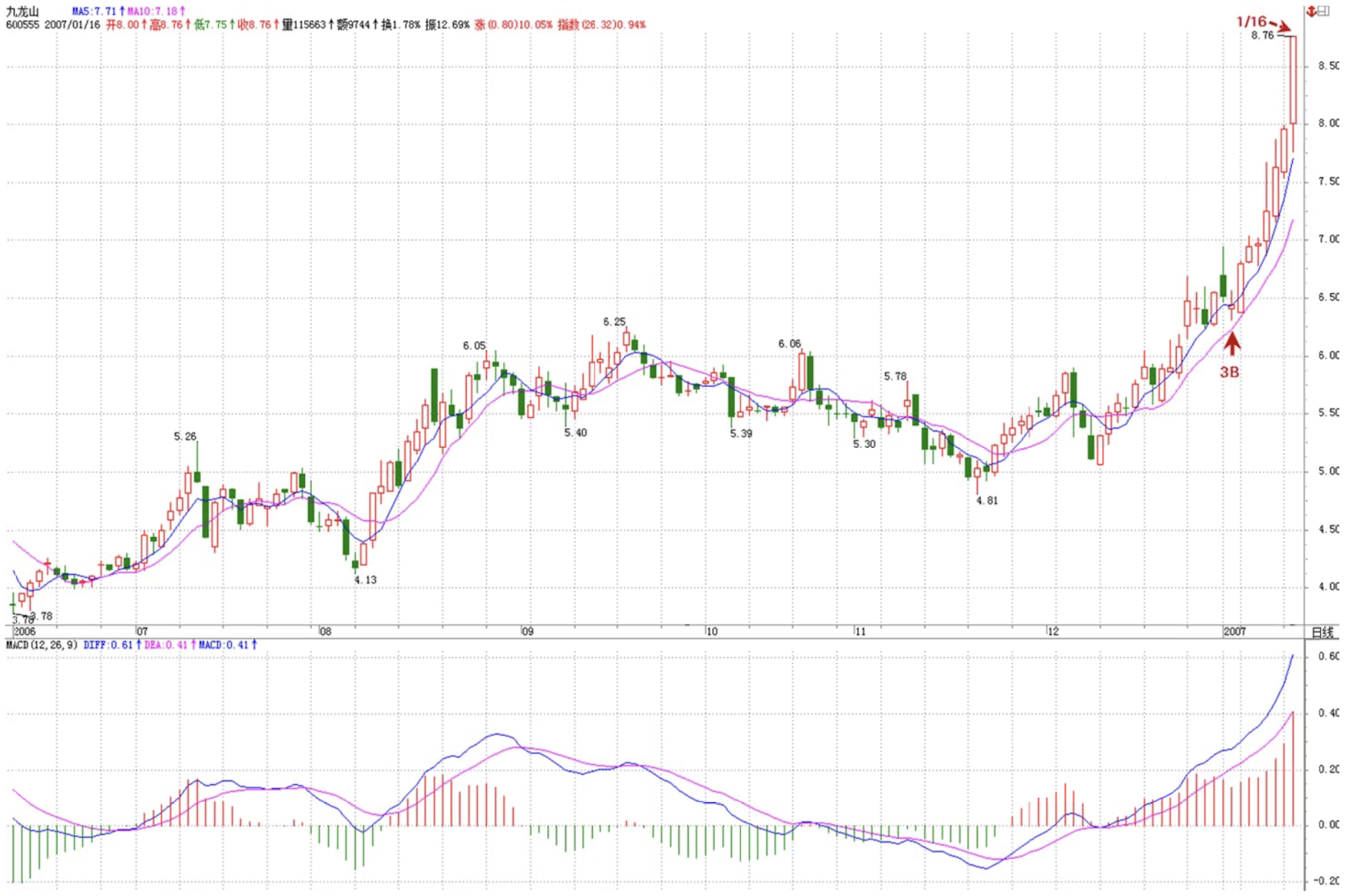
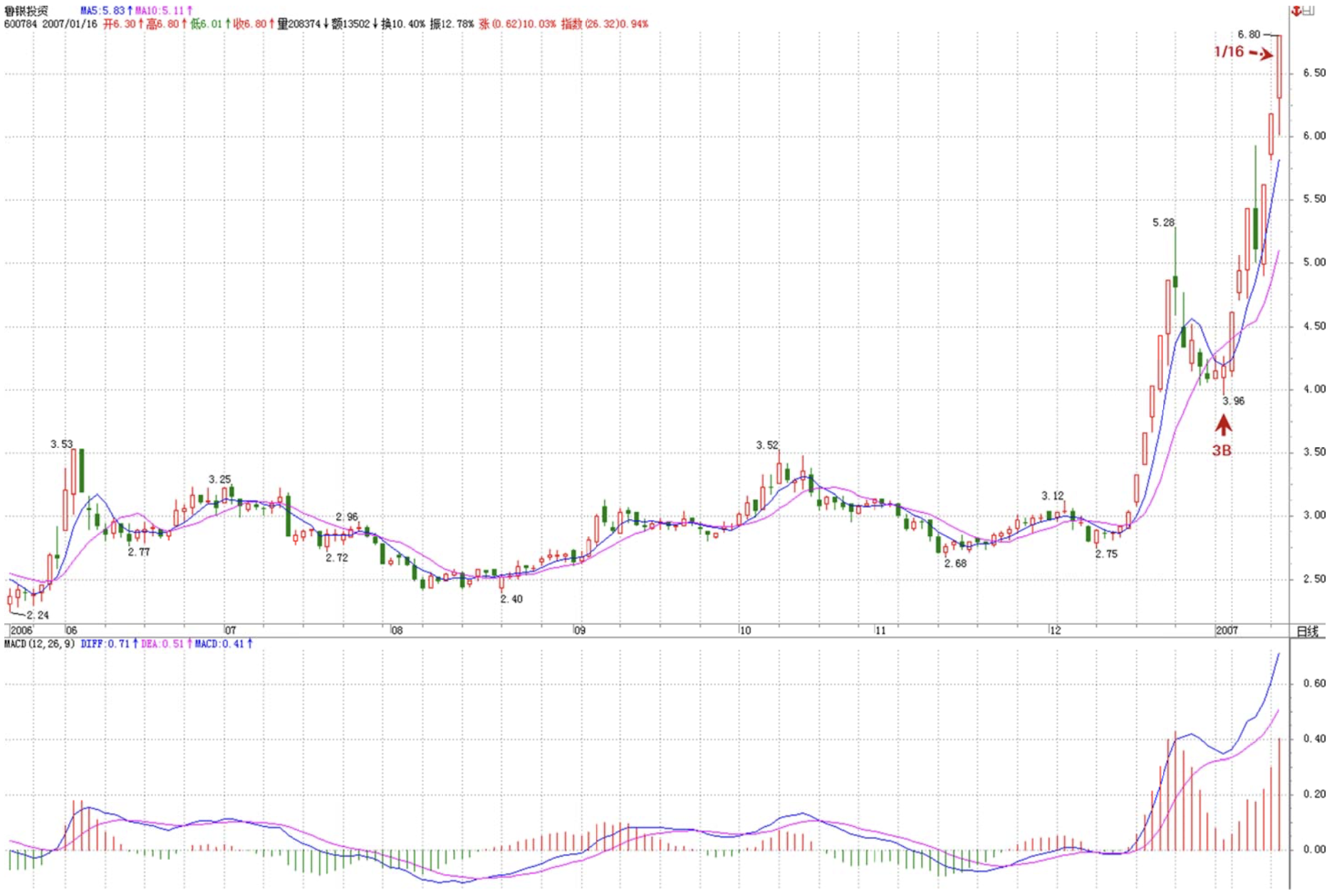
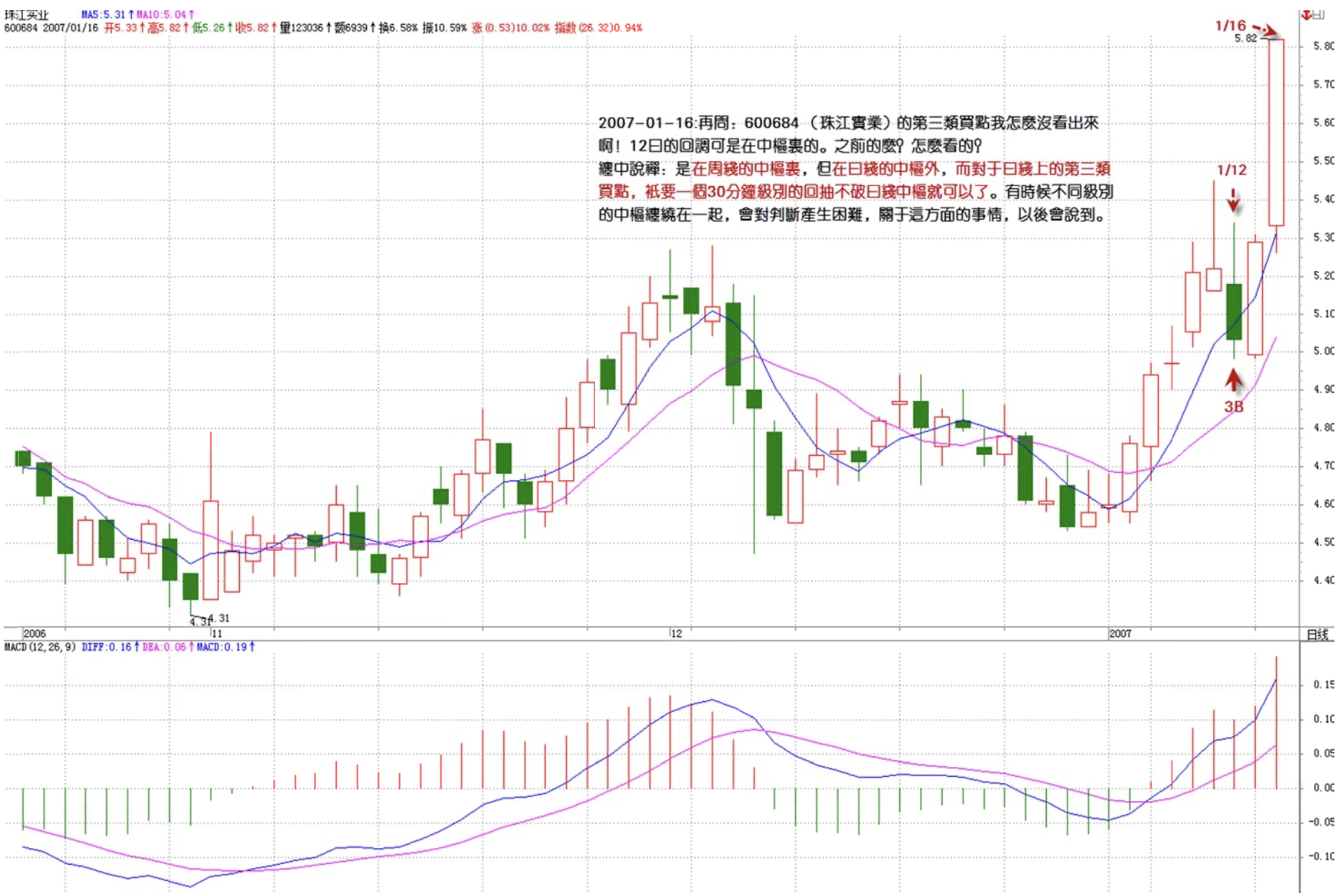
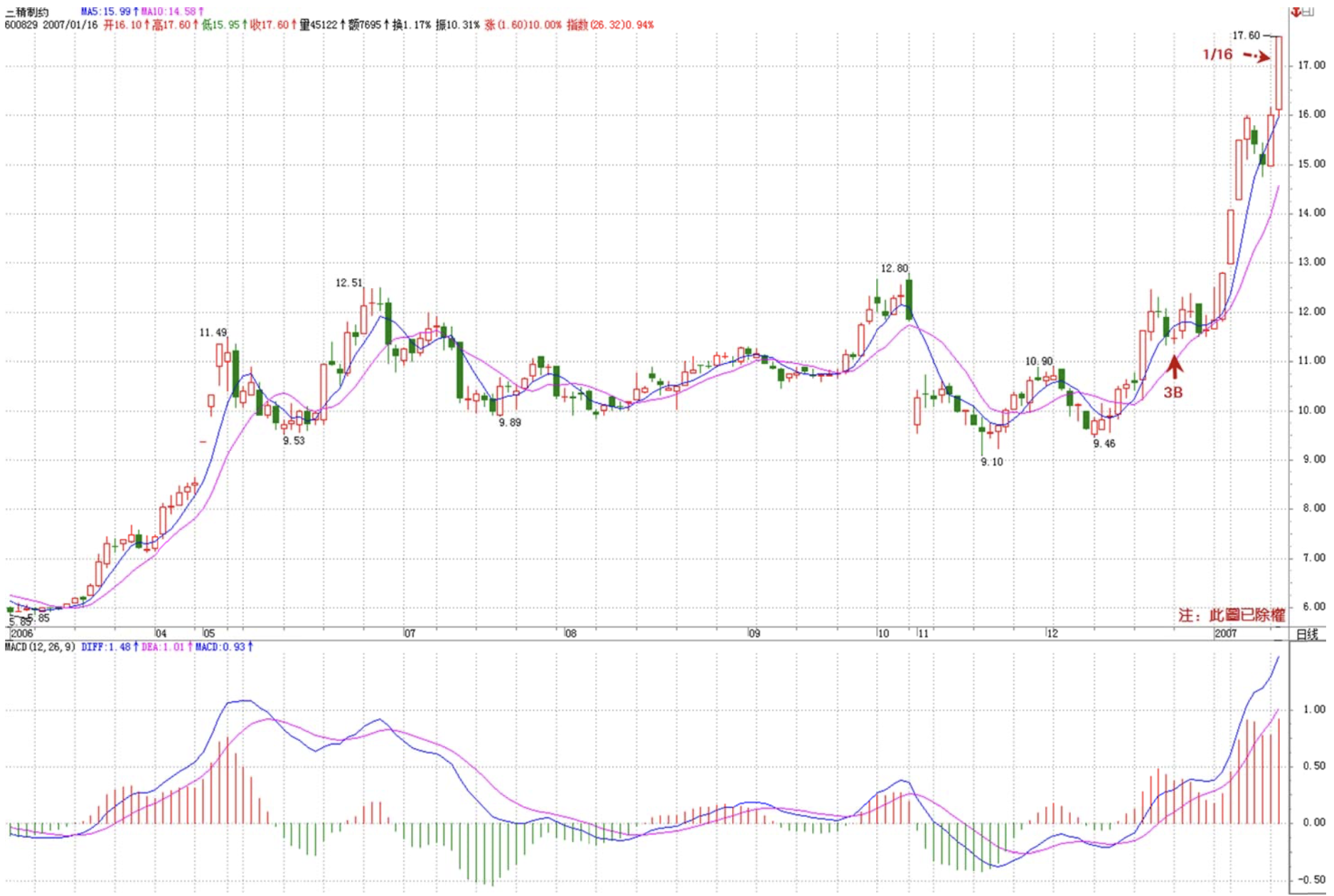
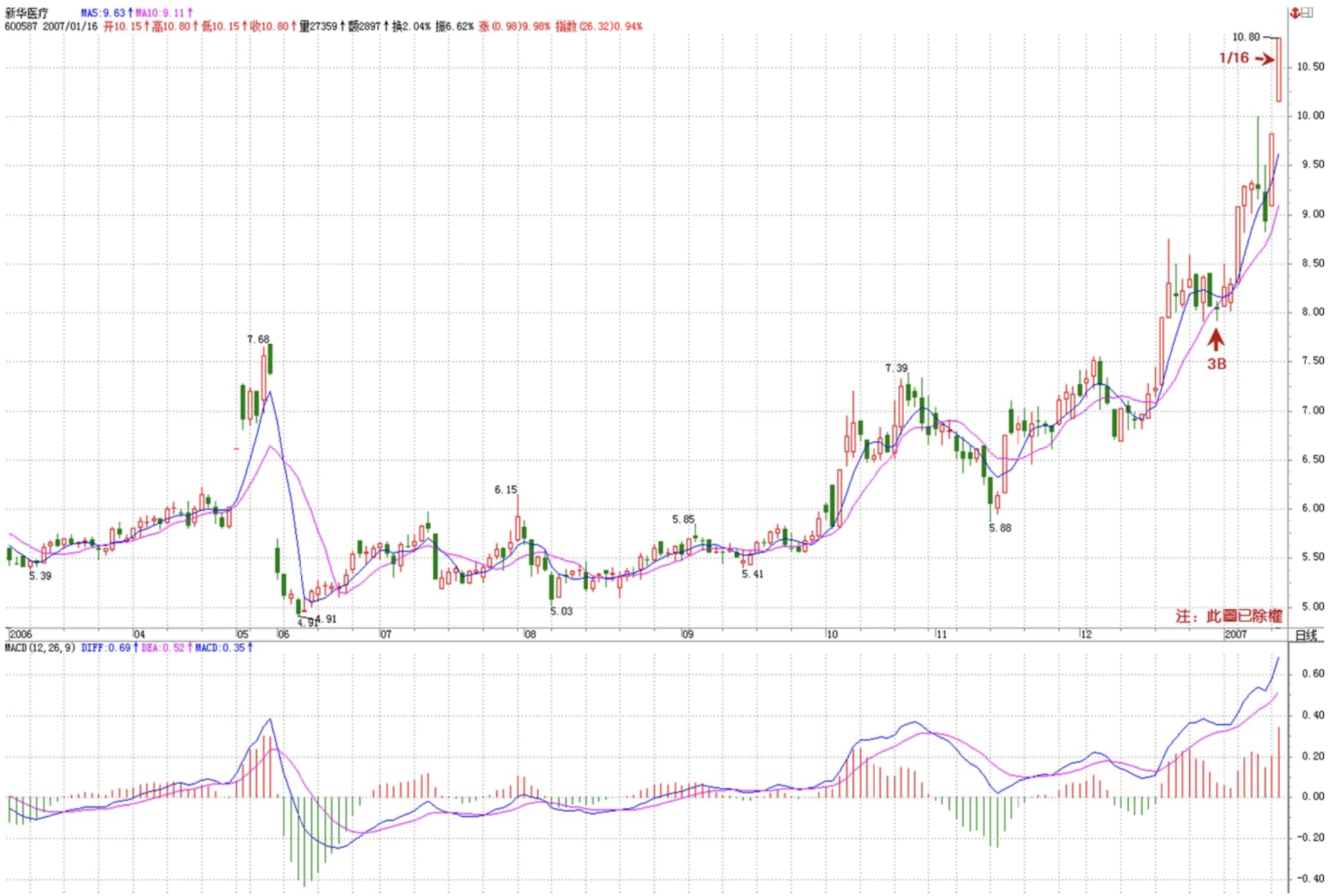
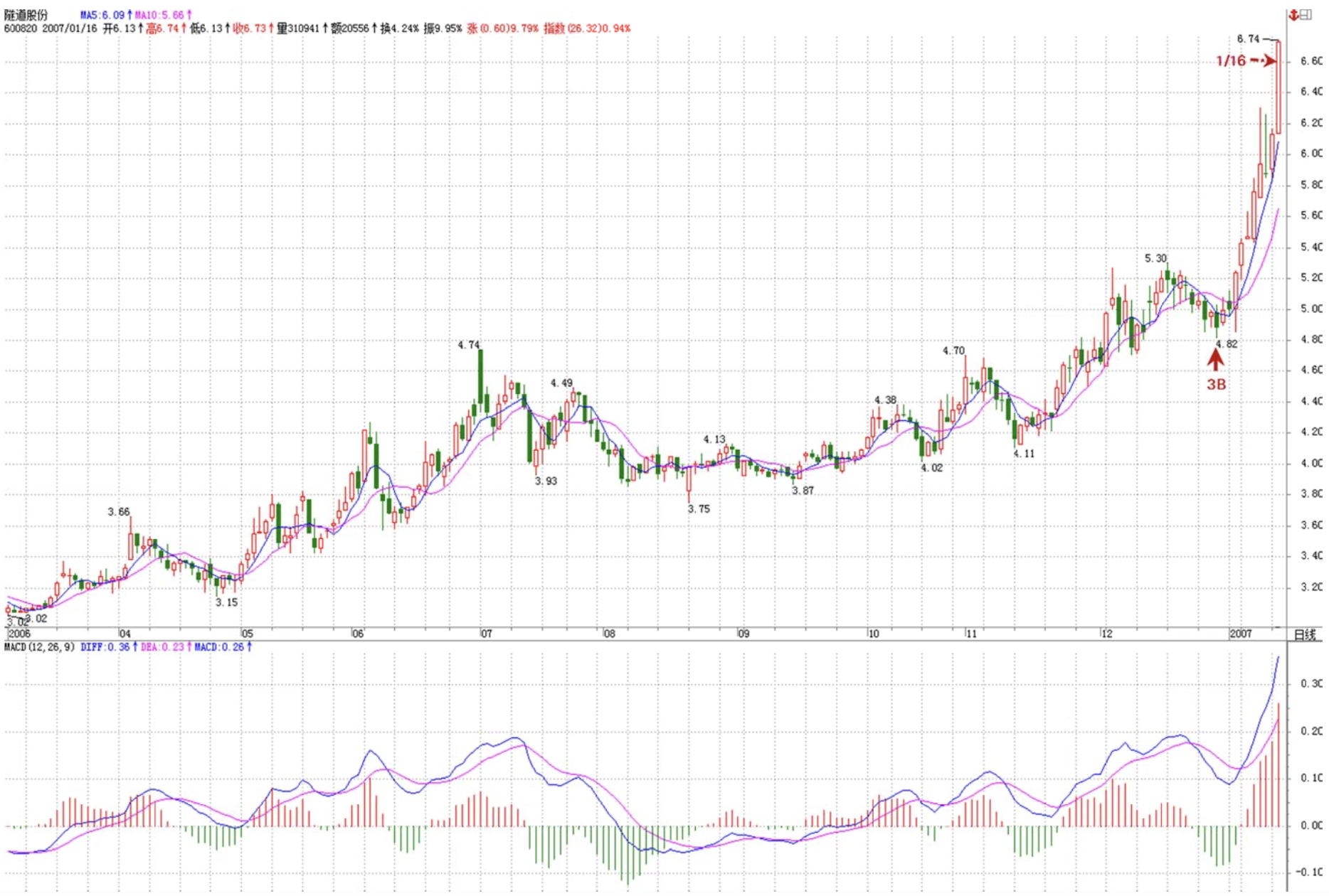
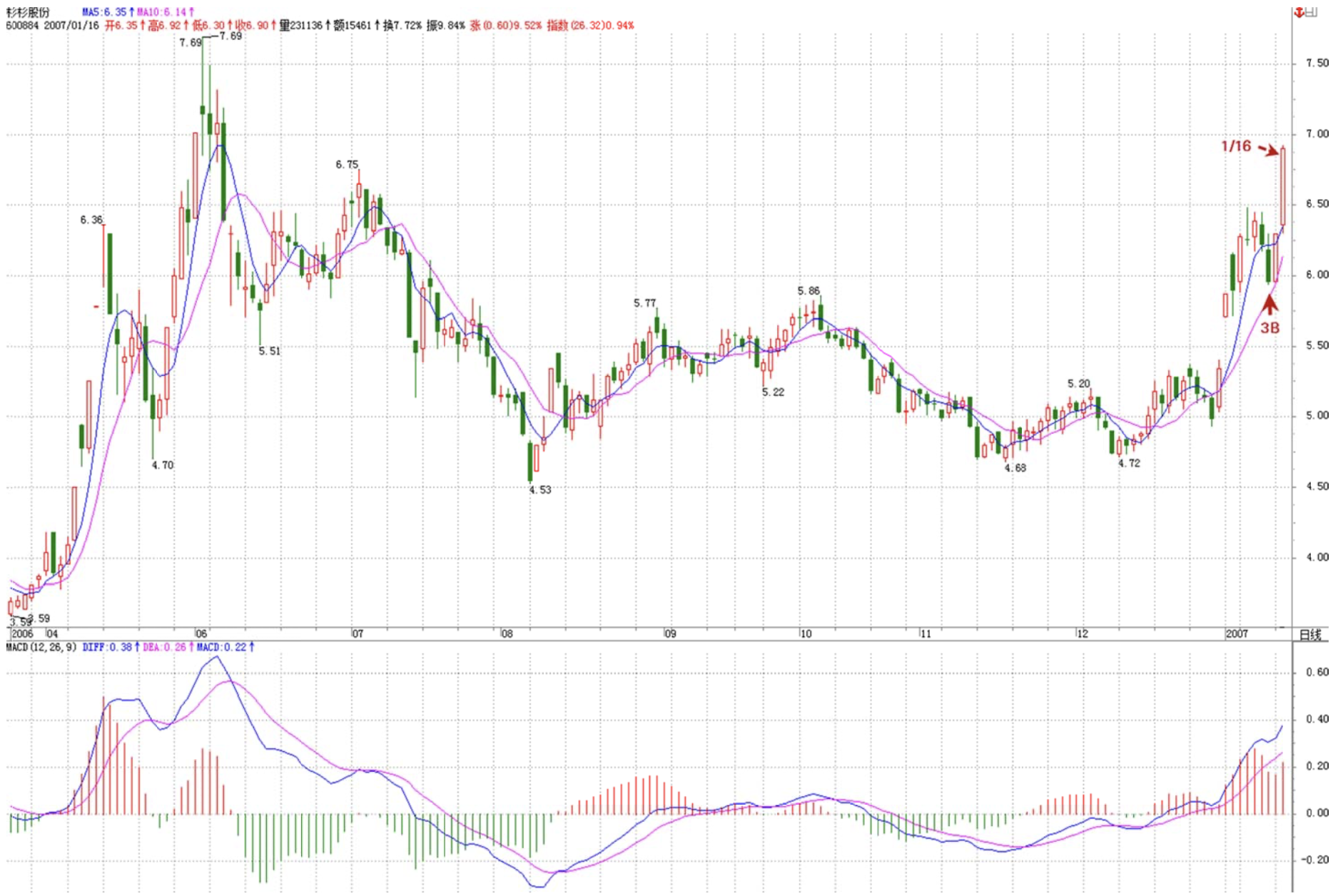
This has been said N times already — right now it's the era of catch-up rallies. Second-tier stocks, especially low-priced ones, are running wild. Find good third-type buy points and you'll be too busy to keep up. What this ID teaches you is the ability to find food, not just handing you a meal. Look at today's limit-up stocks — how many launched from third-type buy points? Just Shanghai, and only the low-priced ones — here are a few off the top of my head:
600608, 600555, 600784, 600684, 600300, 600829, 600587, 600820, 600884
Study these carefully. Just using third-type buy points, you can find more than enough food right now. What you find for yourself is the real skill. The key is to practice this technique well.

缠中说禅 2007/1/16 15:39:15
[Anonymous] 小小
2007-01-16 15:28:55
Hi teacher! I'm always lacking confidence — I didn't hold 600796 again and switched to 600333. I'm kicking myself!!!
==
Confidence is built through action. Do more, review more, and confidence will come. But the key is having a proven, effective operating procedure that you continuously refine and improve.
缠中说禅 2007/1/16 15:51:16
[Anonymous] whq999
2007-01-16 15:38:07
The battle is fierce, the waiting is painful. I've decided not to watch the market for a few days — I'll come back later to harvest. Sis, hold the fort for me — thanks in advance.
==
Everything in the market is an opportunity to temper yourself, especially the painful things. Also, as I've said many times, find your own food — this ID provides the methods for finding food.
Right now the market has two main threads: one is the low-price catch-up rally, the other is mid-to-high priced stocks opening up space. The latter isn't very suitable for retail investors.
Pharmaceuticals are last year's liquor; steel is last year's non-ferrous metals. Additionally, energy, automobiles, military industry, and so on will all have their performances. Later, stocks with good earnings and stock dividends — especially those that were heavily traded last year — must use stock dividends to bring prices down. This will be the focus before and after Chinese New Year, especially during peak earnings-reporting season. This rhythm is very obvious.
Technically, mastering the third-type buy point is enough to beat 95%+ of people. Find them yourself — don't spend all day hoping someone else will spoon-feed you.
缠中说禅 2007/1/16 16:04:49
[Anonymous] 摄影之友
2007-01-16 15:15:09
Dear blogger and fellow students:
Chán Zhōng Shuō Chán
2007-1-11 22:07
I'll answer just one of yours, Mr. Shandong. This ID entered at a weekly-level third-type buy point from a weekly-level hub. That weekly hub is an extended formation — in the chart it's a standard triangle pattern. Generally, when a hub extends in a converging formation, it will form a triangle shape — this will be discussed later.
The rest, research on your own.
______________________________________________
1 Based on the "Chan Theory hub" concept, looking at Mr. Shandong's weekly chart, I found the "Chan Theory hub" from 2005.7.22: 3.52-2.64, 2.64-3.57, 3.57-2.73, range (2.73, 3.57).
2 Based on the "Chan Theory hub" third-type buy/sell point theorem: when a sub-level movement type leaves the Chan Theory hub upward, followed by a sub-level movement type pullback whose low doesn't break ZG, this constitutes a third-type buy point. Based on the blogger's known conditions: during 12.19-12.21, volume surged and it broke upward. From this I judge: the blogger entered with 2x of 1.8M.
Yes, the above is my judgment. It's as if I see our dear blogger, standing on the foundation of "Chan Theory," the corners of her gently upturned smile brimming with wisdom, using that distinctive right hand to lightly tap three times on Mr. Shandong's forehead over three consecutive days…
I love you, dear blogger. I respect you from the bottom of my heart, Chán Zhōng Shuō Chán!!
Chase it! I told myself. Together with the blogger I love — I'm willing. So I followed up with 2.5x of 1.8M!~~~~
Blogger, am I right? Also, I have a question: you often mention short-term trading. How do you do short-term trades? I really don't understand — please teach me.
===
That stock is definitely fine mid-term. The key issue is that it's too messy inside right now, and this ID is reluctant to act — once I do, I might accidentally become the market maker, and that's something this ID doesn't do. Also, this ID's method of making money differs from yours. This ID conducts guerrilla strikes, not market-making, not following market-makers. So sometimes, when everyone's in a standoff, things get very turbulent. Generally, once one side wins, the stock price suddenly moves dramatically — like that energy stock that suddenly soared 50%. But the turbulence beforehand is unavoidable. You all really shouldn't follow this ID's stocks. There are plenty of stocks with third-type buy points — especially for retail investors. Generally, after a third-type buy point breakout, there's at least 20%+ upside. Wait for 30-minute divergence to exit, then switch to another third-type buy point stock. Cycling through a few times like this makes your capital utilization rate much higher — there's no need to follow this ID into battle. Of course, you can watch the live broadcast of this ID's battles. If, like with the pharmaceutical stock, you've held from a low position, then keep holding. Otherwise, at the current price level, forget it. This ID isn't a market maker and doesn't need anyone to carry the sedan chair. Everyone go forage on your own. Master the third-type buy point operation and you'll benefit for life.
缠中说禅 2007/1/16 16:10:05
[Anonymous] 空读
2007-01-16 15:51:19
Of course, politics is also the most foul and turbid place in this Age of the Five Turbidities. Those who fail in politics are not qualified to discuss freedom and liberation. Licentiousness is also the most foul and turbid place in this Age of the Five Turbidities. Those who supposedly remain unmoved when a beauty sits in their lap have nothing to do with freedom or liberation. Rising from the mud unstained is nothing but an act of self-gratification — how was the mud ever dirty? What's wrong with being stained? True freedom and liberation mean being free within unfreedom, liberated within non-liberation. Enter the mud and muddy it, emerge from the mud and muddy it. There is no mud to emerge from, yet everywhere is mud; there is no mud to enter, yet everywhere is not without mud.
==================
Just finished studying the previous post. It resonates with my previous feelings. All dharmas are empty — why does Buddhism create so many precepts and formalities? Of course, creating them is also empty, not creating them is also empty, empty is also empty, not-empty is also empty, evil is also empty, good is also empty, turbid is also empty, pure is also empty. Whatever you do, nothing is wrong. Being wrong — so what? What of it?
"For the sage does not cling to things but is able to move with the world. If the whole world is turbid, why not go with its flow and ride its waves? If everyone is drunk, why not eat their lees and drink their dregs?" Finding joy within — isn't that delightful!
===
Precisely because all dharmas are empty, there are all these various precepts. Taking emptiness as emptiness — sinking and floating in birth and death, when will escape ever come?
缠中说禅 2007/1/16 16:12:59
[Anonymous] 无知
2007-01-16 16:06:51
Chan MM, when looking for third-type buy points, do you need to adjust for ex-rights?
===
It doesn't matter, but if you choose unadjusted, stick with unadjusted consistently — don't keep switching back and forth.
缠中说禅 2007/1/16 16:15:20
[Anonymous] 我的2006
2007-01-16 16:04:07
A weak question: Sis, I've been following your blog for a long time, but I still can't understand your theory. Could you explain it systematically for us?
===
It has been very systematic all along. Read it chapter by chapter, especially starting from the hub concept, and it'll naturally become clear. The current formulation is the most precise and concise. Carefully sort out the relationships within it.
缠中说禅 2007/1/16 16:28:44
[Anonymous] 插班生
2007-01-16 15:58:26
Brought over from before.
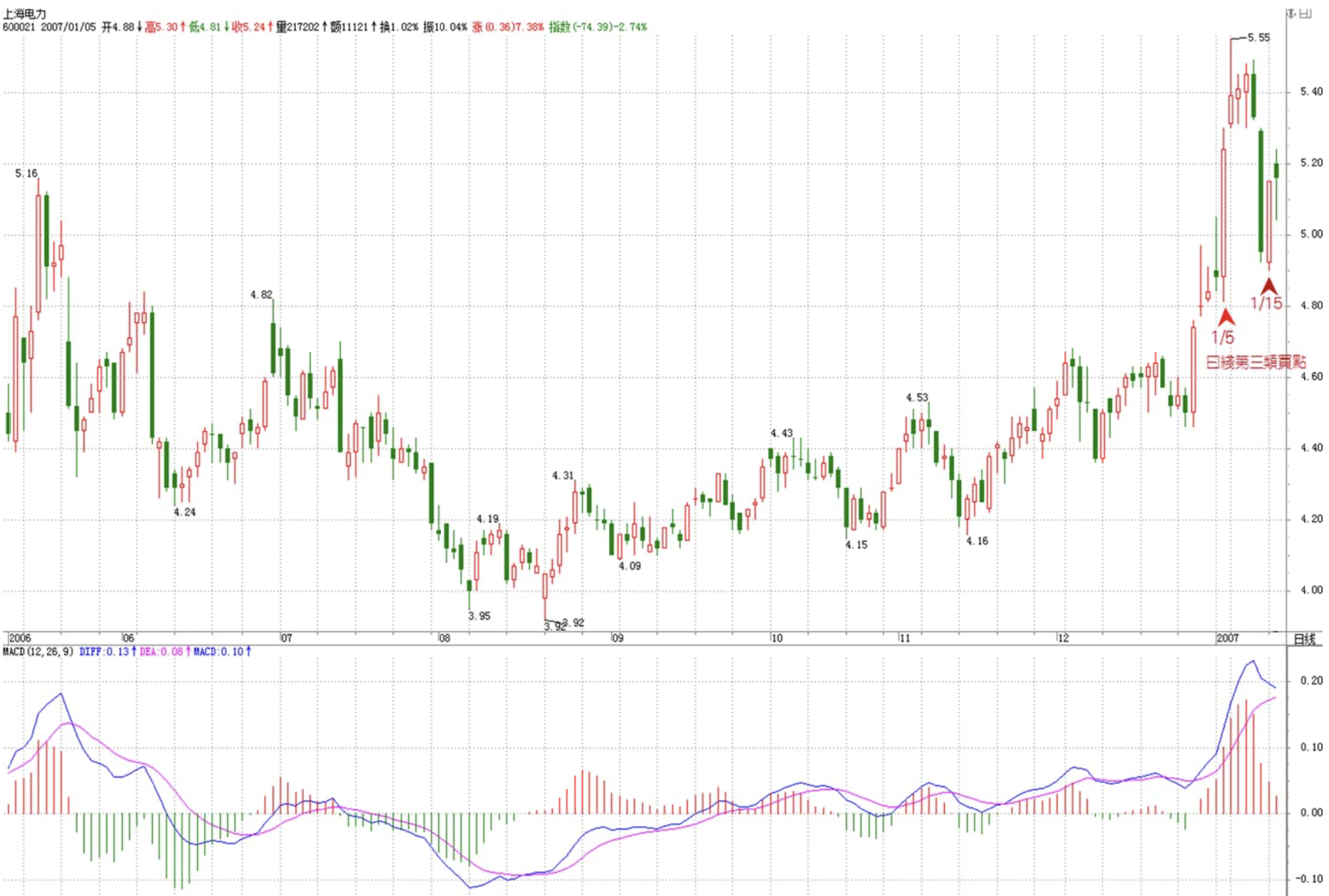
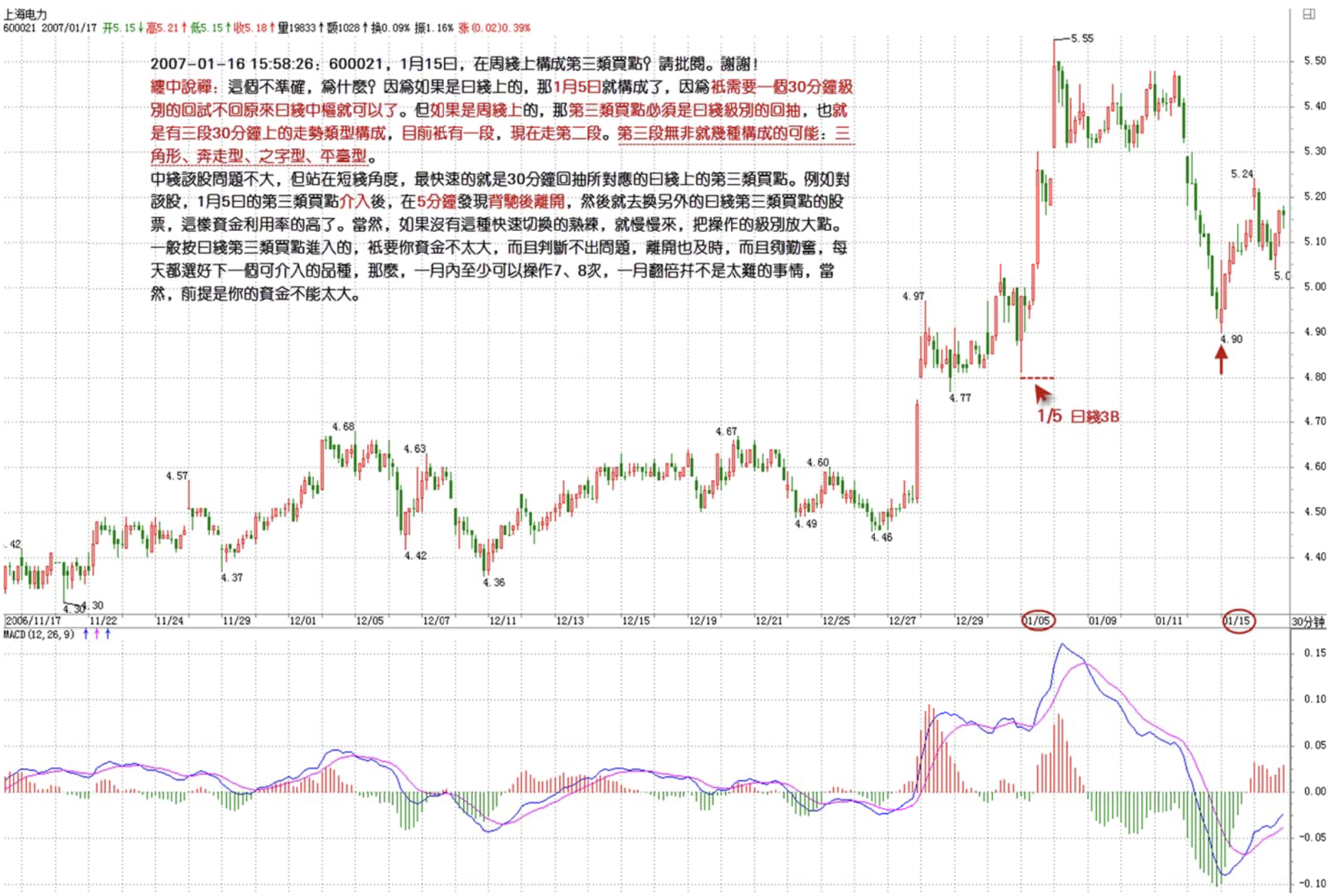
1/15 Currently 600021 has formed a third-type buy point on the weekly chart.
Please review, blogger. Thanks!
===
This is not precise. Why? Because if it's on the daily chart, then it was already formed on January 5th — you only need a 30-minute level pullback that doesn't return to the original daily hub. But if it's on the weekly chart, then the third-type buy point requires a daily-level pullback, meaning three segments of 30-minute movement types. Currently there's only one segment, and the second is in progress. The third segment can only be one of a few possible formations: triangle, running, zigzag, or platform.
Mid-term, this stock should be fine. But from a short-term perspective, the fastest approach is the third-type buy point on the daily chart corresponding to a 30-minute pullback. For example, entering this stock at the January 5th third-type buy point, and exiting when divergence is spotted on the 5-minute chart, then switching to another stock with a daily third-type buy point — this way capital utilization is much higher. Of course, if you're not yet skilled at this quick switching, then take it slowly and operate on a larger timeframe.
Generally, entering at a daily third-type buy point — as long as your capital isn't too large, your judgment doesn't go wrong, you exit promptly, and you're diligent enough to select the next candidate to enter each day — you can operate at least 7-8 times per month. Doubling your capital in a month is not that difficult, though the prerequisite is that your capital can't be too large.
缠中说禅 2007/1/16 16:32:55
[Anonymous] 空读
2007-01-16 16:26:39
Aren't precepts also empty? Aren't they also taking emptiness as emptiness? Then how do you escape? Sinking and floating in birth and death — where do you escape to?
===
If you only know that emptiness is empty but don't know that emptiness is not empty, how can you know emptiness? Since ancient times, those who grasped one word "empty" and rested there are as numerous as carp crossing the river — pitiable and lamentable. First put down the word "empty" and pick up "existence."
缠中说禅 2007/1/16 16:39:52
[Anonymous] 新手
2007-01-16 16:31:29
Hello, I've read many of your articles. This is my first time trading stocks. Following your advice, I bought 000900 at 9.7, but it hasn't been going up much. Could you take a look? Thanks.
===
It's already over 11 yuan now, isn't it? The key isn't how much it's risen, but whether you're following proper operating procedures. Right now you only have 15% gain — tomorrow if it gets pulled up, it might suddenly be 30%. Holding requires patience — unless a sell point appears, you must not move rashly. But once a sell point appears, you must leave.
What you need to think about now is not what the market maker is doing, but what level you're operating at and whether a sell point has appeared at that level. If you want to be faster and you have quick reflexes, you can absolutely operate at a smaller level.
Note: the market tests your long-term profitability, not your ability to have one explosive gain. The key is a long-term effective trading strategy. When buying, think through all scenarios: hold firmly, and sell even more firmly — this is how you gradually improve.
You're the one trading stocks, not stocks trading you. Start by working on yourself.
缠中说禅 2007/1/16 16:44:56
[Anonymous] 牛牛
2007-01-16 16:41:17
"Generally, entering at a daily third-type buy point — as long as your capital isn't too large, your judgment doesn't go wrong, you exit promptly, and you're diligent enough to select the next candidate to enter each day — you can operate at least 7-8 times per month. Doubling your capital in a month is not that difficult, though the prerequisite is that your capital can't be too large."
May I ask, sis — for this operating model, do you use the 5-minute chart as the operating level, select stocks based on daily chart buy points, and enter/exit using 5-minute buy/sell points?
===
Use the daily third-type buy point. To find this buy point, look for a 30-minute pullback, and the pullback's low point is determined by 5-minute divergence. You must use all three levels together.
缠中说禅 2007/1/16 16:49:06
[Anonymous] 空读
2007-01-16 16:42:51
"The nameless is the beginning of heaven and earth; the named is the mother of all things. Therefore, constantly without desire, observe its subtlety; constantly with desire, observe its boundaries. These two emerge together but have different names."
What is "existence"? Empty is not-empty, empty is existence — how should one deal with this?
===
Trying to discuss Chan through Taoist texts with no insight — when will escape ever come? Heaven and earth are but a mote of dust in your mind; the myriad things are but a speck in your eye. Activities in the ghost den — when will escape ever come!
缠中说禅 2007/1/16 16:50:50
[Anonymous] 摄影之友
2007-01-16 16:42:12
Thank you, blogger... I'll remember... I'll keep holding the pharmaceutical stock. That's the most precious gift you've given me!~~~
Blogger, could you discuss the significance of hub formation a bit more? I'm still a bit dizzy...
Like today's pharmaceutical stock — on the 5-minute chart I saw a hub forming. What does that mean?
===
We'll discuss this later. Right now the most important thing is to thoroughly understand the third-type buy point, then continuously improve through practice. Opportunities like these are emerging constantly now — seize this rare opportunity for practice.
缠中说禅 2007/1/16 16:53:57
[Anonymous] 新年好
2007-01-16 16:45:41
Sis, could you answer my question? I'm really confused.
As follows:
2007-01-15 21:48:02
For 600085, the first, second, and third type buy points on the daily chart are 2006/11/14, 12/11, and 12/29, respectively. Is that correct?
===Sis's reply
Incorrect. On the daily chart, during this period there were no first or second type buy points — on the 30-minute chart, of course there were. However, the week of December 28th was a precise weekly third-type buy point. The sub-level pullback on the daily chart is somewhat unusual here, forming a running-type pattern — meaning the B segment's upward thrust is quite strong, and the C segment's pullback only slightly breaks below the A segment's high point. This kind of pattern usually leads to a rapid rise afterward.
========My question
May I ask, sis — the A, B, C segments you're referring to here, which three segments are they specifically? I had thought A: 12.11-12.20, B: 12.21-12.28, C: 12.29-2007.01.05, but it doesn't seem to match what you said — my B segment is clearly not an upward thrust. Could you please specify which three segments they are? If I understand this, then the sharp rise in 000600 afterwards should be based on the same principle.
===
December 4th to the 28th — three segments are plain as day. Note: a hub formed by a pullback must have the down-up-down directional pattern. Of course, one of the down, up, or down segments may be replaced by a sideways consolidation.
缠中说禅 2007/1/16 17:08:11
[Anonymous] 牛牛
2007-01-16 16:53:41
Yesterday I used sis's third-type buy point teaching and bought 600196 at 6.64. Today I sold at 7.36 because the 30-minute MACD showed divergence and volume-price also diverged. But afterward it pulled up again. Was there a problem with this trade? Please advise, sis.
===
First, there was no real divergence on the 30-minute chart for that stock. Divergence requires comparing two segments of the same-direction trend, not simply looking at MACD red bars getting shorter. This pullback was only caused by a sub-level divergence, not a 30-minute level one. Therefore, from a 30-minute perspective, after the pullback you should have bought back in, then waited for the real 30-minute divergence to appear. Generally, if your judgment isn't yet refined and you only know MACD — when MACD forms a double top at high levels and comes down, near the zero axis there will be a process of going back up again, because that double top is usually caused by a lower-level divergence. The real divergence usually requires a pullback to the zero axis first, then a move up from there.
Second, that stock doesn't precisely constitute a third-type buy point because there's some overlap. Rather, it had a precise monthly second-type buy point last November. The current rise is related to that buy point.
Precise analysis of chart patterns requires constant practice — take it slowly, this is the right path.
缠中说禅 2007/1/16 17:12:57
[Anonymous] 中间体
2007-01-16 17:06:33
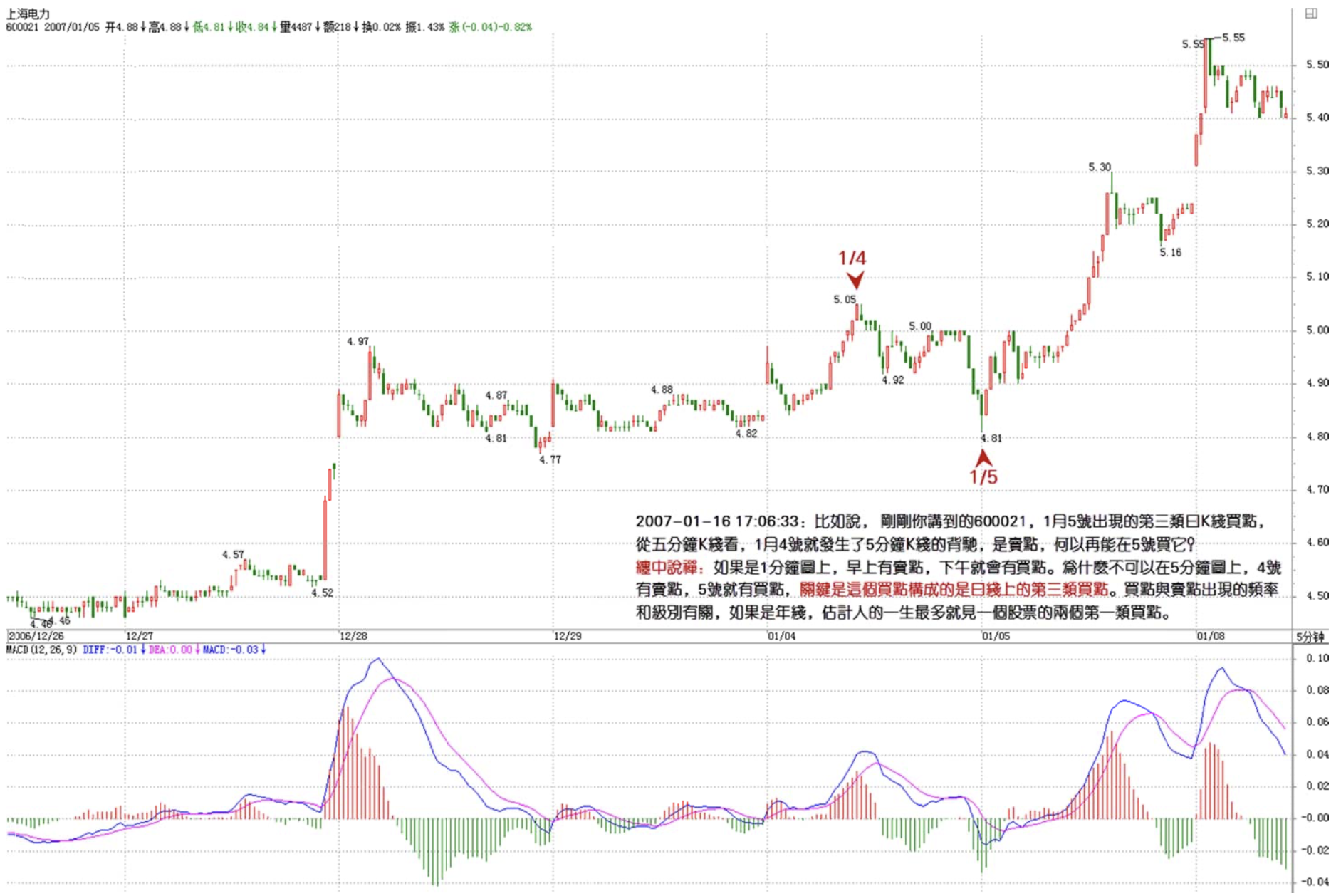
For instance, the 600021 you just mentioned — the daily third-type buy point on January 5th. Looking at the 5-minute chart, January 4th already had a 5-minute divergence sell point. So how can you buy it on the 5th??
===
On the 1-minute chart, there's a sell point in the morning and a buy point in the afternoon. Why can't the same happen on the 5-minute chart — a sell point on the 4th and a buy point on the 5th? The key is that this buy point constitutes a daily third-type buy point.
The frequency of buy and sell points is related to the level. If it were the annual chart, a person might see at most two first-type buy points for a single stock in their entire lifetime.
缠中说禅 2007/1/16 17:13:25
Logging off now — leave any questions below and I'll address them tonight. Goodbye.
缠中说禅 2007/1/16 17:20:41
[Anonymous] 水房姑娘
2007-01-16 17:14:49
Can you analyze the market maker's intentions for short-distance railway 601333?
==
Before I go, let me answer this one. This is a wrong way of thinking: First, for this kind of large-cap stock, there generally isn't a single market maker — the chances of chaotic fighting inside are even greater. Second, even if a market maker has intentions, whether they can be realized is another question. If they run into someone like this ID, the market maker's luck is truly terrible for eight generations.
The correct approach is to look only at the price movement itself. The movement is the composite result of all forces — this is the only thing you can rely on. Currently this stock is operating within a large hub, waiting for the next volume surge. Operationally, watch whether the next volume surge can effectively break through. If an upward attack unfolds, watch the 30-minute and other lower-level charts, waiting for a sell point to appear — this assumes you're operating at the daily level.
Goodbye.
缠中说禅 2007/1/16 21:10:31
[Anonymous] 牛牛
2007-01-16 17:24:18
My sincere thanks to you, sis. Since studying your theory, I've completely broken the bad habit of chasing prices. My performance in the past month-plus equals my entire year last year.
A few more questions:
- In the current broad-rally market, many stocks have already risen significantly by the time a third-type buy point is spotted. Should I pass, or look for sub-level first/second type buy points to enter? How to handle this?
- I have plenty of time and my capital isn't huge. What operating level would you recommend for me?
Thank you, sis!!!
===
If the stock you're holding is in a healthy uptrend, you absolutely must hold firmly. Some stocks start slowly but accelerate as they go. If you drop it and switch to another stock: first, you endure the losses from the initial shaking after entering; second, if the one you dropped performs even better, the psychological impact is even worse.
Didn't this ID mention before about an uncle — told to buy Beichen at over 3 yuan, and he sold at just under 4 yuan, getting a scolding from this ID. He said he'd mainly made some money last year from buying a stock at over 3 yuan. He was extremely familiar with the listed company, but in the end it was the company insiders who shook him out at 10 yuan — all for nothing. Today, exactly a month and a few days later, it hit limit-up and is nearly at 14 — does regret help?
When the sell point doesn't appear, don't sell. Once a stock's mid-term move launches, its uptrend won't be simply reversed.
As for newly entering stocks, it's best to follow proper procedures — this is a matter of habit. If you enter at a sub-level, operate according to sub-level procedures. Once an uptrend is confirmed, you absolutely must hold until a sell point appears.
A good habit is far more important than short-term small profits. No matter how much money you can make, one bad habit is enough to reduce it all to nothing.
缠中说禅 2007/1/16 21:13:18
[Anonymous] 外科医生
2007-01-16 21:02:26
May I ask, sis:
Sometimes no divergence appears at any level — meaning no sell point has appeared — yet the stock price reverses and keeps falling. How do you handle this situation?
Thanks.
===
This situation simply cannot happen — it's just that you haven't found the reversal at the corresponding level. So you must continuously observe market movements to have a chance of improving.
缠中说禅 2007/1/16 21:16:58
[Anonymous] 无知
2007-01-16 20:50:10
Today Shenzhen hit a new high while Shanghai didn't! Does this count as divergence??
===
Currently the Shanghai index is a large-cap index, so if this situation occurs for only one or two days, the problem isn't that serious. But if it persists over a long period, then the problem is big. So Shanghai must hit a new high this week — otherwise the adjustment level will continue to escalate.
缠中说禅 2007/1/16 21:29:23
[Anonymous] 新菜鸟
2007-01-16 18:20:18
May I ask, sis:
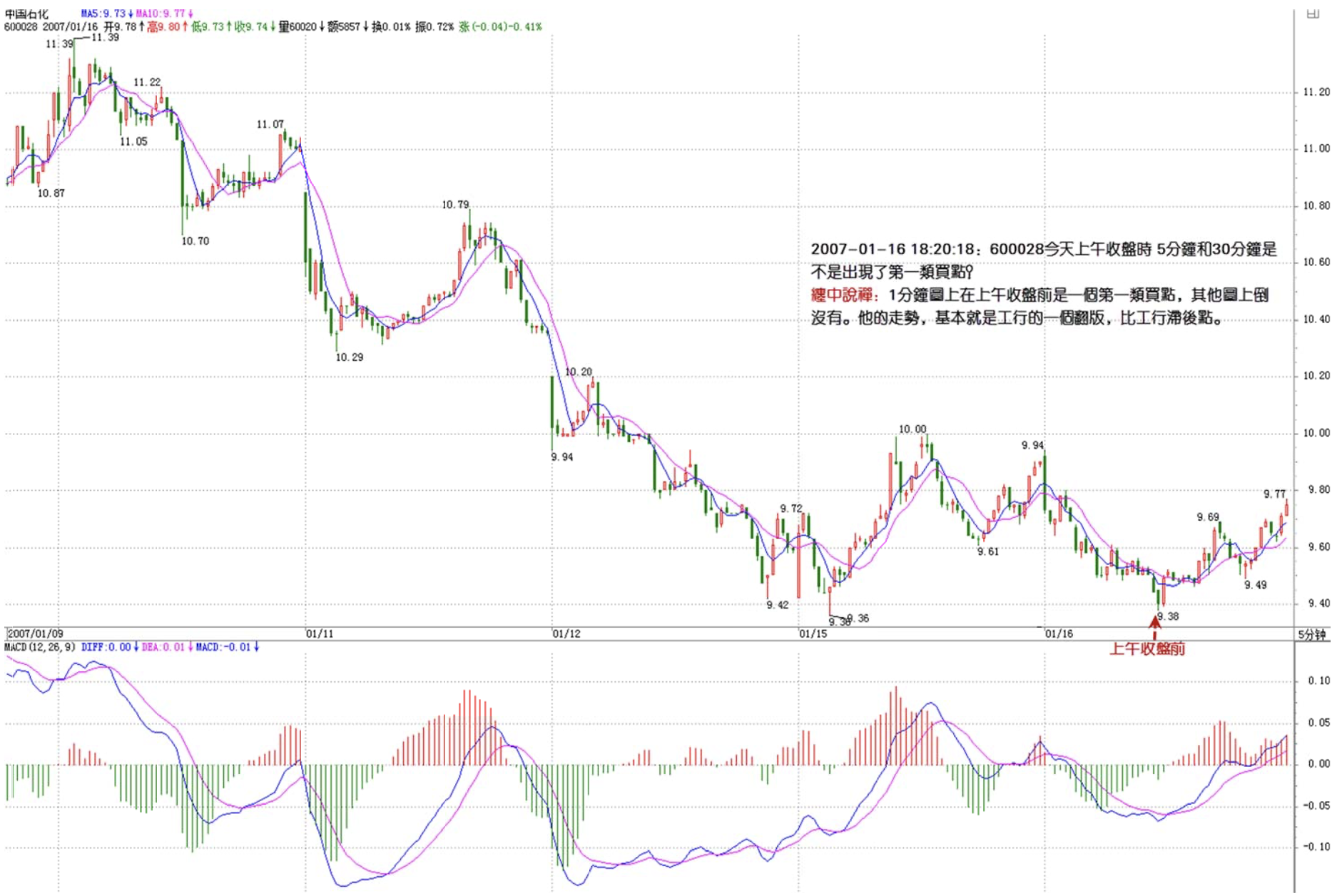
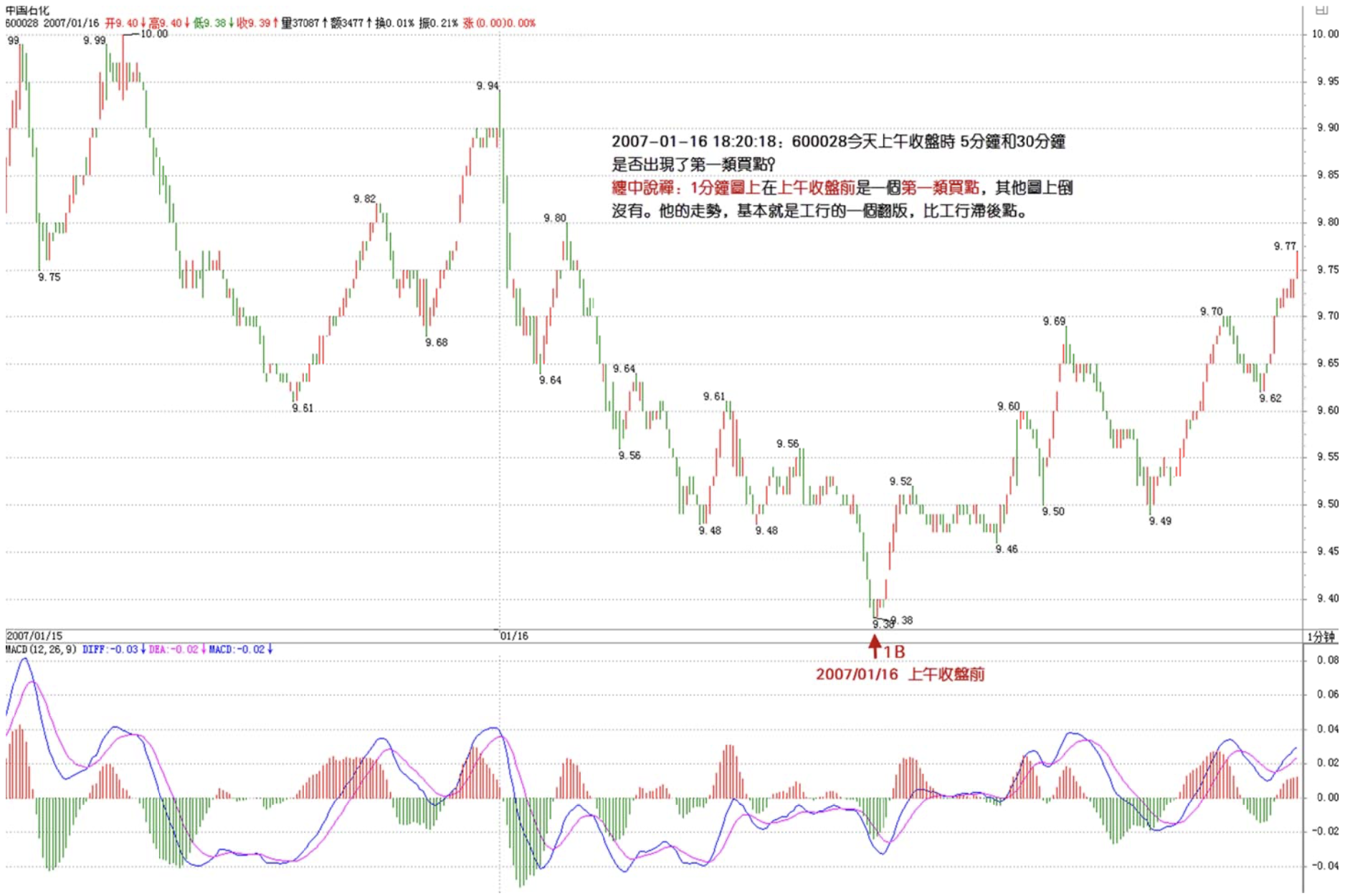
1: Did 600028 exhibit a first-type buy point on the 5-minute and 30-minute charts by the morning close today? According to trend completeness, should it test 10.20 and then what? How should I operate? I've only recently started reading your articles and I'm still not proficient.
===
On the 1-minute chart, there was a first-type buy point just before the morning close — but not on the other timeframes. Its movement is basically a replica of ICBC's, just lagging a bit behind.
2: You said pharmaceuticals are this year's liquor, steel is this year's non-ferrous metals. I think oil is this year's banking. Because it has strategic significance. I'm just guessing — so I was about to cut my losses today but didn't. Instead, I added a bit at what I thought was a 5-minute buy point.
I'm a greenhorn, but I hope through studying here I can become a great roc — haha, don't laugh everyone, help me out!
====
Sinopec should be fine mid-term, but short-term there'll be more jostling around the 10 yuan level.
With stocks, you must pay attention to rhythm. The previous phase was the era of super-large caps; now it's the era of second and third-tier stocks. You can't get the rhythm wrong. If you do, then wait — look for an opportunity to realign. Generally, don't cut losses in a bull market — cutting losses in a bull market is really bad luck. And it easily ruins your mood, making the rhythm worse and worse. Just wait — after all, sectors rotate. When its turn comes, if it can't develop into an extended uptrend, look for an opportunity to exit.
A whole bunch of low-priced stocks are waving at you — is there any need to chase highs?
While waiting, reflect thoroughly — in the future, make sure to master the rhythm.
缠中说禅 2007/1/16 21:34:35
[Anonymous] ccy
2007-01-16 21:08:05
Progress report: I've been studying your theory for two months now. My portfolio has grown from 25,000 to 36,000. Many thanks — just popping in to say hi today.
===
Keep it up. Before this bull market ends, turn that into at least 1 million — that's another 30x, which only takes 5 doublings.
Let this ID design a plan for you. During the first wave of blue-chip stocks, getting it to 100,000 shouldn't be too difficult.
During the second wave of growth stocks, if done well, the 1 million target will be achieved.
Then there's the third and most frenzied wave of restructuring plays — your target should be 10 million.
缠中说禅 2007/1/16 21:36:24
[Anonymous] 手中无股
2007-01-16 21:34:19
Blogger, regarding the "third-type buy/sell point theorem": "…its low point does not break above ZD, which constitutes a third-type sell point." Should that read "its high point does not break above ZD, which constitutes a third-type sell point"? Am I correct?
===
Thanks — it should be "high point." When writing, I copied the buy point text and changed a few words, and apparently missed that one. Going to fix it now.
缠中说禅 2007/1/16 21:43:35
[Anonymous] 在路上
2007-01-16 21:18:36
Chán Zhōng Shuō Chán
2007-01-16 15:37:18
Attention, everyone!
This has been said N times already — right now it's the era of catch-up rallies. Second-tier stocks, especially low-priced ones, are running wild. Find good third-type buy points and you'll be too busy to keep up. What this ID teaches you is the ability to find food, not just handing you a meal. Look at today's limit-up stocks — how many launched from third-type buy points? Just Shanghai, and only the low-priced ones — here are a few off the top of my head:
600608, 600555, 600784, 600684, 600300, 600829, 600587, 600820, 600884
Study these carefully. Just using third-type buy points, you can find more than enough food right now. What you find for yourself is the real skill. The key is to practice this technique well.
==============
Sis's examples here are great. 600820 and 600829 — I couldn't free up funds to chase them, but friends around me made a killing. Seeing sis mention them, my confidence grew even more — it proves the direction of study is right. At least the stocks I identified got a mention.
===
This ID's theory is like Euclidean geometry — once learned, anyone's application is the same. So what deserves respect is the theory itself, not this ID. This ID also cannot violate this theory, just as Newton discovered universal gravitation yet still remains subject to it. So the confidence should be in the theory itself, and confidence in the theory comes from a thorough understanding of its logical structure, then continuously verifying that understanding in practice — that's how it truly becomes your own.
Note: these stocks have already risen after the third-type buy point breakout. There's no need to chase highs — there are even more stocks just at their third-type buy points waving at you. Go find them yourself.
缠中说禅 2007/1/16 21:56:38
[Anonymous] 淡定
2007-01-16 21:36:38
Two questions, please:
- Did 000001 form a daily-level third-type buy point on January 11th?
- Did 600050 form a first-type sell point on January 11th? Am I correct to wait for a third-type buy point to appear?
Thank you.
==
You need to study harder. All buy points definitely appear during corrections — how could January 11th be a third-type buy point for 000001? As things have developed now, buy points can basically only be found on the 30-minute chart or above, unless a major correction occurs.
Note: this approach won't cause you to miss any worthwhile moves. During the extension phase of a rally, the profit from one 30-minute buy-to-sell is much larger than during the initial daily launch.
600050's January 11th was not some first-type sell point. Rather, it was a small-level sell point triggered by a 5-minute divergence on the 4th.
China Unicom's mid-term potential is considerable — quite apart from 3G, one telecom sea turtle alone is enough to push Unicom to 8 yuan. Of course, a short-term consolidation is warranted.
缠中说禅 2007/1/16 22:00:30
[Anonymous] 天地
2007-01-16 21:53:18
Chán Zhōng Shuō Chán
2007-01-16 15:37:18
Attention, everyone!
This has been said N times already — right now it's the era of catch-up rallies. Second-tier stocks, especially low-priced ones, are running wild. Find good third-type buy points and you'll be too busy to keep up. What this ID teaches you is the ability to find food, not just handing you a meal. Look at today's limit-up stocks — how many launched from third-type buy points? Just Shanghai, and only the low-priced ones — here are a few off the top of my head:
600608, 600555, 600784, 600684, 600300, 600829, 600587, 600820, 600884
Study these carefully. Just using third-type buy points, you can find more than enough food right now. What you find for yourself is the real skill. The key is to practice this technique well.
==============================================
I can't see the third-type buy point on 600684! The pullback on the 12th is still within the hub. Before that? How do you see it? Did you type it wrong, or am I not seeing it?
==
It's within the weekly hub but outside the daily hub. For a daily third-type buy point, you only need a 30-minute level pullback that doesn't break the daily hub. Sometimes hubs of different levels are entangled together, which can create difficulties in judgment — this will be discussed in the future.
缠中说禅 2007/1/16 22:01:40
[Anonymous] 手中无股
2007-01-16 21:52:50
Blogger, the growth plan for "ccy" is very appealing to read — but could you give a rough timeline? It won't be "ten thousand years," right? (Just kidding.)
===
Didn't you read carefully? Before the bull market ends. The bull market has three waves. We're currently in the first wave — this has been said countless times already.
缠中说禅 2007/1/16 22:06:17
[Anonymous] 恒旧常新
2007-01-16 21:14:03
The blogger seems to use language that negates everything, urging people to let go — yet also teaches us the real skills to make money in the stock market. Could it be that letting go is for the sake of picking up? Only by letting go of everything can one pick up everything? If this is the purpose, why not let go of this purpose? If you let go of this purpose, then what's the meaning of life? Could it truly be a game? A real game that's not a dream? What's needed is our wholehearted, genuine participation — playing a round until the game ends and everyone goes home. Where is home? Perhaps we've been home all along, and the game is being played at home.
===
Letting go, picking up — these are all self-generated discriminations. Here at this ID's place, there are no such tangled vines. This ID doesn't even negate licentiousness — why would I negate language? Looking for sustenance here is a dead end. Until the thieving heart dies, there is no way out.
缠中说禅 2007/1/16 22:09:27
[Anonymous] 插班生
2007-01-16 21:49:29
Reposted here — please advise, blogger.
Studying the third-type buy point again. My understanding is as follows — please correct me.
For example:
A daily third-type buy point is generated when a sub-level movement type (determined on the 5-minute chart) leaves the daily hub (viewed on the 30-minute chart) and the pullback doesn't return to the daily hub's ZG. This pullback is confirmed by a sub-level movement type (on the 5-minute chart) of the daily hub.
To complete this pullback movement type (determined on the 5-minute chart), it needs to contain 2 sub-level hubs of the pullback movement type (on the 1-minute chart).
So the entry point must be after the 5-minute pullback movement type is completed, meaning a new movement begins (a new hub on the 1-minute chart). Only then does it represent the completion of the pullback movement type.
----- Trends are always completed with beauty.
===
That's not necessary. You just need to enter at the 5-minute first-type buy point — this involves the question of judging divergence, which we'll continue to discuss later. In actual operations, if your judgment isn't precise, reference technical indicators. Generally at this point, the 30-minute MACD has a pullback-to-zero-axis action — it usually shouldn't break below.
缠中说禅 2007/1/16 22:17:01
[Anonymous] 新年好
2007-01-16 22:08:13
Sis, has the daily chart of 000767 and 000800 formed a running pattern?
Also, sis — aren't you going to tell us what's this year's equivalent of last year's banking? I think it's insurance companies. Am I right?
==
000767 had a standard third-type buy point on December 26th — no running pattern at all. 000800's was December 22nd — also no running pattern.
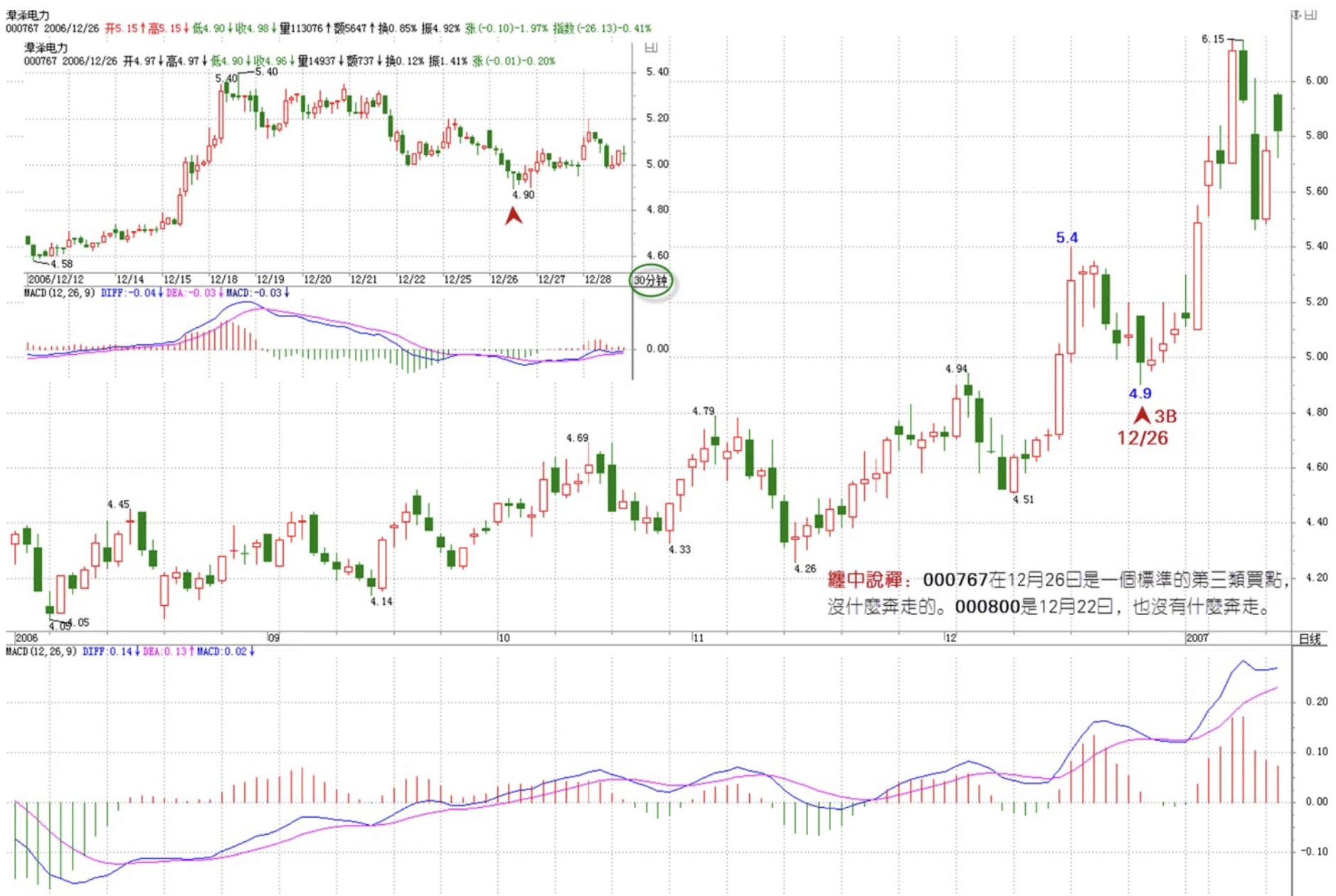
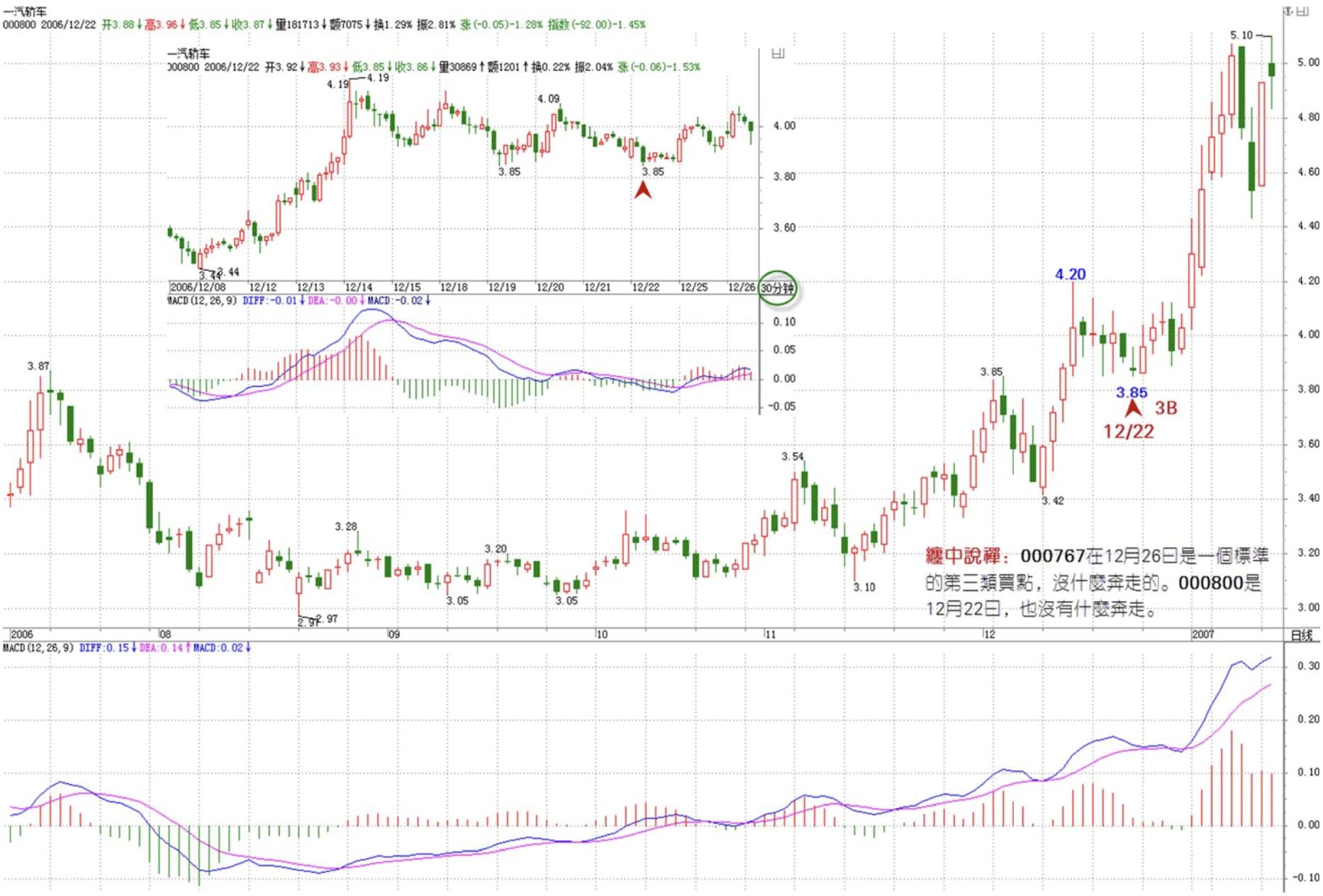
缠中说禅 2007/1/16 22:20:23
[Anonymous] 淡定
2007-01-16 22:12:37
Thanks, blogger! While I'm at it, let me do a self-criticism — lost 600555 yesterday, really frustrated. I need to study harder.
==
Why? Such a standard rally from a third-type buy point — you should at the very least wait for the sub-level divergence sell point to appear before leaving.
Develop good habits — don't get dizzy from a few shakes.
缠中说禅 2007/1/16 22:26:11
[Anonymous] 看聊
2007-01-16 22:10:59
That headache-inducing divergence~~~~~~~~~~~~~~~~~~~~~~~~~~~~~~~~~
==
First understand this: One, it's a comparison between two segments of the same-direction trend.
Two, if using MACD as an aid, the key is the pullback-to-zero-axis process produced by the movement type connecting the two trends. Only divergence appearing after that is effective.
More precise methods of judgment will be discussed later.
缠中说禅 2007/1/16 22:32:41
[Anonymous] 新年好
2007-01-16 22:23:40
000767 000822 do have quite standard third-type buy points on the daily chart around the 12th.
000800's daily chart around the 12th also qualifies as a third-type buy point.
**********
000767 had a standard third-type buy point on December 26th — no running pattern at all. 000800's was December 22nd — also no running pattern.
=======
Sis, your two answers don't quite match — are you talking about different levels?
===
First figure out who made the above reply. Is "Tiandi" this ID?
In the future, when quoting, everyone must include the name — don't quote without even knowing who the respondent was.
缠中说禅 2007/1/16 22:39:31
[Anonymous] 手中无股
2007-01-16 22:28:45
Blogger, I can't figure out the third-type buy point on 600608 that you mentioned.
===
It's 600068 — Gezhouba. A typo. Everyone, please take note. 600608 seems to have been suspended today — how could it have hit limit-up?
Chán Zhōng Shuō Chán
2007-01-16 15:37:18
Attention, everyone!
This has been said N times already — right now it's the era of catch-up rallies. Second-tier stocks, especially low-priced ones, are running wild. Find good third-type buy points and you'll be too busy to keep up. What this ID teaches you is the ability to find food, not just handing you a meal. Look at today's limit-up stocks — how many launched from third-type buy points? Just Shanghai, and only the low-priced ones — here are a few off the top of my head:
600068, 600555, 600784, 600684, 600300, 600829, 600587, 600820, 600884
Study these carefully. Just using third-type buy points, you can find more than enough food right now. What you find for yourself is the real skill. The key is to practice this technique well.
缠中说禅 2007/1/16 22:44:43
Attention, everyone!
Since there are so many questions to answer, the occasional typo is unavoidable. If you spot one, please point it out — this ID doesn't have time to scrutinize every character. For example, the 600068 vs. 600608 issue above — this ID had already given a definition earlier, which was "look at today's limit-up stocks — how many launched from third-type buy points, just Shanghai ones, and only the low-priced ones, here are a few." Check today's limit-up board and you'd know it was a typo. So please, if you have any questions, raise them — don't swallow your doubts.
It's very late. Logging off. Goodbye.
缠中说禅 2007/1/16 15:22:26
Chen has many Dharma descendants, and this ID enters muddy water to stir up tangled vines — muddying the muddy water, tangling the tangled vines — it is both non-play and play.