Teaching You to Trade Stocks 71: Further Clarification on the Standard for Line Segment Division
2007/8/16 23:02:06
Although Lesson 67 already provided the standard for line segment division, since it used a relatively abstract quasi-mathematical language, there may still be difficulties in understanding. Therefore, let me clarify each point one by one.
The first thing to clarify is the inclusion relationship among elements of the characteristic sequence. Note that when discussing the inclusion relationship of elements in a characteristic sequence, the very first prerequisite is that these elements are all within the same characteristic sequence. Discussing inclusion relationships between elements of two different characteristic sequences is meaningless. Obviously, the direction of elements in a characteristic sequence is opposite to the direction of their corresponding segment. For example, an upward segment followed by a downward segment—the former's characteristic sequence elements go downward, while the latter's go upward. Therefore, there fundamentally cannot exist any possibility of inclusion.
Then why can we define fractals of the characteristic sequence? Because in actual judgment, when the previous segment hasn't been destroyed by a stroke, the elements of the subsequent characteristic sequence still cannot be defined. At this point, of course the previous characteristic sequence's fractal can exist, because we're still within the same characteristic sequence, so the inclusion relationship among sequence elements is valid. When the previous segment is destroyed by a stroke, obviously, if the earliest destroying stroke is not the first stroke starting from the turning point, then the fractal structure of the characteristic sequence can still hold. Because in this case, there must be a gap between the last characteristic sequence element before the turning point and the first characteristic element after the turning point, and the latter definitely doesn't have an inclusion relationship with the earliest destroying stroke—otherwise, that gap couldn't be closed, and the destroying stroke wouldn't be able to destroy the previous line segment's trend. The logic here is very clear: for a line segment to be destroyed by a stroke, the gap of its last characteristic sequence must be closed; otherwise, there is no case of being destroyed by a stroke.
Now, we're left with only the last situation: the earliest destroying stroke is the very first stroke coming down from the turning point. In this case, if this stroke subsequently extends into a trend that becomes a line segment, then this stroke belongs to a middle zone—it can neither be said to be part of the previous segment's characteristic sequence nor part of the subsequent segment's characteristic sequence. In this situation, even if what appears to be an inclusion relationship in the characteristic sequence occurs, it doesn't count. Because this stroke doesn't strictly belong to the previous segment's characteristic sequence—it's in a pending state. Once this stroke extends to three or more strokes, a new line segment is formed, and at that point, discussing the inclusion relationship of the previous line segment's characteristic sequence becomes meaningless.
In summary, what was said above is quite complex, but it boils down to one sentence: to discuss the inclusion relationship of characteristic sequence elements, they must first be elements of the same characteristic sequence. This is theoretically very clear.
From the above analysis, we can see that if, starting from the turning point, the first stroke destroys the previous line segment, and then that stroke extends into three strokes where the third stroke breaks past the end position of the first stroke, then a new line segment has definitely formed, and the previous line segment has definitely ended.
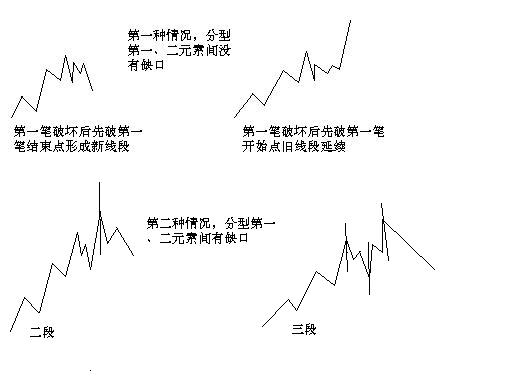
This situation has an even more complex variant: the third stroke is entirely within the range of the first stroke. In this case, these three strokes can't be distinguished as upward or downward, making it impossible to define any characteristic sequence—why? Because the characteristic sequence is opposite to the trend direction, and if the trend doesn't even have a direction, how do you know which elements belong to the characteristic sequence? This situation ultimately has only two possible outcomes: 1. Eventually, the end position of the first stroke is broken first, in which case the new line segment is obviously established, and the old line segment has still been destroyed. 2. Eventually, the start position of the first stroke is broken first, meaning the old line segment was only destroyed by one stroke and then continued in its original direction—in this case, obviously the old line segment still continues, and no new line segment has appeared.
In Lesson 67, line segment division was separated into two situations. Clearly, distinguishing which situation applies is critical for dividing line segments. In fact, the issue was already explained very clearly there—the sole criterion for judgment is whether there is a gap in the characteristic sequence between the first and second elements of the fractal. From the analysis above, we know that the so-called characteristic sequence elements in this fractal structure are actually spoken from the perspective of assuming the old line segment hasn't been destroyed. And like all fractals—even those of ordinary candlesticks—they are the watershed and connecting point between the front and back segments of a trend. This differs from the inclusion situation: inclusion relationships refer to the same segment, while fractals necessarily belong to both front and back. In this case, among the elements forming the fractal, if the line segment is ultimately destroyed, then the elements to the right of the fractal certainly don't belong to any characteristic sequence. That is to say, the right-side element of the fractal definitely doesn't belong to the characteristic sequence of either the previous or the subsequent segment.
The reasoning is actually quite clear. For example, if the previous segment goes upward, then the characteristic sequence elements go downward. If the right-side element of the top fractal ultimately satisfies the requirement of destroying the previous line segment, then the subsequent segment's direction is downward, and its characteristic sequence goes upward—while the right-side element of the top fractal goes downward, which obviously doesn't belong to the subsequent segment's characteristic elements. And since this top fractal's right-side element belongs to the subsequent segment, it obviously even less belongs to the previous segment's characteristic elements. Therefore, the right-side characteristic element of the top fractal is merely a convenient presupposition for general judgment purposes—just like in geometry, adding auxiliary lines to prove a theorem. Auxiliary lines don't belong to the figure itself, just as the right-side characteristic element of the top fractal doesn't necessarily belong to any actual characteristic element. But since it's helpful for research, it should of course be used vigorously, that's all.
In fact, line segment division can all be completed in the present moment. It is nothing more than the following procedure: assume a certain turning point is the boundary between two line segments, then examine whether it satisfies either of the two situations for line segment division. If it satisfies one of them, then this point is a true line segment boundary; if not, then it isn't, and the original line segment continues. It's that simple.
In the fractal of the characteristic sequence, the first element is the last characteristic element of the previous line segment before the assumed turning point, and the second element is the first stroke starting from this turning point. Obviously, these two go in the same direction. Therefore, if there is a gap between them, it's the second situation; otherwise, it's the first situation. Then examine according to the definitions.
Here I also want to emphasize the inclusion issue. From the above analysis, we know that the two elements immediately before and after the assumed turning point do not have an inclusion relationship, because these two have been assumed to not be of the same nature—they're not necessarily from the same characteristic sequence. However, the elements of the top fractal after the assumed turning point can have the inclusion relationship applied. Why? Because these elements are definitely the same type of thing: either they're all from the original line segment's continuation—in which case they're all in the original line segment's characteristic sequence—or they're all in the new line segment's non-characteristic sequence. Either way, they're the same type of thing, and things of the same type can of course have their inclusion relationships examined.
I suspect that after reading the above, many people are even more confused. Below are a few diagrams that you can study carefully. But it's still best to proceed from the definitions. Additionally, regarding the diagram the commenter from Dapan asked about—obviously, according to the definition, it's two line segments. And today's division of 42-44 is also clearly valid.
Note: the last diagram below has an issue. Please see the correction explanation in Lesson 81.