Teaching You to Trade Stocks 13: Trading Without Protection Is Not Good Trading!
2006/12/4 12:08:28
Whether a man without protection is a good man is a question we'll set aside for now, but trading without protection is definitely not good trading—especially for those with large capital! There are two types of protection: active and passive. What is passive protection? It's when you enter a position without knowing why, blindly getting trapped, and then there's another very wrong theory that says you should cut losses at a certain percentage. Operating this way will never lead to great success. Almost all investors are passively trapped like this—these people are trapped by the trap itself.
In reality, there is no such thing as a real stop-loss problem. There is only the question of whether a stock is still in the "tradeable" range. Only in this sense does a stop-loss exist: when a stock's movement transitions from tradeable to non-tradeable. Please note, from a profit-and-loss perspective, this doesn't necessarily mean the trade has failed—you may have already made substantial profits. The only reason for exiting is that the stock's movement is no longer tradeable. The worst habit in the investment market is entering and exiting based on profit and loss. Profit and loss are not a priori—they are determined in real-time based on the current movement. They are passive. Entering and exiting based on profit and loss means acting on passive factors—if that's not passive protection, what is?
What is active protection? This has two layers of meaning. First, entering a position cannot be completed all at once, especially for large capital. If you don't adopt the method of active protection, how can you possibly buy enough shares? Those who claim they never get trapped have certainly never managed large capital. But more importantly, any entry must include active protective measures—this protection means that once a stock becomes non-tradeable, you immediately exit the buying program. The activation of this protection has nothing to do with profit or loss—it only relates to the current movement.
For example, in the buying program described in the previous chapter, for the first buy point, once an upward move still produces male-on-top entanglement, you must exit. Why? Because the basis for buying at the first buy point is that divergence appears after the last entanglement in the male-on-top position. If male-on-top entanglement appears again, it means the entanglement that initially triggered the buying program was not the last one—in other words, there was an error in the program's judgment, so you must exit. Generally, such an exit will be profitable, but that cannot be a reason to not exit. It's even possible that after exiting, the entanglement slowly transitions from male-on-top to female-on-top through a time-for-space process, and eventually rises sharply (even if this happens, you can re-enter based on the second buy point principle, so the real opportunity isn't lost). But even so, you absolutely must not harbor any lucky thinking because of this possibility. There's an even greater possibility that the entanglement will be followed by accelerated decline. For market movements, possibilities are non-positioned, while reality is positioned, and any operation can only be built on a positioned basis—those familiar with this ID's interpretation of "The Analerta" should understand this. "Half the Analects can govern the world"—not to mention the stock market. To achieve transformation in the stock market, read more of this ID's discussions on the Analects—that is the source.
As for the second buy point described in the previous chapter, once the entanglement breaks below the lowest point of the preceding male-on-top position, it means the buying program has encountered a problem. You must clear all shares on any rebound. In this situation, it's possible that an upward move follows, but for the same reasons stated above—no operation is 100% accurate. Once a special situation arises, you must exit first. This is the most important point for long-term survival in an investment career. Of course, experienced people, even when exiting, will do so methodically and in an orderly fashion. It's the same principle as warfare—once you detect the battle situation has turned unfavorable, you retreat. You can't stubbornly resist, or you'll get annihilated.
Investing is a long-term endeavor. Don't approach it with a gambling mentality, expecting to succeed in one shot. With such a mentality, the final outcome will inevitably be tragic—this has been verified by countless cases. Why study a buying and selling program that suits yourself? Because it's the only safe harbor in the stormy seas of the market. Sometimes even the harbor has typhoons, but you can't abandon the harbor just because of occasional typhoons. Another point: the success rate of the buying program is related to market strength. In a strong market, the success rate is basically above 90%, but in a weak market, the success rate is much lower.
Any buying and selling program constructed based on technical systems like moving averages is just one sub-judgment within a comprehensive judgment—it doesn't mean this one trick is enough. At least one thing that no technical buying and selling program can solve is: among stocks selected by the same program, why do some rise more and others less? Can we select the most powerful ones from these? This is a very meaningful question in actual operations. Using a vulgar metaphor, the technical system is the "casting call," and what's needed afterwards are the "semifinals" and "PK rounds"—only then can you select the stocks truly worth entering. This topic will be gradually expanded upon later.
Replies
缠中说禅 2006/12/4 12:17:22
Glad to see Shanghai accepting this ID's warning below today, finally not causing trouble. Hope this continues.
Chán Zhōng Shuō Chán
2006-12-01 12:16:49
The biggest risk for the market right now is that Shanghai people are rather stingy, because it's almost certain that Shenzhen will break its historical high first. Shanghai might deliberately cause trouble, preventing both from breaking through. This sounds like a fairy tale, but it has happened more than once in history. Yet history has proven time and again that as long as it's a major bull market, Shenzhen is always stronger than Shanghai—this is also a very important empirical observation for judging market conditions. When Shenzhen is weaker than Shanghai, the chances of a major rally are slim. Now seeing Shenzhen stronger than Shanghai, even Shanghai people should be happy about it.
缠中说禅 2006/12/4 12:18:41
Announcement
This ID has created a circle, but not for this ID's sake—it's just to facilitate communication among people who come here, putting good articles in one place for mutual reference. Click "My Circles" on the left side of this ID's blog homepage to find it. No barriers are set—anyone can join and then post their articles. Take a look if you're interested.
Any articles permitted by Sina can be posted there. This ID won't manage it and doesn't have time to manage it.
缠中说禅 2006/12/4 12:25:41
[Anonymous] 糊涂蛋
2006-12-04 12:24:36
A while ago I saw "big bull doesn't need protection," and now "trading without protection is not good trading." Is the math girl reminding us to guard against risk?
============
This is about general trading operations and has nothing to do with the market's trend.
缠中说禅 2006/12/4 12:37:10
For this month's market movement, the following statement remains valid:
2006-12-01 15:02:23
Since November was a massive bullish candle, a significant correction after an upward push in December is inevitable. This must be kept in mind.
缠中说禅 2006/12/4 12:41:04
[Anonymous] 糊涂蛋
2006-12-04 12:33:58
I may need to go away for a while. I want to swap my full positions in 600653 and 000822 for 000932. Is it worth it?
==========
You need to develop the habit of completing the entire operation. If the stock you're holding hasn't shown a sell signal, you should hold it all the way. Nobody can guarantee that what you swap into will be gold. Even if it turns out to be gold in hindsight, that's after the fact, and you've developed a bad habit.
In the investment market, habits are the most important thing. One bad habit alone can be fatal.
缠中说禅 2006/12/4 12:43:34
When leaving the market, you must have someone monitoring things. You can't just toss your stocks aside with nobody watching—that's not the attitude a market participant should have. With today's internet, even when traveling, keeping an eye on your stocks isn't difficult.
缠中说禅 2006/12/4 12:46:03
[Anonymous] 醉酒青牛
2006-12-04 12:43:08
I, old bull, now think about female-on-top and male-on-top positions even during intimate moments. Math girl sister, please write more—I've been at this for years and still haven't grasped the basics. I hope your articles will help me achieve enlightenment.
============
For learning technical analysis, the key is to look at lots of charts. And one thing you must pay attention to: you can't rely solely on technical analysis—you must be aware of its shortcomings.
缠中说禅 2006/12/4 12:50:01
[Anonymous] nn
2006-12-04 12:45:13
The entire article makes a lot of sense. I just want to ask: what if it's hard to avoid a loss when exiting? Can you still wait for a rebound? If so, wouldn't the loss be even bigger? Of course, this situation mostly occurs in bear markets, but in bull markets, there's basically no need for stop-losses, right? Because when entering, you've already determined it's in the "tradeable" category. Is my understanding correct?
============
Actually, someone familiar with market movements doesn't need to wait until the low point is actually broken to discover problems. Generally speaking, the halfway point won't be broken, and once it is, problems will arise. As for breaking below the low point, there's usually a bounce—that's your last chance to leave. If you still don't leave, you'll have to cut losses on the way down.
缠中说禅 2006/12/4 12:51:18
[Anonymous] 淡定
2006-12-04 12:49:23
How about stocks 000001 and 600050? Thanks.
===========
Female-on-top—how to operate has been discussed more than enough above. Just patiently hold and wait for the first sell point to appear.
缠中说禅 2006/12/4 12:56:06
[Anonymous] 外科医生
2006-12-04 12:51:09
People are talking about 3000 points now. How far do you think we are from the market's sudden death?
=============
A year and a half ago, this ID already said privately that this rally could eventually reach 5000 or even 10,000 points in N years. Is 3000 points that outrageous?
The key isn't the point level—it's how to use major corrections to increase capital utilization. Don't worry about point levels. Especially for retail investors, any significant correction at any level should be avoided—there's no need to participate. Even if the market reaches 10,000 points, retail investors can completely break it down into many segments to trade, so predicting the final point level is actually of little significance.
缠中说禅 2006/12/4 12:58:07
[Anonymous] 多多
2006-12-04 12:51:10
May I ask about 600210? I bought at 2.40—should I continue holding? Thanks!
===========
After learning so much, you should ask yourself: under the standards you've set based on your own situation, is it still tradeable? If yes, hold; if not, don't hold. It's that simple. No a priori standard applies universally.
缠中说禅 2006/12/4 12:59:43
[Anonymous] 数女粉丝
2006-12-04 12:53:22
Can 600607 be traded?
=========
Stocks that haven't risen yet will all catch up eventually. These questions are meaningless—the key is your own actual situation. It's best to use what's been taught above and slowly learn to judge for yourself.
缠中说禅 2006/12/4 13:00:02
Market is opening, signing off for now. See you later.
缠中说禅 2006/12/4 13:24:23
The simplest method for short-term judgment of a market correction is the divergence between the Shenzhen and Shanghai indices. Once it appears, a correction or at least a shake-up will happen very soon. The method has been stated—now put it into practice yourselves immediately. Not everything can be spelled out, or you'll never improve.
缠中说禅 2006/12/4 15:02:36
[Anonymous] Xiao Ming
2006-12-04 14:53:36
[Anonymous] 缠禅
2006-12-04 13:51:34
Math girl, you said the moving average entanglement is hard to understand! When I look at the charts, I feel like the 5-day and 10-day lines are always tangled together, constantly switching positions! I can't find the turning point!
======================================
Didn't choose the right stock. Look at 600519—that's very typical.
===========
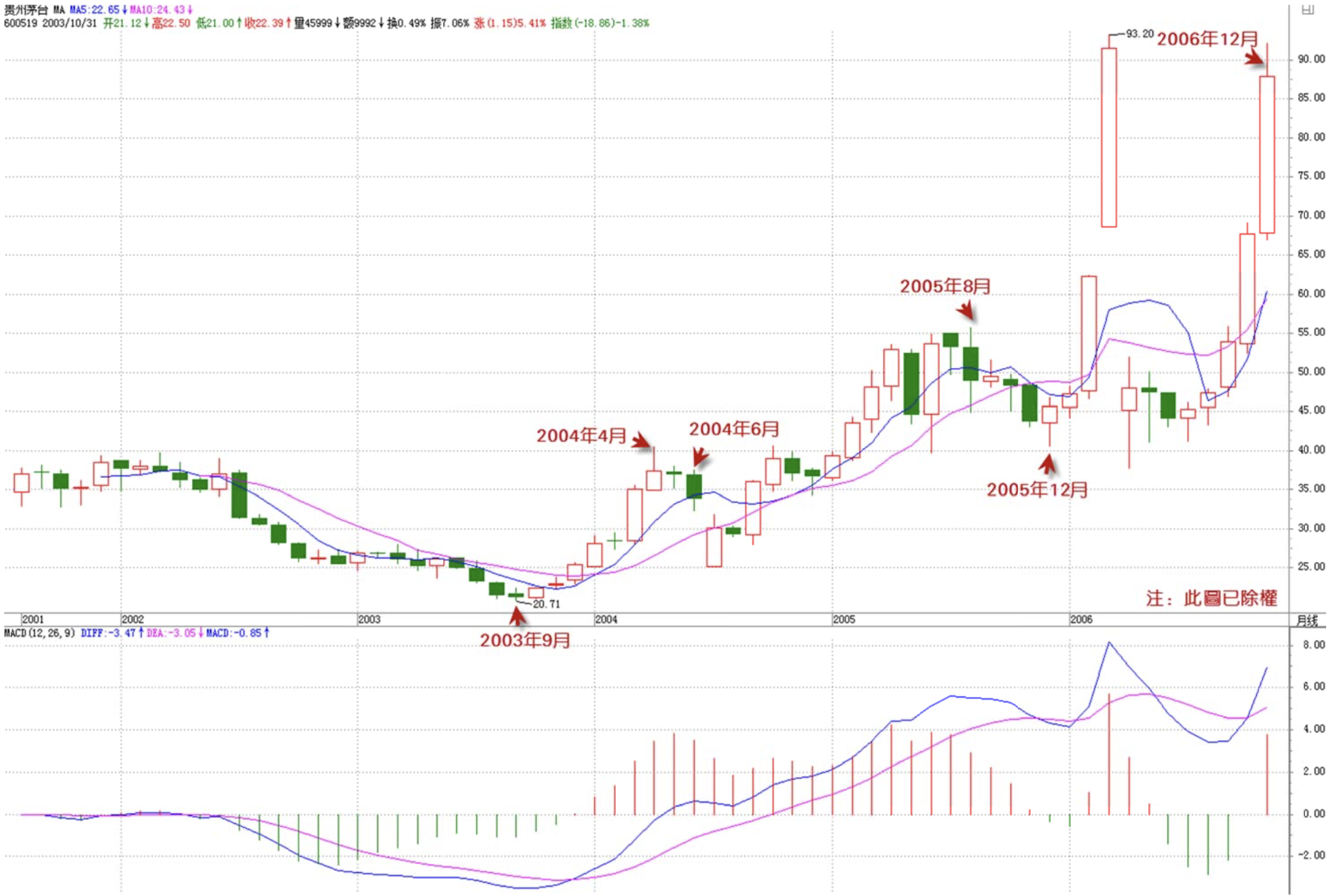
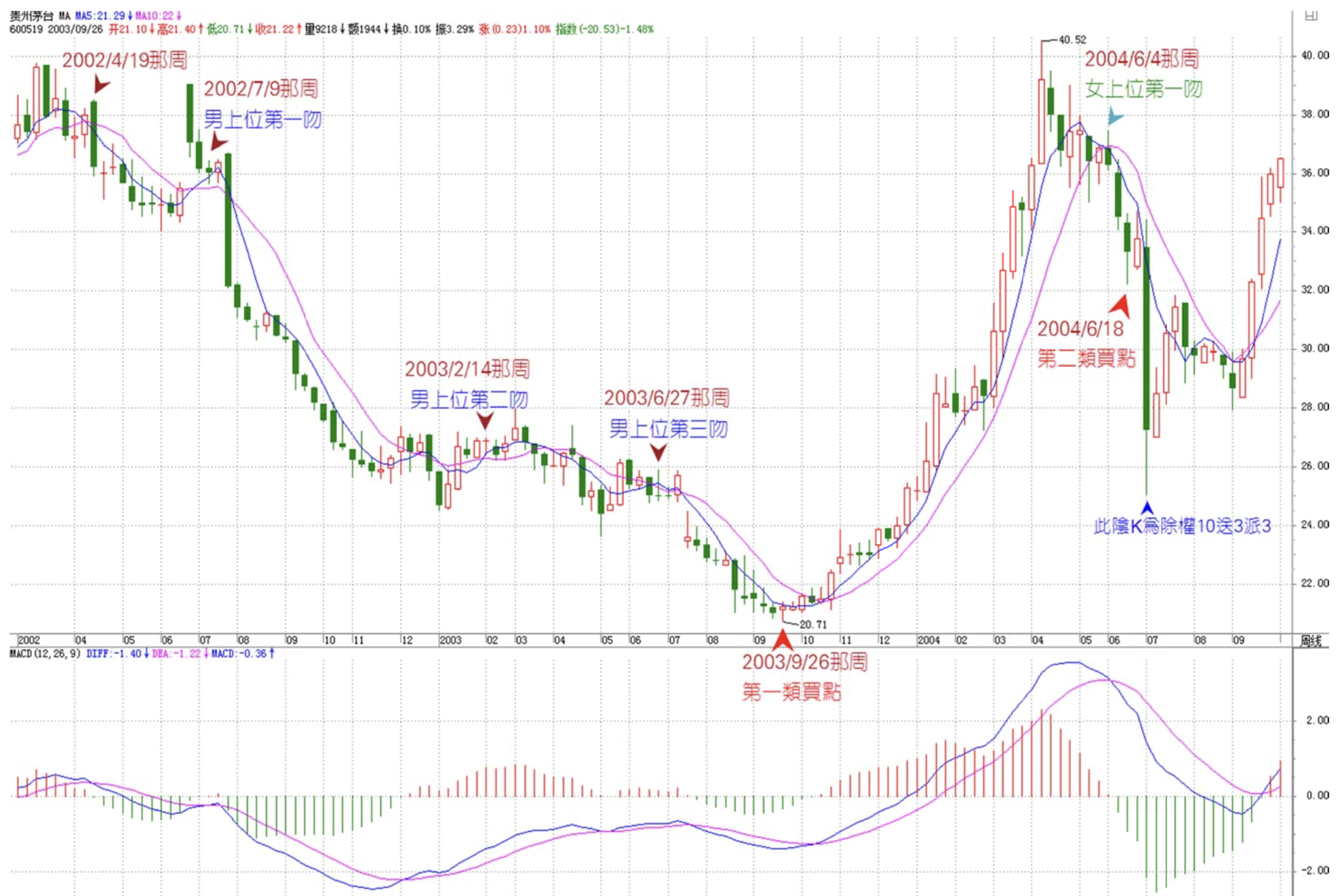
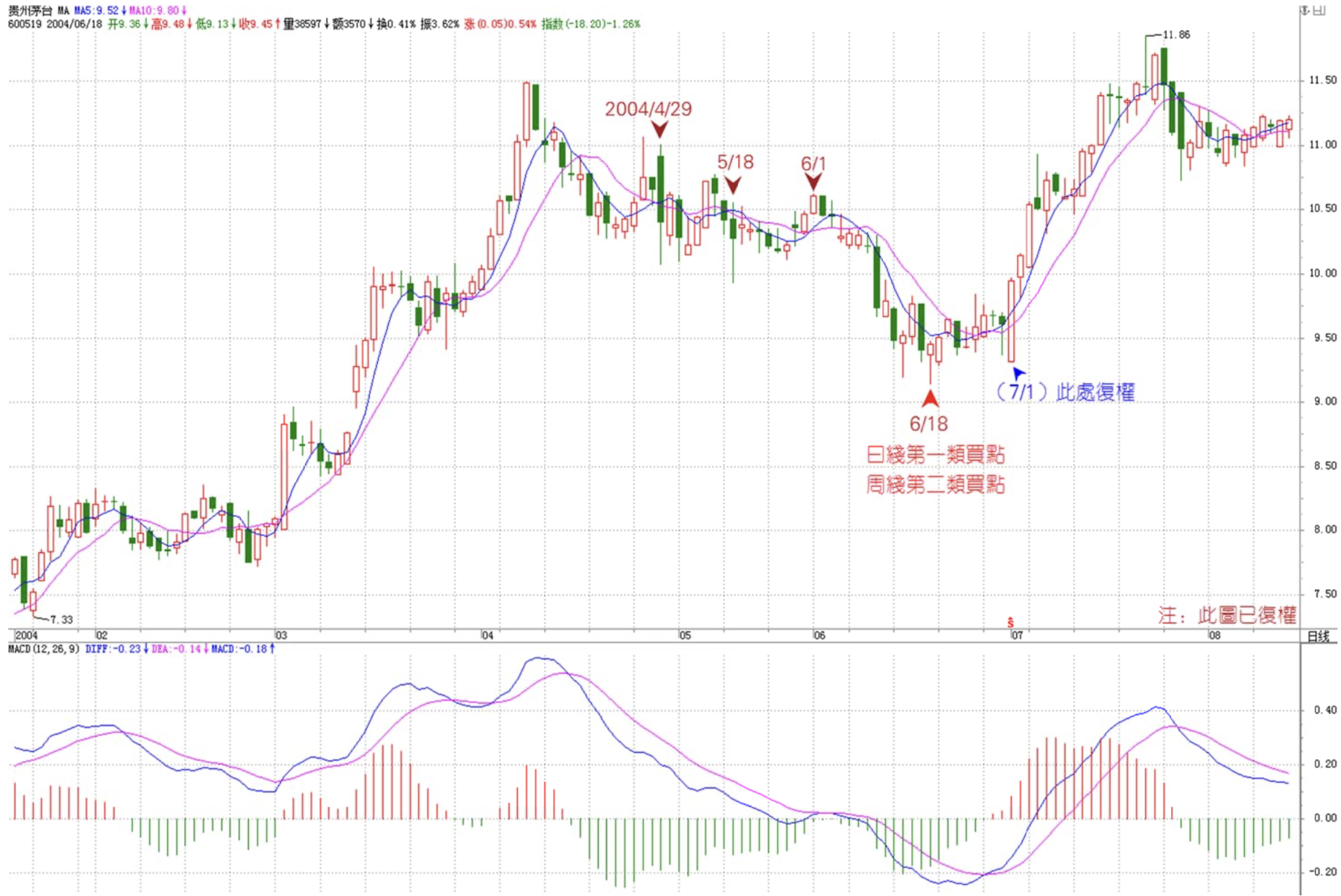
The turning point isn't identified by looking at moving averages, but rather when qualified entanglements appear, every decline is a good opportunity to accumulate. If you want more precise buy points, you can nest medium and short timeframes—this way you can basically buy at the most precise bottoms. This issue will be discussed in detail next time.
Here's an assignment: everyone please carefully look at Moutai's monthly, weekly, and daily charts, then find the qualified buy points on each.
缠中说禅 2006/12/4 15:12:37
[Anonymous] 谗
2006-12-04 13:59:22
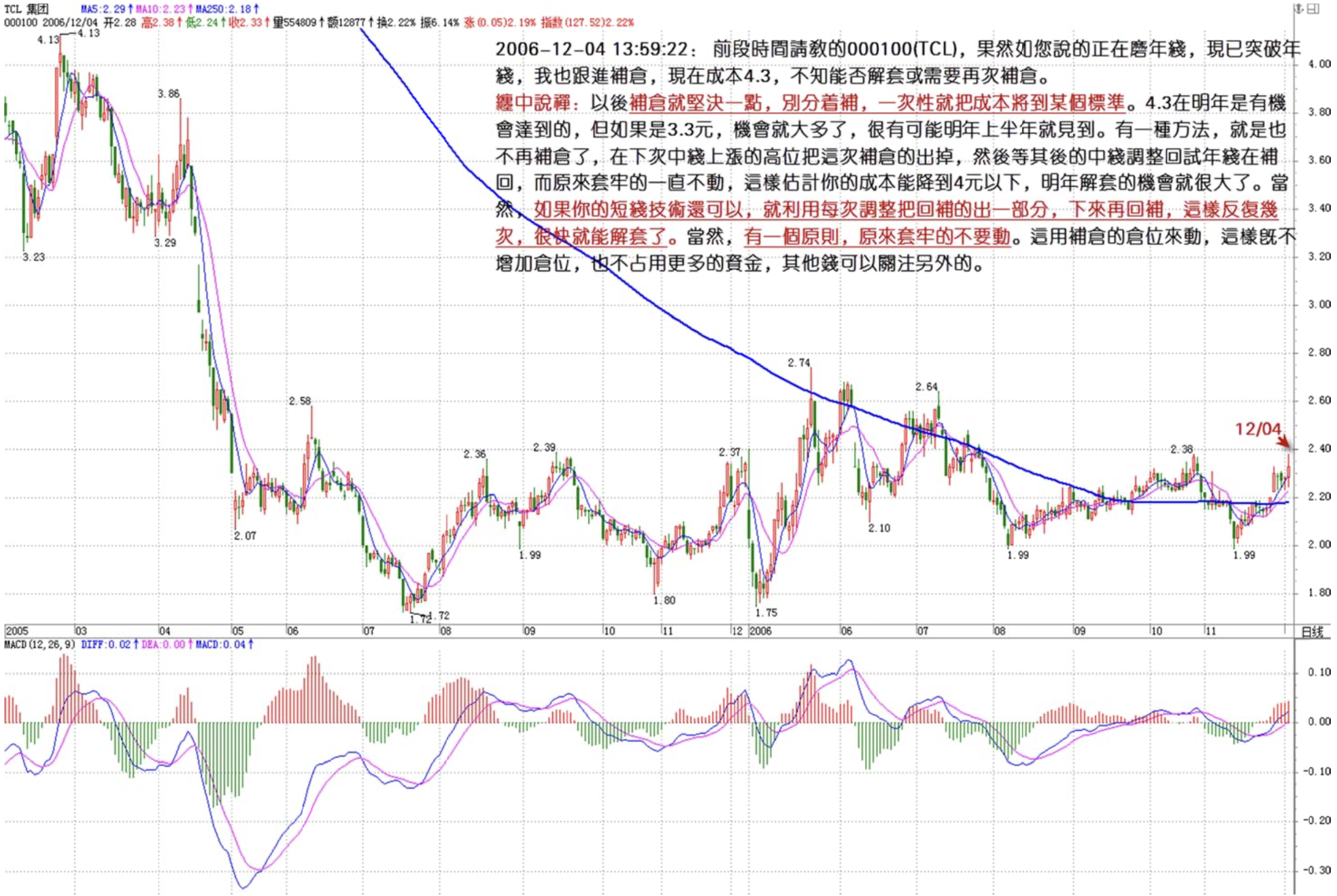
I asked about 000100 (TCL) before. As the blogger said, it was indeed grinding against the annual moving average and has now broken through. I also followed and added to my position. My cost is now 4.3. Can I break even or do I need to add more?
==============
When adding to your position in the future, be more decisive. Don't add in increments—lower your cost to a target level in one shot. 4.3 is achievable next year, but if it were 3.3, the chances would be much greater—it's very possible to reach that in the first half of next year.
There's another approach: stop adding to the position, sell the recently added shares at the high of the next intermediate uptrend, then buy back during the subsequent intermediate correction near the annual moving average. Meanwhile, keep the originally trapped shares untouched. This way, your cost could drop below 4, and the chances of breaking even next year would be much greater.
Of course, if your short-term skills are decent, use each correction to sell part of the added position, buy back on the dip, and repeat this several times—you'll break even quickly. Of course, one principle: don't touch the originally trapped shares. Only trade with the added position. This way you neither increase your position nor tie up more capital, and you can use the rest to watch other opportunities.
缠中说禅 2006/12/4 15:17:21
[Anonymous] 木头
2006-12-04 15:06:16
Math girl sister, what about Shandong Hi-Speed? Can I buy it?
Thank you!
==============
In a bull market, buying randomly at any time based on gambling odds still gives you a high chance of winning. But this isn't a long-term strategy. Based on these recent lessons, you should know that the qualified buy points have long passed. Figure it out yourself by analyzing it—that's what becomes truly yours.
缠中说禅 2006/12/4 15:21:04
[Anonymous] YY
2006-12-04 15:18:07
Blogger, you're teaching us so meticulously—are you trying to train us all to be experts like you? :)
==========
This ID can only teach the most basic techniques. Mindset cannot be taught. To learn that, study more of this ID's interpretation of the Analects, then repeatedly refine yourself in actual practice—only then is there a possibility of improvement.
缠中说禅 2006/12/4 15:23:17
[Anonymous] 瞎鼓捣
600058 is the "face-boy" I selected based on this program. Please comment, thanks.
==================
Good selection. On the weekly chart, this stock had a classic second-type buy point the week of November 17. That was the best time to enter.

缠中说禅 2006/12/4 15:24:15
[Anonymous] 中间体
2006-12-04 15:06:46
I can't hold my nerve—when I see other stocks going up while mine doesn't, I want to switch. How do I overcome this, Chan sister?
==========
The key is that you don't have a solid harbor. You must start building one now.
缠中说禅 2006/12/4 15:27:58
[Anonymous] 中间体
2006-12-04 15:24:01
Following Chan sister's method, isn't capital utilization low? Although safe, stocks at the bottom start rising slowly, and sometimes may entangle further. Wouldn't it be better to go for stocks that just broke out? Like today's 600832. But that would change the buying method.
============
If you want higher capital utilization, it's simple—change your timeframe to minute-level charts, and efficiency naturally increases. But this doesn't work for large capital. What this ID discusses applies to all situations, and each person should choose their operational chart timeframe based on their own capital size.
缠中说禅 2006/12/4 15:35:32
For this afternoon's market movement, the previous analysis remains valid. As long as the two markets don't work against each other, this ID's suggestion below will be realized on schedule. So right now, just watch whether the two markets diverge—once they diverge, be especially careful.
Chán Zhōng Shuō Chán
2006-11-29 15:14:38
From the perspective of a healthy market, this ID's recommendation for the broader market is: first let the Shenzhen Component Index break through its historical high of 6103 points, then Shanghai follows, and after the breakthrough, then correct—this would be healthier. I wonder if the market is interested in listening to this ID's opinion.
缠中说禅 2006/12/4 15:37:38
[Anonymous] Xiao Ming
2006-12-04 15:34:46
Since my capital is very small, each stock stays in my hands for only about 2 days on average. So despite the long bull run, I'm actually still losing money.
I plan to follow what Chan mm said and look at minute charts. Which minute chart is best? Is 30-minute the best?
===========
Choose for yourself—simulate more, study historical movements more. Once you master it with small capital, everything gets easier later. For ultra-short-term trading, 5-minute charts are sufficient.
缠中说禅 2006/12/4 15:40:10
When learning technical analysis, everyone must look at lots of charts and clear up all doubts. If anything is unclear, raise it here—this ID will continue addressing them in future lessons. You must understand everything—even if you don't understand, keep at it until you do.
If you have questions, post them here. This ID is signing off now. See you later.
缠中说禅 2006/12/4 22:47:35
[Anonymous] 幼小班
==============
Tomorrow a detailed analysis will be given. Once you've studied it yourself, the impression will be deep.
缠中说禅 2006/12/4 22:51:28
[Anonymous] 射男哥哥
2006-12-04 22:34:23
I, your brother, think the person who best combines stock trading with sexual metaphors is none other than math girl sister. She also claims no one in China is better at stocks than her, and of course she must be an absolute expert at men too! But she occasionally slips up! I inadvertently found this on the Qianlong K-line analysis circle: "2006-12-02 10:18:18 'Chán Zhōng Shuō Chán(blog)' exited the circle." Don't know when she joined. This at least shows that sister is constantly learning too! She's not always in the female-on-top position.
===============
Note: this ID has never joined any circle. Any circle joined in this ID's name has nothing to do with this ID. This ID has discovered that there is a blog on Sina with the exact same name as this ID, but with a different address. So everyone please be careful and don't confuse them.
This ID only has the one circle just established. This circle welcomes everyone to post their articles for mutual exchange. Apart from that, everything else has nothing to do with this ID. This is hereby declared.
缠中说禅 2006/12/4 22:53:23
[Anonymous] 戈石
2006-12-04 19:53:18
Dear blogger:
"Bu huan" (non-anxiety), meaning the fundamental, indescribable, absolute, absolute truth, non-positioned; "huan" (anxiety), meaning existence, describable, relative, relative truth, positioned. Precisely because absolute truth cannot be described, various relative truths arise to describe it. Don't think you can grasp absolute truth—it's unattainable. All you can master are relative truths of different positions.
Is this understanding correct?
=============
When you treat "bu huan" as "absolute," you've fallen into another trap—a mental trap constructed by a priori concepts.
缠中说禅 2006/12/4 12:15:49
This ID's recommendation for the broader market remains valid, quoted as follows:
This conclusion continues to be valid
Chán Zhōng Shuō Chán
2006-11-29 15:14:38
From the perspective of a healthy market, this ID's recommendation for the broader market is: first let the Shenzhen Component Index break through its historical high of 6103 points, then Shanghai follows, and after the breakthrough, then correct—this would be healthier. I wonder if the market is interested in listening to this ID's opinion.