From Net Assets to Market Capitalization: The Nuclear Power Driving the Great Bull Market
2007/4/16 15:23:54
In any economic system with a mature capital market, without exception, the value of listed companies and shareholder wealth is primarily measured by stock market capitalization. For example, when people discuss the wealth of Bill Gates or Li Ka-shing, it is based on the market capitalization of their stock holdings. Acknowledging the equivalence of physical assets and virtual assets in terms of transaction principles is a crucial marker of a market economy beginning to move from immaturity toward maturity.
In economic systems with mature capital markets, the securities market is a barometer of the economy. However, during the first dozen-plus years of China's securities market, the market was never such a barometer. This phenomenon has never been rationally explained in terms of the deep logic of the real economy — it was always brushed aside as a "Chinese characteristic." In reality, this is merely a simple and universal economic phenomenon. For the securities market to serve as an economic barometer, what it ultimately comes down to is whether the equivalence of physical assets and virtual assets in terms of transaction principles has been established in practice. Obviously, during the first dozen-plus years of China's securities market, under the split share structure, this equivalence was never established. Under full circulation, the establishment of this relationship has become inevitable.
Due to the non-existence of this equivalence, the value of controlling non-tradable shares could only be measured by net assets, while the value of non-controlling tradable shares was measured by market capitalization. These two different valuation standards consequently made it impossible to reconcile the interests of different types of shareholders. For controlling non-tradable shareholders, the cost of engaging in behaviors that harm other shareholders' interests — such as aggressive fundraising through the listed company, reckless investment, profit transfer, and misappropriation of funds — was extremely low. Once all shareholders' interests are unified under market capitalization as the measure, such misconduct by major shareholders becomes counterproductive. The benefits obtainable from these behaviors, once widely adopted by non-tradable controlling shareholders, will fall far short of the market capitalization losses caused by such actions.
For state-owned shares, which comprise the largest proportion of the market, under the new valuation framework, the performance assessment of state-owned listed company executives by state-owned asset management authorities, as well as the value assessment of state-owned assets, will inevitably shift its core criterion from net assets to market capitalization. The preservation and appreciation of state-owned assets will likewise inevitably turn to market capitalization as the standard of measurement. For non-state-owned shares, the logic is the same. Once the market capitalization standard is established, all shareholders' interests become unified, and listed companies' operations will inevitably pivot toward maximizing shareholder value as their primary objective. The correlation between company quality and market capitalization will increase significantly, and the capital market's effective allocation of resources will finally have a fundamental prerequisite. Good companies' stocks deserve good prices and can smoothly obtain sufficient low-cost financing from the market to complete effective allocation and restructuring of various resources. The purely speculative behavior of the past — pumping up bad companies' stocks to astronomical prices without any fundamental support — will therefore become increasingly worthless.
From a pure market trend perspective, the continuation of a long-term great bull market requires substantial support from long-term bulls that hold absolute market power. In the split-share era, the equivalence of physical assets and virtual assets in transaction principles was not recognized, making such long-term bulls fundamentally impossible. So-called bull markets could only be aggressive speculation by various capital pools leveraging various themes. So-called bulls were essentially opportunists, earning short-to-medium-term profits through stock price fluctuations, information exploitation, and theme mining. Since truly long-term bulls could not exist, the market could only cycle between highs and lows within a certain range, making a genuine great bull market impossible. In the full-circulation era, once the principle of equivalence between physical and virtual assets in transactions is established, all controlling shareholders of listed companies become genuine long-term bulls. Their greatest interest ultimately lies in the long-term appreciation of stock prices, and all resources favorable to supporting long-term stock price appreciation will be continuously integrated into listed companies. The truest, most steadfast bulls of the great bull market are thus formed. Since the state is effectively the market's largest controlling shareholder, the state is inherently and necessarily the biggest long-term bull. Although the state may adopt certain regulatory measures due to economic phenomena, the purpose of regulation is only to ensure better long-term outcomes, and it in no way changes the state's nature as a long-term bull.
From net assets to market capitalization — only then can the securities market truly become a barometer of the economy, become the most powerful weapon for market resource allocation. Only then can all shareholders ultimately be unified around the direction of creating and enhancing listed company value, thereby maximizing all shareholders' interests. Only then can the market ultimately form a critical mass of long-term bulls in absolute control, which in turn transforms into the nuclear power that truly sustains the long-term operation of the great bull market. From this point forward, the only factor that can truly turn the market bearish is severe deterioration and recession of the overall economy. Apart from this, adjustments caused by all other factors will not fundamentally alter the direction of the great bull market.
Replies
缠中说禅 2007/4/16 15:30:39
Sorry, I need to go out shortly — there's a meeting.
Will be back online at 9 PM.
Goodbye.
缠中说禅 2007/4/16 21:05:29
Sorry, had things to attend to this afternoon. Just got back.
缠中说禅 2007/4/16 21:09:28
[Anonymous] IRONCROSS
2007-04-16 15:33:13
Chan MM's tone seems increasingly relaxed.
Learning to trade stocks following you has truly been immensely beneficial — "immensely grateful" is not an overstatement.
Today I bought 0912 right at the open. Low P/E ratio, excellent earnings, agriculture-related, expansive prospects, post-adjustment showing breakout potential. Current price level presents minimal risk. Is this analysis sound?
I'm still only at the kindergarten level of watching the 5-day line. Quite embarrassing.
=
The 5-day line isn't very useful during consolidation, but in a one-directional trend, it's more than enough to handle even the most aggressive moves. Being able to do this is already good enough. Of course, if you can advance further and gain a deeper understanding of hubs and such, you won't need to watch the 5-day line anymore.
缠中说禅 2007/4/16 21:17:11
[Anonymous] 瞎鼓捣
2007-04-16 15:35:04
I can barely make out today's 1-minute decline,
but the recovery position came with absolutely no warning.
I couldn't see any recovery signal even on the 2-second chart.
=
Look at the 1-minute chart — today there was never a divergence on the 1-minute level. There was only a very small consolidation divergence below the 1-minute level in the afternoon. In this situation, you don't necessarily need to play short-term differences. Even if you do, it should be stock rotation. Sometimes you can't be too short-term. If your skills are particularly good, you can operate below the 1-minute level, but the prerequisite is being able to distinguish the three segments of the hub from 1055 to 1346.
缠中说禅 2007/4/16 21:19:27
[Anonymous] 傻子
2007-04-16 21:16:34
Teacher, not only did the market not cool down today, it got even hotter. Is this a good thing? I'm a bit worried.
==
Friday's end-of-day decline was the cooling. No negative news over the weekend — that's the biggest positive. Was there any need to cool down further just to give shorts a chance to cover?
缠中说禅 2007/4/16 21:20:53
[Anonymous] AD
2007-04-16 21:15:52
How do you determine whether a trend type is sub-level or sub-sub-level?
==
The sub-level of the daily chart is the 30-minute, and the sub-sub-level is the 5-minute. These can all be confirmed in advance. Please go through the previous lessons several more times.
缠中说禅 2007/4/16 21:36:14
[Anonymous] 新人
2007-04-16 21:32:14
Is this Chan sister criticizing "Daitou777"?
"Only those with heads big enough wear hats that big. You've claimed all the tops for yourselves — what are people like this ID supposed to eat?"
=
Who is "Daitou777"? This ID doesn't target any specific person, nor is any person worth this ID specifically targeting — including Kong the Male. Since he's from Peking University, I give him face by naming him in my criticism. Otherwise, he wouldn't even qualify for this ID to bother scolding.
缠中说禅 2007/4/16 21:39:10
[Anonymous] 黎民
2007-04-16 15:42:01
Today's move was too fierce. Sold the limit-up stocks in the morning, planning to continue playing the spread, but it only dipped 2% so I didn't dare to catch it, and shortly after the afternoon open it was sealed at the limit again. Can only wait.
==
You need to change your thinking. Being too fierce is not the reason to sell. When it should be fierce but isn't, or when it tries to be fierce but can't sustain it — that's the reason to sell.
缠中说禅 2007/4/16 21:40:56
[Anonymous] 迷糊
2007-04-16 21:23:19
Hi Chan sis,
A question: can the first rebound segment after a downward divergence count as the first segment of a hub?
=
Why couldn't it? As long as it doesn't violate the associative law, anything goes.
缠中说禅 2007/4/16 21:43:11
Star
2007-04-16 21:24:34
2007-04-13 16:08:41
I've always had a question about understanding hubs in consolidation. May I ask the host:
- Consolidation should only have one hub. Can it be understood as a+A+b, where segments a and b are mandatory? Must they be sub-level? For example, in a 30-minute consolidation,
a and b are 5-minute trends, A is a 30-minute hub, assume A1+A2+A3 — three 5-minute trend segments forming the hub. My question is: how many 5-minute segments are needed at minimum to form a 30-minute consolidation? 3 or 5?
=
How many sub-level segments do you think a hub requires at minimum?
==================================
It should be that three segments suffice. But the issue is right here. For example, at the 30-minute level, suppose a downtrend completes due to divergence, and afterwards a+A1+A2 emerge, all 5-minute trends. That can be seen as a completed 30-minute hub. But if later it extends to a+A1+A2+A3+c, and then a third-type buy point appears signaling the completion of consolidation — looking at the host's previous analyses, it seems the hub of this consolidation becomes A1+A2+A3. I'm very confused here. Please explain, thank you!!
==
Three overlapping sub-level segments form a hub. Everything after that is extension.
======================
Then why, for a trend like a+(A1+A2+A3)+b+(B1+B2+B3)+c, isn't a+A1+A2 considered a hub? It's also three overlapping sub-level segments. I'm really confused here. Please explain in detail, thank you!!!
==
Go re-read the lesson on the associative law carefully. All these questions have been addressed before.
缠中说禅 2007/4/16 21:47:44
[Anonymous] 乐土
2007-04-16 21:42:14
Teacher:
Hello!
Today around 1:30 PM I reduced my position by half, but the subsequent decline didn't produce a 1-minute bottom divergence before heading straight back up without looking back. Were the bulls a bit too hasty? :) Does this also indicate a high probability of accelerating upward movement for the market?
Thank you!
==
Why does the market need to produce a 1-minute bottom divergence before turning around? Today, not even a 1-minute top divergence appeared — only sub-1-minute level ones. The afternoon plunge completed that third segment of the hub, so naturally it could continue upward. As for whether the broader market will accelerate, that falls under prediction — you'd best break that habit.
缠中说禅 2007/4/16 21:55:18
[Anonymous] 开心
2007-04-16 21:34:58
Good evening, Miss Chan. Two questions for you.
Question 1: I bought Tunnel Shares on April 11. It was suspended on the 13th for earnings announcement. After reopening, it opened at the limit down. Why did it open at limit down? How can one judge the downward momentum of such stocks?
Question 2: Today 000739 Puluo Kangyu rose 17.82% within the first 15 minutes after opening, reaching a high of 19.88. With turnover reaching 28.08%, it ultimately closed up 7.06% at 17.9. How does Miss Chan handle operations in such situations where there's no divergence?
==
The smaller the level, the more experience and proficiency needed for judgment. So when you're first learning, don't torment yourself over small levels — this can easily wreck your mindset. If you can grasp the rhythm at the 30-minute level, 95% of people in this market are no match for you.
As for the two examples you mentioned, those are tick-level issues. You can grasp them by watching order placement and rally patterns on the order book, but this requires exceptionally good tape-reading instincts. After that, it's a matter of small levels transitioning to larger levels.
This is quite fair. If your skills are precise enough to operate at the tick level, you'll naturally exit better than others. Otherwise, when small levels drive larger levels, there are still many positions ahead where you can exit, or rather, where you can trade short-term differences.
缠中说禅 2007/4/16 21:57:31
[Anonymous] 酒吧心情
2007-04-16 21:54:50
JJ, isn't 1345 also a third-type buy point on the 5-minute chart?
First it breaks above the previous hub, 4151415-4161000, and then pulls back...
Please advise, JJ!
=
You can view it that way. What it evolves into next depends on tomorrow's opening. Prediction is unnecessary — just watch how these hubs form and develop, and you'll gradually develop a feel for the market.
缠中说禅 2007/4/16 21:59:44
[Anonymous] 凡
2007-04-16 21:36:19
Hello teacher! On the weekly chart, using Elliott Wave theory — is this the 5th wave currently in progress? If so, would its completion create a weekly-level divergence?
==
Right now, not even a weekly hub has formed. How could there be a weekly divergence? At most it would be daily-level, and whether even that can form is still questionable. There's no need to predict this — let the market play itself out. This ID's framework has no sub-waves — I only look at hub movements.
缠中说禅 2007/4/16 22:03:04
[Anonymous] 走失的爱犬
2007-04-16 21:12:27
Host, please take a look at 600737. I've asked you about it a few times now. Has the daily hub of this stock expanded into a weekly one? Is there still potential?
==
The main issue is that some lingering old problems haven't been fully resolved, but it's not a big deal.
缠中说禅 2007/4/16 22:07:03
[Anonymous] II
2007-04-16 15:40:08
"If your skills aren't up to it, just watch the 5-day line. As for those top-calling masters, go ahead and keep stretching your necks waiting for a big bearish candle. Even when a big bearish candle comes, you won't dare to buy — you'll just dupe yourselves about how brilliant you were, knowing a correction was coming. Too bad these people have been calling for corrections since 2,000 points and 3,000 points. February 27th only gave you one day of joy — did you dare to buy that day?"
===
Sister, those words — you're such a cheeky girl!~~~
I'm a die-hard bull too! A die-hard bull who joined at the end of 2006.
==
Don't be a die-hard bull. You should fully utilize fluctuations at whatever level you can grasp to reduce costs. Die-hard bulls ultimately just ride the elevator up and down — that's pointless.
缠中说禅 2007/4/16 22:10:32
[Anonymous] Sina User
2007-04-16 21:58:58
Teacher, could you discuss the property market in your economic commentary? I remember you once said Chinese property has no investment value, that the property market should become more like the stock market, and also that property prices still had to rise. What's the actual situation?
==
The property market cannot solve its problems without implementing a dual-track system. The shady dealings in real estate are too numerous. This ID has quite a few so-called big property developers in my circle and understands the situation quite clearly. Will discuss when there's time later.
缠中说禅 2007/4/16 22:13:53
[Anonymous] 诚诚
2007-04-16 22:07:45
Host:
I bow again, earnestly requesting an answer!
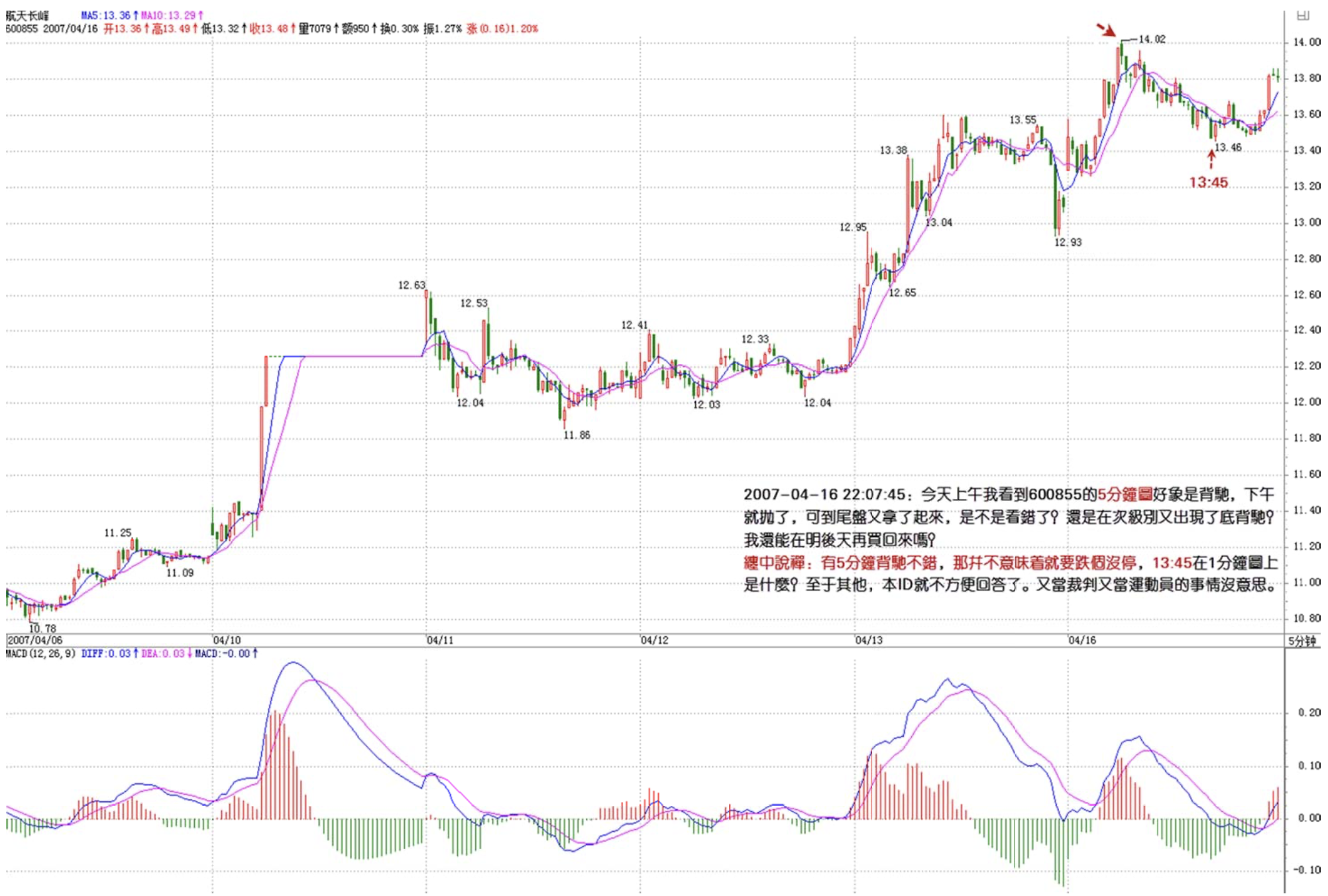
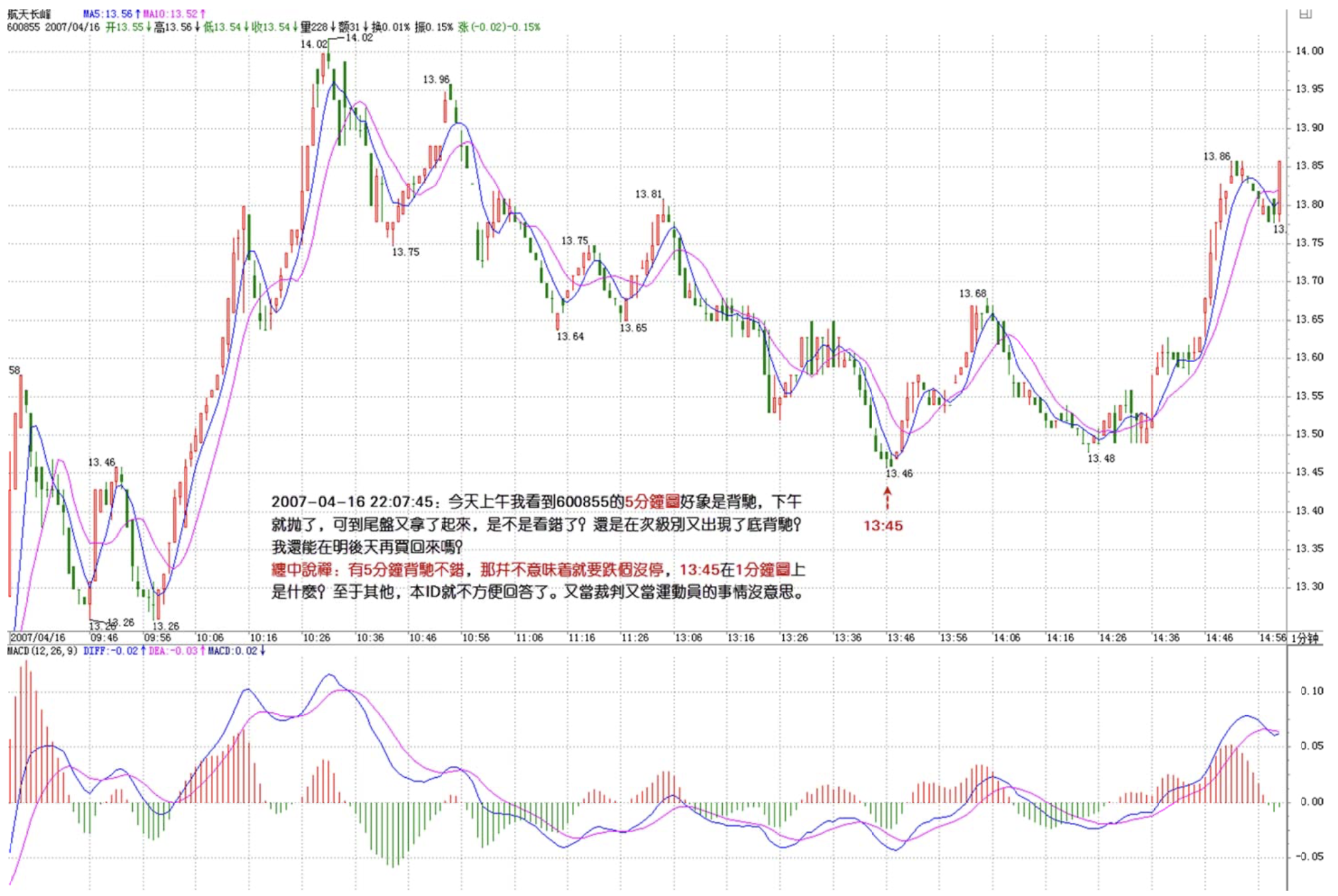
Good evening! Thank you for your hard work! This morning I thought I saw a divergence on the 5-minute chart of 600855, so I sold in the afternoon. But near the close I picked it back up. Did I misread it? Or did a bottom divergence appear at a sub-level? Please explain! Thank you!
Can I buy it back tomorrow or the day after?
==
Identifying a 5-minute divergence was correct. But that doesn't mean it will drop non-stop. What is 1345 on the 1-minute chart? As for the rest, this ID won't comment further. Being both referee and player is no fun.
缠中说禅 2007/4/16 22:15:59
[Anonymous] 也许认识你
2007-04-16 22:11:14
Host, I think I understand now.
Is my question also solvable using the associative law?
The declining hub of buy-3: the first 3 segments can be viewed as consolidation, then combined with the subsequent 1-minute trend segments to form a decline?
Hubs can also be combined this way: sub-level (up + down + up), initially seen as a hub, then up + (down-up-down), with the latter 3 segments combining to form a hub?
==
The associative law allows you to view problems from multiple angles — combining perspectives gives you accuracy. But note: within the same decomposition, you cannot use different combinations, or everything falls into chaos.
缠中说禅 2007/4/16 22:19:10
On individual stocks, from a mid-term perspective, pay close attention to stocks with expected reported losses or deliberately poor earnings. These stocks all have ulterior motives. You don't have to buy them yet, but you must watch them. Quite a few stocks have already pulled this trick. Going forward, more and more will do the same, especially when many people have missed the rally — many will use this method to steal shares on the cheap.
It's too late. Must sign off. Goodbye.
缠中说禅 2007/4/16 15:25:25
The regulators shouldn't be over-praised. Although this time, with the push above 10,000, they performed rather sensibly, they still shouldn't be praised. No news over the weekend was the best news, so today's price action was perfectly normal. Those top-calling masters — if they traded futures, they'd have gone bankrupt hundreds of times. So futures really shouldn't be launched yet, lest the traitors all jump off buildings.
As emphasized many times, a single 5-day moving average is 10,000 times more powerful than all the top-calling masters combined. When the trend hasn't broken the 5-day line, what do you have to worry about? Of course, if your skills are good enough, you can use daily fluctuations to rotate stocks and trade price differences. If your skills aren't up to it, just watch the 5-day line. As for those top-calling masters, go ahead and keep stretching your necks waiting for a big bearish candle. Even when a big bearish candle comes, you won't dare to buy — you'll just dupe yourselves about how brilliant you were, knowing a correction was coming. Too bad these people have been calling for corrections since 2,000 points and 3,000 points. February 27th only gave you one day of joy — did you dare to buy that day? What does a big bearish candle have to do with you anyway? Those who are now fully in cash — the only solution is self-reflection: examine what mindset caused this. If you refuse to let go of your scheming mind, this is the natural result. Only those with heads big enough wear hats that big. You've claimed all the tops for yourselves — what are people like this ID supposed to eat?
There'll be fluctuations this week, of course — saying that is about as meaningful as saying boy-toys are male. The key is how to reduce costs through fluctuations, not using fluctuations as bragging material for how accurate your predictions were. Stocks are like boy-toys — they're for action, not for discussion. Currently, the key remains the regulators' attitude. As long as their attitude doesn't explicitly suppress the market, there won't be any major problems. Operationally, there's no need to chase highs. Those in cash should just watch and reflect thoroughly. For the rest, if your skills aren't great, keep watching the 5-day line. If your skills are good, watch for small divergences on the 1-minute and 5-minute charts to trade the fluctuations.