The Formulaic Gap-Filling Oscillation Plays Out on Schedule
2007/9/5 16:10:28
Today's movement really has nothing worth talking about. Monday left a gap, and technically it takes three days to test it. Today, an overly formulaic gap-filling oscillation played out on schedule, making one think they were watching a Peking opera performance at the Chang'an Grand Theater.
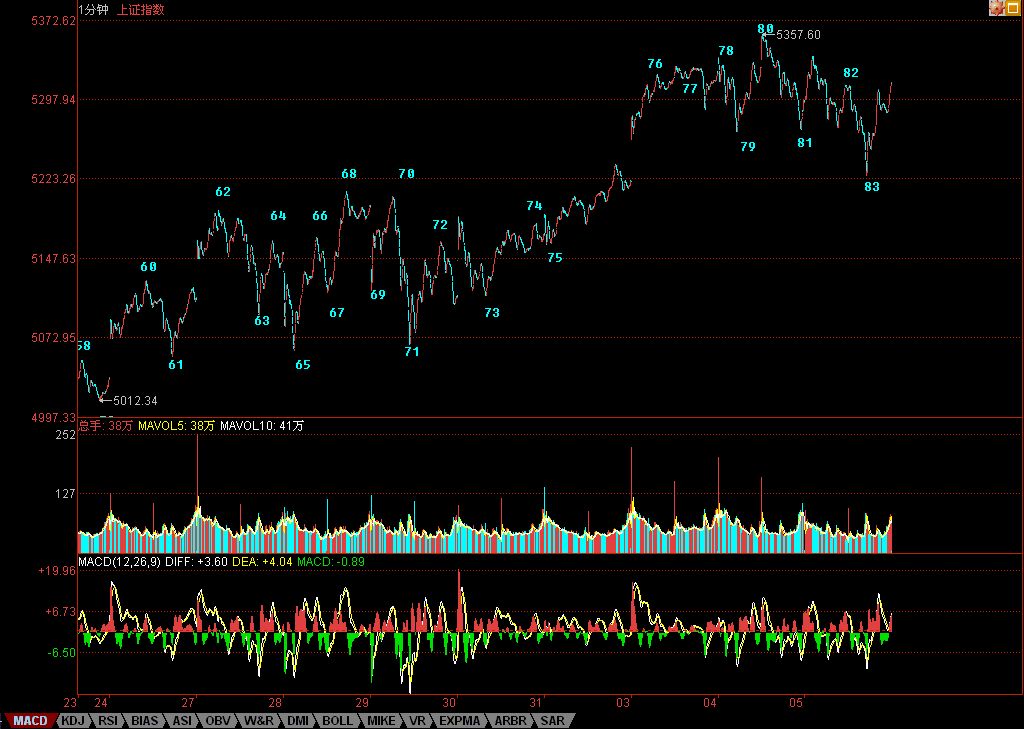
After the formulaic oscillation, that's where the real question lies. From a purely technical perspective, in the chart below, after the 5-minute hub of segments 62–71 was broken, segments 71–80 represent a standard 1-minute uptrend—that is, a sub-level departure. Segments 80–83 represent a standard 1-minute consolidation pullback, meaning segment 83 is a textbook third buy point for the 5-minute hub of segments 62–71. The subsequent movement can only be one of two things: a larger-scale oscillation forming, or a continuation of 5-minute hub migration upward.
Now, the worst-case scenario would be forming a 30-minute hub, and the best case would be continuing the 5-minute uptrend until a new 5-minute hub forms. Technically, the formation can only be one of these two scenarios—there's nothing much to discuss, as it can be determined in real time based on current price action. To be more specific: if tomorrow can't make a new high, or if after making a new high it shows a 1-minute consolidation divergence that doesn't constitute a third buy point, then a new 5-minute hub must form at the current position. After that, it's simple—just see whether the hub oscillation produces a third buy point or a third sell point. As for tomorrow forming a 1-minute third buy point, then the market will rise and continue the process of seeking a new 5-minute hub.
On individual stocks, second- and third-tier concept stocks continue to flex their muscles—this is a good sign. As for first-tier large-caps, the key is the issuance price of China Construction Bank. If they come out with an issuance price close to or even higher than where Bank of China and ICBC currently trade, then none of these first-tier large-caps can be held down anymore. This is actually why this ID has one hand on concept stocks and one hand on Zhong-prefix stocks—both hands must be firm. Think about it: if China Mobile issues at 30–50 yuan, then China Unicom sitting below 10 yuan—how could it not be embarrassed? If PetroChina also comes in at 20–30 yuan, how could PetroChina (A-share) justify staying below 20 yuan?
Currently, the biggest support or driving force for these big rocks is the returning price of their peers. Once CCB shows a high issuance price, those returning afterward won't be able to go low even if they wanted to. So, everyone, keep on going wild.
Now the situation is crystal clear, and this ID has stated it plainly: who cares if tomorrow brings a flood. If you have the right mindset and can strike decisively when the real moment comes—ruthless enough—then fully enjoy this wild game.
The east wind blows, the war drums thunder—who fears whom in this world?
But if you don't have the guts, then adjust your positions accordingly. Otherwise, if you want to ride the frenzy yet expect zero consequences from the frenzy, you might as well go back to Mars.
I can answer questions until 5 o'clock today.
Replies
缠中说禅 2007/9/5 16:22:56
[Anonymous] 退伍老兵 Delete all comments by this person
2007-09-05 16:16:21
Sister, I want to go heavy on 600050. Is that okay? I'm a retired soldier, not very knowledgeable about stocks, and want to earn some startup capital.
==
China Unicom is definitely fine from a medium-to-long-term perspective, but technically this price level isn't a great buy point.
Unicom's themes, roughly speaking, have three aspects:
The return of China Mobile, whole-group listing, and telecom restructuring. Comparatively, the latter two are the key points. And telecom restructuring is the most important—if they follow the current plan, Unicom would handle GSM exclusively, meaning numbers like 139, 138, etc. would all go to Unicom. Can you imagine the upside?
Of course, there are still a lot of variables in this telecom restructuring. Until the very last moment, nobody can say for sure.
缠中说禅 2007/9/5 16:24:14
Blazing Sun 10000 Delete all comments by this person
2007-09-05 16:18:53
Master Chan, could you explain why the high point in the middle of segments 81–82 doesn't count as a separate segment?
==
Because that's just a stroke. A stroke break does not equal a line segment break.
缠中说禅 2007/9/5 16:33:55
[Anonymous] 顶石猴的问题 Delete all comments by this person
2007-09-05 16:22:20
My question is: how is the start and end of a fractals defined? If the second characteristic sequence doesn't have three elements, and simply doesn't exist, then there's fundamentally no possibility of the second scenario in line segment classification occurring. But doesn't the three-segment illustration for the second scenario also fit the condition of the second characteristic sequence not having three elements? So why is it three segments?
Thank you!
==
In the second scenario, if the conditions of the definition are not met, it doesn't count as the line segment being broken. For example, in a decline, if an ABC pullback constitutes the second scenario, then a new downward stroke directly makes a new low—that obviously doesn't satisfy the definition, so the original decline hasn't ended.
But if the ABC pullback constitutes the first scenario, then the original decline has definitely ended. That's the difference between the first and second scenarios.
Additionally, please get some concepts straight. The first and second scenarios are a complete classification—if it's not the first, it must be the second. You must first distinguish between the first and second scenarios before the question of the second characteristic sequence even arises. For the first scenario, this issue doesn't exist at all. If in the second scenario you can't find a second characteristic sequence, then the original line segment hasn't been broken—it's that simple.
Please start from the definitions in all cases.
缠中说禅 2007/9/5 16:46:39
[Anonymous] 此生如初见 Delete all comments by this person
2007-09-05 16:28:12
Boss, if the non-ferrous metals sector, driven by incoming capital especially new funds, doesn't do stock splits over the next N years, many could reach 100 yuan. Of course, P/E might only be 50–60, and trailing P/E might be even lower. That way, the entire A-share market could have 30–50 stocks above 100 yuan. Is this scenario possible?
==
Nothing is impossible. If all the Zhong-prefix companies went through whole-group listings, even 200 stocks above 100 yuan would be perfectly normal.
缠中说禅 2007/9/5 16:52:47
Stone Monkey Delete all comments by this person
2007-09-05 16:35:10
Above segments 74–75, the downward stroke around 08311055 closed the gap, and the price also first broke below the endpoint of this stroke. Why isn't that a line segment?
=
That's just a stroke break, not a line segment break.
缠中说禅 2007/9/5 16:54:43
All Red Delete all comments by this person
2007-09-05 16:38:41
May I ask, Master Chan:
Should the line segment 79–80 be compared against 77–78 (consolidation divergence) or against 75–76? What's the criterion?
79–80 didn't make much of a new high after all.
==
This has nothing to do with how much of a new high was made. The key is whether there's a trend.
缠中说禅 2007/9/5 16:59:02
[Anonymous] 手机用户 Delete all comments by this person
2007-09-05 16:47:16
Boss, sometimes a line segment's departure from the hub is very strong with no divergence, but it doesn't necessarily form a third buy/sell point. How do you anticipate this?
==
A third buy/sell point can only form when the pullback force is less than the departure force. If the pullback movement hasn't even appeared yet, how could you possibly anticipate it? If the departure force is strong but the pullback force is even stronger, then of course no third buy/sell point forms. So everything must wait for the chart to play out in real time.
缠中说禅 2007/9/5 17:00:46
[Anonymous] Sina User Delete all comments by this person
2007-09-05 16:48:07
Second scenario of line segment classification.
Line segment starting with an upward stroke,
            /\  /
     /\     / \ /
    ./ \ /\  /  \/
    /  \/ \ /
   ./     \/
 /\ /
./..\/
/
How many line segments is this chart?
==
One segment.
缠中说禅 2007/9/5 17:03:36
[Anonymous] Sina User Delete all comments by this person
2007-09-05 16:59:41
Master Chan said yesterday that the market would weaken if the gap was filled. Today, after filling it, the market actually dropped its burden and stood back above 5,300 points. What does Master Chan think about this? Thank you.
==
This ID has no particular thoughts.
Not filling the gap would be the strongest scenario. Filling the gap but then pulling back strongly and continuing to new highs would be the second strongest. If the gap is filled and the pullback is weak, unable to make new highs, that would be the weakest.
Now the market can't choose the strongest option. As for the remaining two, which one it picks—let the market decide for itself. This ID has no interest in predicting.
缠中说禅 2007/9/5 17:06:20
[Anonymous] 大盘 Delete all comments by this person
2007-09-05 16:58:11
May I ask the blogger:
For filling a daily gap, is it sufficient as long as the highest point of the candlestick above the gap is breached?
==
Correct. A gap is a range where no trading occurred starting from a certain day. When on some subsequent day, trading occurs in that range, the gap is filled.
缠中说禅 2007/9/5 17:13:18
[Anonymous] Sina User Delete all comments by this person
2007-09-05 17:04:05
        C
 A      ┃
 ┃      ┃
 ┃      ┃
 ┃      ┃
 ┃      ┃
 ┃      ┃
 ┃      ┃┃
┃ ┃    ┃ ┃
┃ ┃    ┃  ┃   ┃
┃ ┃    ┃   ┃ ┃
┃ ┃    ┃    ┃
┃ ┃    ┃    D
┃ ┃    ┃
   ┃  ┃
   ┃  ┃
   ┃  ┃
   ┃  ┃
   ┃  ┃
   ┃  ┃
   ┃  ┃
    ┃
    ┃
    ┃
    ┃
    ┃
    ┃
    ┃
    B
In the chart above, regarding the strokes: is it one stroke from A to D, or three strokes A–B, B–C, C–D?
==
A–B is definitely not one stroke, and neither is B–C. As for whether A–D is one stroke, that depends on the movement after D.
To find strokes, you first need to find fractals. Both A and D satisfy the conditions for fractals, but the key is whether the fractal after D is a top or a bottom. If it's a top, then A–D is one stroke. If it's a bottom, then D is definitely not the bottom that forms one stroke with A.
缠中说禅 2007/9/5 17:15:30
Alright, it's past 5 o'clock. Heading out first. Goodbye.
缠中说禅 2007/9/5 16:16:28
[Anonymous] Sina User Delete all comments by this person
2007-09-05 16:13:43
I wonder if Sister Chan's view on the steel sector has changed?
==
No, the bigger opportunities in steel lie in acquisitions and restructuring.