Tipsy Musings — a "Shui Diao Ge Tou"
2007/6/29 0:30:22
Back from social engagements, tipsy and in high spirits, casually composing a "Shui Diao Ge Tou"
Shui Diao Ge Tou
Chán Zhōng Shuō Chán
Cataclysmic fire topples heaven's pillars; raging waters roll up heaven and earth.
Wild winds and vicious rains still devour four seas and five continents.
A hundred generations of fierce dragons battle the wilds; ten thousand li of long halberds flung at the sun; jade blood transformed to crimson dust.
Piled bones fill the mountain gorges; since time immemorial, clouds of sorrow rise.
Tiger-wolf dens, ghost-god realms, gates of life and death —
In this saha world, deluded guests idly speak of a "global village."
How many foxes and rabbits contend; how many kings rise and bandits fall — one by one buried by the wheel of time.
Casting down the brush, standing beneath the vault of sky; the Milky Way pours into a golden goblet.
Appendix:
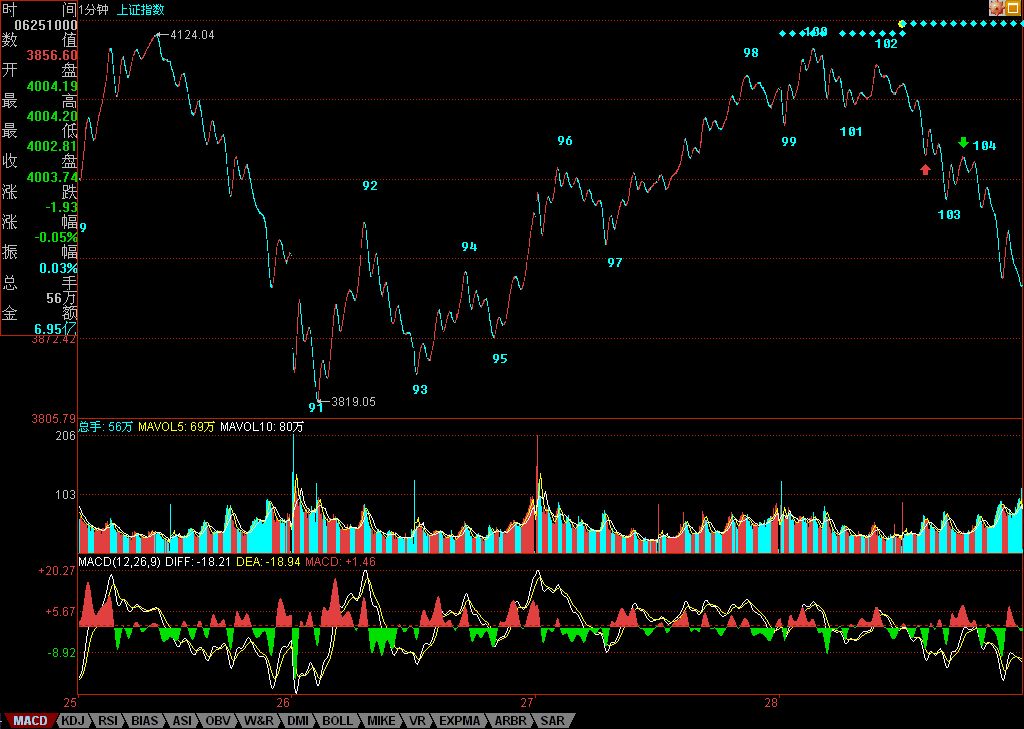
Just turned on the computer and came up to check — found that someone had questions about yesterday's line-segment classification. This issue has been discussed before: the key is what degree of precision you use. In the chart below, the red arrow is at 4022.69, the green arrow at 4022.42. By the strictest standard — precision to two decimal places — this doesn't break the previous line segment, so it's not a new line segment. However, if we uniformly use single digits as the precision, rounding down, then the two values overlap, and by that standard it can be defined as a new line segment (as shown in the chart below). But if we round to the nearest integer, the first is 4023 and the second is 4022, so it can't be defined that way.
The single most important criterion for a new line segment is that it must break the structure of the old line segment. For example, in a declining line segment, the subsequent high point must be lower than the previous low point.
To accommodate everyone's habits and for simplicity, we'll unify the standard going forward: use the truncation method (round down to integer) to confirm. So the line-segment classification can be revised as shown in the chart below.
Signing off for now; see you after the afternoon close.
缠中说禅 2007/6/29 8:54:40
Just turned on the computer and came up to check — found that someone had questions about yesterday's line-segment classification. This issue has been discussed before: the key is what degree of precision you use. In the chart below, the red arrow is at 4022.69, the green arrow at 4022.42. By the strictest standard — precision to two decimal places — this doesn't break the previous line segment, so it's not a new line segment. However, if we uniformly use single digits as the precision, rounding down, then the two values overlap, and by that standard it can be defined as a new line segment (as shown in the chart below). But if we round to the nearest integer, the first is 4023 and the second is 4022, so it can't be defined that way.
The single most important criterion for a new line segment is that it must break the structure of the old line segment. For example, in a declining line segment, the subsequent high point must be lower than the previous low point.
To accommodate everyone's habits and for simplicity, we'll unify the standard going forward: use the truncation method (round down to integer) to confirm. So the line-segment classification can be revised as shown in the chart below.
Signing off for now; see you after the afternoon close.