Teaching You to Trade Stocks 106: Moving Averages, Rotation, and the Chán Zhōng Shuō Chán Sector Strength Index
2008/7/10 12:12:22
First, about the illness. The reason this ID is temporarily not using meditation to cure it completely — first, I must leave an excuse to go learn that extraordinary person's techniques. If I were completely cured, what excuse would there be? Sacrificing oneself for the Dharma is something this ID has always been happy to practice.
Second, the world is far more mysterious than simpleton materialists believe. After I came back from the first round of chemotherapy, this ID mentioned a strange encounter during that period. Because it was so thoroughly un-materialistic, this ID has never talked about it, to avoid promoting strange mystical nonsense. In reality, this ID's high-profile presence here has provoked quite a lot of resentment. Think about it — how many religious and mystical paths has this ID cut off here? And these things all have some weird tricks up their sleeves, all very un-materialistic of course. That time, this ID was nearly trapped by a certain evil curse. Fortunately, thanks to past accumulated merit, at the most dangerous moment, a relative of this ID who studies Buddhism and practices mantras miraculously appeared and broke that evil curse with a particular mantra. Otherwise, how could this ID have gone out feasting and drinking and come back to see all of you again?
Because this ID's body was at that time in a state close to hepatic coma (this was what that extraordinary person later said), that's how the evil curse managed to latch on. During that period, I was making random phone calls to many friends, completely in an unconscious state, so many people can testify to this incident. The next day, when a friend flew in specifically from Beijing, this ID had already been rescued by that relative. Now, this ID's body is in much better shape than back then, and petty tricks certainly can't harm this ID. But there are also masters among the villains of this world. In short, this ID's meditation practice is being prepared for them.
This ID hereby issues a challenge. To that thing that played curse games last time — take your skills and get lost. Is there anyone else in this world who wants to play at a higher level? This ID is ready to take you on right now. All the demons and monsters across the globe — bring all your curses and sorcery. This ID will fight you to the end.
Alright, back to stocks. I have things to do this afternoon, no more posts. My apologies.
Let's use a rebound as an example for this lesson; for pullbacks, just reverse everything.
At any level, there is a minimum extension time. For example, a stroke, since it must contain both a top and bottom fractal, must extend at least 6 basic candlestick units. That means if the 5-day moving average can't even be touched, then it cannot be a stroke-level rebound. By the same logic, one can determine the minimum extension time and the corresponding minimum moving average to challenge for line segments, 1-minute, 5-minute, 30-minute, daily, weekly levels, and so on.
From this, we can see that although there is no necessary relationship between trend levels and moving averages, there is still a rough range correspondence. In particular, based on experience, the suppressing moving average for N hubs within a trend is roughly the same. For example, if the first hub was suppressed by the 89-day moving average, then subsequent hubs within the same trend are very likely to be suppressed by the same moving average. If a rebound can only reach the 34-day line, then the probability of it being the same level as the first hub is very low.
Except for the simplest stroke, any trend involves larger levels nesting smaller levels. Therefore, a single moving average alone has limited significance — what's needed is a moving average system.
Pay attention: the setup of the moving average system must be based on actual price action. That is, the moving average system you set up must align well with actual existing price movements. For example, looking at the decline from 6124 points, if we choose parameters 5, 13, 21, 34, 55, 89, 144, and 233 to construct a moving average system, everyone can see that this system aligns extremely well with the price action.
For instance, the 4778-point level was produced with support from the 233-day moving average. After that, a bull trap formed on the 55- and 89-day moving averages. The subsequent decline was suppressed by the 21-day moving average all the way down to below 3000 points. Then the rebound was precisely suppressed by the 55-day moving average. The decline after that stayed below the 13-day moving average until this current rebound.
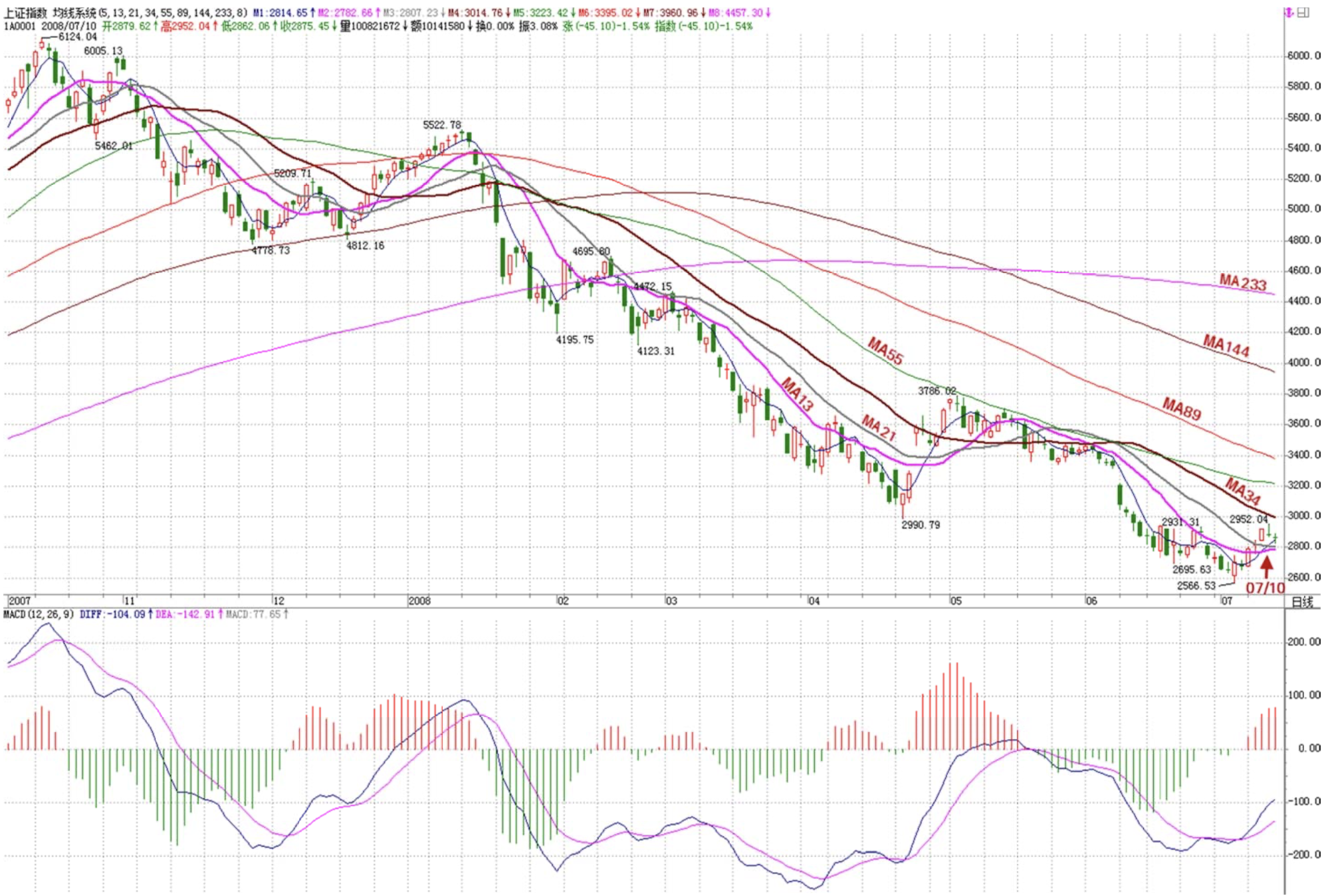
The degree to which this system fits the price action is obviously very high. As long as no major change in the trend appears, one can of course continue using it. From this, we can see that the 55-day line (the 89-day line will soon intertwine with it) is the real litmus test for this rebound. If it cannot break through or even touch it, that means the rebound level is still not large enough, and it's highly likely to pull back and form another same-level move to construct a larger-level rebound. In the short term, the 34-day line is a very practical test.
Using this system, one can establish a complete classification to judge the strength and sequence of trends. Of course, looking solely at the index is not the most useful application of this classification — that's for single-instrument use. The key is that we can also apply it horizontally, classifying all stocks accordingly, and the rhythm of market rotation becomes crystal clear.
The classification principle is the smallest-period moving average that the current rebound has not yet conquered. Thus, 8 moving averages can divide stocks into 9 categories, with the weakest category naturally being those completely below all moving averages. Note that the strongest category is not necessarily those completely above all moving averages — why? (Think about this yourselves; don't depend on this ID for every answer. The effect of thinking once is better than this ID giving you the answer a thousand times.)
Let me still use stocks this ID has been repeatedly trading as examples:
000802, 000998, 600636 are clearly in the strongest Category 9; 600139 belongs to Category 8; 600578, 600607 belong to Category 7, with their pullback on the 89-day line these past few days being extremely textbook; 600195, 600343 belong to Category 6; 600737, 000600 belong to Category 5; while the market index has only managed to stand above the 21-day line at most, belonging to Category 4 counting from the weakest.
From this classification, two points emerge. Running the statistics, the largest number of stocks are currently being suppressed around the 34-day line. This tells us that the 34-day line is also major resistance for the index. Since the index hasn't reached that line yet, this hint has predictive significance.
Furthermore, once a stock adjusts at Category N, it takes at least a considerable period of churning before reaching Category N+1. This provides the best basis for rotation selection. Once a trend-level move in Category N shows a top divergence, you can exit first — there will be at least several days of leisure time to look for other stocks that have finished their pullback and are ready to launch again, or laggards catching up.
There is an even more important application — doing this by sector. Judging a sector's strength is simple: just average the category numbers. The higher the average, the stronger the sector. This average category number can be called the Chán Zhōng Shuō Chán Sector Strength Index.
The strongest sector is the leading sector, and the dynamics of that sector are extremely critical. Furthermore, by plotting the Chán Zhōng Shuō Chán Sector Strength Index for all sectors on a single chart, the order and rhythm of rotation become perfectly clear. Based on this, combined with analysis of specific stocks' price action, rotation trading naturally becomes extremely simple.
The above operations can easily be solved by designing a computer program — that's not something this ID should prepare for you. The bread recipe has been given; there's no reason for this ID to also bake the bread and feed it to you one by one. Go ahead and become your own pastry chef.