Teaching You to Trade Stocks 18: A Virgin Never Kept as a Paramour Is an Imperfect Virgin.
2006/12/26 15:05:58
First, let's list the most basic concepts, principles, and theorems from before:
Movement: what you see when you open a movement chart. Movements are classified by level.
Movement types: uptrend, downtrend, consolidation.
Trend: uptrend, downtrend.
Chan Movement Hub: within a movement type of a certain level, the portion overlapped by at least three consecutive next-lower-level movement types. The specific calculation is based on the overlap of the first three consecutive next-lower-level types. The rigorous formula can be expressed as follows: three consecutive next-lower-level movement types A, B, C, with their respective highs and lows being a1\a2, b1\b2, c1\c2. Then, the hub's range is (max(a2,b2,c2), min(a1,b1,c1)). In practice, you can just eyeball it—no need for anything this complex. Note: the first three next-lower-level movement types must all be completed to constitute a Chan Movement Hub at that level. Completed movement types are very obvious on the next-lower-level chart—there's absolutely no need to look at charts below the next-lower level.

Chan Consolidation: in any movement at any level, a completed movement type that contains only one Chan Movement Hub is called consolidation of that level.
Chan Trend: in any movement at any level, a completed movement type that contains at least two sequential same-direction Chan Movement Hubs is called a trend of that level. If the direction is upward, it's called an uptrend; if downward, a downtrend. Note: the Chan Movement Hubs within a trend must absolutely have no overlap between them.
"Chan Technical Analysis Fundamental Principle One": any movement type at any level must eventually complete.
"Chan Technical Analysis Fundamental Principle Two": any completed movement type at any level must contain one or more Chan Movement Hubs.
"Chan Movement Decomposition Theorem One": any movement at any level can be decomposed into a connection of same-level "consolidation," "downtrend," and "uptrend" movement types.
"Chan Movement Decomposition Theorem Two": any movement type at any level is composed of at least three or more next-lower-level movement types.
Principle One—"any movement type at any level must eventually complete"—this simplest of statements contains the most fundamental essence of technical analysis. Its philosophy and soul reside here; otherwise it wouldn't have been listed as Principle One. This is the most important. A most basic question: how do you determine that a movement type has completed? This is one of the core questions in technical analysis. For example, once you know a "downtrend" has ended, you know that what must follow is either "consolidation" or "uptrend." Both subsequent movement types necessarily produce profits for the long side—the only difference is magnitude and speed. If a 100% guaranteed profit model could be found in the market, that would be the greatest achievement. As for magnitude and speed, further criteria can be developed—but logically, that's a separate discussion.
The greatest and only difficulty here lies in "movement type extension." For example, in consolidation, after three overlapping consecutive next-lower-level movement types, the consolidation can end at any time—meaning once three overlapping consecutive next-lower-level types have played out, the consolidation ending at any point would be complete. But it doesn't have to end—it can extend indefinitely, oscillating up and down around the Chan Hub until infinity. This is somewhat like a young man who, once meeting certain standards, immediately qualifies to become a kept man and is ready to be "consumed" at any time. But he can also persist indefinitely, self-imposing celibacy, staying locked away without letting anyone consume him, until he eventually wastes away into a rotten apple.
Similarly, with trends, after forming two sequential same-direction Chan Movement Hubs, any trend can end and be complete at any time—but it can also extend indefinitely, forming more hubs. This situation is all too common in actual operations. If the trend is upward, it keeps rising. Look at 600519 and similar charts—with ex-rights factored in, you'll see a standard continuously extending uptrend. On the 30-minute chart of the broader market from the 2005 bottom onwards, the same thing is clearly visible. Many people can't hold on to winning stocks and often get shaken off at the first hub—mainly because they lack clear understanding of this. Conversely, the extension of a downtrend is every bottom-picker's nightmare. Why is it so hard to catch tops and bottoms? Fundamentally, it's all because of this "movement type extension."
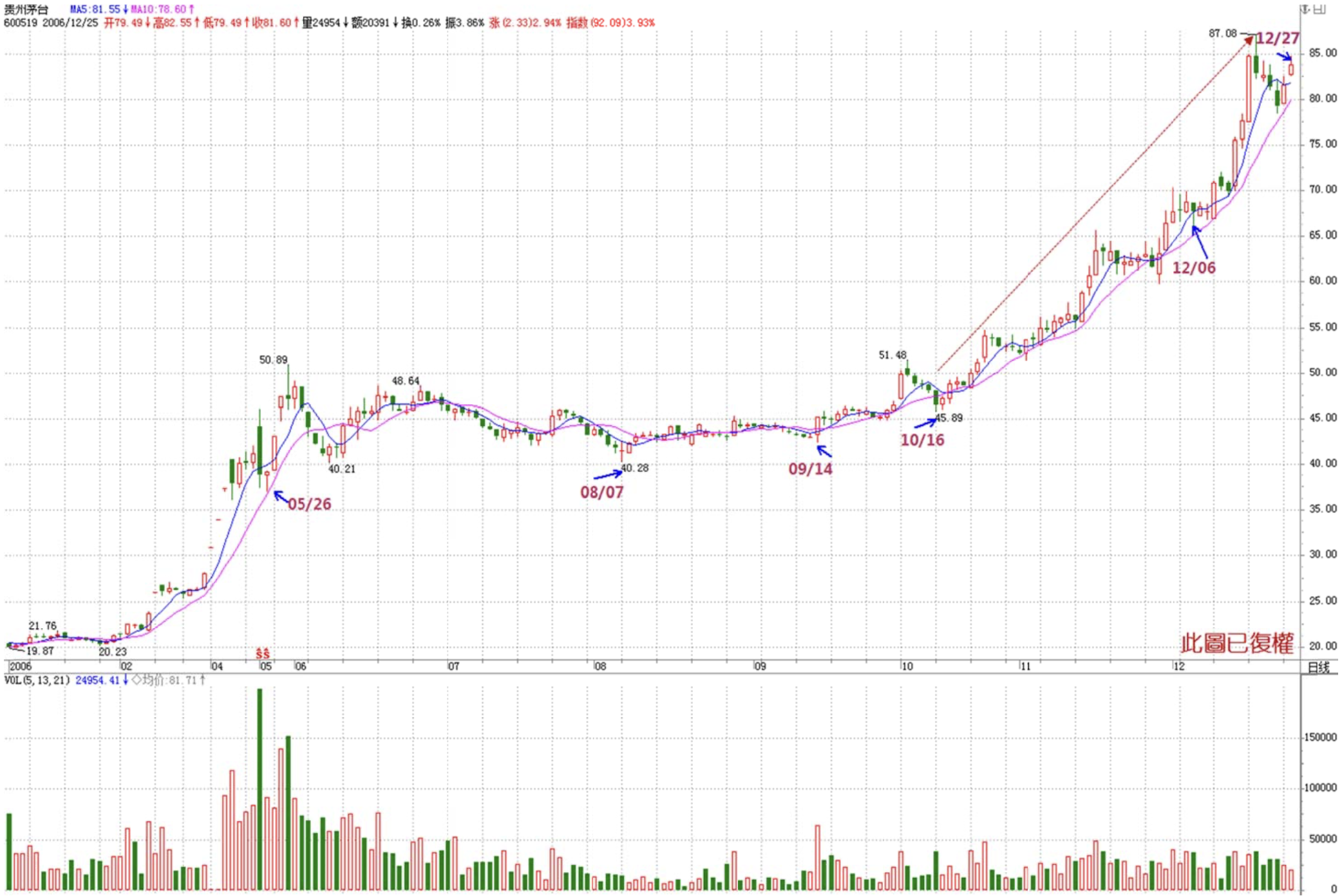
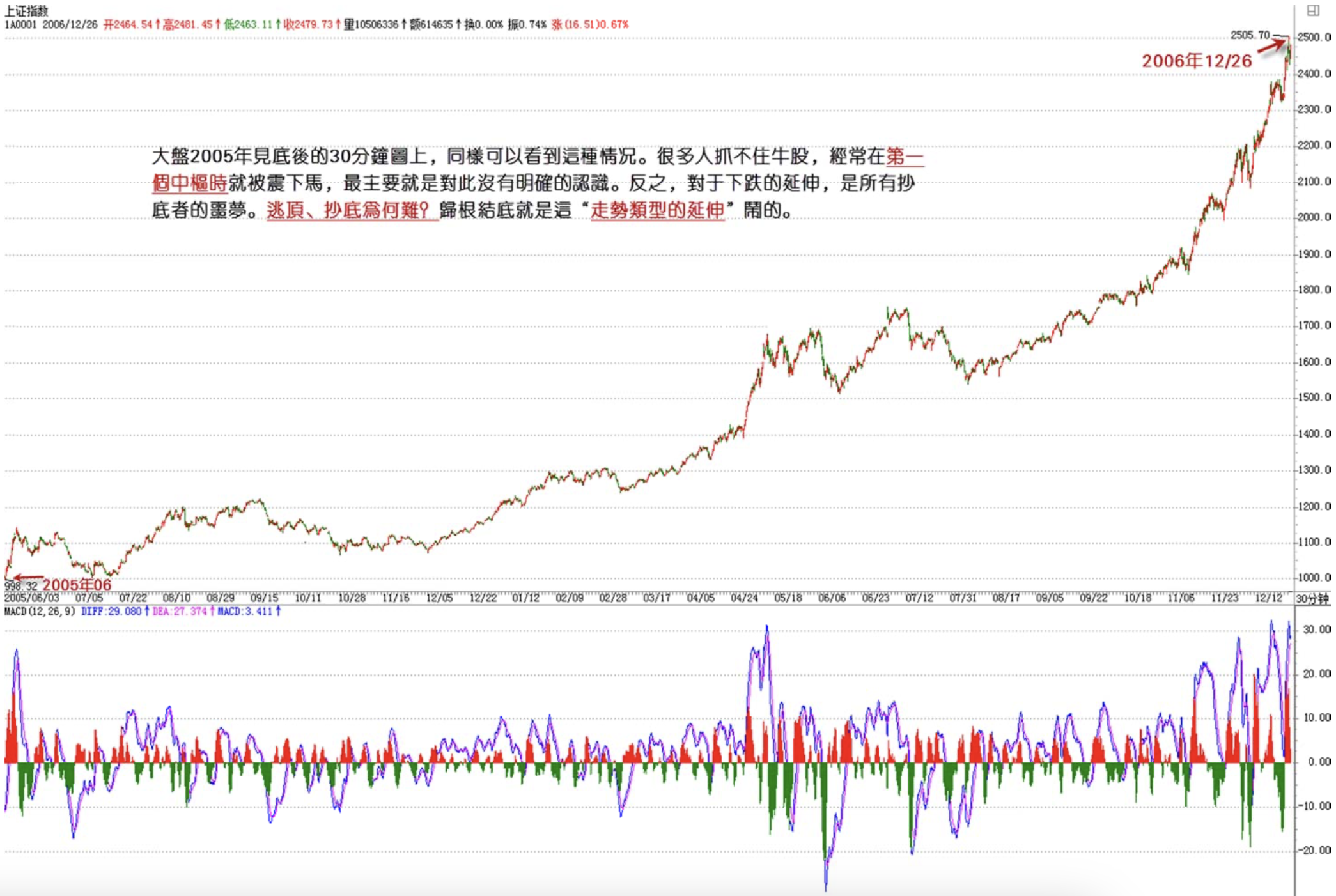
How to determine whether "movement type extension" has ended? First, the essence of "movement type extension" must be clarified. For trends, the "extension" lies in the continuous production of same-level, same-direction "Chan Movement Hubs." For consolidation, the "extension" lies in no new "Chan Movement Hub" being produced. Since "movement type extension" means the current "movement type" could complete at any time, the corresponding "type" must be determined. Therefore, the key to judging whether "movement type extension" has ended lies in whether a new "Chan Movement Hub" is produced. Furthermore, since trends contain at least two "Chan Movement Hubs" while consolidation has only one, the key distinction between trends and consolidation also depends on whether a new "Chan Movement Hub" is produced. From this, it's clear that the "Chan Movement Hub" is the core problem of technical analysis—once resolved, many major judgment difficulties are sliced through like a hot knife through butter.
"Chan Movement Hub Theorem One": in a trend, what connects two same-level "Chan Movement Hubs" must necessarily be movement types at the next-lower level or below.
Using proof by contradiction, this theorem's proof is very simple. This also answers Assignment One from the previous chapter—"Must the connection between two adjacent same-level Chan Movement Hubs necessarily be a trend? Must it be a next-lower-level trend?" First, it's not necessarily a trend—any movement type is possible, the most extreme being a gap followed by formation of a new "Chan Movement Hub." Second, it doesn't have to be next-lower-level—as long as it's next-lower-level or below. For example, a gap belongs to the most basic level, and if the chart shows daily or weekly lines, it wouldn't be next-lower-level. Finally, generally the lower the level of the connecting movement type, the greater its force—this is also the theoretical basis for why gaps have particularly strong technical significance in analysis.
By definition, the Chan Movement Hub's creation mechanism and judgment criteria—its "birth" problem—have been solved. What remains are its "sustaining, decaying, and extinguishing" questions. That is, how a "Chan Movement Hub" is "maintained" and ultimately "destroyed" and abandoned. First, consider the "maintenance" question. A sufficient and necessary condition for maintaining a "Chan Movement Hub" is that any movement type leaving the hub must be at the next-lower level or below and must return with a next-lower-level or below movement type. This is easily proven because whether leaving or returning, any same-level movement type would mean forming a new "Chan Movement Hub," contradicting the premise of maintaining the original hub. This proposition is stated as:
"Chan Movement Hub Theorem Two": in consolidation, the movement types both leaving and returning to the "Chan Movement Hub" must necessarily be at the next-lower level or below.
From this, the answer to Assignment Three from the previous chapter—"How are the highs and lows of consolidation created?"—becomes available: regardless of what level the leaving and returning movement types are, when viewed at the most basic level—for example, treating the 1-minute chart as the most basic level—the point connecting the leaving and returning movement types at the most basic level can only have two possibilities: 1. Three or more 1-minute K-lines overlapping back and forth before reversing; 2. A V-shaped movement with fewer than three overlapping 1-minute K-lines. For the first case, the extreme position of the most extreme bar among those overlapping K-lines constitutes the consolidation high or low—this is relatively uncommon. For the second case, the extreme position of the bar at the V-shaped peak constitutes the consolidation high or low—this is extremely common. This is also the theoretical basis for why true lows and highs always flash by momentarily during the trading session. This ID's theory can explain any fine-grained question on technical charts—this is the quality a true theory should possess. Such a theory doesn't need a Nobel Prize's reward—what's one million dollars in the market? Master such a theory and the market will reward you with far more.
With the above two "Chan Movement Hub" theorems, it's not difficult to prove Theorem Three:
The destruction of a certain-level "Chan Movement Hub" occurs if and only if a next-lower-level movement leaves that "Chan Movement Hub" and the subsequent next-lower-level pullback movement does not return to the "Chan Movement Hub."
The combination of the two next-lower-level movements in Theorem Three has only three possibilities: trend + consolidation, trend + counter-trend, consolidation + counter-trend. The "trend" here can be uptrend or downtrend, representing breakout above and breakdown below, respectively. From a practical standpoint, the most forceful destruction is: trend + consolidation. For example, in an uptrend, if a next-lower-level movement breaks upward and is followed by consolidation for the pullback, the subsequent uptrend is often quite powerful—especially when this breakout occurs from the base area. This situation is extremely common, and its theoretical basis lies right here.
Replies
缠中说禅 2006/12/26 15:12:05
The current market movement is perfectly normal. During the 1996 rally, the market rose many times over, yet many stocks haven't even risen. ICBC hasn't even doubled yet—what's the big deal? Component stocks are the most important stocks in the first round of a bull market—this has been said many times, so stop complaining.
Signing off now. See you later.
缠中说禅 2006/12/26 21:28:26
Got back too late today. Everyone, please do your own research. Don't just casually ask questions without serious thinking—that's not how you learn.
Good night. See you later.
缠中说禅 2006/12/26 15:09:24
Sorry—there's an important negotiation. Have to go to Zhongguancun. Must leave immediately. Post your questions here, and I'll answer them tonight when I return.