"Detailed Analysis of The Analects": For All Who Have Misinterpreted Confucius (18)
2006/10/31 12:01:30
The Master said: Love of bravery coupled with resentment of poverty — that is a recipe for chaos. When people lack benevolence and the disease of excess pleasure spreads rapidly among them — that too is a recipe for chaos.
Detailed explanation: For this chapter, Zhu Xi's Collected Commentaries on the Analects gives this interpretation: "Those who love bravery yet do not accept their position will certainly cause rebellion. Those who despise the unvirtuous and push them until they have nowhere to turn will certainly provoke disorder." That is to say: "A person who both loves bravery and resents being poor, refusing to accept his lot, will certainly cause rebellion. Criticizing unvirtuous people to the point where they have no place to stand will also certainly invite trouble." Standard interpretations are more or less the same.
Under this interpretation, it would mean defining a group of people — and once they exhibit the qualities of "loving bravery and resenting poverty" or "lacking benevolence, criticized too harshly" — they can immediately be branded as "elements of disorder." Setting aside how useful such a sweeping condemnation would be, if even criticizing "unvirtuous people" to the point of making them "uncomfortable" is feared as a source of trouble, does that mean everyone should just be a nice person? When encountering these brawling brutes and heartless rich men, should one simply walk the other way? If the unvirtuous are "tyrannical rulers and corrupt officials," should one let them continue their tyranny? Some have extended this interpretation to say: "When inferior people cause chaos, it often escalates into great calamity. To prevent disaster, one must not be too harsh toward unvirtuous people, but rather use moral influence over the long term to promote their self-reform." This turns the Confucian scholar into a Christian missionary, and the notion of "preventing disaster" is even more laughable — as the saying goes, "if disaster is fated, there's no avoiding it." A human being should stand tall between heaven and earth — how can one crumble into such weakness? Interpretations of this kind are all the opinions of pedantic Confucians, and it is through such interpretations that Confucianism, The Analects, and Confucius have been ruined.
In reality, this chapter is an extension of the previous one: "The Master said: To abandon or indulge profit in one's conduct breeds much resentment." What does "love of bravery coupled with resentment of poverty" mean? It means being inclined toward bravery and afflicted by poverty. "Afflicted by poverty" — that is the appearance of the "poor." Being "poor" and inclined toward bravery — being combative and aggressive. "Love of bravery coupled with resentment of poverty" — the "poor" are combative and aggressive. What does "When people lack benevolence, the disease of excess spreads rapidly among them" mean? "Yǐ" is an interchangeable character for "yǐ" (by means of). "Shèn" — originally the initial form of "zhēn" — its original meaning is using a ladle to scoop wine for drinking, extended to mean "excessive indulgence in pleasure." "Jí" — illness, disease, specifically infectious disease, hence extended to mean "rapid." "Zhī" refers back to the preceding "people who lack benevolence" — specifically those who are wealthy yet unkind. "When people lack benevolence, the disease of excess pleasure spreads rapidly among them" — the wealthy yet unkind are rapidly infected by the disease of excessive indulgence. "Luàn" — the appearance of chaos. "Love of bravery coupled with resentment of poverty — that is a recipe for chaos. When people lack benevolence and the disease of excess pleasure spreads rapidly among them — that too is a recipe for chaos." This describes two types of chaotic appearances that simultaneously exist in a society of "people not understanding": the "poor" are combative and aggressive; the "wealthy" are unkind, rapidly infected by the disease of excessive indulgence — the so-called "paper-drunk gold-dazed, drunken stupor of a living death." The best and most universally familiar example of this chapter is: "the ten-mile foreign concession of Shanghai." In fact, such examples are far too numerous — it is a universal malady of the "people not understanding" society.
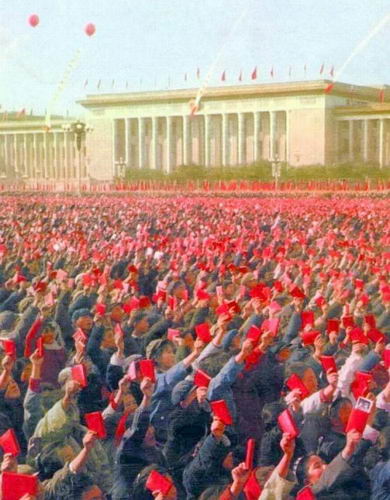
But as has been repeatedly mentioned, "poverty and wealth" does not refer solely to material wealth. In all social phenomena involving human participation, there are appearances of "poverty and wealth." For instance, when some elite group or individual possesses certain ideals or special abilities, and the seduced followers and fans outside the elite group or individual exhibit a particularly fervent zeal, this is a classic case of "love of bravery coupled with resentment of poverty — chaos; when people lack benevolence and the disease of excess spreads rapidly — chaos." The so-called ten years of turmoil beginning in '66 is the most classic example. In fact, beyond those extreme cases, this type of chaotic appearance is commonplace everywhere and at all times — people are simply too accustomed to it and have gone numb. Take an everyday example: setting aside the idol-fan farces seen daily in newspapers, magazines, and on television, even in today's celebrity blog world, celebrities peddle fame with fame like an infectious disease, while the fans, the trolling commenters, and the grassroots are particularly zealous — thus painting the classic picture of "love of bravery coupled with resentment of poverty — chaos; when people lack benevolence and the disease of excess spreads rapidly — chaos."
Why does this happen? Understanding the previous chapter's universal law of the "people not understanding" society — "To abandon or indulge profit in one's conduct breeds much resentment" — one sees that the reason for the chaotic appearances of "love of bravery coupled with resentment of poverty — chaos; when people lack benevolence and the disease of excess spreads rapidly — chaos" is precisely "abandoning or indulging profit in one's conduct." Due to the dominant position of the "wealthy," the indulgence of "profit" for the "wealthy" has become the norm in the "people not understanding" society. This correspondingly means the violation of "profit" for the "poor." And the temptation of "profit" is objectively real — in a society of "people not understanding," mere moral preaching is meaningless. Before "profit," all moral preaching is pale and powerless. This severe polarization of the "poverty and wealth" appearance of "profit" causes the "wealthy," having obtained their "profit," to indulge without limit, while the "poor," deprived of their "profit," grow indignant. Even a coward — when the potential energy stored by the severe polarization of the "poverty and wealth" appearance of "profit" reaches a sufficient magnitude — will become a "brave man." Thus, naturally, we get "love of bravery coupled with resentment of poverty — chaos; when people lack benevolence and the disease of excess spreads rapidly — chaos." This picture can be seen everywhere in a society of "people not understanding" — The Analects had already summarized it over two thousand years ago.
(To be continued)
Strict prohibition on plagiarism — violators will be prosecuted
Replies
缠中说禅 2006/10/31 12:22:06
This ID will also produce a classical Chinese version — that one is for posterity, to prevent error-ridden books like Zhu Xi's Collected Commentaries on the Analects from continuing to plague the world. Everything this ID discusses and says is solely for the sake of the world and the human heart. When you read it, you too should read it for the sake of the world and the human heart, not to satisfy personal egos. If you truly find this ID's interpretations worth spreading, please help more people learn about them and read them. This world is not one person's world — everyone bears responsibility. That, too, is the spirit of The Analects.
缠中说禅 2006/10/31 12:45:59
[Anonymous] uuu
2006-10-31 12:38:37
The Master said: To abandon or indulge profit in one's conduct breeds much resentment
***********************
Profit has a class nature, profit has boundaries. Do you now see how absurd your opposing meanings of "violate" and "indulge" are?
==============
Profit is not an abstract concept. When "class nature" and "boundedness" become abstract concepts, you get Stalinism. All class nature and boundedness have their foundation in reality — that is, in real-world logical relationships. Please refer to this ID's "Defending Marx" series for more on this.
Confucianism — or rather, traditional Chinese thought — has always been based solely on the logic of reality, meaning present, concrete relationships. Profit is the same. Trying to fit it into Western conceptual thinking leads you in the opposite direction.
缠中说禅 2006/10/31 12:49:19
[Anonymous] uuu
2006-10-31 12:44:16
You don't even understand what profit is? Spouting nonsense about "violate" and "indulge" — idiotic. No one who believes in Buddhism is anything but an idiot.
Confucius was just a crackpot spouting rubbish.
==============
You have proven through your own actions that you've lost the standing for this ID to continue responding to any of your posts. But this ID will not delete any of your posts — we don't delete posts here. Let your words hang up there for all to see and admire.
缠中说禅 2006/10/31 12:56:07
Announcement
Since more and more people have been visiting this blog lately, with widely varying levels of understanding, a few principles must be made clear:
First, this blog does not delete posts — do whatever you like. However, if a post contains links or sensitive words, Sina will automatically delete it. That has nothing to do with this ID.
Second, when this ID has time, discussions with everyone are welcome. But for those who like to run their mouths with both upper and lower orifices, this ID has no interest in them — let them run their mouths and enjoy themselves. But this ID will not delete their posts either.
Third, all manner of beings appear in virtual space. Everyone is welcome to express themselves freely — all are welcome here, none turned away.
缠中说禅 2006/10/31 12:14:18
This ID's explanations are written for readers who have at least a high school education, so some passages may be somewhat elliptical. Otherwise, this book would run to at least five volumes. So if there are genuine difficulties in understanding, please feel free to raise them. This ID will revise and supplement accordingly. While it may not be possible to follow Bai Juyi's approach of making poetry comprehensible to an old woman, every effort will be made to use the minimum space to reduce reading difficulty for as many people as possible.