For the First Time, Chinese Science Achieves an Epoch-Making Accomplishment!
2006/6/4 19:23:04
Chinese science has certainly achieved some accomplishments before, but never an epoch-making one—until now, when this has been fundamentally changed. What constitutes an epoch-making accomplishment? Let me give a simple example. Take Chen Jingrun, whom all Chinese people know. His achievement regarding the Goldbach Conjecture would of course be extensively mentioned in any history of research on the Goldbach Conjecture. When writing a history of analytic number theory in the 20th century, the number of mentions would correspondingly decrease. When writing a history of number theory in the 20th century, it would basically receive no more than one sentence. Unless one is specifically writing China's own 20th-century mathematical history, the chance of that achievement being mentioned in a 20th-century history of mathematics is essentially zero. And for the history of 20th-century science overall, the probability is exactly zero. An epoch-making achievement in science, then, is one that must be mentioned when writing the scientific history of an entire century. Today, Chinese science has achieved such an accomplishment for the very first time.
Of course, there are figures like Chern Shiing-Shen and Yau Shing-Tung who have already achieved such epoch-making accomplishments. For instance, without Yau Shing-Tung, at least the frontiers of physics such as string theory and membrane spaces would not look the way they currently do. But since their achievements are more appropriately classified under overseas Chinese, prior to today, Chinese science had indeed never achieved an epoch-making accomplishment. Of course, it must be emphasized again that all of this has been fundamentally changed today.
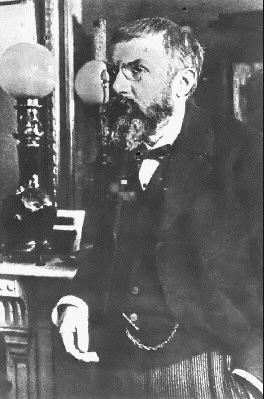
The Institute of Theoretical Physics at the Chinese Academy of Sciences has long displayed a photograph: Brussels, 1911—Einstein, who had published special relativity but would not publish general relativity for another four years, stands respectfully behind a seated elderly man. That man's name was Poincare. Without this elder, at least the emergence and development of topology would have taken an entirely different historical course. And topology is not merely one of the most important and vibrant branches of mathematics—its significance for theoretical physics and beyond cannot be overstated.
In contrast to early modern mathematics, which studied problems in relative isolation, the core concern of modern structural mathematics is to use various isomorphic relations to classify objects of study, thereby achieving a macro-level force and breadth of research. For topology, the most important concern is naturally the problem of topological classification. An infinity of shapes, from the classification perspective, may reduce to just a handful of categories. Different classification methods naturally lead to different research emphases. In topology, the most fundamental is classification from the perspective of homeomorphism. Homeomorphism can be simply understood as being indistinguishable from the topological point of view. The rigorous mathematical statement of the Poincare Conjecture is: a simply connected closed three-dimensional manifold is homeomorphic to the three-dimensional sphere. In other words, the infinitely complex simply connected closed three-dimensional manifolds, from the topological point of view, are all indistinguishable from a simple three-dimensional sphere. Even if you are unfamiliar with mathematics, you should see what a powerful and magnificent conclusion this is. Anyone with even a slight knowledge of mathematics knows that the Poincare Conjecture is and has always been the central problem in the development of topology.
Naturally, generalizations of the Poincare Conjecture followed. Things in mathematics are often wonderfully counterintuitive—probably everyone assumed that the larger the N, the harder the problem to solve. But in reality, the cases N greater than or equal to 5 were solved first, then the case N equals 4, while the original three-dimensional case remained unsolved the longest. Today, this problem has been completely solved by Zhu Xiping and others from Sun Yat-sen University. The significance of this hardly needs elaboration.
As with the Englishman's resolution of Fermat's conjecture last time, whether some issues requiring further resolution will emerge from the proof remains to be seen over the next one to two years of worldwide mathematical scrutiny. Last time, the Englishman had flaws pointed out but ultimately resolved them—it turned out to be a false alarm. What will happen this time? The proof has now been published in the latest issue of the Asian Journal of Mathematics, running over 300 pages. Anyone who can understand it is welcome to go pick it apart. Of course, the number of people in the world who can understand it is certainly far smaller than those who can eat steamed buns or crack codes. And for those who can understand it, this is absolutely one of the most sublime musical compositions in the world—just like the proof of Fermat's conjecture, every page is the highest hymn to human intellect.
For the first time, Chinese people have solved a central problem in foundational world-class science—a milestone event in China's journey toward becoming a scientific and technological superpower. But China still has no Newton, no Einstein, no Poincare. Only when China can not only solve problems but also pose epoch-making questions, further create new disciplines that change the direction of scientific research, and especially achieve the great feat of transforming the fundamental modes of human thinking and observation—only then can China truly become a scientific and technological superpower. Of course, from now on, at least in the world of science, China can be introduced this way: she is a nation that ultimately solved the Poincare Conjecture. The prerequisite, of course, is that these 300-plus pages of proof are proven to be absolutely flawless over the next year or two!