Teaching You to Trade Stocks 100: Traditional Chinese Medicine, Military Strategy, Poetry, and Trading 3
2008/2/25 16:32:23
Any Chinese person knows that Zhuge Liang once failed to destroy Sima Yi because of a rainstorm. Although this is a novel's plot, it still has analytical value. In warfare, you must completely classify all possible situations to the greatest extent. Using fire attacks, the biggest fear is rain. Zhuge Liang calculated the weather so accurately when borrowing arrows with straw boats — how come he didn't calculate carefully this time? Furthermore, since Zhuge Liang knew this was his only chance to eliminate Sima Yi, why didn't he think of every possibility? Actually, even with rain, if he had arranged some troops outside the gorge, Sima Yi still couldn't have escaped.
Of course, it's not that Zhuge Liang really couldn't think of it — it's that historically, Sima Yi simply wasn't eliminated by Zhuge Liang. A novelist can't fabricate things too outrageously, so everything was attributed to destiny. But in reality, so-called destiny is always within human planning — it's just whether your planning is thorough enough. Also, something very important is whether the thorough plan exceeds your capabilities.
Stocks are far simpler than warfare because, for stocks, complete classification or planning essentially doesn't face the problem of exceeding one's capabilities. It's just a matter of how much to buy and sell — if you're more capable, trade more; if less capable, trade less. There's no situation where a certain classification is completely unexecutable. Therefore, all the focus is on this complete classification.
This point has been discussed repeatedly before. But complete classification is not single-layered — it must also necessarily be multi-layered. One of the most important features of this ID's theory is that it naturally provides the levels of classification — the different naturally-formed levels/timeframes. Different levels have different complete classifications, and when combined, they form a three-dimensional complete classification system. This is what our operations must rely on.
Of course, for small capital, you can operate entirely using one layer of complete classification. But for larger capital, this is not appropriate. For example, in a system composed of three layers — 30-minute, 5-minute, and 1-minute — any present-moment state corresponds to a real-world state within a different layer of complete classification.
For example, the current Shanghai Index, coming down from 6124 points, is in a 30-minute downtrend, currently within the hub oscillation of the most recent hub. As long as no third-type sell point appears, this oscillation remains valid. At the 5-minute level, it's moving downward away from the first hub, and since a third-type sell point hasn't formed, whether a 5-minute downtrend forms cannot be determined with 100% certainty. At the 1-minute level, a 1-minute downtrend has already formed.
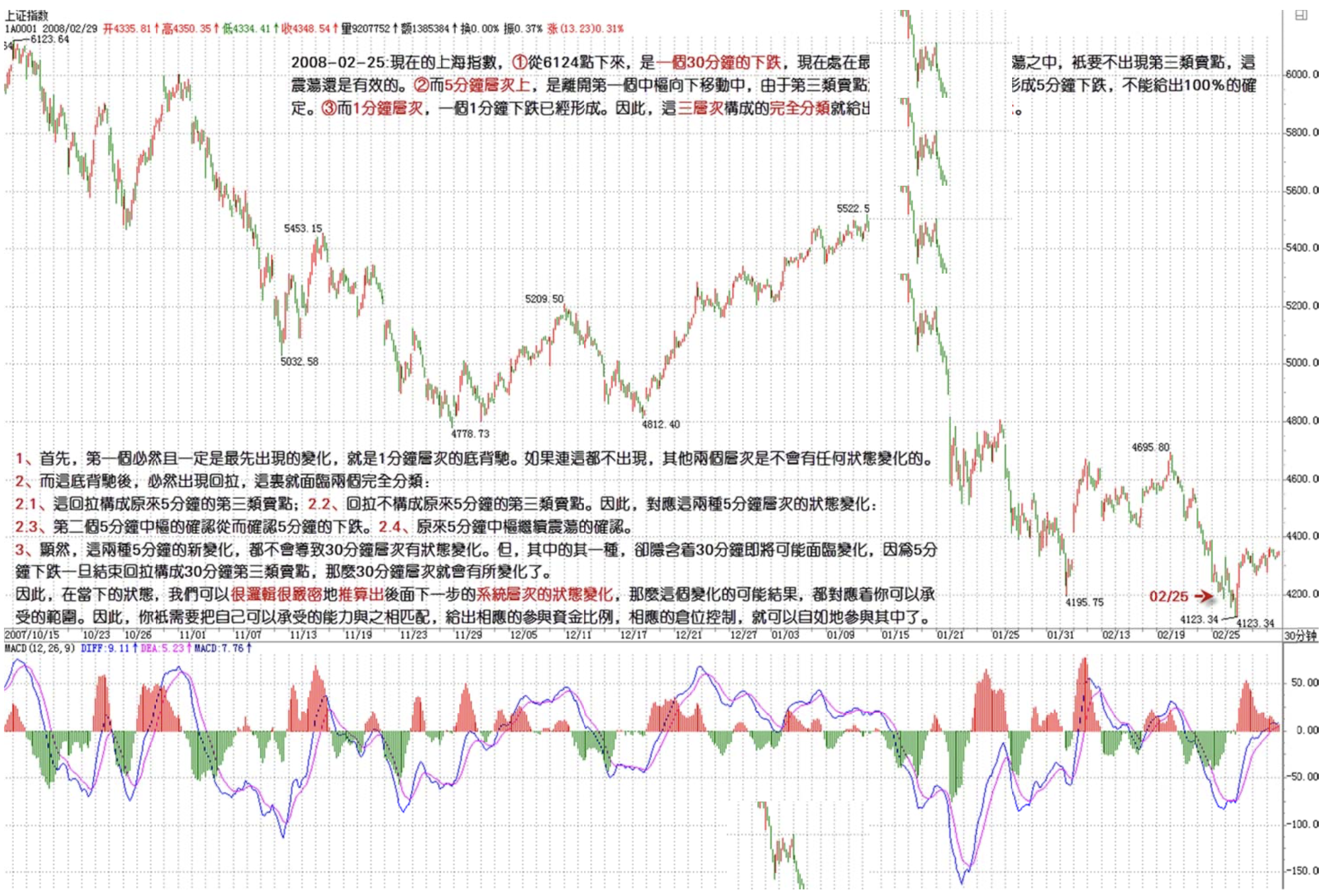
Therefore, the complete classification formed by these three layers gives the most perfect operational guidance. First, the first change that is inevitable and will certainly appear first is a bottom divergence at the 1-minute level. If even this doesn't appear, the other two levels will have no state change whatsoever. And after this bottom divergence, a pullback must occur, which then faces two completely classified scenarios: 1. This pullback forms the original 5-minute third-type sell point; 2. The pullback does not form the original 5-minute third-type sell point. Therefore, corresponding to these two 5-minute level state changes: 1. The confirmation of the second 5-minute hub, thus confirming the 5-minute downtrend; 2. The confirmation that the original 5-minute hub continues to oscillate.
Obviously, neither of these two 5-minute changes would lead to any state change at the 30-minute level. However, one of them implies that the 30-minute level may soon face a change — because once the 5-minute downtrend ends and the pullback forms a 30-minute third-type sell point, the 30-minute level would undergo a state change.
Therefore, at the current state, we can very logically and rigorously deduce the next step of state changes in the systematic hierarchy. The possible outcomes of these changes all correspond to ranges you can tolerate. So you only need to match your own tolerance capacity with these outcomes, determine the appropriate capital participation ratio and corresponding position control, and you can participate freely.
For example, if you can't handle the situation where a third-type sell point might appear, then don't participate. Why? Because this third-type sell point is a possible option. Conversely, if you have the technique to face all possibilities, then you can participate in this 1-minute bottom divergence opportunity.
So, ultimately it comes back to that same question: analyze the market well, classify the situations well, then ask yourself — do you have the ability to handle all possible situations? If not, then forget it; if yes, then go in. It's that simple.
Of course, you can also do this: participate with an extremely small position. This way, you can potentially develop your ability to face corresponding situations — after all, capability must be cultivated through action. All talk and no practice means you'll forever lack ability. The key is knowing what you're doing, rather than being a confused fool blindly guessing.