Calmly Facing Sudden Events Is a Basic Investment Quality
2007/5/30 6:53:34
Although this ID said in The Curtain of the Great Bull Market Has Not Yet Truly Risen, "May is the 180th month since 1429 points — half of 360 — an extremely important time window, after which it would be impossible for something not to happen"; although the day before yesterday it was already stated: "Those at or above a certain level should have already received something today — the specifics this ID cannot say, but the content is of course related to regulating the stock market, and it's estimated to come out in the next few days"; and yesterday further advised: "If you've already profited from stocks, first go improve your own living conditions, go show filial piety to those who deserve it... Making money and not spending it, being a miser — do you have water in your brain? First settle your own and your family's life, take out the principal, and continue the stock market game with the money earned from stocks" — this ID would absolutely never claim to have known in advance the exact timing of the stamp duty increase announcement at midnight, despite it having long been rumored.
Obviously, the final confirmation of this matter's announcement was just last night, so there's no need for everyone to make a fuss about the regulatory authority's clarification on the 23rd, nor can one say they flip-flopped overnight — after all, the 30th and the 23rd are already a week apart. Publishing news at midnight is unprecedented in Chinese securities history. Here, first we must commend the regulatory department for having made significant progress in their operational procedures and confidentiality levels compared to before — this is fairer to all market participants. Second, this policy itself is consistent with the current level of understanding of the regulatory authorities. Lastly, the revenue collected should take care of more people who deserve to be taken care of — this counts as a small contribution from the great bull market to all of China's underprivileged. Therefore, this ID has no objections to this policy — what must come will always come. As for labels like "policy-driven market," this ID feels there's no need to pin that on them. After all, raising taxes is not something unique to China. This is 10,000 times better than that so-called "guidance" — now that is what this ID finds most repugnant.
Alright, now back to the specifics of operations. First, it must be reiterated: the only thing that could change the nature of the great bull market would be an economic recession. Otherwise, everything is merely a trigger for different levels of market oscillation, and correct operations are sufficient to handle it. Second, when facing sudden events, position management and cost control are important. This is precisely why this ID repeatedly emphasizes that stocks are waste paper and that costs must be reduced to zero. Sudden events are inherently unavoidable in the market, and good operational habits are sufficient to handle any sudden event. A position with zero cost is the best tool for handling sudden events.
In the investment market, one must think big. No matter how large this oscillation turns out to be, whether you got out or not, it's just a small matter. Getting out isn't victory, and not getting out isn't doomsday. What matters is your correct operational habits and long-term persistence. In December 1996, after consecutive limit-down days, the market ultimately hit new highs again five months later. The 1987 U.S. stock market crash, in hindsight, was nothing more than a little bump at the foot of the mountain. Calmly facing sudden events — that is the basic quality of investing.
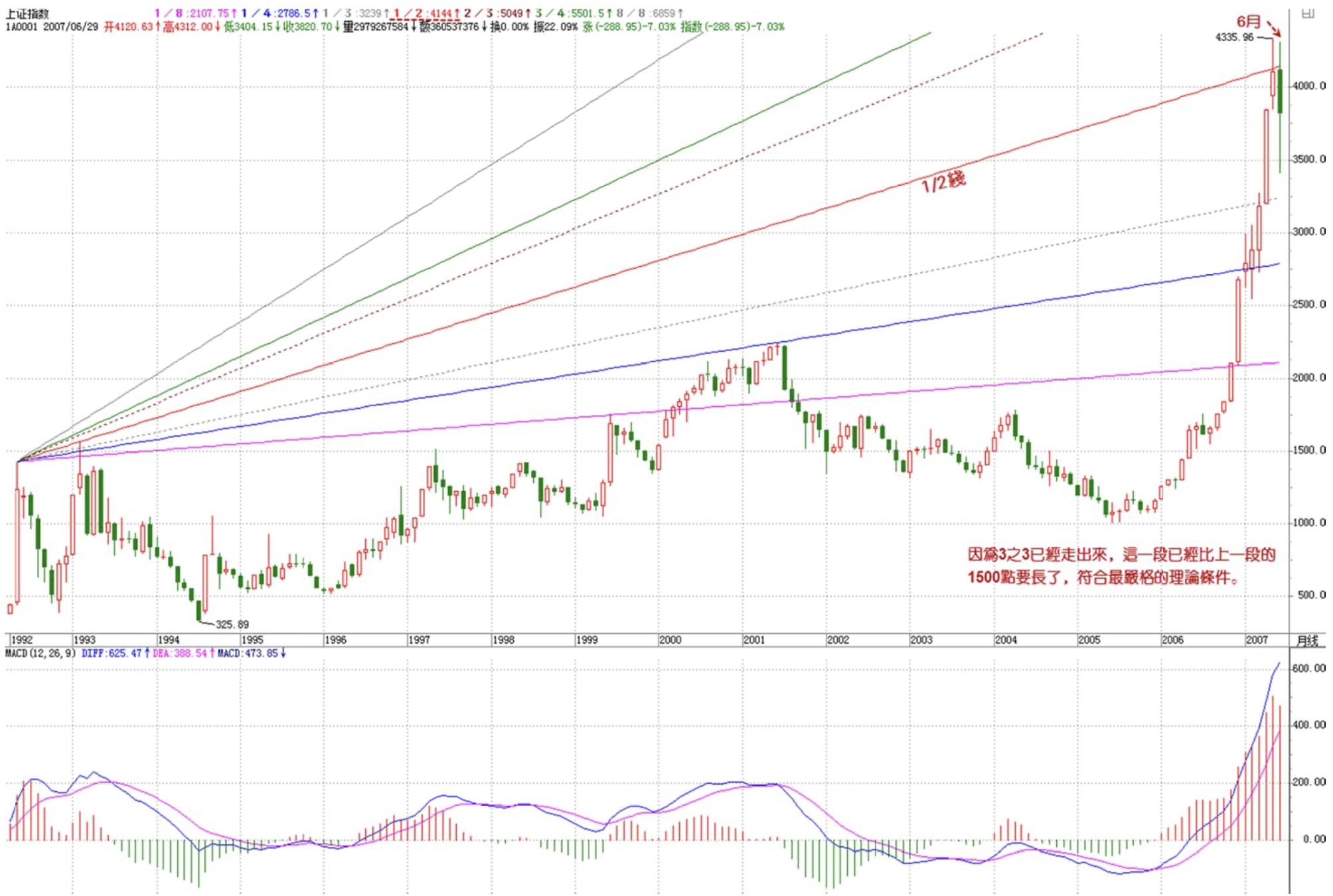
Technically, what has been repeatedly emphasized these past few days is that the monthly candlestick close will trigger a fierce battle between bulls and bears, which of course includes policy as one of the market's combined forces. The corresponding analysis remains valid. If the monthly candle leaves a long upper shadow, then June's adjustment pressure will be significant. Obviously, the regulatory authorities also understand the technical significance of this, striking during these most critical final two days. Here, we must commend the authorities — unlike before, they actually understand some technical analysis now. From a macro technical perspective, that critical 1/2 line was always going to need more testing. The conclusion that this line will influence at least three months of market movement remains valid, and among those three possible patterns, the final confirmation still hasn't been made. There's no need to predict anything here — just trade based on the chart.
This ID knows that yesterday some people, after reading this ID's posts, coincidentally cleared their positions, and some took out their principal — all good. Although there's a bit of serendipity here, one could say filial piety brings good karma — this has nothing to do with this ID. As for those with still-heavy positions, if you've been holding from low levels riding the moving averages up, you have sufficient profit cushion — especially if your cost is already zero, then it matters even less. Just follow normal operations. No matter what happens, even if you didn't exit at the first sell point, you can exit at the second or third sell point — there's nothing difficult about this. As for those who recently chased stocks at high prices, this is a lesson, and only after experiencing it will you remember this ID's words with bone-deep clarity: Stocks are all waste paper. You must buy at well-chosen level buy points and sell at sell points, reducing cost to zero. Only stocks with zero cost are truly safe.
Since future transaction costs will increase dramatically, the corresponding operational level must be raised significantly — the minimum operating level should be at least 5-minute or even 30-minute and above. The principle of buying at buy points and selling at sell points never changes. When the corresponding level's buy point appears, re-enter — there's nothing to debate about that. On short-term technicals, the nested confirmation of the top divergence segment that was already forming on the 30-minute chart will very likely be brutally confirmed by this sudden event. Using this as a starting point, reference the subsequent real-time movements to progressively confirm future buy and sell points for corresponding operations.
As for this ID's positions, it can be stated publicly: aside from the coordination emergency reserve fund that is always maintained, currently approximately 70% are old stocks with zero cost, another 5% is newly established positions in new stocks, and the remaining 25% is all cash. This ID's recent position reduction was also somewhat serendipitous, and none of it was because of the stamp duty. A small portion was for technical reasons, the majority was because of that detestable "guidance," and of course there's also a bit related to some news that was already known and hinted at to everyone — though of course, the impact of that news is incomparable to this stamp duty matter. This ID's view remains unchanged: Unless that detestable "guidance" is implemented, this ID will not leave. As for position reduction activities, whenever there's a sell point, this ID will participate — it's just a matter of quantity. But this ID will re-buy at appropriate buy points.
Finally, let me reiterate and extend yesterday's words — this is also this ID's consistent attitude: In any case, the great bull market pattern in China will not change because of this. The larger the oscillation level, the greater the opportunity to reduce costs and increase holdings. As for the script this ID has been designing all along, there is still no reason whatsoever to abandon or modify it, because Wave 3 of Wave 3 has already played out, and this segment is already longer than the previous 1,500 points, meeting the strictest theoretical conditions — as for whether it can extend further, that's not important. More importantly, this script has already brought enormous returns to participants who started at the 2,000-point levels. These returns are already locked in, costs are already at zero, and nobody can take them away. And this, in turn, is the energy reserve for launching the next round of market action. What must come will come — what's needed now is simply to wait for buy points to appear.
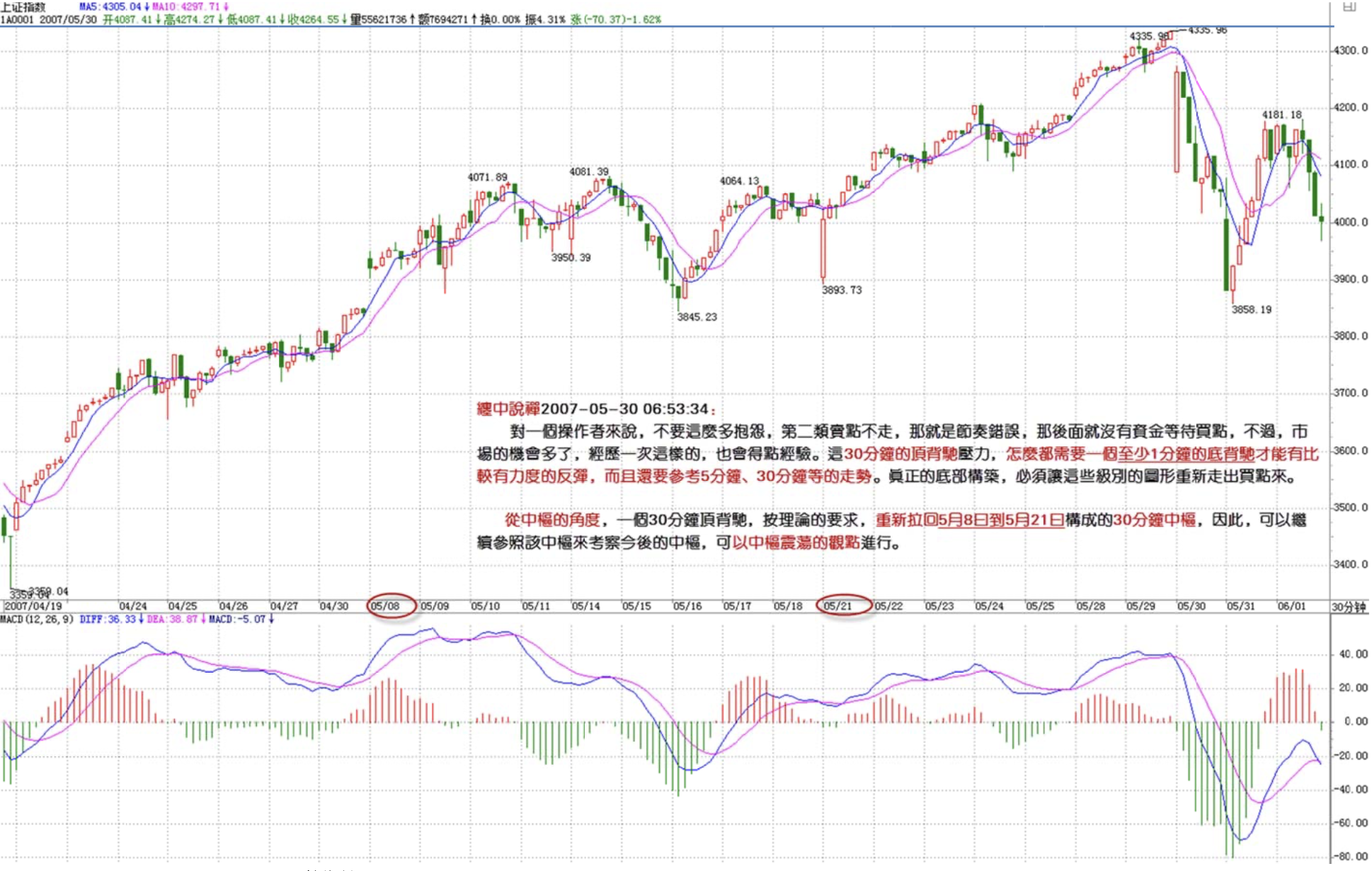
From today's market movement, you can see why this ID's theory distinguishes between the first, second, and third buy/sell points. For instance, with something sudden like today, the first sell point might have been missed, but the second sell point would not have been missed. That's why this ID specifically reminded everyone this morning to exit at the second or third sell point. In the actual chart, if you can't recognize the second-type sell point at 05300947, or knew about it but didn't act, then your learning has been rather unsuccessful and needs more effort. This ID's theory is for real combat — exiting at the second-type sell point, even without knowing the news, would not differ much from the peak. Some stocks even hit new highs today — compare the charts of different stocks to feel the practical use of the second-type sell point in such sudden events.
For a trader, stop complaining so much. Not exiting at the second-type sell point is a rhythm error — then there's no capital to wait for a buy point. However, there are plenty of opportunities in the market, and going through something like this gives you some experience. This 30-minute top divergence pressure needs at least a 1-minute bottom divergence before any meaningful rebound can occur, and you also need to reference the 5-minute, 30-minute, and other timeframe movements. True bottom construction requires these timeframe charts to newly develop buy points.
From a long-term perspective, this ID said that 1/2 line still exerts enormous attraction on the market. Shenzhen's corresponding line is at 13,700 points and has not been broken through, so Shanghai's movement relative to this line is more instructive. The pressure from May's 180-month time window likewise constitutes the most significant technical pressure for future market development. The current adjustment is targeting the 1,800-point rise from the February 6th low of 2,541 points — this must be clearly understood.
From a hub perspective, a 30-minute top divergence, per the theory's requirements, should pull back into the 30-minute hub formed between May 8th and May 21st. Therefore, you can continue using that hub as reference to examine future hub dynamics, applying a hub oscillation perspective.
For those with short-term capability, you can reference short-term indicators to buy back the stocks sold at the second sell point, then conduct hub oscillation operations. None of this ID's views have changed at all, so I won't say more. Additionally, once the market stabilizes, individual stock opportunities will be plentiful. Going forward, stocks correlated with strong mid-year earnings reports will gradually strengthen. Technically, watch for stocks that form daily third-type buy points during this selloff.
Replies
缠中说禅 2007/5/30 15:38:29
From today's market movement, you can see why this ID's theory distinguishes between the first, second, and third buy/sell points. For instance, with something sudden like today, the first sell point might have been missed, but the second sell point would not have been missed. That's why this ID specifically reminded everyone this morning to exit at the second or third sell point. In the actual chart, if you can't recognize the second-type sell point at 05300947, or knew about it but didn't act, then your learning has been rather unsuccessful and needs more effort. This ID's theory is for real combat — exiting at the second-type sell point, even without knowing the news, would not differ much from the peak. Some stocks even hit new highs today — compare the charts of different stocks to feel the practical use of the second-type sell point in such sudden events.
For a trader, stop complaining so much. Not exiting at the second-type sell point is a rhythm error — then there's no capital to wait for a buy point. However, there are plenty of opportunities in the market, and going through something like this gives you some experience. This 30-minute top divergence pressure needs at least a 1-minute bottom divergence before any meaningful rebound can occur, and you also need to reference the 5-minute, 30-minute, and other timeframe movements. True bottom construction requires these timeframe charts to newly develop buy points.
From a long-term perspective, this ID said that 1/2 line still exerts enormous attraction on the market. Shenzhen's corresponding line is at 13,700 points and has not been broken through, so Shanghai's movement relative to this line is more instructive. The pressure from May's 180-month time window likewise constitutes the most significant technical pressure for future market development. The current adjustment is targeting the 1,800-point rise from the February 6th low of 2,541 points — this must be clearly understood.
From a hub perspective, a 30-minute top divergence, per the theory's requirements, should pull back into the 30-minute hub formed between May 8th and May 21st. Therefore, you can continue using that hub as reference to examine future hub dynamics, applying a hub oscillation perspective.
For those with short-term capability, you can reference short-term indicators to buy back the stocks sold at the second sell point, then conduct hub oscillation operations. None of this ID's views have changed at all, so I won't say more.
缠中说禅 2007/5/30 15:41:38
Two Tigers
2007-05-30 15:25:51
The fairy sister had a meeting after 7am, probably to assign the important task of sitting on the floor.
Wonder how the fairy sister will counterattack tomorrow.
The sight of hundreds of stocks all sitting on the floor together today surely embarrassed China before the whole world again — and it's not the first time we've embarrassed ourselves like this.
==
Some people enjoy embarrassing themselves. This ID doesn't mind playing along.
缠中说禅 2007/5/30 15:46:42
[Anonymous] 脑瘫
2007-05-30 15:41:46
[Anonymous] Sina User
2007-05-30 15:30:05
Damn you, every time you speak ambiguously so you're always right no matter what, and I end up carrying your sedan chair!
====
Are you pig-brained? The blogger wrote it so clearly, you're blind and still blame others. What an ungrateful wretch.
Brain-dead!!!
==
People can say anything they want here at this ID's blog — no need to get upset over such things. The key is to think through your own operations. For example, if you managed to exit at the second sell point today, that's a great practical experience. If you didn't, analyze carefully to see what the reason was — psychological or technical.
What you should be learning here at this ID's blog is real combat, not lip-flapping.
缠中说禅 2007/5/30 15:52:22
[Anonymous] 止水
2007-05-30 15:48:25
Strongly urge the blogger to delete those vulgar and abusive comments. Nobody has an obligation to hand you money. People who can't think independently have no need to come here. People like that should hurry up and join a pyramid scheme instead
"The current adjustment is targeting the 1,800-point rise from the 2,541 level on February 6 — this must be made clear"
This statement should put most people at ease — it's at most a consolidation for hot sector rotation
It would be even better if the blogger could give some hints about future sector trends, of course referring to the second half of the year
==
Right now we must first unify our thinking. Unifying thinking during oscillation — just like what was done below 3,000 points. Adjustment isn't necessarily a bad thing; for those with good technique, adjustment is a great opportunity to lower costs.
Additionally, once the market stabilizes, individual stock opportunities will be plentiful. Going forward, stocks correlated with strong mid-year earnings reports will gradually strengthen. Technically, watch for stocks that form third-type buy points during this selloff.
缠中说禅 2007/5/30 15:56:36
[Anonymous] LL
2007-05-30 15:52:47
Chan sister, I went all-in this morning. Your courses are too difficult, I've never understood them. Sister, should I cut my losses tomorrow or hold my ground?
==
Why didn't you exit at the second sell point today? It was so obvious — ABC up, with the C segment lacking momentum, a classic chart pattern. If you didn't exit, just wait — no need to panic-sell. Look for opportunities in subsequent oscillations to bring your position down. Half-position is the ideal right now — flexible both ways.
缠中说禅 2007/5/30 16:00:41
[Anonymous] Sina User
2007-05-30 15:54:47
Chán Zhōng Shuō Chán
2007-05-30 15:52:22
[Anonymous] 止水
2007-05-30 15:48:25
Strongly urge the blogger to delete those vulgar and abusive comments. Nobody has an obligation to hand you money. People who can't think independently have no need to come here. People like that should hurry up and join a pyramid scheme instead
"The current adjustment is targeting the 1,800-point rise from the 2,541 level on February 6 — this must be made clear"
This statement should put most people at ease — it's at most a consolidation for hot sector rotation
It would be even better if the blogger could give some hints about future sector trends, of course referring to the second half of the year
==
Right now we must first unify our thinking. Unifying thinking during oscillation — just like what was done below 3,000 points. Adjustment isn't necessarily a bad thing; for those with good technique, adjustment is a great opportunity to lower costs.
Additionally, once the market stabilizes, individual stock opportunities will be plentiful. Going forward, stocks correlated with strong mid-year earnings reports will gradually strengthen. Technically, watch for stocks that form No. 3 type buy points during this selloff.
===========
Can a third buy point withstand the overall market? The third buy point stock I bought yesterday still hit the limit-down today
==
If yours is a 5-minute third buy point, of course it can't withstand a 30-minute top divergence. If it's a daily-level one, then of course there's no problem. As for the limit-down issue — that isn't really the issue. The practical reality is that if you didn't exit at the second-type sell point, then you still need to learn or temper yourself. This has nothing to do with what happens after any sell point.
缠中说禅 2007/5/30 16:09:31
Sorry, there's a meeting at 4:30. Now is the time for extensive communication and unifying thinking, so this ID needs to go attend to that. Heading out first. See you tomorrow morning.
缠中说禅 2007/5/30 6:56:09
The regulators are working overtime, so this ID can't sit idle either. There's a meeting at 7:30 AM, so I spent fifteen minutes writing the post and putting it up.
Heading out first. After-market analysis after close in the afternoon. See you then.