Teaching You to Trade Stocks 43: A Remedial Lesson on Divergence
2007/4/6 15:31:28
I've noticed that many people still aren't clear on the most fundamental divergence issues. This weekend, here's a remedial lesson. I won't discuss how to identify divergence or the differences between divergence and consolidation divergence — that's too basic. If you haven't even figured that out, the best approach is to retake the course, not attend remedial sessions.
Reversals are necessarily caused by divergence, but reversals caused by divergence are not necessarily of the same level. In "Teaching You to Trade Stocks 29: The Strength and Level of Reversals," there is the "Chán Zhōng Shuō Chán Divergence-Reversal Theorem: Divergence in a trend of a certain level will lead to level expansion of the last hub of that trend, consolidation at a larger level than that level, or a counter-trend at or above that level." This is an extremely important theorem. What does it tell us? That divergence at a certain level necessarily causes the termination of the original trend type at that level, thereby initiating another trend type at that level or above.
Since "uptrend + uptrend" and "downtrend + downtrend" situations are not permitted, this theorem has great practical significance for operations. For example, a 1-minute level top divergence means it will necessarily lead to at least a 1-minute level consolidation or downward trend type — this gives a very clear delineation of possible movements and levels after divergence. Some people often ask, why does it still rise after a 1-minute top divergence? What's so strange about that? As long as there is a 1-minute consolidation, it can continue to rise — this is one of the possible scenarios after a 1-minute top divergence. Of course, there are other possibilities, for example, the most extreme case: creating a yearly-level decline. But you can't say this was caused by the 1-minute top divergence, because this results from the consolidation or decline formed after the 1-minute top divergence gradually expanding in level, eventually slowly forming over time. If you see any random 1-minute top divergence and claim it will form a yearly-level major correction, then your head is waterlogged. If reversals and divergences in the market all had such one-to-one correspondence in levels, the market would be too boring and rigid. It's precisely because of this possibility of small-level divergence gradually accumulating to cause large-level reversals that the market is full of present-moment vitality.
Note that distinguishing between these two different types of reversal is critically important. All reversals are related to divergence, but when you add the relationship between the divergence level and the current trend level, you get these two different types of reversal. Since the divergence level cannot be greater than the current trend level — for example, a 30-minute level divergence can only exist within at least a 30-minute level trend type — there is a clear classification of these two different reversal types.
I. The divergence level equals the current trend level
For example, a 30-minute trend type produces a 30-minute level divergence. This divergence will at least pull the trend back to the last hub of that 30-minute trend, naturally breaking below or above the corresponding high or low points. Note that this situation includes entering the divergence segment — for example, a 30-minute trend type entering a divergence segment at the 30-minute level. Of course, this divergence segment doesn't necessarily evolve into actual divergence, because small-level extensions can be sufficient to cause the larger level to ultimately escape divergence, which relates to present-moment trend assessment.
II. The divergence level is smaller than the current trend level
In this case, the trend clearly shows no divergence at the corresponding level. For example, a 30-minute trend type clearly shows no 30-minute divergence — that is, the divergence segment ultimately doesn't materialize — but a 1-minute level divergence appears. Using the simplest upward form a+A+b+B+c, where A and B are 30-minute hubs, a 1-minute divergence appears in c, while c versus b shows no divergence at the 30-minute level. In this case, there is no guarantee that c's 1-minute reversal will definitely not fall back into B. But even if this pullback occurs, its form differs from the first case. In this second case, a hub larger than 1-minute level must first form, then break downward, ultimately creating a pullback movement into B.
Someone might ask: in the first case, if there's a 5-minute level pullback, it would also form a hub larger than 1-minute, so what's the difference from the second case? The difference is enormous. In the first case, the pullback is inevitable, while in the second case, after forming a hub larger than 1-minute, a pullback is not inevitable — it can break upward, causing a+A+b+B+c to continue extending. This situation of small-level divergence ultimately transforming into large-level reversal deserves the most attention when it occurs during the topping push or bottom-chasing of a trend movement. Such situations generally trigger large-level reversals. Examples of this have been discussed before — such as ICBC on 2007/01/04, North Star on 2006/12/07, and Swellfun on 2007/01/22.
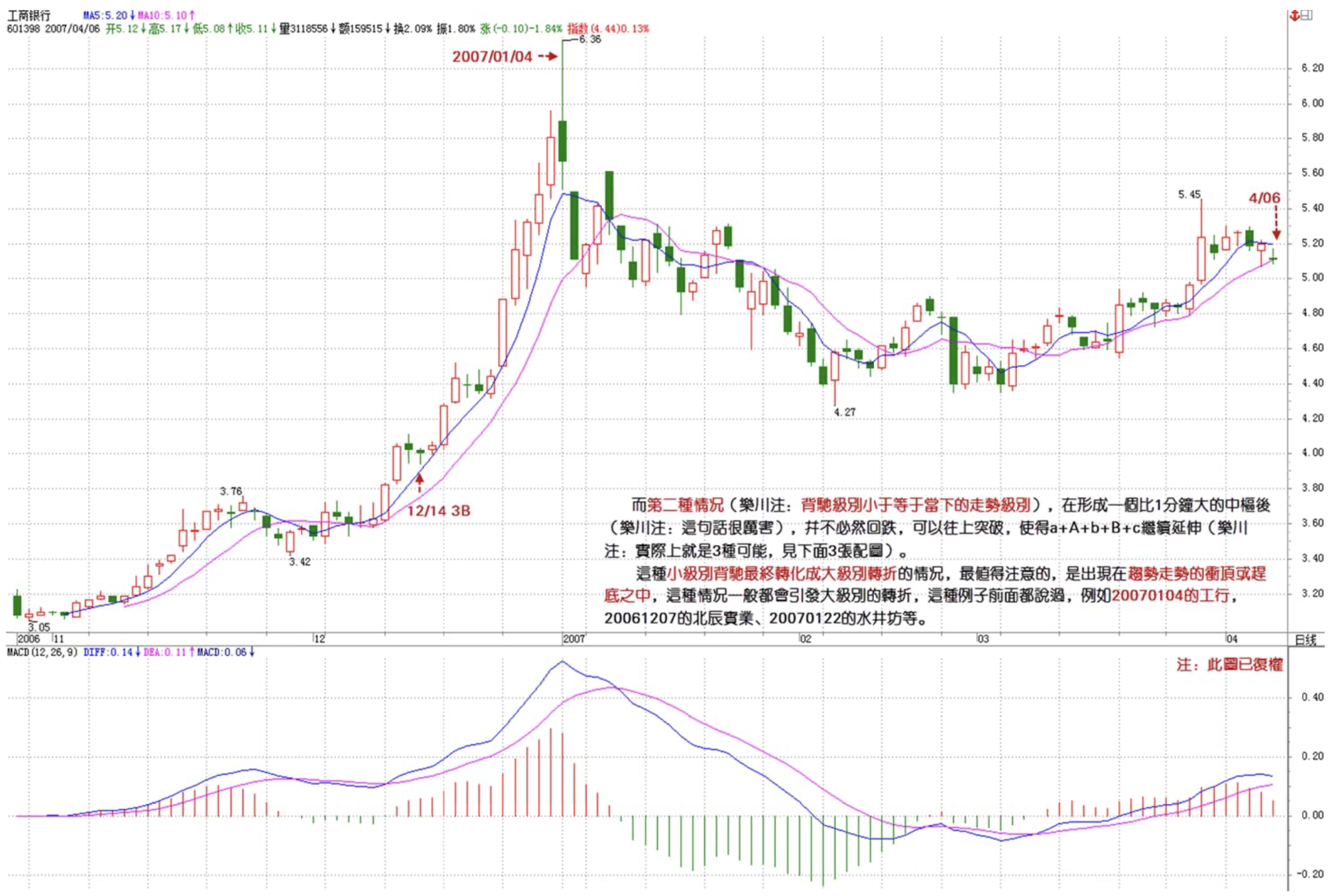
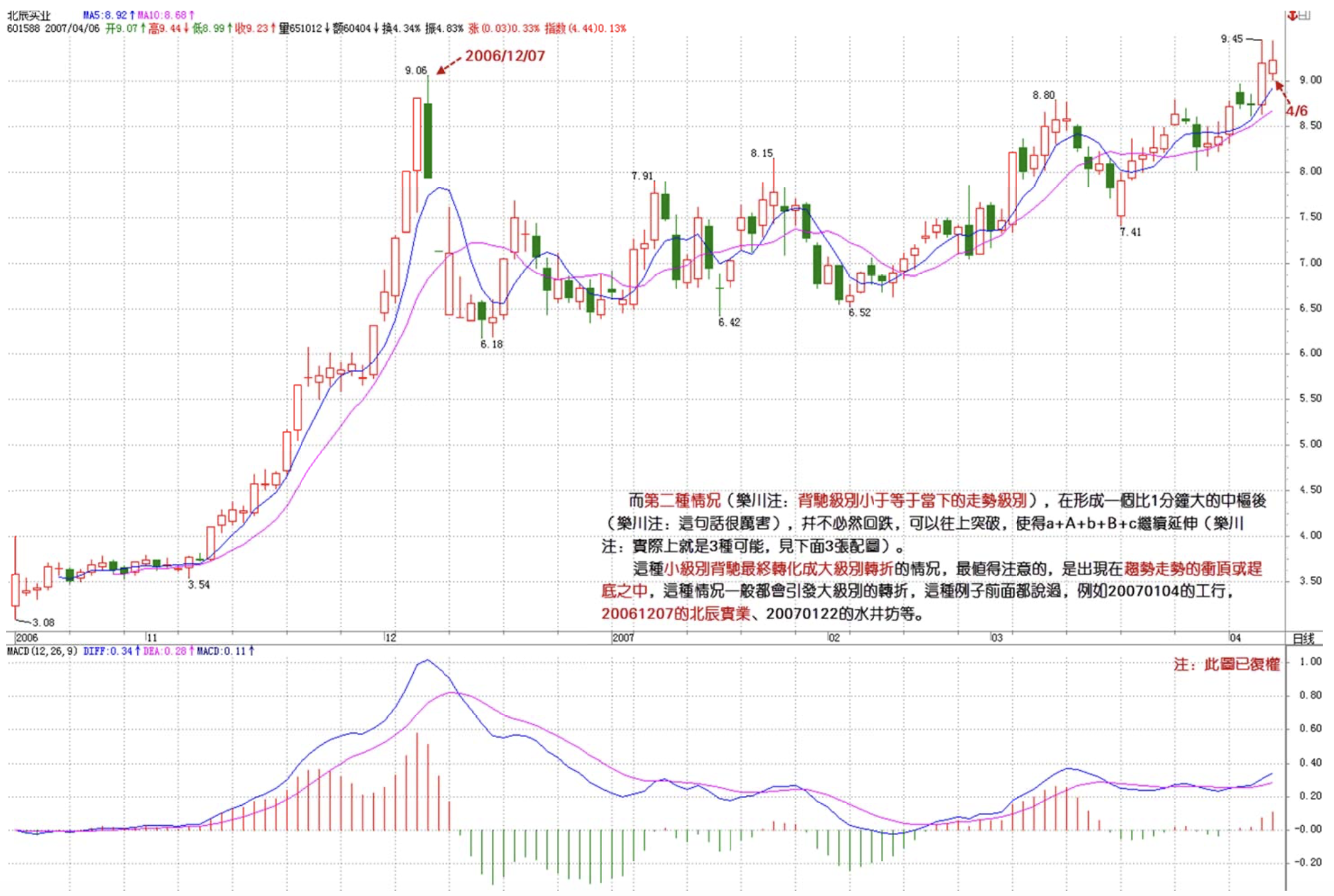
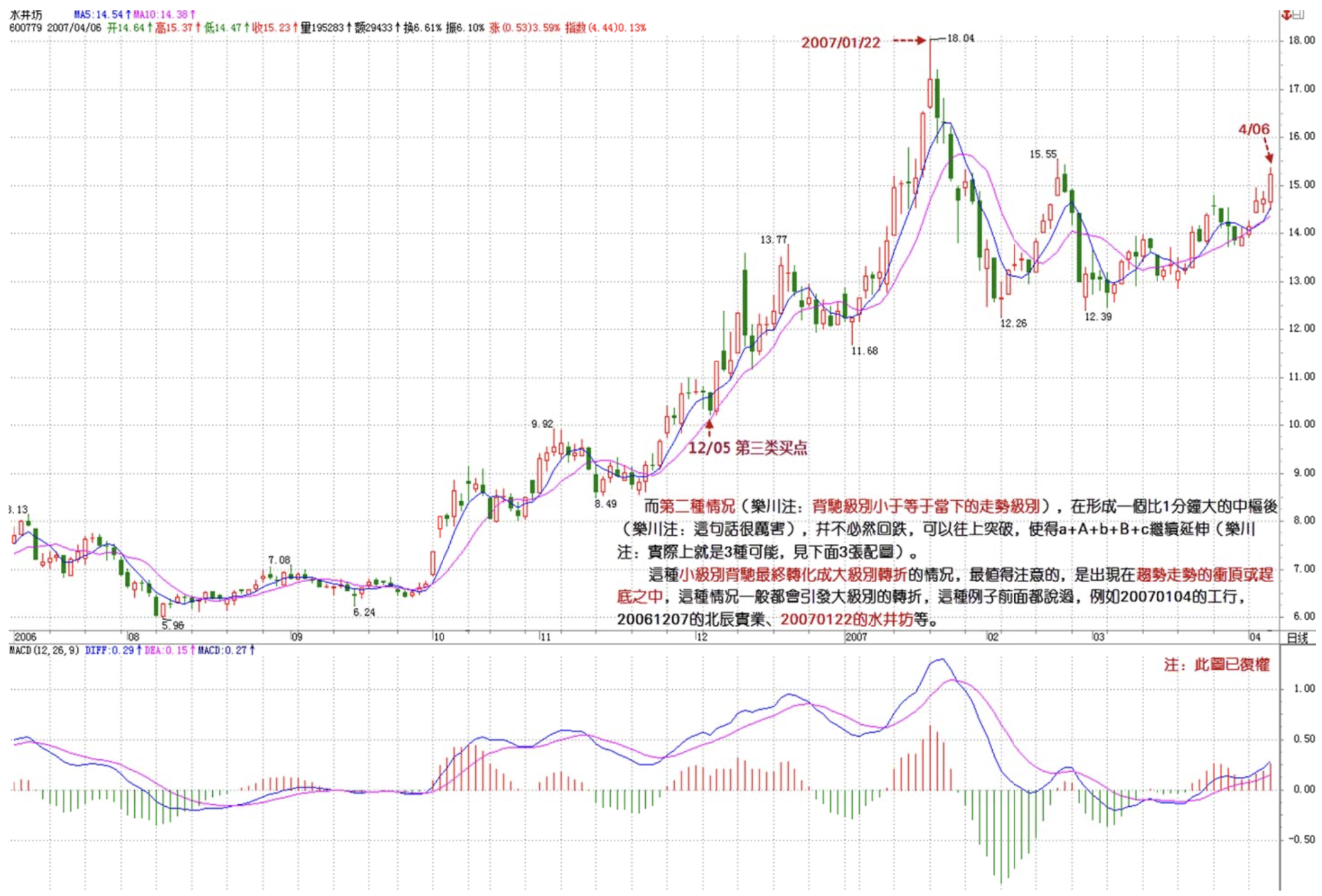
The above two situations are also very meaningful for decomposing trends. For example, the completion of a 30-minute trend type also has two corresponding situations. The most common one is where a 30-minute divergence appears, thereby completing a 30-minute level trend type. In this case, there is no ambiguity in decomposing the trend type — the preceding and following trend types are divided at the divergence point. As for the case where small-level divergence triggers a large-level reversal, this is more complex, but the principle of decomposition is consistent:
Chán Zhōng Shuō Chán Trend Type Decomposition Principle: Within a trend type of a certain level, no hub of a larger level can appear. Once one does, it proves this is not a trend type of that level, but rather part of a larger-level trend type or a connection of several trend types at that level.
Here, the decomposition possibilities under the second case above are analyzed as follows:
Let's still use the upward 30-minute level a+A+b+B+c example. Suppose a 1-minute level divergence appears in c, and afterwards a 30-minute hub C evolves. If C has no overlap with B, this means the original a+A+b+B+c was not a completed 30-minute trend type. The trend type extends to a+A+b+B+c+C, and the corresponding decomposition must wait until the trend type is completed. If C overlaps with B, then a+A+b+B+c+C = a+A+b+(B+c+C), where (B+c+C) necessarily evolves into a daily-level hub. Then a+A+b+B+c is merely part of a daily-level trend type. If you insist on performing same-level decomposition at the 30-minute level, then the decomposition point is that 1-minute divergence point: a+A+b+B+c+C = (a+A+b+B+c)+C.
With the above examples, you should have a general understanding of the basic principles of how to use divergence for trend decomposition. Once you're familiar with these decomposition methods, market charts will no longer be hieroglyphics but will be as clear and legible as the lines on your own palm.
Replies
缠中说禅 2007/4/6 15:42:17
[Anonymous] YY
2007-04-06 15:40:08
Boss, can you talk about something new?
The course hasn't been updated in a while
--
Of course, but right now many people can't keep up. Using one or two lessons for remedial study is also necessary.
缠中说禅 2007/4/6 15:43:18
[Anonymous] 平安保险
2007-04-06 15:40:40
Teacher, is it that new stocks whose weekly charts haven't formed yet won't launch so quickly? What level should we look at for stocks like 601318? Is it not worth participating in the short term? No chart patterns can be drawn yet. Like Datang Power, it took four months before it activated. Awaiting your reply.
==
For new stocks, just look at the short-term charts.
缠中说禅 2007/4/6 15:45:18
[Anonymous] 缠心雕龙
2007-04-06 15:42:05
Hello blogger, I have a question about the same-level decomposition procedure described in Lesson 39:
"This operation ignores everything else and only pays attention to one thing: whether there is consolidation divergence between Ai and Ai+2. As long as there is consolidation divergence, sell when i+2 is even, buy when it's odd. If not, when i is even, if Ai+3 doesn't break below Ai's high point, continue holding until Ai+k+3 breaks below Ai+k's high point, then sell at Ai+k+4 when it doesn't make a new high or shows consolidation top divergence, where k is even."
--
My question: When there's no consolidation divergence between Ai and Ai+2, and Ai+3 doesn't break below Ai's high point, but Ai+4 shows consolidation divergence against Ai+2 — should Ai+4 be sold?
Reading the original text, it seems to say don't sell. If not, then even if consolidation divergence occurs between Ai+4 and Ai+2, you don't necessarily sell, and you still need to check whether Ai+3 breaks below Ai's high point. Why not exit at Ai+4 first (to avoid a potential big drop at Ai+5)?
==
Why not sell? Isn't there this sentence — "or sell at Ai+k+4 that shows consolidation top divergence"?
缠中说禅 2007/4/6 15:49:55
[Anonymous] Hindsight
2007-04-06 15:44:23
Thank you, Master Chan, for the teaching — granting me the key to unlock my dullness!
As you analyzed, indeed everyone is very cautious now. However, the gap-down open followed by an instant pull-up does suggest a change in thinking. I just don't know if it was pulled up by the session's main force, or hungry wolves entering from outside?
Based on quality and value analysis, I feel 601318 is worth pursuing, but without someone like you to provoke it, its stock personality isn't very active. Next week Ping An releases its annual report. I've seen Shenyin's analysis report, which is quite detailed. Earnings should be 0.7-1.5, depending on how certain things are provisioned and valued.
Ping An showed some excitement today, as if with a "stirring" desire. Based on cost analysis, it's now at the same level as the close price on the first day. Does Boss have any interest in making a move before or after the annual report?
Looking forward to your answer and analysis!
Thanks!
==
Ping An has no issues. Currently the biggest pressure is from restricted shares, but this doesn't constitute a substantive impact. The earnings of the next few big guys are all very good, so the traitors have one fewer excuse.
缠中说禅 2007/4/6 15:53:58
[Anonymous] Sina User
2007-04-06 15:45:33
Hello teacher. Datang Telecom released an earnings pre-announcement yesterday. The earlier estimate of turning from loss to profit was changed to expected losses in yesterday's announcement, startling the market, and the stock hit the daily limit down. Rumors are flying.
I'm a new investor. I currently hold 15,000 shares of (600198) bought at 19.65. I've never seen anything like this! Now I don't know whether to stay or leave. What should I do? Thank you.
=
This is nothing. If you have experience, you could add to your position today. Make a couple of short-term trades and your cost comes down. This stock, after the shakeout, will go back up, but it takes some time.
缠中说禅 2007/4/6 15:57:04
[Anonymous] 那一天
2007-04-06 15:45:37
Sister Chan, I was introduced by a classmate, and I've just studied up to lesson 18.
You repeatedly used the word "level" in lesson 17. Could you give a precise definition of "level"?
I have two understandings of level:
- Weekly K-line, sub-level daily K-line, next sub-level 60-minute K-line, etc.
- On the trend chart, (for example) the weekly K-line overall goes upward, but contains downward, consolidation, and upward movements within it.
These contained movements would be sub-levels.
Are both understandings correct??
Thank you in advance!
==
It's all in the lessons — please read through all the lessons first.
缠中说禅 2007/4/6 16:00:06
[Anonymous] 兰兰
2007-04-06 15:56:08
Hello sister! Hello classmates! It's been a long time since I've chatted with sister!
A detailed question for sister:
After cost is at 0, when making short-term trades to earn stocks, do you only retrieve the principal each time you sell? For example, with 3,000 yuan principal, each short trade only takes back 3,000 yuan, so when the stock price rises to 30 yuan at a buy point you can only buy 100 shares, right?
==
Generally, after cost is at 0, you can use the sell-first-then-buy method. For example, sell 10,000 at 20, then you can buy back 10,000+ shares at 19. This way the number of shares keeps increasing. The prerequisite is that the stock still has medium-to-long-term potential.
缠中说禅 2007/4/6 16:04:23
[Anonymous] 瞎鼓捣
2007-04-06 15:58:50
Boss, hello.
So the divergence segment doesn't necessarily produce actual divergence? Is this common? How specifically do you distinguish?
==
This is quite normal. If you use MACD to assist, when it pulls back to the zero axis and goes up again, you can first consider it as entering a divergence segment. For example, the current daily chart of the market index. But whether the yellow and white lines ultimately make a new high is impossible to know at the beginning. Then you need to look at the smaller-level structure. If the smaller-level movement is particularly strong, causing the yellow and white lines to make new highs, then there's no divergence issue.
缠中说禅 2007/4/6 16:05:22
[Anonymous] 中信海直
2007-04-06 16:00:50
May I ask, Miss, why are some three overlapping segments counted as hubs and some are not? Is it only when there are moving average crossovers that it counts as a hub?
==
It has nothing to do with moving averages. The key is that they must all be at the sub-level.
缠中说禅 2007/4/6 16:06:47
[Anonymous] 新年好
2007-04-06 15:48:31
Sister Chan, regarding the two situations in today's lesson — for the second situation with a 30-minute upward move: if C and B don't overlap, do we not need to participate? If C and B do overlap, should we exit first at that 1-minute divergence point? But how do we predict in advance whether they will overlap?
==
This is complex. It will be discussed later.
缠中说禅 2007/4/6 16:10:51
Sorry, I need to go out for the weekend. Friday traffic in Beijing is terrible. Although this ID doesn't need to drive myself, leaving late means getting stuck in traffic, which is just as painful. I'm heading out now.
Everyone enjoy your weekend indulgences.
Goodbye.
缠中说禅 2007/4/6 15:32:12
Today, Shenzhen has achieved the push toward that resistance line, though it hasn't broken through and held above yet. To some extent, this is the last line of defense for the traitors. Once it breaks through and holds, Shenzhen's 10,000 points will be within the range of this ID's powerful artillery fire.
As I said yesterday, the traitors are now crying everywhere. Unable to succeed in the market, they're working hard outside the market — the traitors will stoop to anything. I hope next week the traitors will commit everything they have and fight a big battle here. Don't make it so boring that this ID has no interest in dealing with you.
Currently, the rally in second-tier stocks has become somewhat unstoppable. Since stocks around the 10-yuan level are continuously pushing upward, this is causing the entire price structure to loosen, driving second-tier stocks at 15, 20, 30, and even higher levels upward. This helps you understand the deep intention behind this ID specifically targeting second-tier stocks around 10 yuan.
Now, this ID's spark has started to spread like wildfire, and it no longer needs to be specifically around 10 yuan. Any second-tier stock with sufficient consolidation and earnings support is going to launch, thereby lifting the entire price structure one level and making room for the next round of third-tier stock activation.
However, one should never chase highs at any time. One should select buy and sell points well, especially for retail investors. Otherwise, a small fluctuation is enough to cause problems. Currently, there are subtle aspects on the policy front. How much effect the traitors' crying will have is uncertain — that's a war on another battlefield, which it's not convenient to discuss here.