"Currency Wars and the RMB Strategy" Sequel 1
2006/12/11 11:47:11
Over 3 years ago, this ID wrote "Currency Wars and the RMB Strategy," which circulated widely online. The stance at the time was very clear: to explore how China could seize the opportunity to become the top power amidst the great shifts in the world economic landscape. There was a very important premise and objective: opposing RMB appreciation. Obviously, this premise and objective became invalid after July 2005, and this ID wrote "The 'July 7th Incident' of China's Currency War" that very day. Because the strategic premise of "Currency Wars and the RMB Strategy" no longer existed—in this ID's stock terminology, the long-term first buy point had passed, and one could only wait for the second buy point to appear.
Anyone with even basic economic knowledge would have known, the moment RMB appreciation was announced in July 2005, that a magnificent drama of resource-led bull market and capitalist globalization plunder was about to unfold. The subsequent surge in resource commodities and the global stock market rally were all within expectations. This ID was also busy extracting blood and had no time to summarize "Currency Wars and the RMB Strategy." Once a trend forms, everyone in the world can only go with it—regardless of your views, grab the profits first. There are no inherently valid viewpoints in this world; viewpoints require interests and power to be realized.
However, in that original text, some of the most fundamental viewpoints don't change with circumstances. These most fundamental viewpoints were collected by this ID in "The Historical Resonance Between the National Renaissance Cycle and the World Economic Cycle: National Geopolitics and Monetary Strategy." Key points include: "In the cycle of capitalist economics, there exists a 5x incremental structure between total saturation and population, similar to the quantization of electron orbits. In the medieval and early modern periods, 10 million and 50 million were the two basic population quantities for completing so-called great power status. After Great Britain completed its imperial ambitions at the 50-million level, the US and USSR completed their historical performances at the 250-million level. The next level is 1.25 billion. The current alliances between global economic entities are building strength for the 1.25-billion-level competition of capitalist globalization.
In 1929, the old 50-million-level dominant cycle of Britain and Germany ended, and the 250-million-level dominant cycle of the US and USSR began. The midpoint of this 90-year cycle—1974—produced the oil crisis medium-scale adjustment. The competition between these two different types of capitalism at the same level ended with America's victory. The peak of this cycle already appeared in 2000. The enormous adjustment ahead will reach 1929-level severity by 2019, thereby announcing the end of this level and the beginning of the 1.25-billion-level world economic grand cycle."
For China's reality, the most fundamental question is how to transform itself from a strong contender in the 1.25-billion-level world economic grand cycle into the ultimate winner. One point must be clarified here: from the perspective of US dominance, the worldwide peak created by the 2000 internet boom was essentially the peak of this 90-year grand cycle. Think of it like the stock market—when the lead dragon stock's momentum begins to wane, that's actually the market's turning point. Of course, the market will continue to make new highs, but rotating through third-tier stocks often just choreographs the final sprint. The year 2000 was the beginning of America's zenith-to-decline trajectory, the beginning of the grand cycle's lead dragon's decline—the significance is profound.
After 2000, the entire global economic landscape can be summarized in one phrase: searching for the new dragon. Note that the old dragon can also continue as the new cycle's dragon after restructuring—this is the most fundamental significance underlying all of America's subsequent moves. Standing at this height, any subsequent capital redistribution phenomena should not be mistaken for capital having found a new dragon. This is merely rotation. For the tail end of a rally, no so-called new dragon exists.
Because of July 2005's RMB appreciation, the American economy weathered its short-term difficulties. This means the first half of "the American economy will enter a more destructive decline after one or two years of platform consolidation, and this decline is merely the prelude to an even larger-scale decline" needs modification. The corresponding movement changed from declining directly from that platform to breaking upward to create a bull trap. This bull trap is still being constructed—in the most extreme sense, the craziest movement hasn't appeared yet. 2008 is the midpoint between 1997 and 2019, creating a noteworthy time window around it. But the second half needs no modification—the bull trap's rise and subsequent decline are also merely a prelude to an even larger-scale decline. This devastating decline will reach its climax around 2019.
The ultimate confirmation of the new dragon will inevitably be a post-2019-devastating-decline event—this is beyond doubt and needs no modification. If this ID were the strategist for America's strategy, this ID would develop it along these fundamental lines: lure the bulls. In more explicit language: destroy all potential new dragons within a bull trap, restructure oneself in the process, and position for ultimately retaining the dragon throne. Note: "destroy" here doesn't mean actual elimination, but achieving control through a bull trap, ensuring all potential new dragons are ultimately under American control. From a long-term grand perspective, this is the strategy America must and is adopting. Over the next decade-plus, political and economic struggles will intensify, though in most cases they'll proceed peacefully—even placidly. The real currents flow beneath the surface.
America's current military actions around the world serve nothing but the ultimate re-confirmation of its dragon status. From America's perspective, the Iraq theater has already achieved maximum benefit—pulling back behind the scenes to manipulate is the optimal choice. If America doesn't do this, it's a mistake, and other dragon competitors will have greater opportunities. But judging from America's usual operational proficiency, such mistakes are unlikely. Gradually withdrawing from Iraq to behind-the-scenes manipulation will be America's keynote for the next two to three years. 9/11, Afghanistan, Iraq, etc.—their greatest historical contribution to America was dissolving the historical pressure from the 2000 grand top. And China's WTO accession and the RMB's eventual appreciation made America the biggest winner of the new century. In the competition for new dragon status, America has achieved a more favorable position than when this ID wrote those articles in 2003. Unless America makes enormous blunders like getting bogged down in Iraq, this advantageous position cannot be changed for now.
The most powerful challenger to America's position currently appears to be China. Although the first buy point was lost in 2005, China still has a second buy point to wait for. If seized, things aren't too bad. A so-called dragon is simply an engine, the most important vortex in the economic whirlpool. A "two-dragon" scenario ultimately cannot exist. For example, last century's US-Soviet two-dragon competition ended with one dragon's victory. Therefore, after 2019, a period of two-dragon coexistence cannot be ruled out, but this will ultimately change. Of course, at the 1.25-billion level, the world may fracture into a tectonic plate model, and the dragon/non-dragon relationship may exhibit many new characteristics—but that's not the topic of this article.
China's greatest advantage lies in its low levels of population consumerization and asset virtualization. This ID has long said that Mao's greatest achievement was making China a nation of over a billion people, and the long period of planned economy kept China's asset virtualization at the lowest level. These constitute the two pillars of China's rise. Actually, the secret of modern economic development is quite simple: population consumerization and asset virtualization. Of course, those poisoned by mainstream economics won't accept this view, but this ID still proclaims the Chán Zhōng Shuō Chán Law of Modern Economic Growth: the driving force of modern economic growth lies in population consumerization and asset virtualization.
From the standpoint that capitalism must eventually perish: once "population consumerization and asset virtualization" reach their limits, capitalism's time is up. Economic growth necessarily leads to capitalism's demise. When the driving force of economic growth—"population consumerization and asset virtualization"—can find no more untapped reserves anywhere globally, the capitalist game is over. The essence of globalization is the globalization of "population consumerization and asset virtualization."
Why is capitalism still vibrant? Because that limit is far from being reached. The ultimate endpoint of "population consumerization" is the garbage-ification of everything. The ultimate endpoint of "asset virtualization" is the bubble-ification of everything. Garbage-ification and bubble-ification are capitalism's only two ultimate products. This process is still in process—that's the inevitable and reality of history. Anyone who doesn't want garbage and bubbles can continue moaning in writing that doesn't even rival a cat's mating calls, then watch as capitalism's machine garbage-ifies and bubble-ifies them too.
Capitalism's power lies in its evil—in the fact that everything anti-capitalist eventually becomes capitalist. Only when capitalist garbage-ification and bubble-ification reach their absolute limits, when even the force of decay is gone, can capitalism truly die. Capitalism's death requires the ultimate elimination of all anti-capitalist forces. Only when everything anti-capitalist has died can capitalism die. And only when capitalism dies can socialism in the Marxian sense possibly arrive. Socialism can only emerge after capitalism has garbage-ified and bubble-ified everything that can be garbage-ified and bubble-ified.
China's current primary strategy must be: don't get destroyed by the bull trap's luring rally. Some so-called people are now clamoring about how America is failing—this and that—their thinking has already been lured by the bulls. They won't even know how they die when the time comes. This ID will repeat what was just said: the historical pressure from the 2000 grand top has been successfully resolved in recent years, making America the biggest winner of the new century. And this ID must give George W. Bush a historical evaluation: although this ID emotionally dislikes him very much, from a purely economic and political perspective, he is absolutely one of the most important presidents in American history. His importance lies in this: under his seemingly clumsy but actually masterful leadership, America finally escaped the historical risk from the 2000 grand top. If America ultimately does continue leading the new rally, his accomplishments are absolutely comparable to Roosevelt's, who led America out of the 1929 quagmire. Although foolish historians won't rate him highly, in actual results, he deserves this ID's evaluation. True greatness is invisible. Standing on the platform of American history, Bush deserves the word "great."
For China's current situation, stock terminology is more vivid: originally, if entering at the first buy point, China could have played the role of a raider—mess up the old market maker first. But now, one can only wait for the second buy point, so raiding is impossible; one can only follow the market maker. Following also comes in active and passive forms. China's greatest current opportunity lies in active following—gradually draining the market maker's blood while following, ultimately leaving the market maker holding positions at the peak, unable to sustain them, forced to dive from the heights to their death.
Market makers can be killed too, and this ID's favorite thing is killing market makers. To kill a market maker, you need patience—constantly grinding down your own costs while driving up the market maker's costs. Make accumulation uncomfortable and non-accumulation uncomfortable; make shakeouts uncomfortable and non-shakeouts uncomfortable; make pushes uncomfortable and non-pushes uncomfortable; make distribution uncomfortable and non-distribution uncomfortable. In short, make everything unsatisfying while leaving no outlet for frustration, no place for a decisive battle, until the market maker expires from exhaustion.
This ID's analysis above is purely from an operational perspective, setting aside all political positions. When this ID says America is the new century's biggest winner, it's not because this ID has any pro-American stance—quite the opposite. This ID's anti-American, anti-capitalist stance has never changed. But the anti-capitalist this ID still proclaims that capitalism will continue to develop greatly, that everything will first be capitalized. And the anti-American this ID also points out that in this magnificent wave of capitalization, America still holds the edge in the next-round dragon competition. This ID never shies away from saying this. To understand why, please study carefully this ID's interpretation of "The Analerta."
Although America currently holds the initiative, China's opportunities still exist. How to turn these opportunities into reality—that's the work of the next decade-plus. China's only correct strategy right now is to play the role of active follower well, patiently awaiting the second buy point. Specific recommendations will be discussed later as opportunities arise.
Replies
缠中说禅 2006/12/11 11:55:39
Apparently Sina Blog conflicts with IE 7.0. Ever since this ID installed IE 7.0, Sina Blog can't even format properly. Everyone please bear with it.
缠中说禅 2006/12/11 12:04:06
[Anonymous] Photography Friend
2006-12-11 11:59:39
Blogger:
I suggest you use TT, Tencent's browser. It opens huge numbers of windows conveniently, and even after a crash or intermittent operation, when you return, just reopen the last browsing session—everything's right there. Very easy to use.
Support domestic products... heh!~~~
===========
Good, I'll try it when I have time.
缠中说禅 2006/12/11 12:09:58
[Anonymous] Luobu
2006-12-11 09:01:00
May I ask about 600050—time to exit the short-term position? Thanks
===========
First clarify what "short-term" means and which chart you should be looking at. If your short-term is the 1-minute chart, your trading frequency needs to be high. If you use the 30-minute chart, the frequency is lower. First determine which chart to use, then discuss whether to exit or not.
Also, even if you play short-term on the 30-minute chart, you can use the 1-minute chart to scalp—having part of your position operate based on 1-minute signals.
As for whether to exit—check the chart for first or second sell points.
缠中说禅 2006/12/11 12:16:08
[Anonymous] Qing
2006-12-11 12:05:39
Continue trading, continue asking questions—this is wisdom.
Regarding "Lesson 12: How Can a Kiss Be Soul-Consuming?": "Note, when buying, it's generally best at the second buy point"—why?
Also in the same article: "Generally, after the male-on-top position, the first entanglement is definitely not the last one; from the second one onward, any could be"—is this analysis valid on charts of any time period?
Hoping for a reply!
===============
If you're already very familiar with divergence, the first buy point is better of course. The second buy point is better for those who aren't familiar—at least it avoids the risk of misjudging divergence and buying during a decline.
What this ID says is valid for any time period. But note: "first entanglement" is not about finding divergence within a trend, because if it's a trend, there will definitely be two or more entanglements—without a trend, there's no divergence.
How to identify trends will be covered later.
Of course, in consolidation, a buy point appears after just one entanglement, but this ID doesn't recommend buying stocks during consolidation—unless it's weekly or monthly level consolidation, which can yield big profits.
These issues will all be discussed in detail later. No need to rush.
缠中说禅 2006/12/11 12:21:32
[Anonymous] Want to Fly
2006-12-11 12:15:17
OP, how should we analyze ex-rights positions?
============
If using the 5 and 10 moving averages, operations below the daily chart aren't much affected by ex-rights—no need to adjust. For weekly and monthly charts, you can use adjusted prices.
缠中说禅 2006/12/11 12:28:56
[Anonymous] Qing
============
For female-on-top position, except for the last entanglement, buying after each entanglement makes money. But this ID only defines the first entanglement afterward as the second buy point. This ID only recommends buying at the bottom of the chart—that's how you control risk. This is a good habit.
In the market, good habits are the most important thing. One bad habit might let you profit for a while, but it's ultimately the grave.
缠中说禅 2006/12/11 12:33:02
[Anonymous] Photography Friend
2006-12-11 12:29:16
Brother Shenan:
Stock market ATM, easy as pie! Poetry and music, exquisite! Golden needles to enlighten, compassion incarnate! Cultivating both worldly and spiritual arts! You're the living Guanyin!
Bravo!!!!
===========
Everyone is Buddha—no need for "living."
缠中说禅 2006/12/11 12:53:33
Market opens. Heading out. Goodbye.
缠中说禅 2006/12/11 13:44:29
Protest! Protest! Protest!
To avoid affecting retail investors' operations, I won't say what I'm protesting yet. You'll know tomorrow.
缠中说禅 2006/12/11 15:06:11
Market closed. This ID said it wouldn't comment on individual stocks or the market, so there's nothing to say. Just saying hello to everyone.
缠中说禅 2006/12/11 15:16:25
[Anonymous] Bank of China International
2006-12-11 15:02:40
Blogger, you said on Friday that Beichen would have a strong rebound. I bought some at the limit-down today. When should I sell?
===========
I won't answer individual stock questions anymore. But let me explain the method: generally, for this type of rebound, the 5-day line is an important level. For short-term, look at the 1-minute chart.
Also, on Friday, someone said Beichen was already limit-down during the 30-minute "kiss." Using divergence, you should exit when the upward force looks problematic—don't wait until the moving averages have crossed down before reacting. This is very basic logic.
For example, on the 30-minute chart of this stock, if you use MACD to check divergence, it clearly forms three rounds of red bars, each lower than the last—this is the most obvious divergence signal. You absolutely don't need to wait until it breaks down to react.
How to apply technical indicators and how to choose which timeframe to watch will be covered gradually.
缠中说禅 2006/12/11 15:20:34
[Anonymous] Stay Calm
2006-12-11 15:09:56
Without solving the entire social security problem, how can you talk about population consumerization?
==========
Unsolved problems will all need to be solved in the future—this precisely proves the enormous potential.
缠中说禅 2006/12/11 15:25:14
[Anonymous] Photography Friend
2006-12-11 15:16:08
Blogger:
You not talking about the market makes me even more depressed... Didn't the Chairman also say: "Despite the winds and waves, it's better than a leisurely stroll"?~~~
But I respect your decision. Thanks again... Coming here has become a habit for me
=============
The market has been explained clearly enough. The medium-to-long-term trend was stated long ago. On the 1st, I discussed the short-to-medium term: December will see large-amplitude shocks. Such shocks are precisely great short-term opportunities.
The market's banner is also very clear: banking and real estate stocks as represented by constituent stocks. As long as they don't fall, the first wave of the bull market won't end.
So there's no need to talk about the market every day. You should gradually learn to read it yourself.
缠中说禅 2006/12/11 15:33:33
[Anonymous] Qing
2006-12-11 15:23:49
Unicom went up another 5% this afternoon. Didn't chase the high. Not too regretful either, hehe, because "this ID" said: to be a ten-year bull master, good habits must be cultivated.
But I still don't understand—for stocks like these that have already risen, if you want to participate but also control risk, how should you operate? Watch the 15-minute chart? Seems like to make money, you first need to understand the theory. Frustrating. Hoping for a reply. Thanks!
============
Your understanding of this ID's words is wrong. What this ID said was: if you operate on the 30-minute chart, then indeed it's not a buy point, and the sell point hasn't appeared on the 30-minute chart either. So just hold.
But if you operate on the 1-minute chart, this problem doesn't exist. So the key is your capital size and trading habits.
Actually, if your capital isn't large, for stocks like Unicom where the buy point on the medium-term chart has passed and the sell point hasn't appeared, the best approach is to hold, then use charts one level below the medium-term to scalp partial positions—this way capital utilization is higher.
For example, if you bought at first or second buy points on the 30-minute chart, you can correspondingly use 1-minute and 5-minute charts for scalping.
缠中说禅 缠中说禅 2006/12/11 15:35:52
Xin Chan
2006-12-11 15:29:11
"Chan Master," this weekend I seriously studied the "divergence" you mentioned. Here's my summary and questions: "1. 'Divergence' is about area—formed after the 5 and 10 moving averages 'kiss.' In an uptrend, the area gets smaller, forming 'divergence,' and a sell point appears (female on bottom). In a downtrend, the area also gets smaller, and a buy point appears (female on top reversal). Volume typically isn't very large at this point.
2. Question: Which timeframe (1-min, 5-min, or 30-min) is most ideal for spotting 'divergence'?
3. On the daily chart, I have questions about 'divergence.' What does 'double top formation' mean? What does 'approaching the 0 axis' mean? What line is the '0 axis'?
Today I closely watched the Shenzhen market's movement and learned some things. Should continue looking positive tomorrow, right?
==============
You've mixed up two concepts. "Area" is this ID's own definition. The "0 axis" is from MACD—they're two different things. This will be expanded on later; don't rush.
缠中说禅 2006/12/11 15:44:11
[Anonymous] Photography Friend
2006-12-11 15:06:04
Blogger:
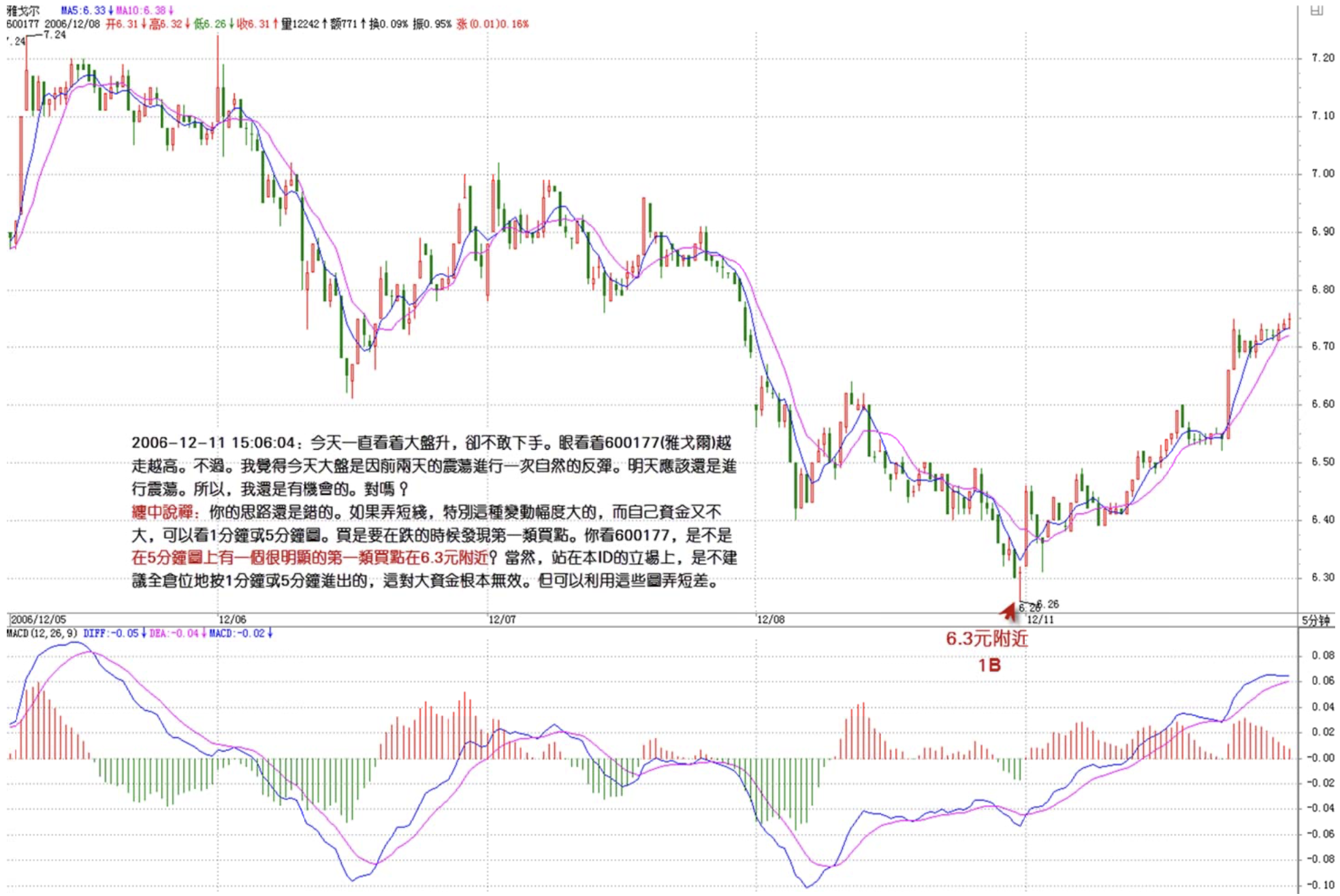
I watched the market go up all day but didn't dare buy. So frustrating!!! Watching 600177 (Youngor) go higher and higher...
However, I think today's market is a natural rebound from the past two days' shocks. Tomorrow should continue to oscillate. So I still have a chance.
Blogger, am I right?
===============
Your thinking is still wrong. For short-term trading, especially with big swings and small capital, you can look at 1-minute or 5-minute charts. You buy when you spot a first buy point during a decline. Look at 177—isn't there an obvious first buy point around 6.3 yuan on the 5-minute chart?
Of course, from this ID's standpoint, I don't recommend going all-in based on 1-minute or 5-minute charts—this is completely ineffective for large capital. But you can use these charts for scalping.
缠中说禅 2006/12/11 15:45:21
Xiao Ming
2006-12-11 15:43:23
Chan MM, you teach us so selflessly—we don't know how to thank you enough
===========
When I have time, I'll say a few more words. When I don't, I won't.
This ID has to go now—need to rush to Jianguomen for a meeting. Goodbye.
缠中说禅 2006/12/11 11:53:17
If you have articles to share, you can go to this ID's circle. Many people have already posted articles. Besides reading this ID's posts, you can also check out others' and post your own for mutual exchange.
Method: Click "My Circle" on this ID's homepage, then follow Sina's instructions.