Tomorrow Is the Real Short-Term Key for the Market
2007/8/2 16:06:21
Today, it didn't break below what this ID mentioned yesterday — the connecting line of the previous two highs and the 10-day moving average — so a rebound was naturally expected. Combined with external factors, it also emboldened the third wave of entrants. Today also closed at the 5-day line that was particularly emphasized yesterday, but this doesn't mean the market is out of the woods. On June 20-21, the market produced a similar K-line combination, also on Wednesday and Thursday, and Friday's decline confirmed the start of a major adjustment. Of course, generally speaking, history doesn't simply repeat itself. This is only to remind that today's price action isn't really what matters — the key is tomorrow. Considering the weekend news factor, this timeframe extends to next Monday. In other words, whether the market can confirm it has re-established itself above the 5-day line by next Monday will be the key determinant of the short-term market direction.
For the newly entered third wave of buyers, if they don't want to be stuck holding positions for N months, they must fight hard here. Currently, compared to June 20-21, there are many favorable conditions. Technically, the MACD pattern is much better, with the connecting line of the previous two highs below, and the weekly gap from last week has a technical convention that if not filled within three weeks, it gets filled later. In other words, as long as the new wave of entrants can hold for three weeks, they can at least lure some medium-term capital in. Therefore, for this wave of people, they have no choice but to defend the previous high connecting line and re-establish a foothold above the 5-day line.
However, this wave of people could also ultimately destroy the market. Why? If they impatiently rush to break through 4500 points, triggering a massive influx of new capital, then the first half's one-sided rally would become inevitable. But currently, the government's overall judgment on the economy and corresponding countermeasures are at a sensitive stage. Such a market move would inevitably cause an extremely unfavorable shift in the public opinion and policy environment that currently favors the bulls. Currently, something even more severe than the stamp tax would be changes to trading systems and rules. If someone's reckless behavior ultimately forces such changes, that would be the truly terrible outcome.
Therefore, although the bulls currently have the ability to quickly break through 4500 points, a steady approach is still necessary. Reasonable oscillation around 4500 points would benefit the market's long-term development. Even a long-duration large-range oscillation between 4000 and 4500 points would be better than launching yet another campaign of N consecutive long bullish weekly candles.
Of course, markets often don't proceed in a rational manner — markets often just go on one wild ride of drunken abandon. Then, for those who entered with the first wave like this ID, you must adopt this strategy: absolutely do not increase positions, because you've already bought enough starting from 3600 points. Buying more now would be a sign of having too much water in your brain. Second, adopt the strategy of maintaining positions while doing sell-first-buy-later spread trades — this way, with costs lowered, you'll always be in an invincible position. Third, never listen to anyone hyping that the market is about to surge to some number. Surging is other people's business — our business is riding the sedan chair. If you have the ability to carry the sedan chair up to the summit of Mount Hua, we have no objections. But the moment someone can't carry it anymore, we must kick the sedan chair off without hesitation.
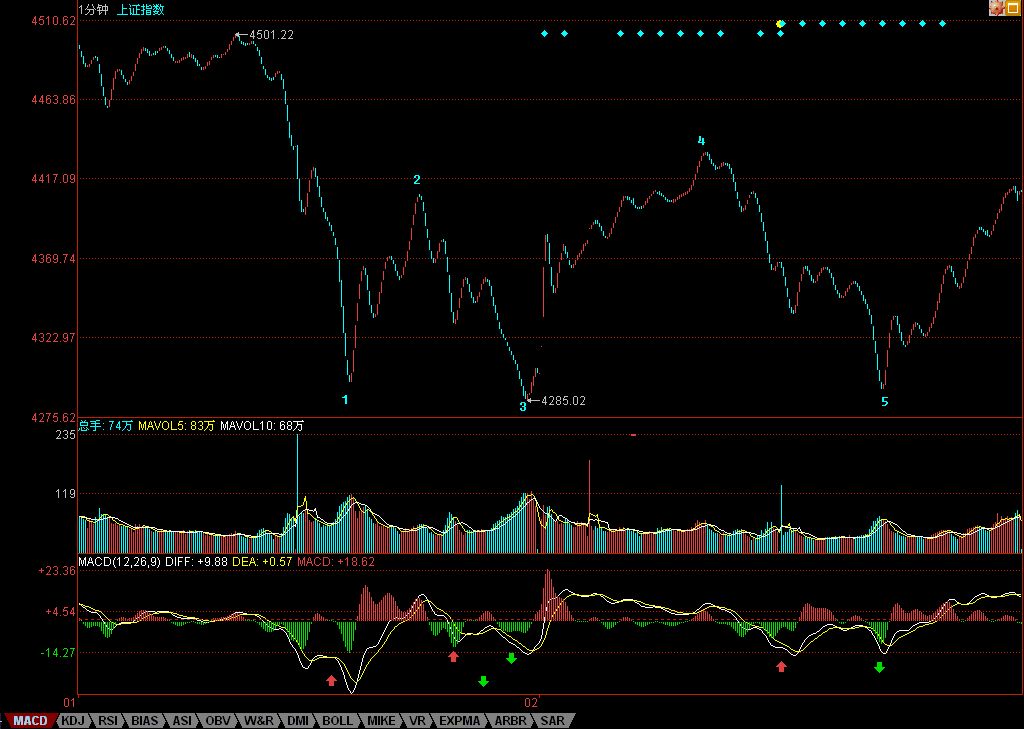
Regarding individual stocks, component stocks continue to lead the charge. Once the weekly breakout is confirmed as established, second and third-tier stocks will follow. Below is a segment breakdown of this recent decline. The red and green arrows show comparisons of the yellow-white lines or column areas — look and you'll know these buy and sell points are entirely determinable in real-time. Now, a 1-minute hub has formed. The short-term trend depends on this hub's evolution — everything is determined in real-time.
These past two days, Beijing's rain has finally made an appearance. This ID doesn't want to go out indulging either, lest some bridge creates another N-meter-deep reservoir and I can't get home.
Today I can answer questions until 5 o'clock.
Replies
缠中说禅 2007/8/2 16:18:13
[Anonymous] 大盘
2007-08-02 16:11:55
May I ask the blogger:
When performing stroke division, if adjacent K-lines show the following three situations, do they need to be merged:
-
One of the highs or lows of adjacent K-lines is equal
-
Both the highs and lows of two adjacent K-lines are equal
-
The same price is maintained for several minutes, i.e., the K-line chart shows "dots"
==
As long as there's no inclusion, merging is not needed. Inclusion means one K-line is completely inside an adjacent K-line.
缠中说禅 2007/8/2 16:19:25
[Anonymous] Sina User
2007-08-02 16:18:29
"Then, for those who entered with the first wave like this ID, you must adopt this strategy: absolutely increase positions, therefore you've already bought enough starting from 3600 points. Buying more now would be a sign of having too much water in your brain."
---------
Hello!
This sentence seems wrong?
==
Fixed it, but Sina's system is slow, so it may not be displayed yet.
"Of course, markets often don't proceed in a rational manner — markets often just go on one wild ride of drunken abandon. Then, for those who entered with the first wave like this ID, you must adopt this strategy: absolutely do not increase positions, because you've already bought enough starting from 3600 points. Buying more now would be a sign of having too much water in your brain."
缠中说禅 2007/8/2 16:20:29
[Anonymous] 悠悠
2007-08-02 16:16:30
Taking the sofa first. Just newly registered. Really learning the feel for stocks. Want to ask what you think about today's halt of 3 aunties, and any instructions for tomorrow?
==
One shouldn't go overboard with things. Go overboard, and naturally there are reasons to punish you to death.
缠中说禅 2007/8/2 16:24:09
[Anonymous] 田鸡和猪肝
2007-08-02 16:17:40
New learner, sorry to trouble you.
Question 1: How to determine when a trend type is completed?
2: How to determine when hub oscillation forms or completes?
=
These are all covered in the lessons. To explain this clearly would require going through all the lessons, so please read through the lessons completely. For example, the end of a hub oscillation is the formation of that hub's third-type buy/sell point — this has been said N times in the lessons. So please study the lessons first.
缠中说禅 2007/8/2 16:37:27
[Anonymous] 轻风吹断
2007-08-02 16:20:14
Today, the Hualing put warrant, after yesterday's rebound from a sharp decline, continued to rebound in the afternoon without showing any violent fluctuations during the trading process. Under the original warrant trading rules, Hualing's daily limit price should be 4.291 yuan! That means it can only be automatically suspended at that price! But at 13:43:16 in the afternoon, the Shenzhen Stock Exchange suddenly imposed a 30-minute suspension on Hualing and other warrants, with the reason being "abnormal price fluctuation"! Let me ask the Shenzhen Stock Exchange: according to your original rules, the daily limit price for this warrant is 4.291 yuan, which means you allow it to rise to that price. Since you think it can rise to that price, why do you say it's "abnormally fluctuating" when the warrant is still far from that price? If this constitutes abnormal fluctuation, then isn't the daily limit price even more of an "abnormal fluctuation"? So why do you even allow that daily limit price? Now, you've broken the very rules you yourselves created. May I ask the Shenzhen Stock Exchange, what kind of logic is this? Moreover, speaking of "abnormal fluctuation," on the fifth trading day after the stock market's "5.30" crash, most stocks went from the daily limit down to the daily limit up, with price fluctuations reaching 20% — wasn't that abnormal enough? Why didn't you suspend those stocks then?
=============================
Would like to hear the blogger's view on today's incident.
==
During the 327 incident, even completed trades could be voided — what's so strange about this? Policy risk is something you must always guard against. So always remember: stocks are waste paper. You must buy at buy points — only zero cost is relatively safe. Otherwise, there is no safety to speak of.
Also, this incident is actually a signal. If the same can happen with stocks, then the rules can be changed too.
Stocks are for trading, not for arguing about. In stocks, making money means you're right, losing money means you're wrong. Everything else is empty talk.
As for the exchange — it's a truly monopolistic institution. If you have questions about its rules, you can go to exchanges elsewhere. If you insist on trading here, then you must know what kind of entity you're dealing with. Get this precondition established first. Otherwise, that's your problem, not the exchange's.
缠中说禅 2007/8/2 16:38:10
[Anonymous] Sina User
2007-08-02 16:37:23
[Anonymous] 天平007
2007-08-02 16:34:23
Dear blogger:
I've been reading your articles for 3 months and am speaking up for the first time today :)
Through studying your theory, I've benefited greatly and also achieved good results in the market. Thank you!
Now I'd like to ask a question: Yesterday the market fell, and you said it was a 15-minute divergence, which I agree with — the 15-minute chart indeed showed divergence. But I found that the 30-minute and 60-minute charts also showed MACD divergence, yet you don't think the 60-minute has diverged. I'm confused, please advise.
====
The 60-minute yellow-white lines haven't pulled back to the zero axis yet. That's my understanding.
-
Correct.
缠中说禅 2007/8/2 16:43:22
[Anonymous] 百思不解
2007-08-02 16:39:09
Hello blogger:
The concepts of strokes and line segments are clear to me now. My confusion lies in the details of same-level decomposition.
For example, on a 1-minute chart with line segments already divided, when performing same-level decomposition of 1-minute trend types, could you express these rules in strict mathematical language like the line segment division rules?
Although previous lessons have general descriptions, text descriptions always leave some details unclear. Could you, when time permits, explain same-level decomposition in detail like you did for line segments? Ideally drawn on an index chart.
Thank you.
==
This will be covered in future lessons — just wait.
缠中说禅 2007/8/2 16:47:11
christine
2007-08-02 16:42:11
Sister, last night's new lesson made me very dizzy. My comprehension is too poor.
- In the standard characteristic sequence, the three adjacent elements forming a top/bottom pattern —
does this refer to the three strokes forming the pattern? - "In the top pattern of the characteristic sequence, if there is no gap in the characteristic sequence between the first and second elements, then the line segment ends at the high point of that top pattern, and that high point is the endpoint of that line segment; ....." and "In the top pattern of the characteristic sequence, if there is a gap in the characteristic sequence between the first and second elements, and if the characteristic sequence of the downward stroke sequence starting from the highest point of that pattern produces a bottom pattern, then the line segment ends at the high point of that top pattern, and that high point is the endpoint of that line segment; ......" These two descriptions look like they have no difference.
==
The three adjacent elements in the characteristic sequence are not three consecutive strokes in the actual chart. If the elements are for an upward line segment, they are the downward strokes — this is explained very clearly in the lessons. Get this clear first, otherwise you definitely won't understand what follows.
The pattern of the characteristic sequence is formed by treating each element in the characteristic sequence as a K-line — it is not a pattern on the actual chart. Please study it again.
缠中说禅 2007/8/2 16:51:14
[Anonymous] 随风
2007-08-02 16:47:12
How do you view the comprehensive price increases recently? Has the government lost control?
==
Go read the posts this ID wrote about the currency war. What wasn't done in 2003 — it's only natural this situation has emerged now. The current problem isn't even this: once you get on the appreciation bandwagon, there's no getting off. Historically, after appreciation movements of this magnitude, there seems to have never been a soft landing. Whether China can be the exception — only heaven knows.
缠中说禅 2007/8/2 16:52:34
[Anonymous] Sina User
2007-08-02 16:51:12
Boss: I don't understand what the red/green arrows below in the chart mean. Could you explain? (Maybe the question is too basic, but I really don't understand.)
==
They're telling you to compare the yellow-white lines or column areas that the arrows point to.
缠中说禅 2007/8/2 16:59:59
[Anonymous] Sina User
2007-08-02 16:51:27
[Anonymous] Sina User
2007-08-02 16:50:09
Boss, you've worked hard. That 600636 is very different from what you initially said. Hope you can respond. Thank you.
==================================
Hello boss.
==
636 has no problems — it's in a long-term position-building phase. Just like 737, even though it has gone from over 7 yuan to over 10 yuan, it's still in long-term position-building. Note: position-building is always dynamic. If the cost hasn't been reduced to a certain level, the position-building isn't complete.
A huge misconception is that costs must be high during position-building. Actually, a skilled operator can continuously reduce costs during position-building. Of course, this kind of technique is painful for those without patience and with short-term thinking. That's why this ID has said before: retail investors also need to learn dynamic position-building.
缠中说禅 2007/8/2 17:01:25
Qian Mo Shi
2007-08-02 16:58:28
Boss, it's almost 5 o'clock. I've posted N times. A question: when the number of warrants changes significantly, how do you calibrate when comparing momentum using MACD? Also, when you have time, could you discuss the other system among the three systems — the price comparison system? Thank you.
==
No calibration needed. That will be covered later.
缠中说禅 2007/8/2 17:03:17
Sorry, it's 5 o'clock. I'll answer questions next time when there's a chance.
Signing off for now, see you later.
缠中说禅 2007/8/2 16:16:02
[Anonymous] 知劲草
2007-08-02 16:13:10
I've been following your posts and have benefited greatly. May I ask how you view the future trends of US stocks and Hong Kong stocks? If a global stock market crash comes, can China remain unscathed?
==
No, it cannot. Never believe the hype that China's stock market can rise against the global stock market. One day is possible, two days are possible, but it can't last forever.