Teaching You to Trade Stocks 29: The Force and Level of Reversals
2007/2/9 15:08:08
Within consolidation of a certain level — that is, oscillation and continuation around a hub of that level — the question of reversal doesn't arise, unless viewed from the sub-level chart where reversal becomes a topic for exploration. For an uptrend reversal, there are two possibilities: decline and consolidation. For a downtrend reversal, there are also two possibilities: uptrend and consolidation. Reversals have levels. Regarding the relationship between reversals and divergence, there is the following theorem:
Chán Zhōng Shuō Chán Divergence-Reversal Theorem: Divergence in a trend of a certain level will lead to the level expansion of the last hub in that trend, consolidation of a larger level than that level, or a counter-trend of that level or above.
The proof of this theorem is somewhat abstract, and most people probably have no interest. So let me use an example to illustrate, which roughly outlines the proof and more importantly gives everyone a deeper understanding of how price movements form. For example, a 5-minute divergence segment decline — through precise positioning at the 1-minute and sub-1-minute levels — can ultimately find the exact point of divergence, after which a rebound occurs. Note that "rebound" is just a general term. In this ID's theory, this rebound has a very clear definition encompassing three situations: 1. Level expansion of the last hub in that trend; 2. Consolidation of a larger level than that level; 3. A counter-trend of that level or above.
I. Level Expansion of the Last Hub in That Trend
For a 5-minute level trend experiencing divergence, all hubs within this 5-minute trend are 5-minute level. Assume there are N of them; obviously N >= 2. Consider the last hub. The final divergence segment, after breaking below the hub, is clearly a movement of 1-minute level or below — otherwise it would contradict the premise that this hub is the last one in the 5-minute trend. After a first-type buy point in the divergence segment triggers a rebound, this rebound must touch the last hub's DD = min(dn), i.e., the lowest point of oscillation around that hub. Otherwise, if the rebound can't even reach this level, it means at least one new 5-minute hub has formed below — contradicting the premise that the upper hub is the last one. This kind of rebound that only touches the last hub's DD = min(dn) is the weakest rebound after divergence. This rebound will turn the last hub into an expanded hub of a higher level — for example, expanding a 5-minute hub into a 30-minute or even larger hub.
As previously stated, first-type buy points are absolutely safe. Even with this lowest-grade rebound, there's sufficient space for profitable buying. Moreover, this situation appears particularly rarely — very special circumstances — but theoretically, everything must be precisely accounted for without missing any scenario. If you're unfortunate enough to encounter this situation, under the requirement of capital efficiency, you should naturally find an opportunity to exit immediately; otherwise, you'll waste time.
Note that this situation differs from the case in consolidation divergence where it transforms into a third-type sell point. In that case, the rebound's level must be lower than the last hub's, whereas in this situation, the rebound's level must be equal to or larger than the last hub's. Therefore, these two situations are not hard to distinguish.
II. Consolidation of a Larger Level; III. Counter-Trend of That Level or Above
These two situations are the two cases where reversals occur. The principle is the same; only the corresponding force differs. When the rebound at minimum re-touches the last hub, a reversal occurs — meaning consolidation or an uptrend. For the 5-minute decline example above, this means either a consolidation larger than 5-minute level or an uptrend of 5-minute level or above. The connection of two trend types yields two possibilities: decline + consolidation, or decline + uptrend. Note that the hub level of the consolidation here must be larger than the hub level within the decline — otherwise it would be confused with the decline's extension or the first situation of hub level expansion. The uptrend's hub, however, doesn't necessarily have to be larger than the decline's hub. For example, a 5-minute decline followed by a 5-minute uptrend is perfectly normal. But if it's consolidation, it must be at least 30-minute level.
Some people can never understand why in "decline + consolidation," the consolidation's hub level must be larger than the decline's hub level. Let me illustrate with an example: For instance, with a 5-minute decline, there are at least two hubs. The most general case of the entire decline is a+A+b+B+c, where a, b, c are at most 1-minute level, and in the most extreme case, can be just a gap. Since A and B are 5-minute hubs, they consist of at least 3 segments of 1-minute trend types. If we measure everything in 1-minute trend types and assume a, b, c are all 1-minute trend types, then a+A+b+B+c has 9 one-minute trend types.
A 30-minute consolidation has at least 3 five-minute trend types, and 1 five-minute trend type has at least 3 one-minute trend types. So a 30-minute consolidation has at least 9 one-minute trend types — consistent with the count of a+A+b+B+c above. From this quantity-matching perspective, you can understand why the consolidation level in "decline + consolidation" must be larger than the decline's level. If the level were the same — say a 5-minute consolidation with only 3 one-minute trend types — that's far from 9 and doesn't match. Of course, the main reason the consolidation level must be larger than the decline's isn't this, but what was mentioned above: if the level were the same, only two situations exist — decline extension or last hub expansion — which have nothing to do with "decline + consolidation."
Some might still have doubts: if the last hub of the decline expands — say from 5-minute to 30-minute — what's the difference from a 5-minute decline + 30-minute consolidation? The difference is huge because in "5-minute decline + 30-minute consolidation," i.e., "decline + consolidation," both the decline and consolidation are completed trend types, meaning this is a connection of two trend types. Whereas the expansion of the last hub in the decline is the continuation of an uncompleted trend type, still within one trend type. For example, in the above a+A+b+B+c, if B+c undergoes hub expansion from 5-minute to 30-minute, then a+A+b is one 5-minute trend type (call it a~), and B+c's expansion (call it A~), so the entire movement is expressed as a~+A~. The subsequent movement can continue evolving into a~+A~+b~+B~+c~, expanding into a 30-minute decline. Of course, other evolutions are possible too. The point is that the trend type must be completed — this is obviously different from "decline + consolidation."
This ID's theory is the most precise analysis of market movements. You must have all situations and their distinctions crystal clear in your mind before you can have a precise grasp of market movements. If this ID were to publish this theory, the book could be titled "Mathematical Principles of Market Philosophy", because the rigor of this ID's theory and its significance to markets is in no way less than Newton's significance to physics. This must be gradually and clearly recognized. Moreover, this ID's theory is built on pure mathematical reasoning, with absolutely no possibility of an Einstein-overthrowing-Newton-type reversal. Without understanding this point, it's impossible to truly understand this ID's theory, and thus "learning as if you can't catch up, yet fearing you'll lose it."
The above three situations completely classify the level and force after divergence at a certain level — that is, what will happen after a first-type buy point at a certain level. The situation for first-type sell points is identical but in the opposite direction. Note that this describes the most precise scenario. Since the first situation rarely occurs and bears similarity to the second, loosely speaking, one can say that divergence implies consolidation and counter-trend. So how to distinguish these situations? The key is to observe whether the first sub-level movement of the rebound (for the 5-minute decline above, look at the first 1-minute rebound) re-enters the last hub. If it doesn't, the first situation's possibility is very high, and the rebound's force is questionable. Of course, this distinction isn't absolute, but its effectiveness is high.
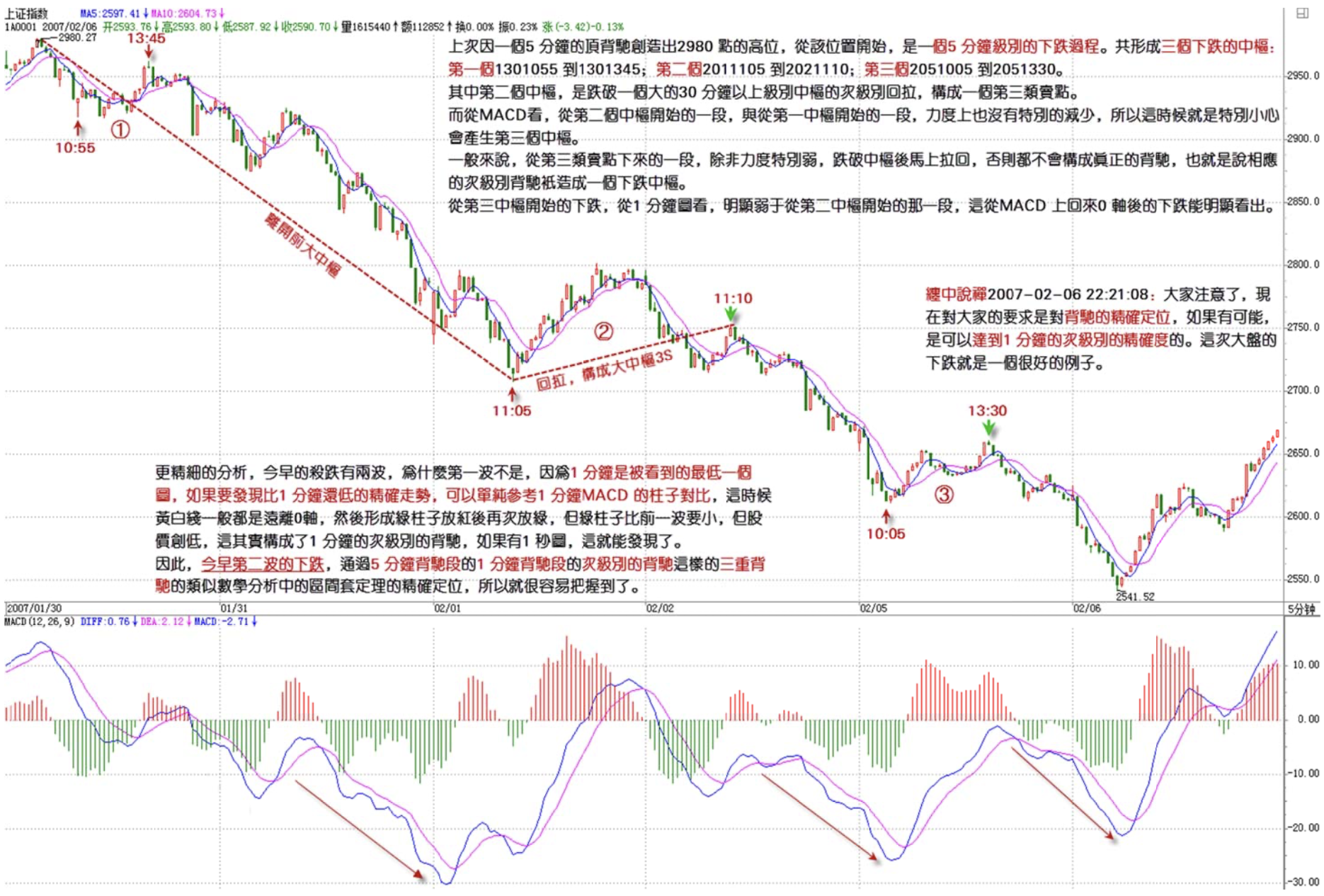
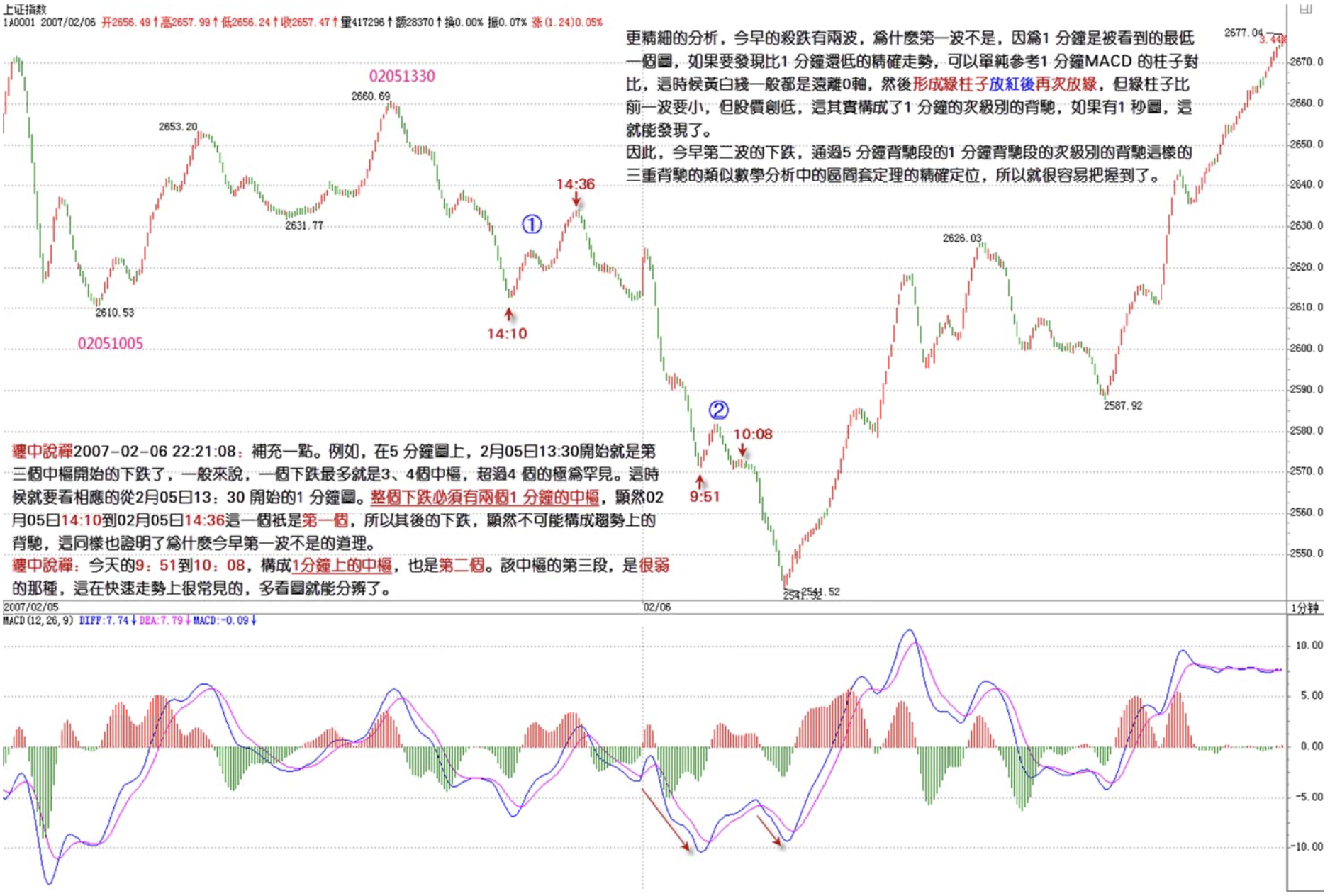
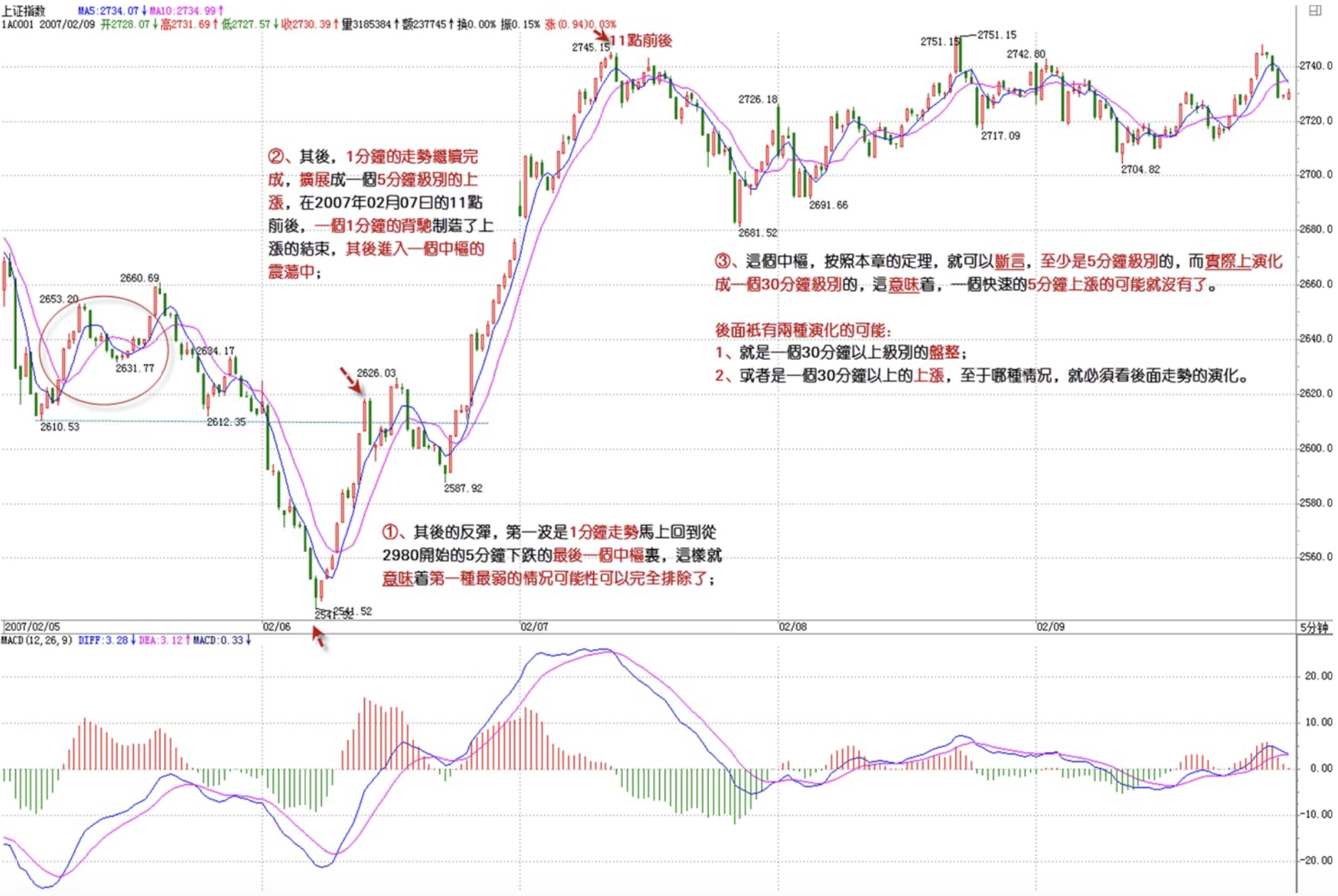
For example, the rebound on 20070206 — using the 5-minute divergence segment, then examining 1-minute and sub-1-minute divergence for precise positioning — the bottom could be captured with extreme precision. In practice, many people grasped this bottom following this ID's theory. The subsequent rebound's first wave was a 1-minute movement that immediately re-entered the last hub of the 5-minute decline starting from 2980. This meant the first and weakest scenario could be completely ruled out. Subsequently, the 1-minute movement continued to develop, expanding into a 5-minute uptrend. Around 11 AM on 20070207, a 1-minute divergence ended the uptrend. Then it entered a hub oscillation which, according to this chapter's theorem, could be declared to be at least 5-minute level. In actuality, it evolved into a 30-minute level hub, meaning a rapid 5-minute uptrend was no longer possible. Only two evolution possibilities remained: a 30-minute or higher consolidation, or a 30-minute or higher uptrend. Which scenario plays out must be determined by subsequent price movement evolution.
For actual trading, the difference between these two situations isn't very significant. Whether it's consolidation or an uptrend, the key is whether a third-type buy point forms after breaking through the first hub. In practice, you buy at first or second-type buy points first, then observe whether a third-type buy point appears. If it does, continue holding; if not, you can sell. This creates no operational difficulty whatsoever. Of course, if your capital is particularly small or you've reached elementary school graduation level in this ID's theory, you can completely exit on the sub-level movement's divergence after the breakout, then see whether the pullback forms a third-type buy point. If it does, buy back; if not, don't. It's that simple. Of course, to reach this level, you first need to be an elementary school graduate in this ID's theory. Otherwise, you fundamentally cannot distinguish the transformation relationship between consolidation divergence and third-type buy points — how could you possibly trade? Moreover, this kind of trading requires repeatedly studying charts and actual trading practice to become proficient and skilled. But once you truly are proficient and skilled, apart from others who have also graduated elementary school in this ID's theory, virtually no one will be your match.
So in practice, how do you achieve the highest efficiency? One method guaranteed by theory is: when bottom-fishing for the first time, it's best to buy those stocks whose current position has the largest distance from the last hub's DD = min(dn). The so-called "oversold" should be measured by this standard. Because this chapter's theorem guarantees the rebound will definitely reach above DD = min(dn). Then exit after the rebound's first sub-level divergence wave. If this position still can't reach the last hub, this stock can basically be disregarded — there may be exceptions, but the probability is very low. Then, after the rebound's first sub-level pullback, buy stocks whose rebound can reach the last hub, preferably those that break through the hub and hold firm after the pullback. According to "all trends must complete," there must be another sub-level upward trend type. If this trend type shows consolidation divergence, then exit. If it doesn't appear, then congratulations — you've bought a so-called V-shaped reversal stock, and the subsequent force will naturally be substantial. As for how to predict V-shaped reversals in advance, that's not a problem this chapter's theorem can solve — it must wait for future lessons.
Plagiarism is strictly prohibited; violators will be prosecuted.
Replies
缠中说禅 2007/2/9 15:17:34
Everyone wait a moment — formatting isn't done yet.
Hold on before I answer questions — let me fix the layout first.
缠中说禅 2007/2/9 15:33:09
[Anonymous] 罗锅
2007-02-09 15:16:06
数学妹妹!!!!!!!!Math sis!!!!!!!! Beware the Zhongshan wolf!!!!!!!!!!! No good deed goes unpunished!!!!!!!!!!! Don't think they'll really be grateful!!!!!!!! Just you watch!!!!!!!! Your theory will soon be plagiarized and claimed as their own!!!!!!!! Then they'll publish books!!!!!!!! Stop sharing your theory!!!!!!!!!!! Stop telling them about stocks!!!!!!!!!!! If they chase highs and buy in, they'll blame you for it!!!!!!!! They're all bad people!!!!!!!!!!!! Just make your own money!!!!!!!!!!! Let them lose everything!!!!!!!! Drain them of every last drop!!!!!!!!!!! I'll never leave!!!!!!!! But I'll always lurk!!!!!!!! I want to 100x this year!!!!!!!!!!! I want to make money and marry you!!!!!! Count on it!!!!!!!!!!!!!
==
This ID's place is come-and-go as you please. Do whatever you want — it's up to you.
缠中说禅 2007/2/9 15:37:30
Attention everyone!
Since everyone is so excited — it's Friday after all — feel free to vent. This ID's place is freedom to come and go, do whatever you want. But no spamming — that's bad for everyone.
If everyone won't settle down, this ID will just come back later.
缠中说禅 2007/2/9 15:42:45
Notice:
This ID just deleted some posts from 罗锅 and xxxx that appeared to be repeated spam. This ID normally never deletes posts, but spam must be deleted — keeping just one is sufficient. This is for everyone's comfortable reading.
缠中说禅 2007/2/9 15:44:56
[Anonymous] longs
2007-02-09 15:09:50
Boss, do you like grabbing the first reply spot now, haha
==
No — this way, those who want to see the daily market commentary can find it. Otherwise it gets pushed to the back and is hard to find.
缠中说禅 2007/2/9 15:47:38
Little Muddled Little Dance
2007-02-09 15:09:59
楼主,现在看 "论语" 系列,写得很好,是有学问在里头。你在一开头就说,不能把握 "论语" 的整体思想的,很容易曲解它。你在清扫这些曲解的时候,对"字"的解释有很多篇幅,这种解释一方面清扫了那些曲解,一方面整体而又连贯地阐述 "论语" ,让人叹服。
我就有一个小问题了,楼主是先对古字下功夫后才研究 "论语" ,还是同时研究 "论语" 和古字的?这个问题有点象"鸡生蛋"的类型,但是感觉你是自己形成了一个对 "论语" 的整体感觉后,它里面的"字"就不太容易"迷惑"你了,反过来又进一步印证了你的整体感觉。这个过程两者是相辅相成的,但是总有哪一个是更早开始的吧?
很希望楼主能再写一个系列,就是怎么去学国学。。。能象现在的炒股系列一样,一步一步来,那就更好了。。。
还有就是,楼主你的 "论语" 详解什么时候能出版啊。。。现在觉得这个比股票更有意思,股票只能慢慢来了,心急也没用。。
==
Your thought must transcend the Analects before you can annotate them. Otherwise, if you can't even figure it out yourself, at best you're having a dialogue — how could you explain it well? Characters and sentences are actually the least important things.
缠中说禅 2007/2/9 15:53:44
[Anonymous] 听缠释禅
2007-02-09 15:46:39
来这里一段时间了,收获不小,谢谢"带头大姐".
当然,这里您的年龄肯定不是大姐,但学问是绝对够格的,并且是占排头的.偶知道您这类人都是"人精"一类的,人极聪明,所涉学问也很广泛.所谓有禅机的万事万物,都是绝大多数人难以悟明的诀窍,在这里听君释解万事"缠"绕之中的真谛和禅机,也是一种享受和炼化.这里很想知道您对"何新"的评价.
==
He Xin — a passable scholar, but far from a true sage. And even from a scholar's perspective, still very far from having mastery across Chinese and Western learning that can respond to all challenges. Of course, their generation had foundational deficiencies, and some things require the right opportunity.
缠中说禅 2007/2/9 16:01:08
[Anonymous] stone
2007-02-09 15:17:50
Could you analyze 600050 China Unicom's trend?
==
Short-term is naturally the domain of second and third-tier stocks. For China Unicom to launch significantly, there must be new catalysts — otherwise it's just hub oscillation. Currently, China Mobile's return listing is its biggest support. The reason this ID has been gradually entering to ambush it involves some personal reasons. This ID has some old acquaintances with very deep historical ties to Unicom, stationed there long-term with approximately 10 billion in capital — that was a figure from over a year ago, should be more now. "Old acquaintances" meaning old adversaries. Already played a round with them recently — this time continuing the game. As for retail investors — forget about it.
缠中说禅 2007/2/9 16:03:01
[Anonymous] ccy
2007-02-09 15:17:17
ccy
2007-02-09 08:47:16
"But a true gentleman must not only emerge from the mud unstained, but must also brave fire and flood, 'seeing, hearing, learning, and practicing' the 'Way of the Sage' amidst an evil world of evil people. Without this, there can be no achieving true irreversibility, nor can the world of 'people not knowing' be transformed into a world of 'people not being resentful.'"
===================
Birds of a feather flock together, people group by kind — gentlemen and petty men find it hard to "associate" or their association lacks depth. How then can there be "steadfastness"? So in reality, true gentlemen are extremely rare.
Isn't that right, Miss Chan?!
==
Don't speak of others' faults — first examine your own shortcomings.
缠中说禅 2007/2/9 16:04:48
[Anonymous] 袖手旁观
2007-02-09 15:30:20
The first wave is a 1-minute trend that immediately returns to the last hub of the 5-minute decline starting from 2980. This means the weakest case — the first type — can be completely ruled out.
———————————————————————
Does it only need to touch the oscillation edge around the last hub, or must it strictly enter the hub's range?
==
The weakest case is just touching the edge. Of course, this situation rarely occurs in practice — the article makes this very clear.
缠中说禅 2007/2/9 16:06:36
[Anonymous] 酒吧心情
2007-02-09 15:33:22
First, sweating a bit for the class monitor......
You've already developed feelings of admiration... haha... read the Analerta first before anything else.
Once again, greetings to Chan JJ.
Regarding 600130.
On the 30-minute chart, I can only see consolidation. The only opportunity is to use consolidation divergence.
On the daily chart, I think it's similar to the broad market — it's entered a triangle zone too. It's now on the 5th segment.
I think the 4th segment didn't break below the high of the 1st segment, so I believe it will continue rising! I wonder if Chan JJ has any guidance — I've posted N times with no reply....
==
Moving stronger than the market. Medium-term, no problems.
缠中说禅 2007/2/9 16:10:20
[Anonymous] 过客
2007-02-09 15:37:30
Miss Chan, could you analyze 601398? Has it already completed the first phase? You once said 601398's trend could represent the first phase of the bull market — is it over?
==
What's running now are second and third-tier stocks, and the first round of the bull market is far from over. What this ID calls the first round is a broad concept. To be precise, when the first round ends, the market will have a quarterly-level adjustment. We're still far from that. This bull market has a long way to go.
缠中说禅 2007/2/9 16:16:30
[Anonymous] 蜗牛
2007-02-09 15:40:35
I've posted several times now, please answer, Teacher Chan. I just started studying your theory, so I'd like you to analyze the stocks I'm holding: 000690 and 000858. Are there any problems with holding these two long-term?
==
This ID doesn't like the concept of so-called "long-term holding." If you mean buying at a long-term buy point and holding until a long-term sell point, then this ID can accept that. Otherwise, it's just an excuse for insufficient technique. Like 000858 — a large weekly hub. Unless your capital is enormous, this level of pullback should at least employ what this ID describes: turning costs negative first, then holding long-term. That way, you have more freed-up money for other things. Of course, if you didn't exit, so be it. But this adjustment won't be short, with more back-and-forth ahead. As for the long term, of course there's no problem — the bull market is far from over, and ultimately almost all decent stocks will be fine and will make new highs.
缠中说禅 2007/2/9 16:20:18
[Anonymous] 袖手旁观
2007-02-09 15:55:07
Chan MM, hubs and trend types are mutually defining — a hub is formed by at least three sub-level trend types, and a trend type contains at least one hub of that level. But when you get down to the smallest level, 1-minute chart hubs become relatively fuzzy, like the second 1-minute hub in that lowest section on the 6th.
In such cases, should one use fuzzy processing, or can 1-minute hubs be given a more precise definition?
==
If you treat 1-minute as the lowest level, then the overlap of 3 consecutive candlesticks constitutes a 1-minute hub. Of course, if you treat every single transaction as the lowest level, then it's a different calculation.
缠中说禅 2007/2/9 16:22:29
[Anonymous] 大盘
2007-02-09 16:01:08
Blogger, just asking for fun — the highest education standard you've given so far is just elementary school graduation. So what would be the college or even doctoral level standard? Or is your curriculum still long and we need to learn step by step, with everything taught so far being elementary foundational courses? Of course, foundations are the most important.
What I admire most is your judgment on China's future great bull market. I wonder if by 2018 any of your students could graduate with a "doctoral" qualification — let's discuss.
==
Everything will be covered in due course. First build your foundation solid.
缠中说禅 2007/2/9 16:23:34
[Anonymous] YY
2007-02-09 16:16:48
Blogger, a question about the broad market:
If the market chooses to go up, then on the 30-minute chart there's a good chance it'll form a consolidation divergence?
==
Not necessarily — it could also evolve into an uptrend. No need to predict any of this. When the time comes, just respond to what the chart shows.
缠中说禅 2007/2/9 16:27:19
Everyone should first study the lessons repeatedly, especially this one. There's plenty of time over the weekend — invest some time.
But the weekend is also for resting. This ID is signing off — going out to indulge.
Music session Sunday morning. Goodbye.
缠中说禅 2007/2/9 15:09:19
Nothing much to say about today's market — just oscillation around the constantly emphasized 2720 point. Anyone with experience can see that this hub is a triangle, with today's late sell-off being its 5th segment. After the triangle forms, it inevitably faces a breakout, and the timing will be early next week. The direction is simple: see whether 2720 holds or not. If it doesn't hold, there'll be a second test of the bottom. Otherwise, another wave up. Whether it holds or not is easy to judge using short-term indicators.
Nothing to say about individual stocks — find your own opportunities on the charts. Next week, this ID will tell everyone how to turn stocks like 999 and 777 — which doubled into negative cost — into an ever-increasing pile of shares while maintaining negative cost. This is the most formidable blood-sucking method, one that makes all market makers and funds tremble in fear.