Teaching You to Trade Stocks 7: Some Sincere Advice for Those Who Made Money on the Index but Lost Money in Stocks
2006/11/16 12:00:01
Today I won't be favoring Confucius the Second — instead, I'll favor stocks. I've said it long ago: no one in China is qualified to discuss stocks with this ID. Before the National Day holiday, several major fund managers from Hong Kong came over. During dinner, this ID gave them a thorough dressing-down, and they went back all flustered. This ID talked to them about major international economic trends, the financial outlook for the Greater China region, and the mainland's political and economic situation, strengthening their confidence. Their main issue was lack of understanding about mainland conditions, which left them somewhat doubtful. Recently, this bunch has been doing quite well. In the market, when you strike, you strike to kill — there's no point in holding back. You have to heat up the wok before you can cook good dishes — isn't that simple enough?
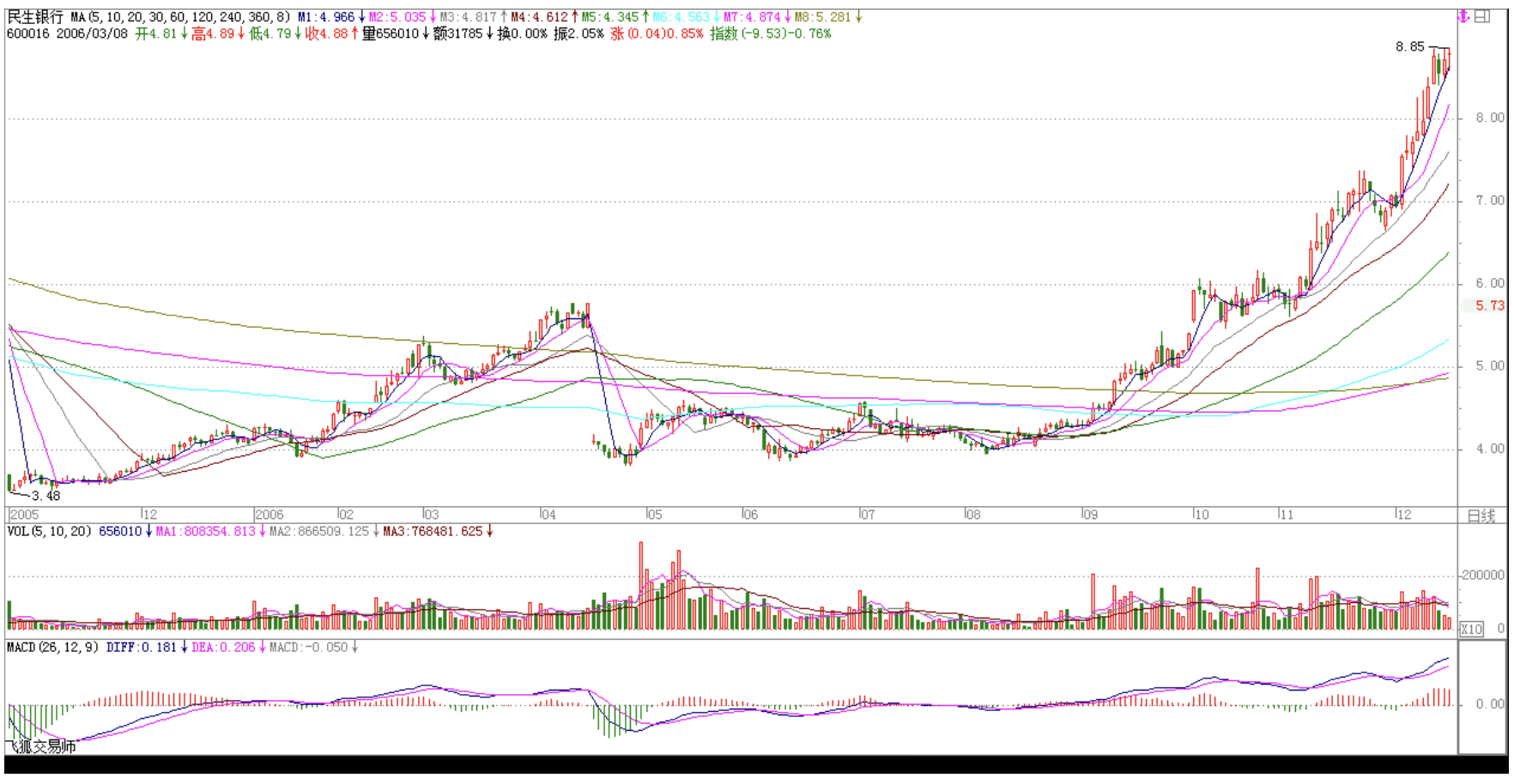
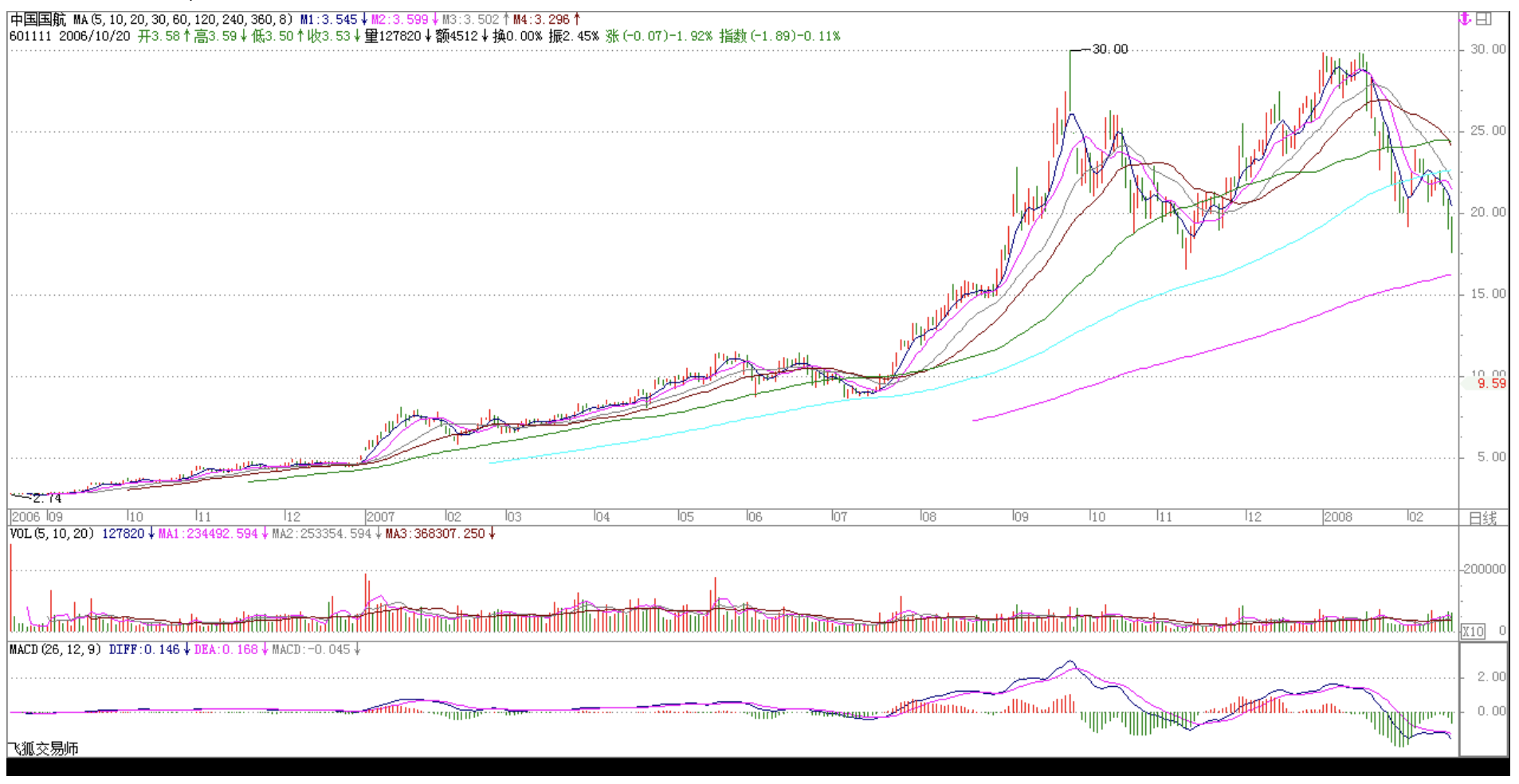
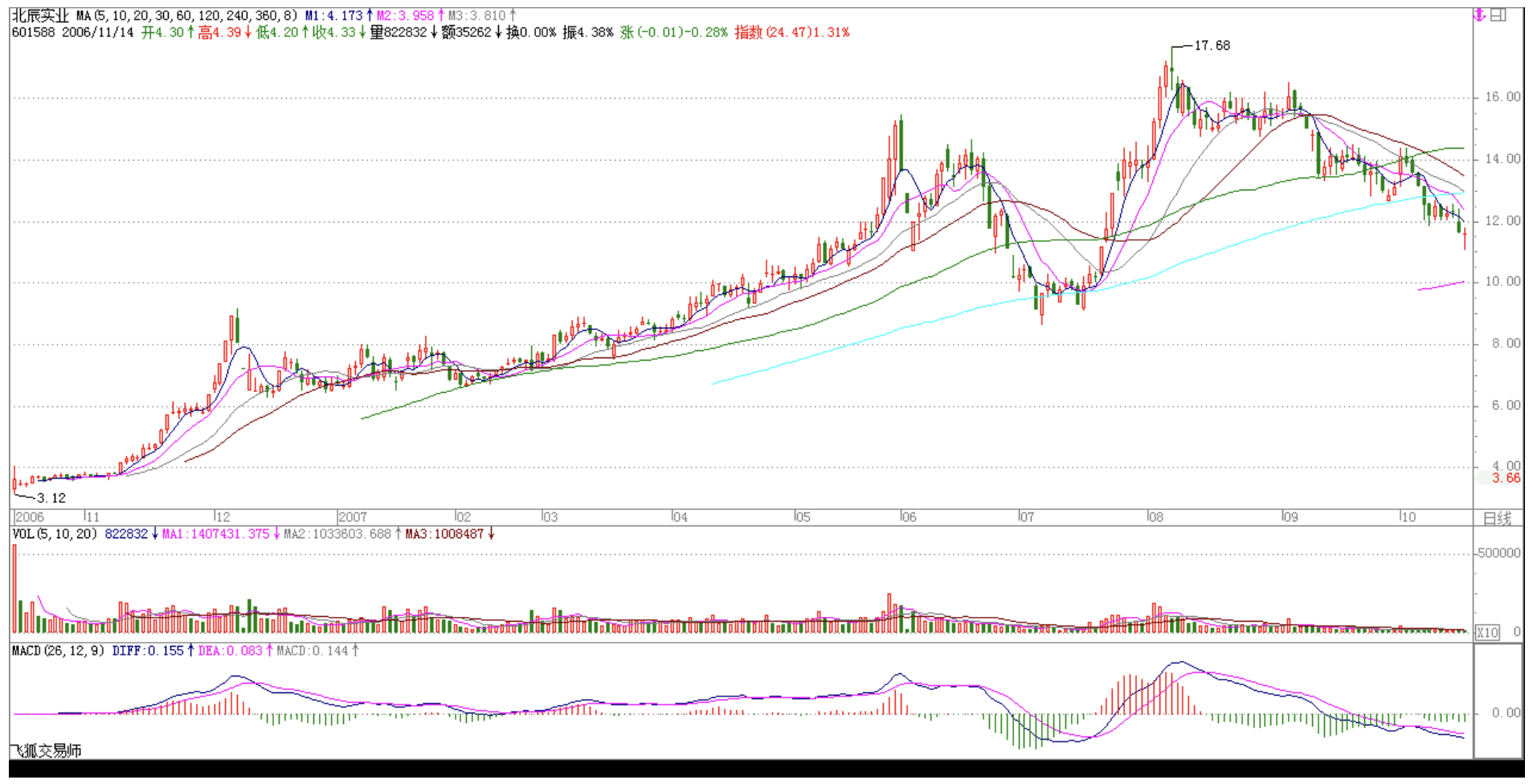
But these past few months have been a bit annoying — I've been constantly harassed by this middle-aged guy. He doesn't have much money, just capital in the tens of millions range. This ID normally wouldn't bother with such people, but this guy is somewhat special — there's a certain history between us, and he's getting on in years, already in his late forties, so you have to give him some face. But sometimes I really want to kick him twice. In April, when this ID was positioning in warrants, he didn't dare buy. Later, when warrants went crazy, he regretted it. Then I told him, at your age, don't play with such high-risk stuff — buy bank stocks instead, Minsheng Bank, buy around 4 yuan and just hold. He made a few mao profit and ran — what a disgrace. The most infuriating thing was when China International Airlines dropped below its IPO price and I told him to buy. He's a military veteran himself, and I specifically reminded him that Air China's President Li was military-born too — how could he possibly let his company's stock stay below the IPO price and lose such face? This guy hemmed and hawed, barely bought anything over many days, then sold again after it went up a few mao. Recently, I told him to accumulate Beijing North Star around 3 yuan, and he ran at below 4 yuan. This ID has completely given up on him. However, he did at least do one thing right — he had invested some money in a Beijing stock he was very familiar with at 3-4 yuan near the beginning of the year, and it's now at 10 yuan. But this guy's biggest problem is that he panics at every swing up and down, calling to harass this ID, and when I teach him how to play short-term swings during box consolidations, he doesn't dare sell when it rises and doesn't dare buy when it falls. This ID truly gives up on him.
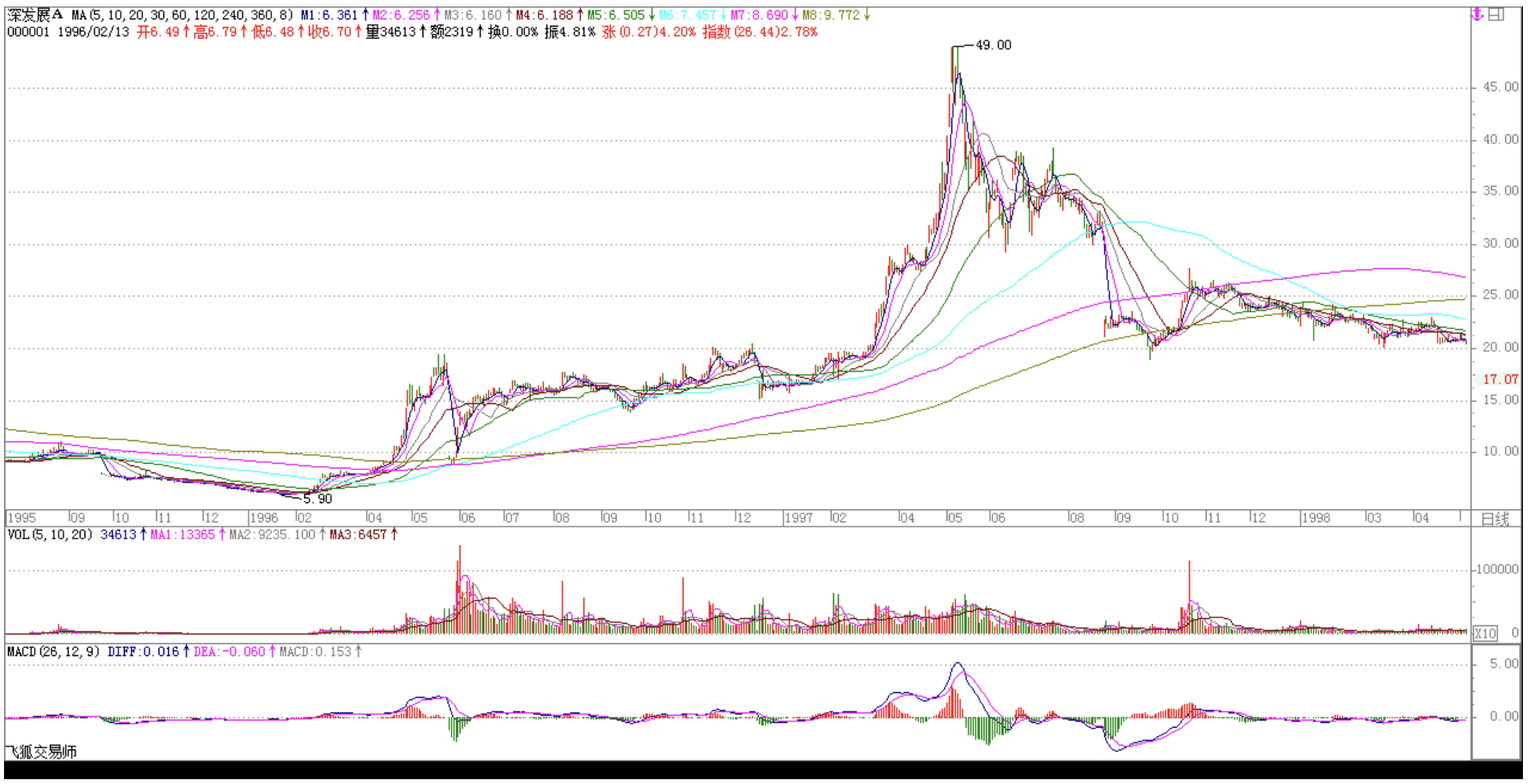
The reason I bring this up is that this situation is all too common among retail investors. Retail investors are like duckweed — no roots, no convictions. No wonder they get slaughtered. Probably recently, there are quite a few people in worse shape than this middle-aged guy — people who made money on the index but lost money on their stocks. This ID will also ramble a bit, so that those with the right karmic connection may benefit. Before the index broke 1000 points last year, this ID wrote "G-shares are the G-spot," and right after the breakout this May, this ID wrote "No need for safety gear in a big bull market!" So why have some people still managed not to make money? The main reason is a lack of confidence in the bull market and a failure to grasp its rhythm. The rise in non-ferrous metals before May was just the warm-up phase of the bull market, and the current rise in index-weighted stocks like financial stocks represents Phase One of the bull market. In 1996, Shenzhen Development Bank had risen N-fold while many stocks hadn't budged. The first phase of a bull market is always like this — first-tier stocks rise first. Until they've reached their targets, how are other stocks supposed to rise? Every bull market in the world basically works this way — there's nothing new about it.
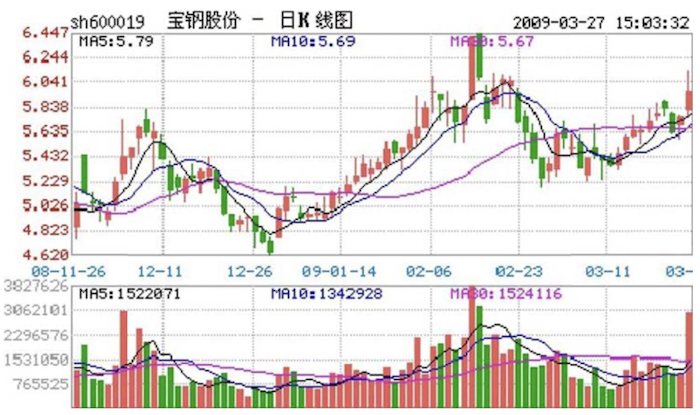
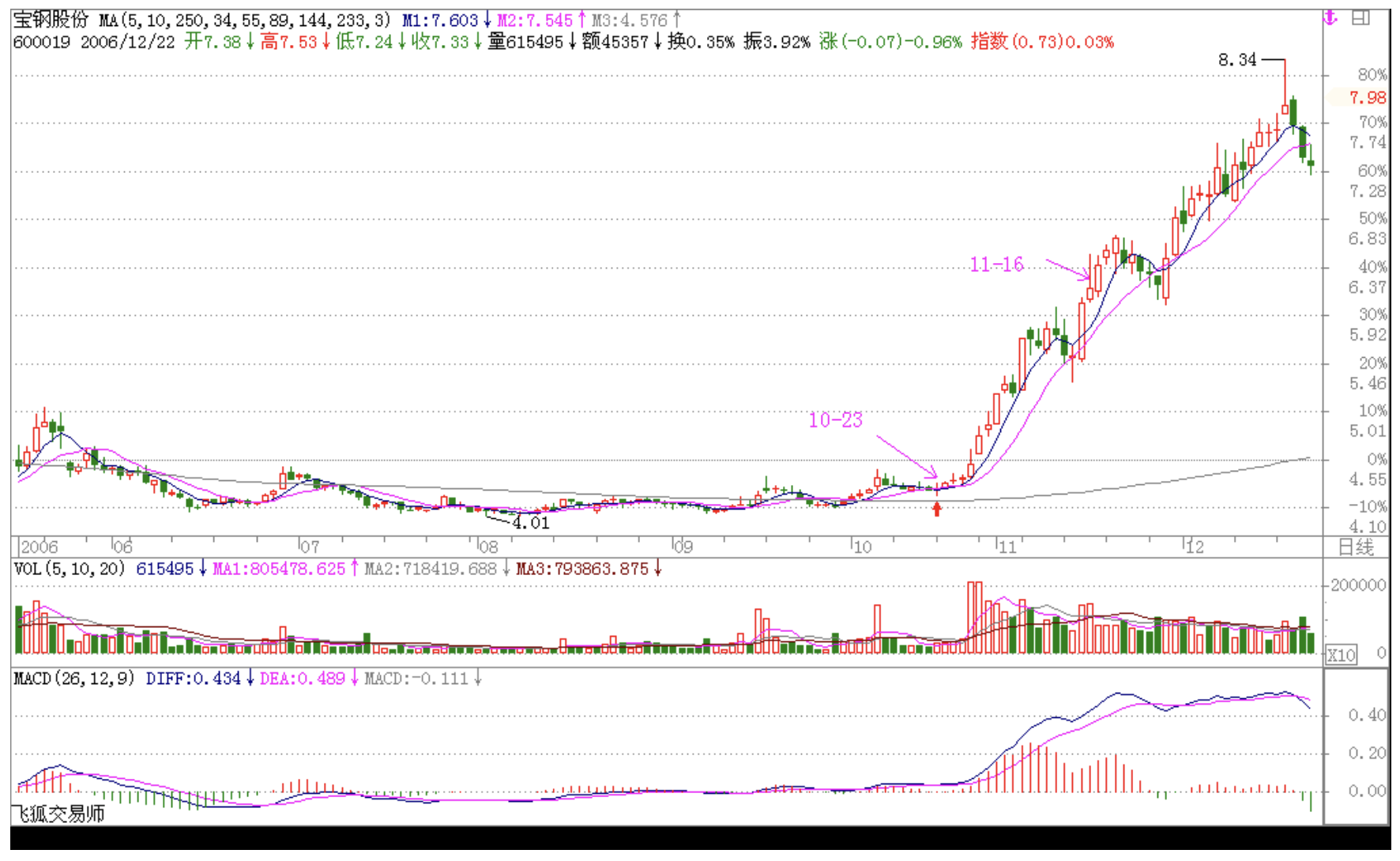
What if you've missed this rhythm? If your tape-reading skills are decent, you should enter strong stocks during pullbacks. Retail investors fear drops, but in a bull market, drops are like daddy coming home — every drop means daddy's here again, about to hand out money. If your tape-reading skills aren't up to par, there's one approach that's the simplest: watch for all new stocks that break above their first-day-of-listing highs on increased volume, and old stocks that break above their annual moving average on volume then pull back to it on reduced volume — these are the future dark horses. Pay particular attention to stocks whose annual moving average has flattened and then turned upward at an inflection point. As for stocks still below their annual moving average, don't bother — wait until they get above it. Actually, this is the simplest and most reliable method for finding so-called bull-market stocks. Let me give an example: look at Baosteel. After breaking through the annual moving average and pulling back on reduced volume, it pulled back to 4.20 yuan on October 23rd, when the annual moving average was at 4.17 yuan. Then it launched again on increased volume. Today, November 16th, it's already above 6 yuan — a 50% gain, just like that. Launching from the annual moving average for an initial 50% gain — isn't that like child's play? This ID generally only watches large-cap stocks since small-cap stocks are hard to get into with large positions, but retail investors can watch small-cap stocks — the principle is the same. However, with small-cap stocks, you need to be careful: large-cap stock breakouts usually have fewer fakeouts, but that's not necessarily the case with small-cap stocks, so you need to study this carefully yourself. Retail investors should just be good retail investors. Stop dreaming about catching bottoms and escaping tops every day. If you caught all the bottoms and escaped all the tops, what would the non-retail players eat? Retail investors must wait until the trend is clearly established before entering or exiting — this will save a lot of detours.
Once a stock starts rising, don't casually sell it. Mid-term, if it hasn't even broken below the 30-day moving average, it proves the trend is very strong, and you should hold it. Of course, if your skill level is a bit higher, you can play short-term swings based on short-term indicators during the rise, which increases your capital utilization rate. But if you sell at the highs, as long as the mid-term chart hasn't broken down, you must buy back on pullbacks — especially for stocks that haven't yet shown acceleration. There's a principle for selling stocks, divided into two situations: the first is for slow, steady advances — once acceleration kicks in, you need to constantly watch for selling opportunities; the second is when the first wave is an explosive rise, and after a correction, once the second wave shows divergence or massive volume, you must be careful and look for opportunities to exit. The specifics of execution are a matter of timing and feel — you must experience it yourself. It's like making soup: the matter of timing can't be taught, only experienced in practice. Also, you must never have emotional attachment to stocks you've sold. Stocks are like men — use them and toss them. Never get emotionally attached.
One more thing must be emphasized: in a bull market, you absolutely must pay serious attention to index component stocks, especially if you have significant capital. Component stocks are where the main forces are fighting. Stop fooling around with guerrilla operators every day — those people can barely protect themselves. This ID has seen so many of these so-called hot money operators get wiped out that I'm numb to it. The big money loves eating them — gobbling them up billions at a time. That's what's interesting. Otherwise, eating the tens of thousands from small retail investors — isn't that exhausting? In a bull market, eventually all stocks will have their chance to perform. It's just that if you master the rhythm, your capital utilization rate will be higher. After a bull market is done, if your returns don't exceed several multiples of the final index gain — if the index doubles and you don't make 4 or 5 times — then you're a worthless pastry. To reach this level, it's actually very simple, just one principle: avoid the major pullbacks and use pullbacks to ride the sector rotation rhythm. Don't ever believe the hype about so-called fundamentals, especially for retail investors. You've got at most a few hundred million at best — is there any need to study fundamentals? So-called fundamentals are just a pretext, used to boost your own courage and fool others. Regarding fundamentals, just know what other people think the fundamentals are and the corresponding impacts — never actually believe them yourself.
This ID will repeat: if you're playing the capitalist game, you must use capitalist principles. Since you're playing stocks, you need to be ruthless and merciless. The market never sympathizes with losers. The market doesn't need crematoriums — losers' corpses won't leave even a shadow or a scent in the market. Don't make excuses for your failures. Failure can only be your own failure. If you fail, find opportunities to recover, but the prerequisite is finding the true cause of failure — otherwise you're just continuing different plots of the same tragedy. This ID hopes that people who come to this blog, besides studying "The Analerta," listening to music, and reading articles, can all learn to make money. The most shameless and despicable people in this world are those who can't make money. You call money a "grandson," but you can't even handle a grandson, so you're at most a turtle's grandson — what right do you have to speak? Having money doesn't make you somebody, but having no money certainly doesn't make you somebody either. Making money in the market is like fighting a war — surviving by a thread — and those who ultimately survive are the real deal. Real players gotta play — what more is there to say?
Replies
缠中说禅 2006/11/16 12:07:13
This ID's place is a variety store — everything's here, if only you can handle it.
缠中说禅 2006/11/16 12:47:19
Market's open, heading out.
缠中说禅 2006/11/18 12:16:34
[Anonymous] 无
2006-11-18 11:51:50
The blogger is dishonest — how come my inquiry was deleted?
================
It definitely wasn't deleted by this ID. It's possible your comment contained a link or sensitive characters.
Feel free to leave another comment, and this ID will come back online tonight.
缠中说禅 2006/11/21 22:00:12
[Anonymous] 傻妞
2006-11-21 21:15:16
"Master Zen," after hearing your stock-Zen wisdom, I really admire you! But I'm still confused. I'm a beginner retail investor and I have a simple question: which line on the K-line chart is the annual moving average? Please don't laugh — I only know the 5, 10, and 20-day lines. Please advise! Also, when will the stock I bought, 东方金钰 (formerly G多佳, 600086), go up? Could you spare a moment to analyze it? Thanks, waiting for your reply!
===================
This ID is not a stock commentator. Talking about stocks is just one aspect of this blog, purely hoping that people who come here can learn something. Normally your question shouldn't be answered, because this ID is afraid that once I start answering questions, this place will become a consultation desk. But seeing your sincere request, this ID will make an exception this once. The annual moving average generally refers to the 250-day moving average, but it can be applied to charts of various timeframes — for example, minute charts, hourly charts, weekly charts, monthly charts, and so on. For how to set it up specifically, ask someone near you.
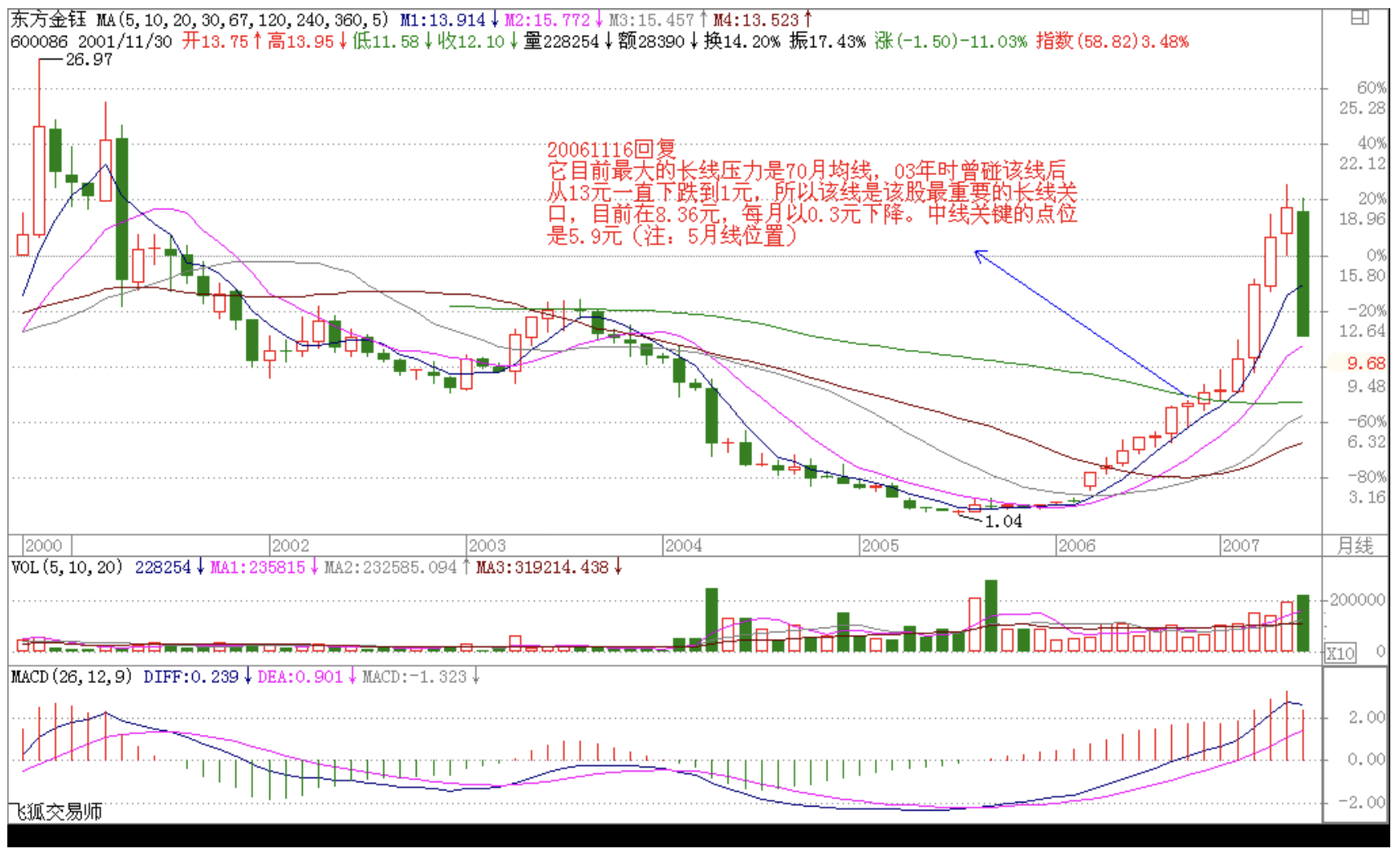
As for 600086 that you mentioned, it's already risen a lot — it pulled 8 consecutive months of bullish candles going from a little over 1 yuan to over 7 yuan, so a correction is perfectly normal. The key is your entry price. If you bought recently, you need to be prepared to weather the correction risk ahead. This ID can only tell you its current specific situation: its biggest long-term resistance is the 70-month moving average. In 2003, it touched that line and then fell from 13 yuan all the way to 1 yuan, so that line is the stock's most important long-term barrier, currently at 8.36 yuan, declining by 0.3 yuan per month. The mid-term key level is 5.9 yuan — if that level is effectively broken, the correction could be very deep. Currently, it can be viewed as box consolidation between 5.9 yuan and 7.2 yuan, and you can do short-term operations based on the box pattern — the so-called sell high, buy back low approach. Mid-term, wait for the breakout direction to be chosen.
But I still want to remind everyone: don't casually enter stocks that have already risen significantly. From the very beginning, learn to exchange the smallest possible risk for the greatest possible profit.
缠中说禅 2006/11/21 22:07:06
[Anonymous] 冰火
2006-11-21 22:05:15
But I still want to remind everyone: don't casually enter stocks that have already risen significantly. From the very beginning, learn to exchange the smallest possible risk for the greatest possible profit.
============================
I always thought experts only play the final parabolic surge. Didn't expect someone as great as the host to also be so risk-averse.
========================
For long-term success, you must insist on exchanging minimum risk for maximum profit. Risk comes first — there's no distinction between high and low here. Losses are calculated in percentages. Ten billion or one million — lose 100%, and it's all zero.
When others discard, I don't necessarily pick up; when others scramble, I definitely give it away.
缠中说禅 2006/11/16 12:04:37
"The Analerta" has reached its thirtieth installment. Taking a day off to celebrate — continuing tomorrow.