Teaching You to Trade Stocks 12: How Can a Single Kiss Be Soul-Melting?
2006/12/1 12:03:48
Even if you're watching adult videos, the ultimate purpose is real-world practice. The previous chapter discussed so much about "kissing" — the goal is to do, not just to watch. Watching without doing — that makes you a ghost in the netherworld. Watching too many AVs without practicing is definitely bad for your health. But when you actually do it, you immediately face the problem of risk. Entering at any position carries risk, and unless the trend has already played out, even with the simplest moving average system, nobody can be 100% certain in advance exactly what kind of "kiss" will unfold. Those familiar with this ID's interpretation of "The Analerts" know that risk is "not to be worried about" — it has no fixed position. Any delusional desire for absolutely zero risk in investing is a pipe dream. The only solution is to set up a system that turns the positionless, "unworried" risk into a positioned, "worried" system — this is the only method for long-term victory over the market.
You must design a classification and evaluation system based on your actual circumstances — capital size, skill level, and so on — then set corresponding response procedures for all possible scenarios. This way, all risk is handled in an operable manner. And the only thing the operator needs to do is: when a situation arises, take the corresponding action. For stocks, actual operations boil down to just three things: buy, sell, hold. Of course, in practice, there's also the question of quantity, which relates to capital management — we'll set that aside for now. So any investment operation boils down to this simple mathematical problem: N types of completely classified risk scenarios, mapped to three possible actions (buy, sell, hold).
For example, consider a simple trading system composed of the 5-day and 10-day moving averages. First, their relative positions form a complete classification. Female-on-top is bullish, male-on-top is bearish, and then there's the entanglement situation, which must ultimately resolve into either female-on-top or male-on-top. This resolution has only two properties: continuation or reversal. Correspondingly, the simplest possible operating system is born — enter after the entanglement completes. For the bulls, this system yields only two outcomes: success if it resolves to female-on-top, failure if it resolves to male-on-top. Since entanglement that acts as continuation maintains the original position, and reversal changes it, for the bulls, the only two situations worth entering are: male-on-top reversal, and female-on-top continuation. For bears, it's the opposite.
For any trend, the primary judgment is the position: male-on-top or female-on-top. This question can be answered by anyone with eyes. For the 5-day/10-day moving average system, when the 5-day is above, it's female-on-top; otherwise, it's male-on-top — this is clear in every situation. In a female-on-top scenario, once entanglement appears, the only thing you need to deal with is whether this entanglement is continuation or reversal. It can be stated definitively that no method can determine this with 100% certainty. However, there are many methods that can make the judgment accurate enough. For example: the first entanglement after a female-on-top trend begins has a very high probability of being continuation. If it's the third or fourth occurrence, the probability of it being a reversal increases. Also, before the first entanglement appears, the 5-day line's movement must be very robust — not limp and feeble. Under such conditions, entanglement is extremely likely to be continuation, with at least one subsequent advance following. Third, the volume before the entanglement shouldn't be excessive. Once volume is too large, the probability of fakeouts increases significantly. If volume suddenly surges too much then shrinks too quickly, even without fakeouts, the entanglement period generally extends, and volume typically shows a double-contraction pattern.
For the female-on-top scenario, select the first entanglement's continuation case. For male-on-top, do the opposite — look for the last entanglement's reversal case. If what follows is a sharp drop with divergence, that's the optimal buying opportunity. Bottom-fishing isn't impossible — but only choose this situation. However, nobody can be 100% certain that it's the last entanglement. Generally, the first entanglement after a male-on-top scenario definitely isn't. Starting from the second, it's possible. How to judge? The most powerful tool is using the bear trap created by divergence. Using divergence is a specialized topic that will be discussed in detail later.
Synthesizing the above, using the moving average trading system: first, use the bear trap formed by divergence after the last entanglement in a male-on-top scenario to bottom-fish and enter — this is the first buy point worth entering. The second buy point worth entering or adding to positions is the low point formed during the first entanglement after female-on-top is established. Within this system, these two buy points have the smallest risk — more precisely, the highest reward-to-risk ratio — and are the only two points worth buying at. But I must point out: it's not that these two buy points carry zero risk. Their risks lie in: for the first buy point, misjudging continuation as reversal or misjudging the divergence; for the second buy point, misjudging reversal as continuation. These constitute their risks. But these risks are largely related to operational proficiency. For experts, judgment accuracy is much higher. And how to become an expert? The key is to practice more, participate more, and develop intuition. But whether expert or novice, the principle of buy points remains unchanged — the only thing that can vary in skill level is the judgment of continuation versus reversal and divergence.
Understanding this point, any buying behavior not at these two buy points is unforgivable, because it's an error of principle — not a difference in skill level. If you've chosen this trading system, you must follow these principles. Once you understand how to buy, selling is simply the reverse — it's very straightforward. One kiss that melts the soul — learn this soul-melting kiss, and you can find solid footing in a turbulent market. Of course, the corresponding moving average parameters can be adjusted based on capital size and other factors. The larger the capital, the larger the parameters should be — this requires personal experimentation. This principle is equally effective for short-term trading — just replace daily charts with minute charts. And once you've bought, hold until the first sell point arrives — that is, when divergence appears after a female-on-top entanglement — and the second sell point, the high of the first entanglement after switching to male-on-top. Sell at those points, and you've completed a full operation.
Note: when buying, it's generally best to buy at the second buy point. When selling, try to sell at the first sell point. This is where buying and selling differ.
Let me add an example for those not comfortable with abstractions:
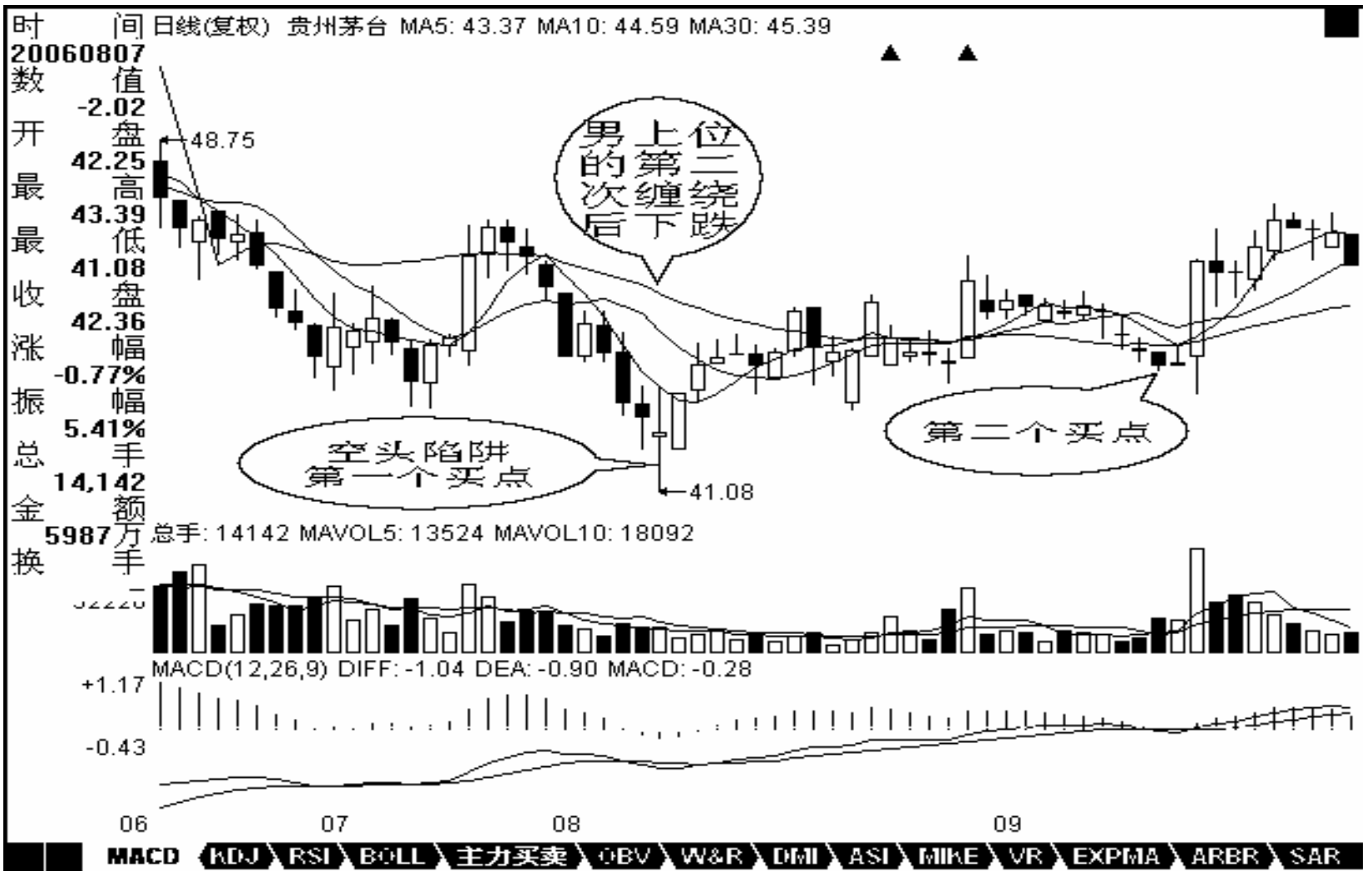
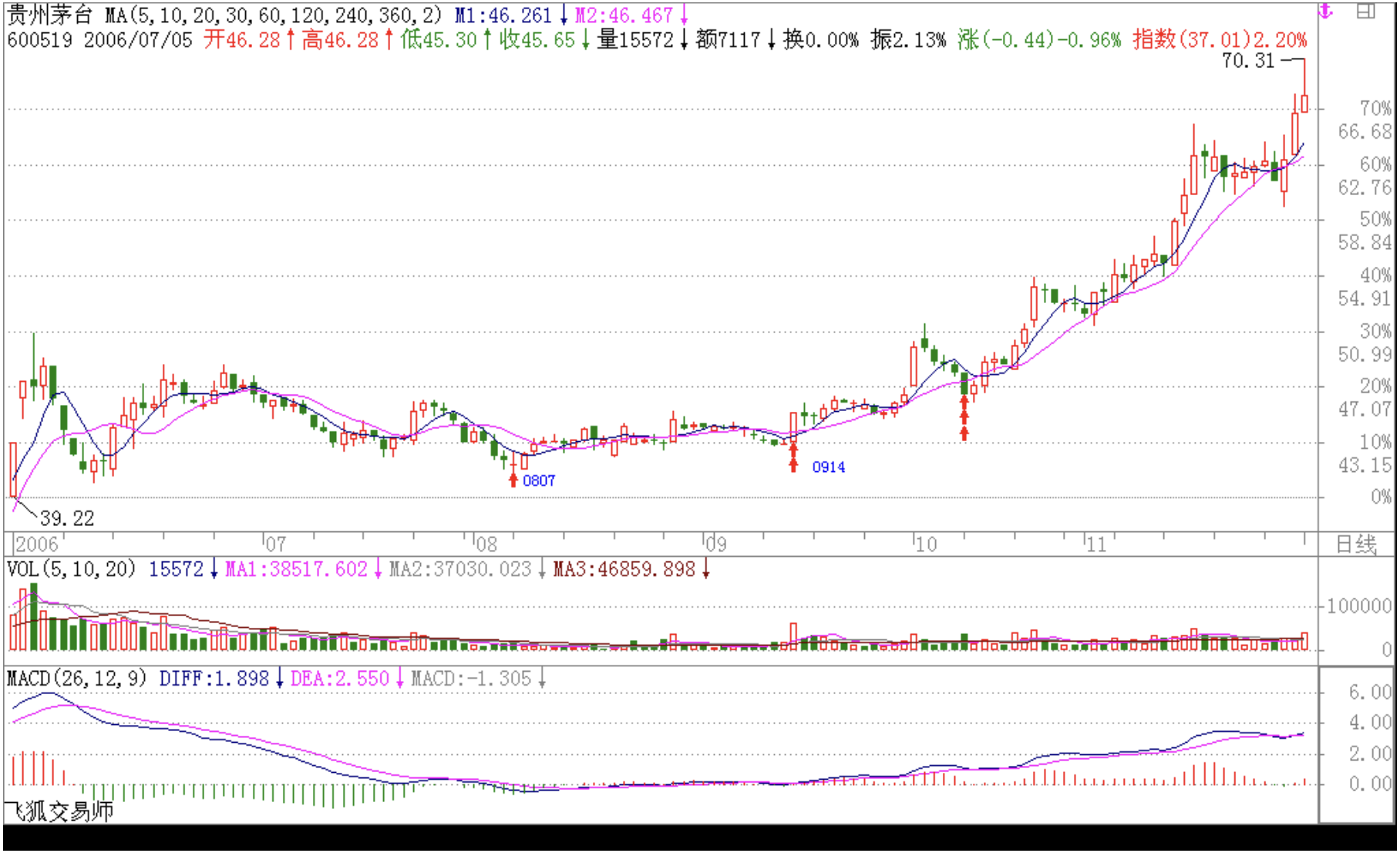
For those who prefer daily charts, here's an analysis using Maotai as an example, with the 5-day and 10-day moving averages.
August 7th: After the second entanglement in a male-on-top scenario, the drop showed clear divergence in volume and other indicators, forming a small bear trap and constituting the first buy point around 41 yuan.
September 14th: The first entanglement's pullback in the female-on-top scenario formed the second buy point around 44 yuan.
Then it basically rose along the 10-day line. Even for short-term traders, as long as the 10-day line isn't effectively broken, continue holding and wait for the first sell point — i.e., the appearance of divergence after an entanglement. The second sell point is the high of the first entanglement after switching to male-on-top. Currently, neither has appeared, so just hold and wait.
One more note:
I hope people who come here will gradually stop asking questions like "how much will it rise" or "how much will it drop," because such questions are produced by flawed thinking. This ID is not a stock commentator, not a fortune teller — I have no interest in guessing upside or downside targets. This ID is merely an observer: I enter only when buy points appear, then hold and wait for sell points to appear. Beyond that, this ID has zero interest.
If you come here and ultimately can't undergo a fundamental transformation — gaining new eyes for investing — then you've come in vain.
Replies
缠中说禅 2006/12/1 12:10:55
This ID's advice to the market remains valid, quoted below:
The following conclusion remains valid:
Chán Zhōng Shuō Chán
2006-11-29 15:14:38
From the perspective of a healthy market, this ID's advice to the market is: let the Shenzhen Component Index break through its historical high of 6103 first, then Shanghai follows, and adjust after the breakout — that would be healthier. Not sure if the market is interested in listening to this ID's opinion.
缠中说禅 2006/12/1 12:16:49
The biggest risk for the market right now is that Shanghai people are relatively stingy, because it's almost inevitable that Shenzhen will break the historical high first. Shanghai might deliberately sabotage things, preventing everyone from breaking through. This sounds like fantasy, but it's happened more than once historically. Yet history has proven time and again that in every major bull market, Shenzhen outperforms Shanghai — this is also a very important empirical observation for judging market conditions. When Shenzhen is weaker than Shanghai, the chances of a major rally are slim. Now seeing Shenzhen stronger than Shanghai, even Shanghainese should be happy about it.
缠中说禅 2006/12/1 12:18:15
[Anonymous] 糊涂蛋
2006-12-01 12:09:07
First?
May I ask — can 000958 be entered?
===========
After learning the technique above, first analyze it yourself. Using the 5-day and 10-day, where are this stock's optimal and second buy points?
缠中说禅 2006/12/1 12:26:27
Alright, let me analyze 000958 that "Confused Egg" just asked about.
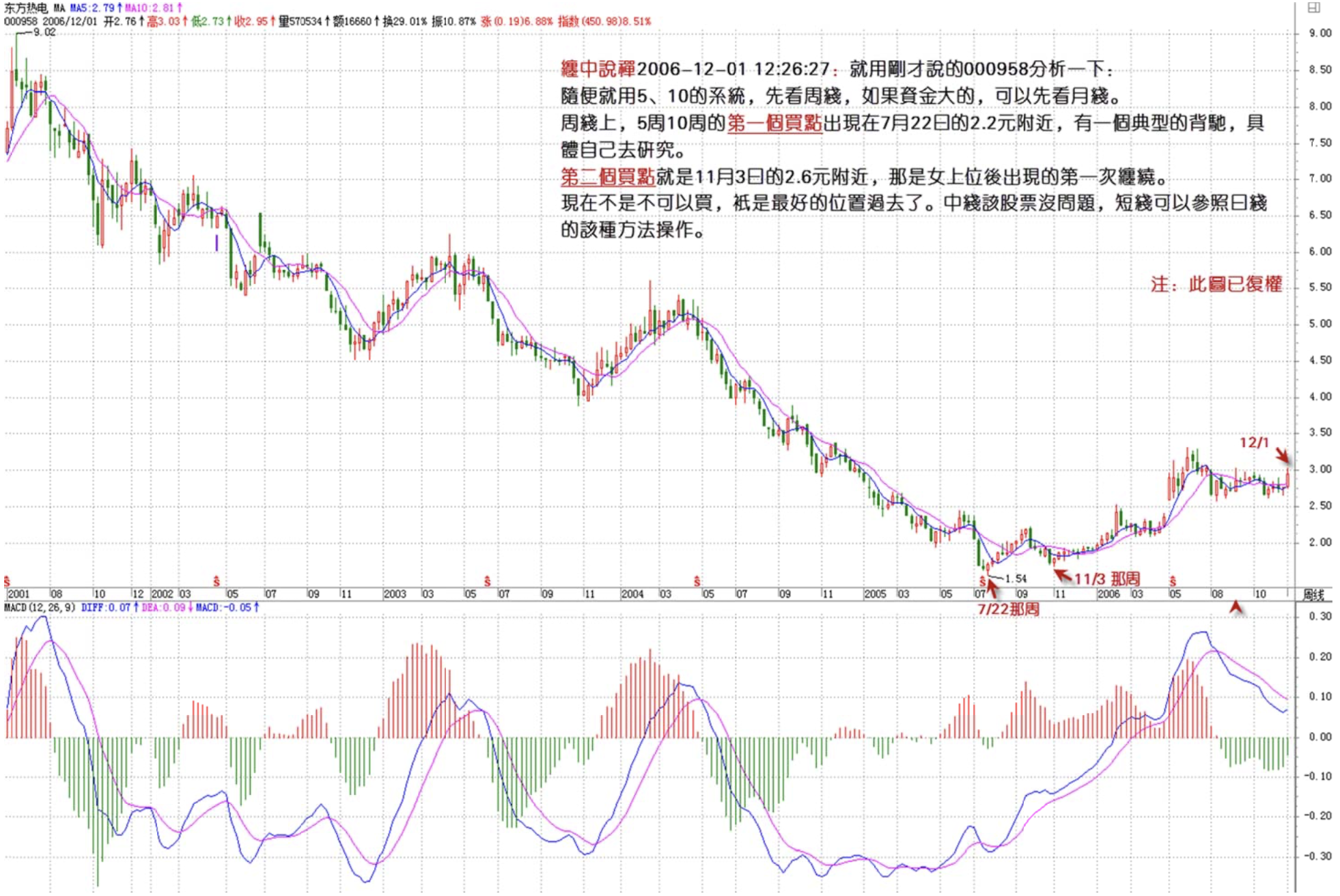
Casually using the 5/10 system, first look at the weekly chart. If you have large capital, start with the monthly chart.
On the weekly chart, the first buy point for the 5-week/10-week system appeared around July 22nd at 2.2 yuan. There's a classic divergence — study it yourself.
The second buy point was around November 3rd at 2.6 yuan — the first entanglement after female-on-top.
Buying now isn't impossible, just that the best positions have already passed. Mid-term, this stock is fine. Short-term, you can apply the same method on daily charts.
缠中说禅 2006/12/1 12:30:55
Everyone please note:
This ID is teaching you how to identify the optimal buy points — not saying you can only buy at these two points. Buying elsewhere just means bearing greater risk. And for long-term success, you must learn to keep risk at its minimum.
Also, this is just one technique. You absolutely cannot rely on this one technique alone. But if you can't even learn one technique, how will you learn the ones that follow?
缠中说禅 2006/12/1 12:33:53
[Anonymous] 7NT开叫
2006-12-01 12:23:47
The host is both brilliant and compassionate. Thank you. When you have time, could you write an article on capital management? Thanks!
============
Step by step — we'll get there.
缠中说禅 2006/12/1 12:41:24
For those who prefer daily charts, here's an analysis using Maotai as an example, with the 5-day and 10-day moving averages.
August 7th: After the second entanglement in a male-on-top scenario, the drop showed clear divergence in volume and other indicators, forming a small bear trap and constituting the first buy point around 41 yuan.
September 14th: The first entanglement's pullback in the female-on-top scenario formed the second buy point around 44 yuan.
Then it basically rose along the 10-day line. Even for short-term traders, as long as the 10-day line isn't effectively broken, continue holding and wait for the first sell point — i.e., the appearance of divergence after an entanglement. The second sell point is the high of the first entanglement after switching to male-on-top.
缠中说禅 2006/12/1 12:50:57
[Anonymous] 糊涂蛋
2006-12-01 12:44:59
Many thanks to Number Lady for taking time out of her busy schedule to teach us daily about kissing, entangling, entering, positioning, and G-spots. I have three questions:
- If everyone learns these techniques, what would the market become? (Maybe there's never a shortage of confused eggs.)
- What is your purpose in teaching daily?
- How should we thank you?
==============
First, not everyone will learn it. Second, what the market ultimately compares isn't technique but mentality — and that can never be unified. Experts will always be experts. Newbies, if they don't go through tempering, will be useless no matter how many techniques they learn.
Your second question is quite boring. Why must everything have a purpose? Can't the thing itself be the purpose?
As for gratitude — here's a harsh truth: who in this world has the ability to thank this ID? This ID lacks nothing. Who is even qualified to thank this ID?
缠中说禅 2006/12/1 12:52:19
[Anonymous] 7NT开叫
2006-12-01 12:47:35
Fully agree with the host's safety principle and moving average methodology. What the host teaches is absolutely the true scripture — extremely practical. Thanks!
===========
That's just a compass. The road must be walked yourself. Watch more AVs — meaning study various stock charts — analyze them well. You must understand them completely in your mind and turn them into your own intuition. Only then will they be somewhat useful.
缠中说禅 2006/12/1 12:55:32
[Anonymous] 无言
2006-12-01 12:51:26
Hello, I bought 600809 today. How much upside is there? Thanks.
==========
I hope people who come here will gradually stop asking questions like these, because they come from flawed thinking. This ID is not a stock commentator, not a fortune teller — I have no interest in guessing upside or downside targets. This ID is merely an observer: I enter only when buy points appear, then hold and wait for sell points to appear. Beyond that, this ID has zero interest.
If you come here and ultimately can't undergo a fundamental transformation — gaining new eyes for investing — then you've come in vain.
缠中说禅 2006/12/1 12:58:59
Added a few lines at the end of the article. Please take another look.
Market's open. Heading out. See you.
缠中说禅 2006/12/1 15:02:23
As expected, the market oscillated today. Currently the market's biggest danger is the aforementioned competition between Shanghai and Shenzhen, especially given Shanghai's historical precedent of deliberately sabotaging things — this must be watched carefully.
Technically, the gap left by Shenzhen Component Index today is very important. If it gets filled quickly, that sends a negative technical signal.
Next Monday will still see oscillation, but individual stock rallies will continue. Since November closed as a huge bullish candle, a significant oscillation is inevitable after a December push higher — this must be clearly understood.
缠中说禅 2006/12/1 15:03:44
[Anonymous] liang
============
Treating fundamentals as God is just as laughable as treating technical analysis as God.
缠中说禅 2006/12/1 15:04:13
Social engagement coming up. Must go. Heading out. See you.
缠中说禅 2006/12/1 12:09:33
This afternoon assessment remains valid:
Chán Zhōng Shuō Chán
2006-12-01 09:13:03
Today's market oscillation is normal. Key is still the 5-day line. As long as the 5-day line holds, sectors will continue rotating and performing.