Traitors, If You've Got the Guts, Dump Billions of China Unicom Shares and Crush this ID!
2007/2/26 15:50:13
Traitors
If You've Got the Guts, Dump Billions of China Unicom Shares
and Crush this ID!
When this ID said on the 8th that we would attack China Unicom, push Unicom above 5 yuan before the Spring Festival, and push the market above 3000 points, the traitors were presumably snickering, calculating how to destroy this ID this time. In the end, on the last day, seeing that Unicom couldn't be taken down, they could only ambush at the close using leaked information, closing the market at 2998, thinking this would make this ID lose face. Such pettiness — only traitors could pull off something like that. What can such a pointless ambush change? Thinking you can control the market by bribing a few officials and knowing some garbage information? Too much water in the brain!
China's century — is China's turf not supposed to be controlled by Chinese people? This ID's high-profile approach this time is not because this ID has any fondness for running naked, but because this battle, like the Hundred Regiments Offensive, had to be fought — even if it broke the pot, it had to be fought. Otherwise, trash like Jim Rogers and the traitors would think this world still belongs to them! And like the Hundred Regiments Offensive, it had to be fought so loudly that the whole world would know — to tell those spineless Chinese people that foreign devils and traitors aren't even worthy of being gigolos! On a side note, the clicks on this ID's blog haven't even reached a third of that Kong guy's — this is probably one indicator of why China has so many traitors.
Those gigolos and those who don't even qualify as gigolos, let's not talk about them. Oscillations and reversals in the market are inevitable, and from a purely technical standpoint, even after standing firm above 3000 points and pushing up, there's a very high probability of entering a divergence segment on the daily level. But individual stocks, especially second- and third-tier stocks with catalysts, will increasingly break free from the influence of the index. China Unicom was for everyone to observe — retail investors really don't need to buy it. As for the 14 stocks mentioned before, everyone can see how they've performed overall. Let me list them again:
Mentioned in mid-December: 000999, 000777, 000600, 000778, 600777.
Mentioned after New Year: 000416, 000915, 000099.
Mentioned in late January: 600343, 000998, 600649, 600578, 600432
Mentioned in early February: 000938
In reality, making money as a retail investor is truly simple. Take these 14 stocks — their basic rhythms are all different. Using technical analysis, swap those with large gains for those with smaller gains, and your capital efficiency improves. For instance, 000999, which nearly everyone held at the start, doubled by January 25th and entered a correction, while 000416 hit its washout retest low on January 26th. Why so coincidental? There's no need to investigate. But as of today, exactly one month later, it's basically doubled too. This ID gave special notice on this stock — this ID called it "No gifts accepted this New Year" — everyone should know the second half of that phrase, right? And you've all seen how it performed before and after the holiday. If you get your rhythm right, doubling twice in two months is not difficult at all.
Now that China Unicom has happened, this ID probably can't mention specific stocks anymore, or they'd get raided into chaos. Regarding this year's sectors, this was made clear at the end of last year: pharmaceuticals are this year's liquor, steel is this year's non-ferrous metals. Some didn't believe it then — can they see it now? For second- and third-tier small sectors, it was clearly stated in late January: agriculture, environmental protection, military, non-ferrous metals, utilities — these will continue to perform. Agriculture and environmental protection are areas where Chinese policy must tilt toward, and recent policies have been making this increasingly clear. Additionally, some special small sectors, like VC (vitamin C) and Shenzhen/Shanghai local low-priced stocks — especially Shenzhen ones — deserve full attention. Historically, the biggest dark horses, especially the biggest dark horses when speculating on penny stocks, frequently emerge from here.
Having studied so much, finding a suitable stock within such a small range — you all should be up to the task by now. If this ID explicitly names another one, it would actually harm everyone — treating this ID like a stock commentator would be too disrespectful to this ID's courses.
Replies
缠中说禅 2007/2/26 15:56:57
The music upload website still hasn't been fixed, so uploading music will have to wait a bit longer. Sorry about that.
缠中说禅 2007/2/26 16:12:33
x-Stock Trader
2007-02-26 16:00:16
Blogger
Here to ask a question.
Regarding the 5-minute decline from 2980 mentioned last time,
why doesn't the first hub start from 1301035, but rather from 1301055?
Is the period from 1301055 to 1301310 the first three segments of this hub, with the rest being the hub's extension?
--
The one at 35 is the hub of the preceding trend type. The hub within the same trend type versus the hub of consolidation in a "decline + consolidation" pattern — you need to understand the distinction.
Generally when marking hubs, you mention the first three segments; the later extension can be mentioned or not — the key is knowing it's an extension. Otherwise, if you described every hub in that much detail, the article would be impossible to write — far too long.
缠中说禅 2007/2/26 16:14:37
[Anonymous] 赚到了
2007-02-26 16:04:43
Chán MM, is the traitor in China Unicom the old acquaintance you mentioned before, the one camped inside with hundreds of billions?
--
That one is just a mountain king — a target for united front work. You can't just attack everyone indiscriminately.
缠中说禅 2007/2/26 16:25:09
[Anonymous] 小小的我
2007-02-26 15:53:55
First, happy belated New Year to you!
I spent the entire Spring Festival sitting at my computer studying Chan Theory, and I feel like I understand a tiny bit now.
So, based on the 5-minute chart of 000761 Bengang Steel, I thought: 02301030–02150935 is segment A, with a hub before it; then going to 02161500 is segment B, forming a larger consolidation hub, while the MACD pulls back toward the 0 axis; today from the opening is segment C. At 10:45 AM the price made a new high, and C's red bars were smaller than A's — that must be divergence. Remembering what you said about definitely selling at sell points, I sold. But how come at the close it made another new high? Can you tell me where my problem is — wasn't that divergence?
Also, for ICBC at 09:58 AM, is 4.99 on the 1-minute chart a first buy point? And on the 5-minute chart, it doesn't exceed the previous hub's high of 4.98 — does that count as a second buy point?
I'm fascinated by Chan Theory — please answer!
==
You need to understand: divergence necessarily involves a correction, but not necessarily a large correction. If it's consolidation divergence, it often transforms into a third buy point. Whether small-level divergence produces a large correction must be assessed from the larger level — this is what the nested interval method describes. For example, with 5-minute divergence, you must first check whether the 30-minute level has the possibility of entering a divergence segment. If, like this case, the 30-minute is in its major rally phase, then the 5-minute divergence often results in just a small intraday correction, and such divergence has little operational significance. Otherwise, if you acted on every 1-minute divergence without knowing how to re-enter, that would be exhausting. Generally, such divergence can be handled with an intraday hedge. But divergences that satisfy the nested interval conditions demand full attention.
缠中说禅 2007/2/26 16:30:23
[Anonymous] 勇敢的心
2007-02-26 16:21:59
May I ask: would 1 million yuan going into a stock with 60 million in tradable shares in one day get trapped? Daily turnover 5%. Thank you!
==
Whether you get trapped depends on where you buy. 1 million yuan isn't much — generally, anything below 0.5% of the tradable shares can be disregarded.
缠中说禅 2007/2/26 16:32:11
[Anonymous] 炼铁设备
2007-02-26 16:27:25
"In reality, making money as a retail investor is truly simple. Take these 14 stocks — their basic rhythms are all different. Using technical analysis, swap those with large gains for those with smaller gains, and your capital efficiency improves."
I can't understand "swap those with large gains for those with smaller gains." Does it mean I should swap my stocks at 17.40 and 15.20 for stocks in the 7–8 yuan range?
==
Those that have risen a lot and have a large-level sell point can be exited first — no need to participate in the consolidation. Find those that have a relatively large buy point, and your capital efficiency improves.
缠中说禅 2007/2/26 16:34:52
[Anonymous] 兰兰
2007-02-26 16:26:31
Hi Chán! Lan Lan reporting in.
Regarding capital management — I'd like to hear your advice. If I've already bought several stocks in an uptrend and small amounts of cash trickle in over time, you don't recommend buying more of these same stocks. If I use these funds to buy new stocks, I'd end up with more than 2 or 3 stocks, which you also don't recommend. How should I manage and use these small amounts of money?
==
As I've said before, you must analyze carefully before buying — only buy when you have sufficient confidence, and buy all at once. Keep a bit of reserve capital for flexibility. Never chase and buy incrementally. There are thousands of stocks — don't hang yourself on one tree.
缠中说禅 2007/2/26 16:36:08
[Anonymous] 下下
2007-02-26 16:32:30
I have the same question:
[Anonymous] 兰兰
2007-02-26 16:26:31
Hi Chán! Lan Lan reporting in.
Regarding capital management — I'd like to hear your advice. If I've already bought several stocks in an uptrend and small amounts of cash trickle in over time, you don't recommend buying more of these same stocks. If I use these funds to buy new stocks, I'd end up with more than 2 or 3 stocks, which you also don't recommend. How should I manage and use these small amounts of money?
==
Generally speaking, holding 2–3 stocks isn't too many, but definitely don't hold a dozen or more — unless your capital is exceptionally large.
缠中说禅 2007/2/26 16:36:52
[Anonymous] 古代
2007-02-26 16:32:07
Master, please rest well! Take care of your health! Your good health is our greatest comfort!!!
=
Thank you.
缠中说禅 2007/2/26 16:40:55
[Anonymous] 请教
2007-02-26 16:19:36
Master Chan, I couldn't understand the part about consolidation divergence: are the three segments A, B, C mentioned therein the three overlapping trend segments that make up the hub of that consolidation trend?
==
The three segments A, B, C inside a hub, viewed from the sub-level, are the overlap of three completed trend types — this is very easy to understand.
缠中说禅 2007/2/26 16:44:43
[Anonymous] mmhh
2007-02-26 16:40:18
Hi Chán MM! Happy New Year!
It seems like 000962 is about to diverge on the 5-minute chart — what would be the best way to operate? Thank you!
Sorry, my question might be a bit shallow, but I can't pretend I understand when I don't. Please explain, Chán MM!
Thanks again!
=
When entering the divergence segment, to find precise sell points, look at the 1-minute and below — this is the nested interval method. There was a lesson specifically about this earlier. But whether small-level divergence can trigger a large correction must be assessed by checking whether the larger level is entering a divergence segment. I just answered a related question above — please refer to that.
缠中说禅 2007/2/26 16:50:25
[Anonymous] 勇敢的心
2007-02-26 16:42:50
May I ask:
Chán Zhōng Shuō Chán
2007-02-26 16:12:33
x-Stock Trader
2007-02-26 16:00:16
Blogger
Here to ask a question.
Regarding the 5-minute decline from 2980 mentioned last time,
why doesn't the first hub start from 1301035, but rather from 1301055?
Is the period from 1301055 to 1301310 the first three segments of this hub, with the rest being the hub's extension?
--
The one at 35 is the hub of the preceding trend type. The hub within the same trend type versus the hub of consolidation in a "decline + consolidation" pattern — you need to understand the distinction.
Generally when marking hubs, you mention the first three segments; the later extension can be mentioned or not — the key is knowing it's an extension. Otherwise, if you described every hub in that much detail, the article would be impossible to write — far too long.
--------
At 1301055 the price was not the low point. 1120 was a new low. It belongs to a point within the decline. By definition, shouldn't we start counting from 1120? Student is confused....
=
Segment B's low can't break below segment A's? The definition of a hub has no such requirement. Please carefully reread the second case in Lesson 29: consolidation at a higher level.
缠中说禅 2007/2/26 16:54:17
[Anonymous] 你的样子
2007-02-26 15:56:27
Thank you for your hard work.
Regarding the determination of hub levels, and judging the starting point of higher-level hubs after hub expansion — after discussing back and forth with classmates, I still can't be sure. Could you provide an example?
==
I'll write another article on this topic later, but first the classifications in Lesson 29 need to be thoroughly understood.
缠中说禅 2007/2/26 16:55:37
[Anonymous] momo
2007-02-26 16:53:12
600028 — on the weekly and monthly chart, it's not the kind of stock worth trading as you described, but below the daily level it seems fine. Should we also skip it? Daily turnover 5%. Thank you!
==
If your capital isn't large and you can do short-term trading, then looking at the 30-minute buy points is sufficient. Of course, ideally the daily level shouldn't be in a divergence segment.
缠中说禅 2007/2/26 16:56:47
[Anonymous] 潜水员
2007-02-26 16:54:56
Many of us have been lurking and studying, not daring to surface (afraid of exposing our incomplete learning). Everyone is studying hard, and so am I!
==
Don't be afraid of making mistakes when studying — that way you'll make fewer in actual practice.
缠中说禅 2007/2/26 17:03:42
[Anonymous] Cold Wind Clear Autumn
2007-02-26 16:00:15
Chán, the Shandong stock is looking quite weak.
==
That stock has been mentioned long ago — there are four groups inside it. This ID has been busy with other things lately, no time to tangle with them for now. One at a time — this ID doesn't have 14 hands.
缠中说禅 2007/2/26 17:05:53
[Anonymous] 笨笨
2007-02-26 17:01:35
Blogger~ I'm very ashamed. I got trapped in the original 600036. Last time I worked very hard on short-term swing trades using your theory, and finally broke even — then today I'm stuck again~
Could you give some guidance? Thank you so much!
==
First, your entry position was wrong — never chase stocks and buy at highs in the future. Second, have patience — that stock has no medium-term problems. Just treat it as a learning exercise. CITIC is about to come up, which will get things moving.
缠中说禅 2007/2/26 17:07:19
[Anonymous] 勇敢的心
2007-02-26 17:05:50
May I ask:
"The one at 35 is the hub of the preceding trend type. The hub within the same trend type versus the hub of consolidation in a 'decline + consolidation' pattern — you need to understand the distinction."
--------
Can 1055 be considered segment a if it hasn't even reclaimed the short-term moving average? Student still doesn't understand. Slow learner! Please advise.
=
The moving average is irrelevant here — the key is whether the sub-level has completed the preceding trend type. For how completion works, please see Lesson 29.
缠中说禅 2007/2/26 17:14:32
[Anonymous] 无敌槟榔
2007-02-26 17:04:45
Based on LZ's article, I went heavy into stock 66 today for its local and low-price concept, but my entry wasn't ideal — I couldn't buy at 10:00 AM and ended up chasing.
This is my second time using LZ's theory in practice — last time was a trial run. This time I'm concentrating my small capital all into 66. I divided capital into 5 parts: 4 parts for buying, 1 part as reserves. The maximum scope for swing trading is half the position. I'll operate until LZ signals a large-level sell point to clear positions. Changing away from my previous method of clearing based on profit/loss percentage.
Questions for LZ:
- Ideally, should swing trading aim to reduce cost by 1/3 or 1/2? Excluding large price moves — say a slow grind up, 5% daily amplitude, 1-month timeframe, ignoring other factors, I lean toward the former.
- For a 2-month horizon, should the trading system be daily + 60-min, or 60-min + 30-min?
Thank you
==
The entry position was indeed not good — even buying at 10 AM would only have been a small-level third buy point. But for small capital as pure practice, it's fine. Swing trading should follow the chart — don't set targets, don't box yourself in. If your capital is very small, you can find a hedging position each day, meaning you effectively get a swing trade daily — this can generally be found on the 1-minute chart. For 5-minute and 30-minute levels, you can reduce cost significantly. Especially for active stocks with large oscillation ranges — one 30-minute level operation, if your capital is small, can typically reduce cost by at least 10%.
Note: once you have the concept of hubs, moving averages should only be used as reference.
缠中说禅 2007/2/26 17:16:55
[Anonymous] 请教
2007-02-26 17:07:26
Or, could it be that the entire consolidation trend itself is a hub, rather than having connecting segments before and divergence segments after like a trend does?
==
A consolidation of a certain level is a trend type containing one hub of the corresponding level. Consolidation and hub are not the same concept — hub extension, expansion, etc. are all within consolidation. Consolidation is an imprecise concept that must be made precise through the precision of hubs.
缠中说禅 2007/2/26 17:20:12
[Anonymous] momo
2007-02-26 17:13:28
[Anonymous] momo
2007-02-26 16:53:12
600028 — on the weekly and monthly chart, it's not the kind of stock worth trading as you described, but below the daily level it seems fine. Should we also skip it?
==
If your capital isn't large and you can do short-term trading, then looking at the 30-minute buy points is sufficient. Of course, ideally the daily level shouldn't be in a divergence segment.
In the teacher's lessons, many places say the operating level should depend on capital size, but we really lack clarity on the specific definition of capital size. In the teacher's eyes, money is just numbers — we're different. For example, where should I start looking for someone with 3 million? Also: following how you described above, 600028 from the 30-minute view has already entered divergence, but the 60-minute and daily still look fine — so there's no need to sell at the sell point now, correct? We wait until it diverges on the daily level to find the sell point — is that right?
==
If your capital is less than 0.5% of the stock's tradable market cap, basically any level from 30-minute and above can be freely traded. As for 1-minute level operations, generally as long as the volume stays below 1% of the 10-day average volume, they can be executed smoothly.
缠中说禅 2007/2/26 17:21:02
Red Flag Fluttering
2007-02-26 17:17:10
Thank you blogger for the info. Another question — how do I upload my own music? Thank you!
==
Just register on that website and you can do it.
缠中说禅 2007/2/26 17:23:51
[Anonymous] 缠文观止
2007-02-26 15:58:51
Hello blogger!
Could you please organize and tidy up the earlier content when you have time? Fill in the gaps and correct some concepts that could cause confusion between earlier and later material.
It's really very difficult to learn — I've never found any technical system this mentally taxing.
==
Starting from the hub concept, all definitions are very clear. Most people tend to mix pre-hub concepts with later ones — just be careful not to do that and there won't be any problems. With the hub framework, you can skip all that earlier stuff about kisses and whatnot — those are for reference only now.
缠中说禅 2007/2/26 17:27:04
[Anonymous] narcissus
2007-02-26 17:23:24
Dear goddess sister:
I've been lurking and studying your theory for a long time. Today I surface to wish you a Happy New Year and smooth traitor-elimination, with a beautiful life!
I have a question about a stock that seems to contradict what I learned. 000922 — whether on the 30-minute or daily chart, it keeps diverging but keeps rising. I'm utterly puzzled. Please do enlighten me when convenient!
Thank you in advance!
==
This stock hasn't even shown a daily-level divergence segment — how could there be daily-level divergence? If using MACD as assistance, the signal lines haven't even pulled back toward the 0 axis — how could there be divergence?
缠中说禅 2007/2/26 17:29:34
It's 5:30 PM, must go. Will come back tonight if time permits. Also need to check if the music can be uploaded.
Signing off, see you.
缠中说禅 2007/2/26 21:03:21
The music upload website still hasn't been fixed — uploading music is impossible today. Let's wait a bit longer.
缠中说禅 2007/2/26 21:10:15
[Anonymous] Chu Kuangren
2007-02-26 17:31:18
Master Chan:
Regarding the completion of a trend type, please advise:
Does a trend type of a certain level require at least two or more hubs of the same level to be complete?
Must the 3 sub-level trend segments constituting a hub contain 6 or more hubs? Or can segment b be a consolidation at one level higher?
I still have many doubts about when a trend type is "complete" and how to distinguish levels. Please advise.
==
Such questions should be clear. How could the completion of a trend type require at least two or more same-level hubs? Isn't consolidation a trend type? A consolidation of any level can only contain one hub of the corresponding level when completed. First, get the most basic concepts straight — otherwise things get increasingly confused later.
As for how a trend reverses, Lesson 29 already explains it very clearly. There are three categories — no need to repeat them here.
缠中说禅 2007/2/26 21:10:39
[Anonymous] 咻咻
2007-02-26 21:08:42
Good evening, sister.
=
Good evening.
缠中说禅 2007/2/26 21:22:12
[Anonymous] 大盘
2007-02-26 20:19:26
I re-studied your stock trading lesson articles during the Spring Festival break and gained deeper understanding. Of course, there are still many details I don't understand, especially regarding judging consolidation trends. Summarizing, the difficult questions I encountered while studying consolidation trends include the following:
==
A quick look at your questions shows the basic concepts aren't clear. (1) The issue of reversals after a consolidation trend ends:
After a consolidation trend ends, if what follows is an uptrend, must there necessarily be a downward divergence segment departing from the low point of the consolidation hub? If it's consolidation + decline, must there be an upward divergence segment from the high point of the consolidation hub?
====
How can consolidation have divergence? Consolidation can only have consolidation divergence. First distinguish between divergence and consolidation divergence as basic concepts.
(2) Determining the direction of a consolidation hub:
Although your hub definition itself doesn't mention the initial direction of the three trend segments constituting the hub, you've said in replies that, simply put, in an uptrend the three segments go down-up-down, and in a downtrend up-down-up. So how is the direction determined for hubs within consolidation? Is it based on the trend preceding the consolidation? For example, in a decline + consolidation combination, would the hub direction be down-up-down? In an uptrend + consolidation, would it be up-down-up?
===
Consolidation has no direction — only trends have direction. This is the most basic concept. A hub is a hub — there's no distinction between "consolidation hub" and "trend hub." The only difference between consolidation and trend is that consolidation has only one hub of the corresponding level, while a trend has two or more hubs of the corresponding level.
缠中说禅 2007/2/26 21:41:35
Si Pu
2007-02-26 21:22:27
Haha, you're already this formidable — why do you still care about mere click counts?
Happy New Year.
Please give us a heads-up when the market is at high risk. Frankly, making money is easy right now, but seeing risk — for most people — isn't that easy.
==
Clicks represent how many people have seen it — only by seeing it can they potentially benefit. That's the only use of clicks.
As for risk, that's a typical pointless way of thinking. If you understand this ID's theory, such questions don't exist. This ID's theory only considers questions like: has it entered the divergence segment? Is there divergence? These are concrete, actionable questions. "Risk" as a vague and ethereal concept holds no interest for this ID. From the standpoint of so-called risk, all stocks are waste paper — that's the real risk.
缠中说禅 2007/2/26 21:46:44
[Anonymous] 傻子
2007-02-26 21:32:28
First, thank you White Magnolia sister. I did sell the copper stock without regret, then entered 600269, which is also rising.
The main issue is I haven't mastered Chan Theory, and I'm very anxious — heart burning with impatience.
My foundation is too weak — I don't know where to start. I'll visit the bookstore on Sunday. Could you recommend a good book on moving averages? Thank you.
==
No need to learn about moving averages — just understand the hubs and such, and you can manage without moving averages at all. Not having been influenced by other theories actually makes it easier to learn.
缠中说禅 2007/2/26 21:56:50
Star
2007-02-26 21:32:09
Are you there, blogger? I have some questions I'd like your reply on. Thank you!!!
- Looking at the 30-minute chart of Beijing North-Star Industry (601588), divergence occurred at 06-12-07 10:00. According to your theory, the trend resulting from this divergence should at least touch the highest point of the previous hub, i.e., 6.15. Why hasn't subsequent price action touched that level to this day???
==
Does the 30-minute MACD satisfy the conditions for divergence?
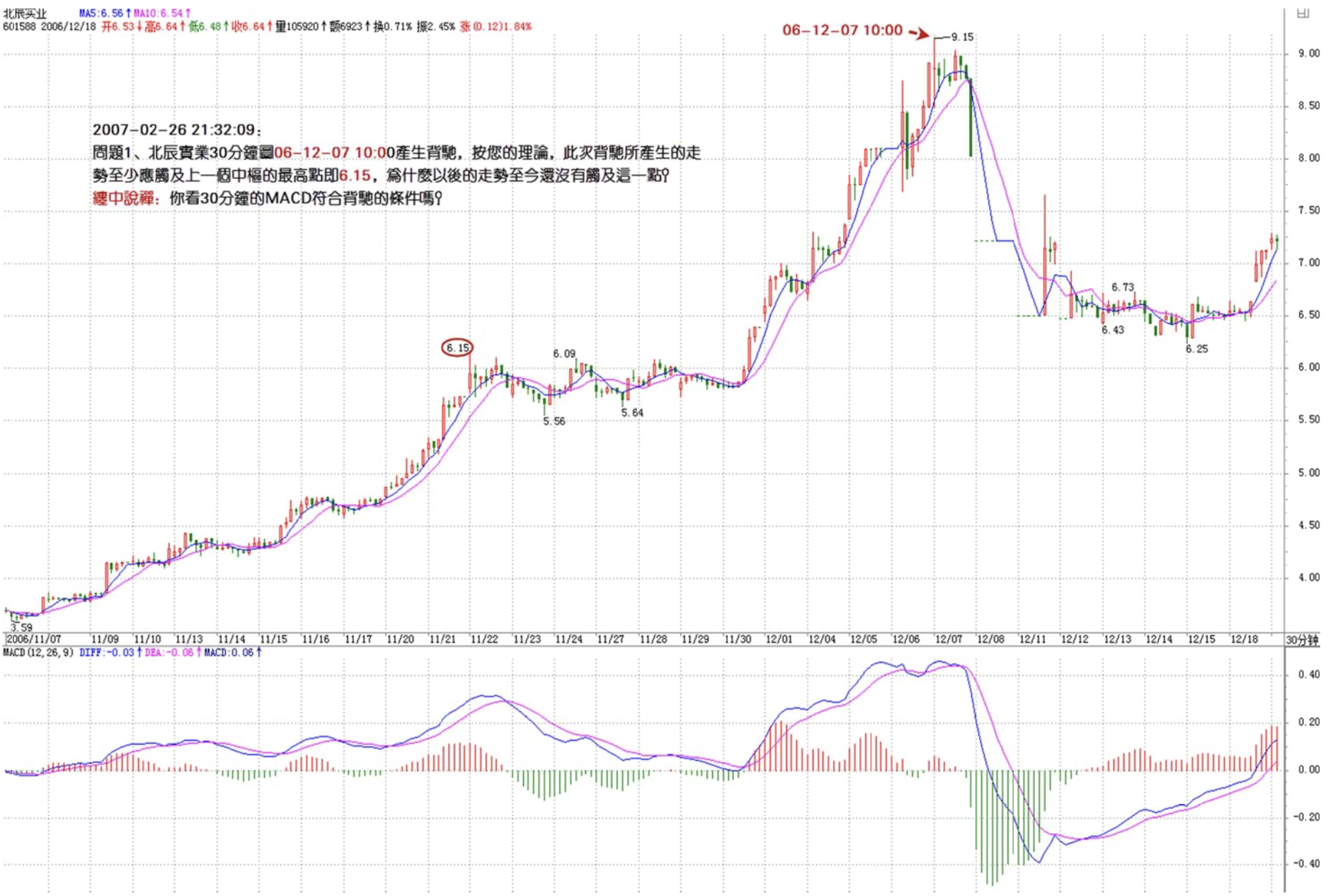
-
How do you determine the beginning and end of a consolidation? For example, after an uptrend is complete, the corresponding subsequent trend must be consolidation or decline. So when a hub forms, how do I determine if it's a consolidation or the first hub of a downtrend — should I wait and see? Also, trends can be judged to end via divergence — what marks the end of a consolidation?
==
Why do third buy points and third sell points exist? Have you thought through this? -
In an uptrend, the hub is down-up-down; in a downtrend, it's up-down-up. So what is a consolidation hub?
==
How can you still be asking this kind of question? How is a consolidation hub different from a trend hub? A hub is a hub — there's no such thing as consolidation hubs versus trend hubs. You can say "a hub that arose within a trend," but you cannot say "a hub that arose within consolidation" — having a hub is what makes consolidation possible in the first place. -
It seems from your meaning that we shouldn't predict the direction of a trend, but rather wait for it to complete before making a judgment. Does that mean it's impossible to determine in advance whether something is an uptrend or downtrend? Then why do we say this bull market is an uptrend? Why couldn't it be a consolidation — forming one hub and then ending? In that case, what significance does "all trends must be complete" have — isn't it just classic hindsight?
==
Another confused concept. "All trends must be complete" has nothing to do with guaranteeing rises or consolidation. "All trends must be complete" is equivalent to saying hubs must inevitably form. First get the concepts straight. No level can possibly never form a hub — that's what "all trends must be complete" means. -
Could you point out the daily-level hubs from the 998-point bottom of 2005 onward?
==
These were shown in earlier articles.
- After so many theoretical lessons and careful study, I can understand a bit in theory. But now I find my biggest problem is being unable to accurately identify hubs — this is truly life-threatening. Could you dedicate a lesson to specifically teaching how to identify hubs — take a chart and walk through the steps for identifying hubs, including key points like candlestick patterns? Thank you!
==
Identifying hubs is like reading characters from a picture — anything that meets the hub definition is a hub. It's that simple. First get the definition clear.
缠中说禅 2007/2/26 21:59:21
[Anonymous] 竹影
2007-02-26 21:47:46
After reading your articles, may I ask: among the 1000+ stocks on both exchanges, many don't exhibit the classic patterns described in your theory. So when selecting stocks, should we unhesitatingly exclude those that don't fit the classic patterns of your theory — even if their fundamentals are excellent? Thank you.
==
There is no stock whose trend doesn't conform to this ID's theory. If you can't even understand that, then you haven't studied it clearly. Start with the hub concept and study well — once you understand it, looking at any chart will be like reading the lines on your own palm.
缠中说禅 2007/2/26 22:02:31
[Anonymous] 天山飞狐
2007-02-26 21:47:54
Master Chan, is my understanding correct? That is, the three sub-level trend segments constituting a hub — whether down-up-down or up-down-up — on the sub-level chart, each up or down segment is an independent and complete trend, not a consolidation? So on the sub-level chart, each up or down segment should contain at least two hubs of that level?
==
First get the most fundamental concepts straight. What is a trend type? Isn't consolidation a trend type?
缠中说禅 2007/2/26 22:11:34
I notice many people haven't even grasped the most basic concepts.
Trend types: trend (uptrend, downtrend), consolidation.
The hub is the most primitive concept. "All trends must be complete" refers to the inevitability of hub formation — there is no level at which a hub can never form. Any trend will ultimately form some trend type, or a superposition of them. Any market's price action can necessarily be decomposed into a superposition of same-level trend types. The only difference between trend and consolidation is that the former must contain two or more hubs of the corresponding level, while the latter can only contain one.
These are all the most basic concepts. If you can't even sort these out, there's no way to continue studying further.
Keep at it, everyone. This ID's theory is a purely mathematical theory — literary types like that Kong guy might find it a bit difficult, but it's really not that hard. Just put in a bit more effort.
It's too late, signing off, see you again.
缠中说禅 2007/2/27 16:06:44
I'm a psychopath, quite seriously ill at that.
缠中说禅 2007/2/26 15:52:01
Hello everyone, happy belated New Year.