The Market Only Climaxes Amid a Trail of Chicken Feathers
2007/8/23 16:08:01
A market rally without third-tier stocks participating is forever incomplete. The market only climaxes amid a trail of chicken feathers everywhere—a climax without third-tier stocks strewn like chicken feathers all over the ground has never been seen by this ID, at least not in China's uniquely characteristic market. The principle here is simple: investors cultivated in a culture that adores mass movements—a culture where even talent shows can go full "Super Girl" and "Super Boy" with chicken feathers flying everywhere—how could stocks be any different? How else would one live up to the four Chinese characters "broad and profound"?
The heat in this pot is rising on schedule, and third-tier chicken feathers are starting to roll all over the ground. This is only the beginning. The retail investors abandoned by first-tier large-caps and high-priced stocks are just now starting to prance around with joy. The essence of humanity is Dionysian—the Dionysian revelry in human nature can always triumph over the cruelty of the sun. Revelry always belongs to the masses. Moutai and Wuliangye might be too exclusive for the masses, but Erguotou and Laobaigan—those are what truly ignite the wildness in people's hearts. Thus, the stock market's climax always belongs to Laobaigan.
Someone asks, why haven't you mentioned today's historic moment of breaking through 5,000 points? What's 5,000 points? Didn't this ID tell you all the script for the stock market's 20-year trajectory first thing this morning? In that script, 5,000 points doesn't even warrant a single line of dialogue—what's there to talk about?
From a purely technical standpoint, once the 1/2 line is broken, you look at the 2/3 line, then the 3/4 line. But for now, let's first watch the 2/3 line. Judging from how the market broke through the previous lines, it didn't just touch and turn back, but rather oscillated around them. Since the distance between the 2/3 and 3/4 lines isn't large, the oscillation magnitude at these two lines won't likely be the same. Generally speaking, if it's a small-scale oscillation at the 2/3 line, then the 3/4 line will see a larger one. Therefore, how the market develops around the 2/3 line has certain significance for future market development. How to calculate the 2/3 line? 1429 + 183 × 30 × 2/3 = 5089. For the 3/4 line, just change the 2/3 to 3/4. Of course, when calculating next month, 183 needs to become 184, and so on.
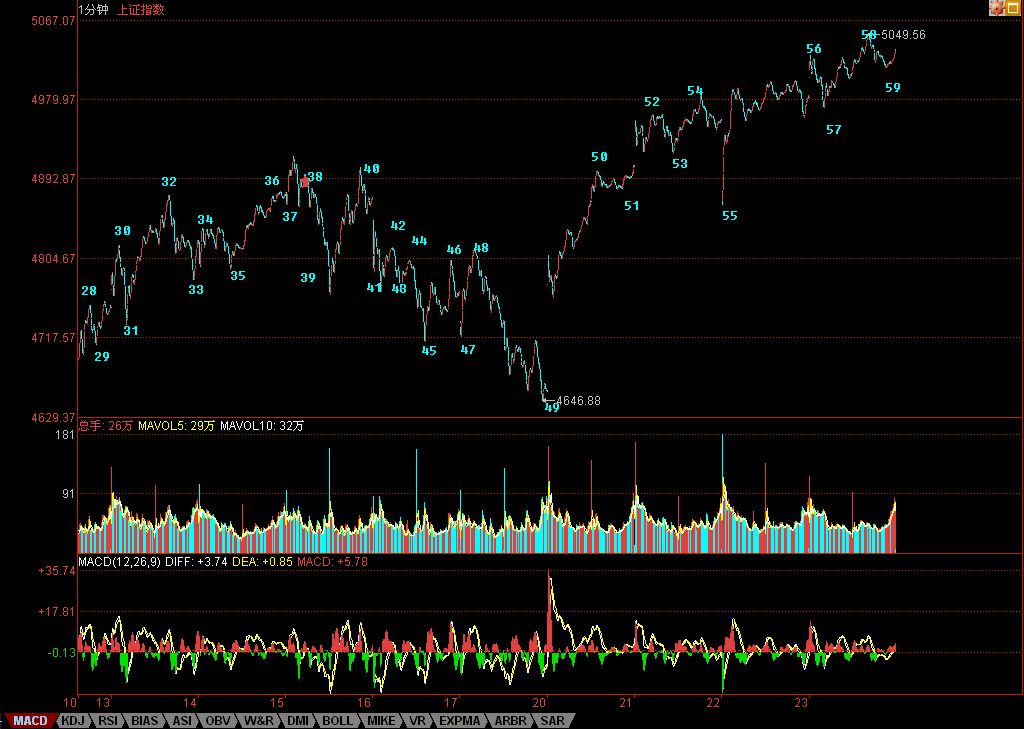
On short-term technicals, yesterday's segment 56 couldn't achieve the 100% confirmation condition, and today that scenario materialized. What does this mean? This ID's theory is geometry—without a precise mathematical attitude, you can't get it right. Anyone with a prediction fetish is far from the gates of true technical analysis. In today's chart, yesterday's segment 56 position needs to be adjusted based on this situation. Note, it's not that this ID's classification can be changed arbitrarily, but rather because yesterday's movement didn't 100% satisfy this ID's classification criteria—it was only a temporary mark. For example, today's segment 59 has the same issue: marking 59 there doesn't mean segment 59 is complete, because the criteria for segment 59 being 100% broken have not yet been met. But segment 58 and everything before it are all uniquely determined and cannot be altered. Why? Because they met the criteria—it's that simple. On this issue, one is one and two is two, with no room for ambiguity whatsoever.
On individual stocks, let me give you all a technical criterion for judgment. Currently, individual stocks on the daily chart fall into three categories: first, those that have broken above their May 30th high; second, those that haven't broken the May 30th high but have broken above the first rebound high after May 30th; third, those where even the first rebound high after May 30th hasn't been broken.
Generally speaking, for stocks in the first category, watch for those that have just broken out and are pulling back for confirmation before launching again—these stocks carry the risk of a false breakout. For the second category, these are the most eager to perform, but beware of a series of shakeouts after they break through the May 30th high. For the third category, these most easily attract capital that missed the rally, but the only downside is that since capital is newly arriving, if the market maker likes to push down to accumulate, you'll be tortured for a while; of course, if it's a market maker who likes to push aggressively higher, then congratulations. Actually, this isn't hard to judge—the key is to look at the pullback position after the first volume surge.
Yesterday I mentioned that this ID prefers third-tier stocks transforming into first-tier ones. Regular people truly can't hold onto such stocks. This ID's portfolio contains many of them, but I doubt anyone can truly hold from the very bottom for years like this ID does. Future first-tier stocks must at least be "Zhong-prefix" companies or even world-class corporations. To transform from third-tier to first-tier, there are only two paths: first, growing on their own into a "Zhong-prefix" or world-class company; second, having a "Zhong-prefix" or world-class company fully move in.
Something came up, heading out first. Goodbye.