Coming Here, First Reform Yourself!
2007/1/31 15:13:30
Everyone has opinions, especially about things like the stock market. But coming here, you must first reform yourself! Otherwise don't come — coming would be pointless! If after coming here you still chase highs and panic sell, refusing to buy at buy points and sell at sell points, then don't come. The world is vast — why bother coming here? Today's big drop was nothing more than the result of yesterday's 5-minute divergence. According to this ID's theory, couldn't you have escaped? Then if you re-enter at the 5-minute or other buy points, can't you avoid all the declines? For practitioners of this ID's theory, declines are a joyful thing — because before the decline, you've already left, because declines always come after sell points!
As for those who won't buy at 6 yuan but love to buy at 12 yuan — fine. Didn't someone say they could hit the daily limit in 15 minutes? Never mind the daily limit — going from limit-down to limit-up takes 10 minutes, tops. But first, all those who love panic-selling must be killed off! A 5-million-share wall means what? A 150-point drop in the index means what? Good — this ID is no Lei Feng. This ID operates purely based on technicals and necessity. The PLA has already done its part. If anyone still wants to spout nonsense going forward, they can continue, but those of you who want to talk real skill should stop listening to the nonsense and stop doing stupid things like not buying at 6 yuan only to buy at 12! As for those black-hearted folks hoping for another limit-down tomorrow — stop daydreaming. Don't think you're something just because you picked up a little surface knowledge. You've got a long way to go.
Everything above is sleep talk. Any resemblance to reality is purely coincidental and has nothing to do with this ID. This ID bears no legal responsibility whatsoever.
Left in a rush this afternoon, adding a supplement. It's necessary to repeat some principles that have been stated many times before.
-
The money in your hands must be capital that can stay in the stock market long-term and stably. There absolutely cannot be any borrowing involved. This is critical — this ID has seen too many people killed by the non-long-term nature of their capital. Stories for another time.
-
Levels must be viewed in combination. It's best not to do purely short-term trading. Any stock you enter should ideally be at least at a daily-level buy point, and definitely not far from the bottom — this is especially important for beginners. Short-term trading is for bringing down your cost basis and ensuring the safety of your holdings. Except during one-sided daily uptrends, short-term trading must be insisted upon. But position size can be controlled — for example, use 1/3 of your capital. After gradually developing good habits, you can be more flexible.
-
If your judgment isn't accurate, selling at the wrong sell point doesn't matter — with so many stocks out there, are you afraid of not finding good ones? But buy points must be approached cautiously. Better to end up with fewer shares than to chase highs to buy back in. In practice, being unskilled at the start is not surprising — this kind of thing improves only through constant practice.
-
When initially entering with a medium-to-long-term mindset, try to reference the fundamentals. Don't pick terrible stocks. For short-term trading, you don't need to care much about this — just look at the technicals.
-
Don't develop a dependency mentality. Only what becomes part of you through your own practice is real.
-
A single bad habit can destroy everything. After every trade, you must constantly review and gradually improve.
-
If you chose a stock with a cautious medium-to-long-term mindset, then don't casually cut your losses. This ID is against stop-losses and cutting losses — money lost is truly lost. But as long as you hold the shares, continuous short-term trading is enough to bring down the cost. Can cutting losses guarantee you'll buy something better? Especially when the medium-to-long-term outlook is still positive, there's even less reason.
-
Selling first and buying back later can also make money. Don't only think about buying first and selling later.
-
Stocks are all waste paper. What you want isn't any stock — it's to extract blood through stocks!
-
Fear and greed both stem from ignorance of the market.
Replies
缠中说禅 2007/1/31 15:26:51
[Anonymous] 新年好
2007-01-31 15:25:01
Sister Chan, I can't see the divergence in 999's rally today? I almost sold it — good thing I wasn't that impulsive. Can you explain?
==
Large capital operations have their characteristics. Don't try to learn too much at once — first learn what you're supposed to learn.
缠中说禅 2007/1/31 15:30:27
[Anonymous] salmon
2007-01-31 15:27:53
Blog host, for office workers like us who don't have time to watch the market, how do we grasp short-term buy and sell points? Can we only do daily-level short-term? I always feel larger levels lag behind the market too much!!
===
The daily level is indeed slower to respond, but the effect is the same — it's still a matter of buy and sell points.
缠中说禅 2007/1/31 15:31:22
Attention everyone
This ID has to go to a certain neighborhood office. Will be back tonight.
Heading out now.
Goodbye.
缠中说禅 2007/1/31 21:17:34
Attention everyone
It's necessary to repeat some principles that have been stated many times before.
-
The money in your hands must be capital that can stay in the stock market long-term and stably. There absolutely cannot be any borrowing involved. This is critical — this ID has seen too many people killed by the non-long-term nature of their capital. Stories for another time.
-
Levels must be viewed in combination. It's best not to do purely short-term trading. Any stock you enter should ideally be at least at a daily-level buy point, and definitely not far from the bottom — this is especially important for beginners. Short-term trading is for bringing down your cost basis and ensuring the safety of your holdings. Except during one-sided daily uptrends, short-term trading must be insisted upon. But position size can be controlled — for example, use 1/3 of your capital. After gradually developing good habits, you can be more flexible.
-
If your judgment isn't accurate, selling at the wrong sell point doesn't matter — with so many stocks out there, are you afraid of not finding good ones? But buy points must be approached cautiously. Better to end up with fewer shares than to chase highs to buy back in. In practice, being unskilled at the start is not surprising — this kind of thing improves only through constant practice.
-
When initially entering with a medium-to-long-term mindset, try to reference the fundamentals. Don't pick terrible stocks. For short-term trading, you don't need to care much about this — just look at the technicals.
-
Don't develop a dependency mentality. Only what becomes part of you through your own practice is real.
-
A single bad habit can destroy everything. After every trade, you must constantly review and gradually improve.
-
If you chose a stock with a cautious medium-to-long-term mindset, then don't casually cut your losses. This ID is against stop-losses and cutting losses — money lost is truly lost. But as long as you hold the shares, continuous short-term trading is enough to bring down the cost. Can cutting losses guarantee you'll buy something better? Especially when the medium-to-long-term outlook is still positive, there's even less reason.
-
Selling first and buying back later can also make money. Don't only think about buying first and selling later.
缠中说禅 2007/1/31 21:30:28
[Anonymous] Star
Chiho-Tiande (600497)
2007-01-31 21:20:04
LZ, are you back? I have many questions from studying. Please help:
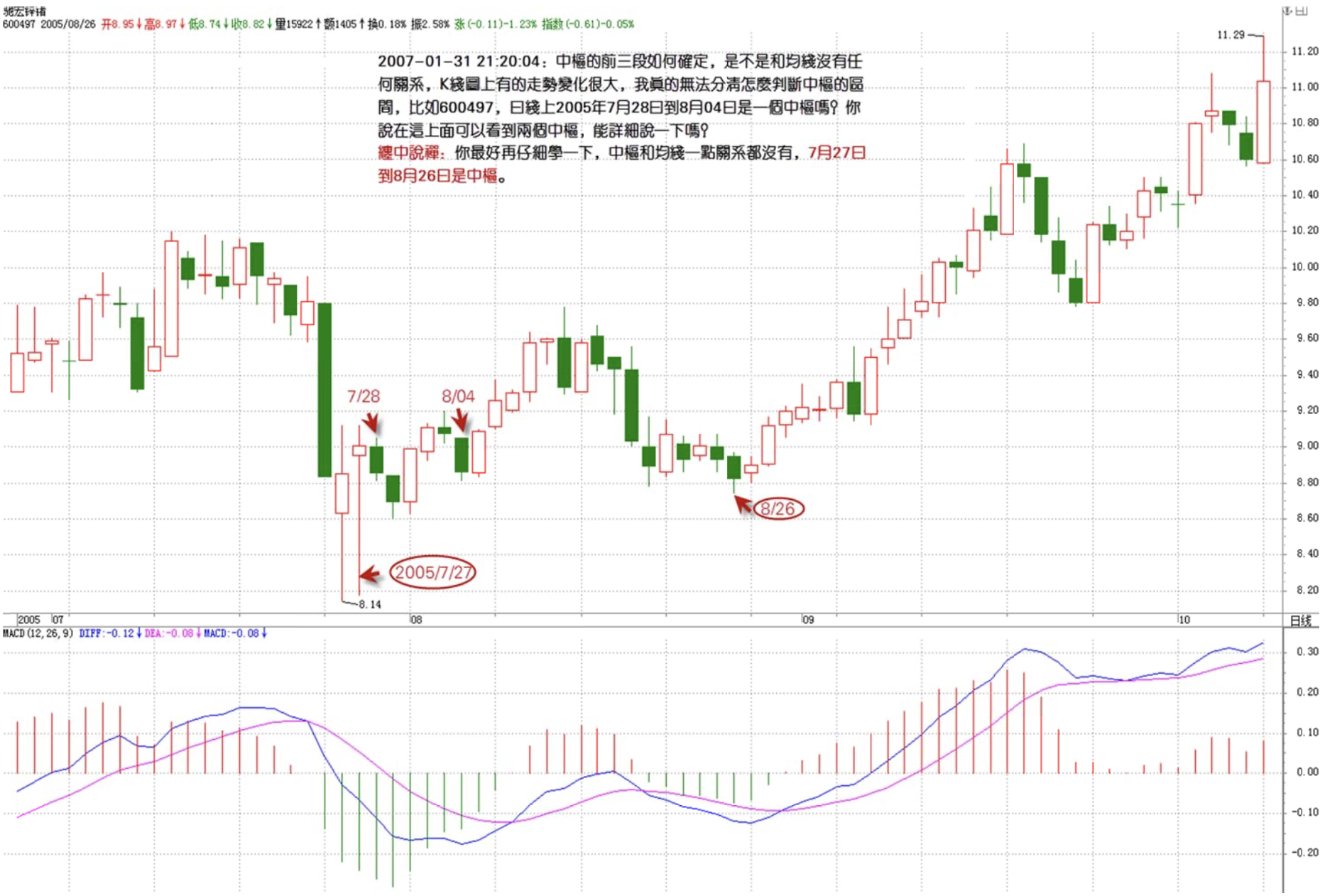
- How are the first three segments of a hub determined? Do they have nothing to do with moving averages? On K-line charts, some movements change dramatically and I really can't tell how to determine a hub's range. For example, 600497 — on the daily chart, is 2005.7.28 to 8.04 a hub? You said two hubs can be seen here. Can you explain in detail?
===
You'd better study more carefully. Hubs have absolutely nothing to do with moving averages. 7/27 to 8/26 is the hub.
Shanghai Composite Index (1A0001)
- What's the specific difference between a consolidation hub and a trend hub at the same level? LZ said a consolidation hub is one level larger than a trend hub. Could you give an example? Is a consolidation at one level the same as a hub at a higher level?
I hope LZ can answer. I think many classmates are also stuck here. Our comprehension isn't great, but we want to learn LZ's theory.
===
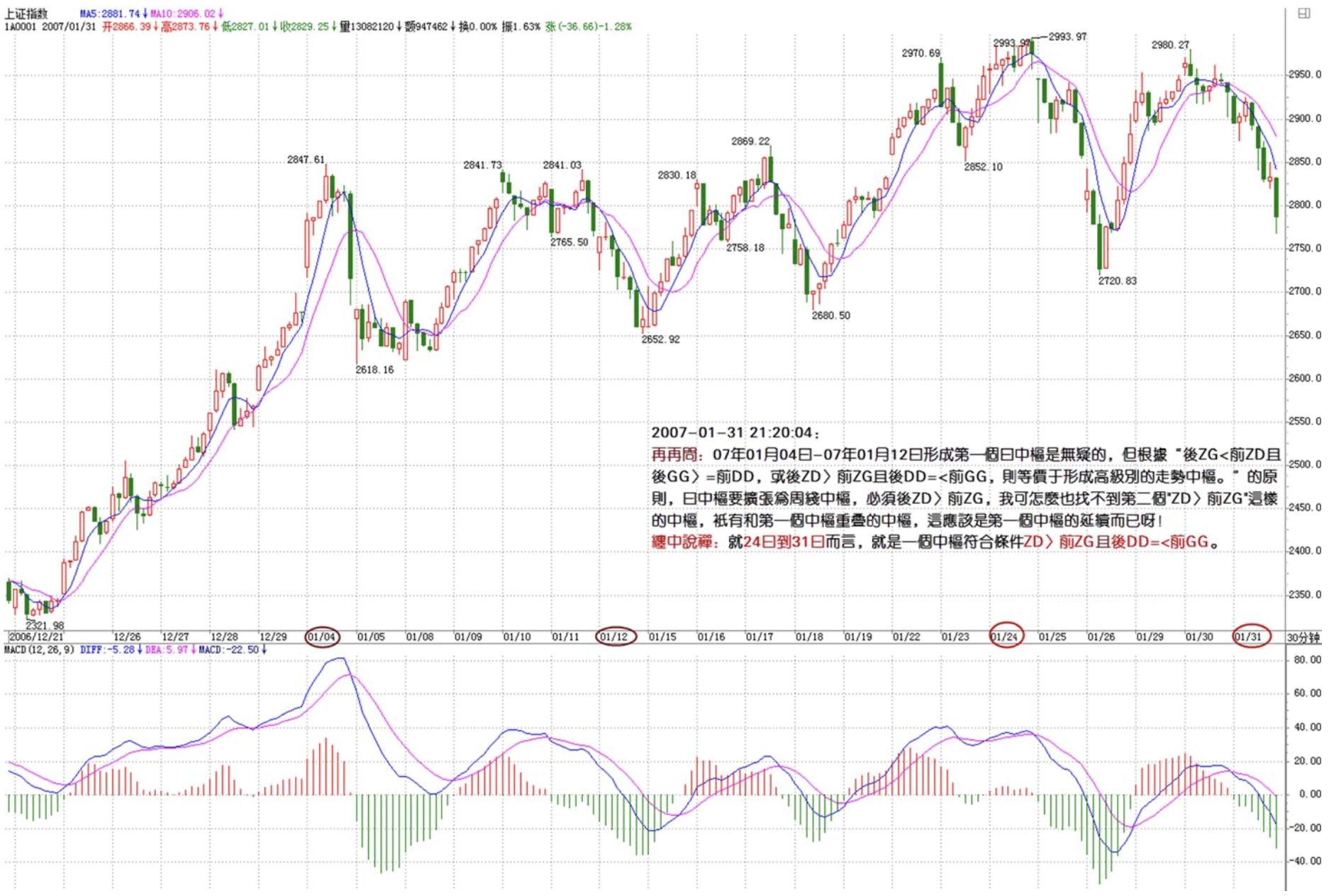
The Shanghai index is the best example. From August through the end of last year, the trend hubs were at most 30-minute level. From the start of this year through now, first a daily hub formed, then it expanded into a weekly hub — the difference between these is too obvious.
Follow-up question: (Shanghai Composite Index) 07.01.04-07.01.12 forms the first daily hub without doubt. But according to the principle "if subsequent ZG < previous ZD and subsequent GG >= previous DD, or subsequent ZD > previous ZG and subsequent DD <= previous GG, then it's equivalent to forming a higher-level hub" — for a daily hub to expand into a weekly hub, it requires subsequent ZD > previous ZG. But I can't find a second hub meeting "ZD > previous ZG" — only hubs overlapping with the first hub, which should just be an extension of the first hub! Can someone explain???
===
Just from the 24th to the 31st, there is a hub that meets the condition ZD > previous ZG and subsequent DD <= previous GG.
缠中说禅 2007/1/31 21:31:50
[Anonymous] 晕晕乎乎
2007-01-31 21:28:46
I'm dizzy! I can read classical Chinese, but how come I can't understand the blog host's "hub" and "divergence" theory? I truly can't understand!
===
Look at it as geometry and you'll understand. It's a mathematical theory. All theorems can be rigorously proven.
缠中说禅 2007/1/31 21:40:56
[Anonymous] 手中无股
2007-01-31 21:37:05
Every word is a gem of truth! Studying hard! Experience comes from practice. May I ask LZ — have you ever gone bankrupt trading futures or stocks?
==
As long as it's the market, nobody can ever make this ID go bankrupt. But in China, the greatest risk often isn't from the market itself. That's why everything this ID says is sleep talk, bearing no legal responsibility whatsoever.
缠中说禅 2007/1/31 21:43:46
[Anonymous] 赚到了
2007-01-31 21:38:50
Sister Chan is here! I propose we send her 999 roses — what do you say?
All in favor, upvote!
===
Don't develop a dependency mentality. Any stock is just waste paper. This ID merely bought back what was sold at highs — nothing more. The moment a sell point appears, this ID will dump any stock harder than anyone.
Stocks are all waste paper. What you want isn't any stock — it's to extract blood through stocks!
缠中说禅 2007/1/31 21:46:51
Attention everyone
Add this to the eight items above as the most important ninth principle:
Stocks are all waste paper. What you want isn't any stock — it's to extract blood through stocks!
缠中说禅 2007/1/31 21:48:37
[Anonymous] 巴索林
2007-01-31 21:45:22
LZ, following your advice I entered the military sector. 600316 clearly had a third-type buy point on January 26, but now it's tanked. What should I do?
===
Have you ever seen a third-type buy point without preceding first and second-type buy points? Get the concepts straight first.
缠中说禅 2007/1/31 21:52:16
[Anonymous] 麒麟
2007-01-31 21:41:05
LZ: looking at your recent posts, it feels like the market is doomed. I was planning on medium-to-long-term — should I exit?
==
A weekly-level hub is precisely the best time for swing trading. I suggest you first study the theory. If you can't even figure out what the market is doing, there's no way to play.
Fear and greed both stem from ignorance of the market.
This can serve as the tenth statement — perfection in ten.
缠中说禅 2007/1/31 21:55:15
[Anonymous] Star
2007-01-31 21:48:24
LZ, is this how to identify the third buy point:
For example, on the daily chart, when a 30-minute trend goes up and then pulls back, you use the 5-minute to determine whether the 30-minute pullback trend is complete. If complete but hasn't fallen into the previous daily hub's high point (or is it the GG point??), that counts as a third buy point??? Is determining whether the 30-minute trend is complete based on whether there's 5-minute divergence? Also, after entering at the third buy point, when do you sell??? Sometimes the MACD histogram height shrinks or area decreases, but the fast/slow lines haven't made a new high (low) — is that divergence???
===
MACD is merely auxiliary. The third-type buy point builds upon the first and second-type buy points. Unless it's an IPO with no first-type buy point, but the second-type definitely exists.
缠中说禅 2007/1/31 21:59:06
[Anonymous] YY
2007-01-31 18:45:19
[Anonymous] 背驰
2007-01-31 18:39:03
Today at noon the market showed divergence, but it didn't matter. Many stocks showed 5-minute divergence too, but those didn't matter either. I know the market is bad, but I believe in technical analysis. Maybe nothing is absolute? I don't know what went wrong????????????????????
-------------
There's no single principle in the world that works for everything. If there were, wouldn't it be too simple? I now feel Buffett's saying is quite apt: "Precise errors, imprecise accuracy." In the stock market, there's no theory or experience that's 100% accurate. A vague, approximate grasp actually ends up being more accurate.
Please advise, Sister Chan.
===
If you have doubts about the 100% nature of this ID's theory, it's like doubting plane geometry. In most cases, it's because you haven't understood it clearly. Only by studying this ID's theory with the mindset of learning geometry can you truly understand it.
缠中说禅 2007/1/31 22:04:36
[Anonymous] 猫猫
2007-01-31 21:58:29
Dear blog host, I have a question that I can't figure out
According to the Chan Theory Trend Level Continuation Theorem One: Before a higher-level hub forms, the current level's trend type will continue.
So a trend type reversal at a given level means hub expansion has already occurred?
But when discussing the second-type buy point, the probability of hub expansion is very small when the second buy point is above the hub. Wouldn't that mean a trend reversal can occur without hub expansion?
Trend extension means no reversal. Trend reversal depends on hub expansion; whether trend extension is over depends on whether a new hub forms? I'm confused...
Blog host, please help explain. I'm stuck in a dead end...
===
Hub expansion and trend reversal have no necessary connection. Don't mix unrelated things together. Only divergence has a necessary connection with trend reversal.
Hongdu Aviation (600316)
缠中说禅 2007/1/31 22:14:51
[Anonymous] 巴索林
2007-01-31 22:00:39
[Anonymous] 巴索林
2007-01-31 21:45:22
LZ, following your advice I entered the military sector. 600316 clearly had a third-type buy point on January 26, but now it's tanked. What should I do?
===
Have you ever seen a third-type buy point without preceding first and second-type buy points? Get the concepts straight first.
=====
So is this stock no longer worth holding? Should I switch?
===
Why didn't you research the fundamentals before buying? From a trend perspective, if you have ample time, the cost can be brought down through short-term trading, and then it gains value. Do you think this ID buys stocks randomly?
Fine. This ID won't avoid suspicion either — let me tell you why this ID bought 600343. Because based on research, its 2007 earnings will reach 1 yuan per share, and there will be major moves in the aerospace sector, along with some other things not worth mentioning. Otherwise, on what basis would this ID buy it?
Of course, with this ID's skills, any stock this ID buys can be ground down to negative cost. But why not pick a better one to work with? You can't say that just because all gigolos are men, every man should be taken on, right?
Select stocks with a medium-to-long-term mindset, then use pure technicals for short-term trading to turn the cost negative — that's how you remain forever undefeated.

缠中说禅 2007/1/31 22:18:31
[Anonymous] 满目山河
2007-01-31 22:14:08
Sister Chan, did you see my suggestion?
Without a comprehensive grasp of the theory, it's easy to get stuck in dead ends. Many classmates here are in exactly that situation.
===
I didn't see it. Where?
缠中说禅 2007/1/31 22:23:14
[Anonymous] 也许认识你
2007-01-31 22:15:52
Blog host, the more I study your theory, the more I admire it. It's corrected many analysis and operation problems — mostly operational ones.
I only have one question.
For smooth operations: enter at buy points, exit at sell points.
But if during the process there's a sudden sharp drop — a very deep one, very fast fall well below moving averages — should I wait for moving average entanglement, or wait for an uptrend to form a hub before acting? Rather than selling first?
I know this situation doesn't happen often. Could you explain?
===
First understand MACD — it's more efficient than moving averages. Once divergence appears, you can buy, or rather, buy back. The quantity relates to the level. If capital is large and operations aren't proficient, you can use a larger level, such as 30-minute. Generally, from a pure short-term perspective, unless it's a particularly prolonged decline, 5-minute divergence is sufficient for small capital to generate operable profit between buy and sell.
缠中说禅 2007/1/31 22:27:05
[Anonymous] 听缠说禅
2007-01-31 22:22:28
LZ, isn't it 151's turn? It hit the limit-down today.
==
Technique has nothing to do with whether it hits limit-down. Sell points always come before limit-downs. And after limit-downs, buy points are still buy points — that's enough. The key is your own operation.
Huamao Shares (000850)
缠中说禅 2007/1/31 22:33:27
[Anonymous] 孜
2007-01-31 22:26:38
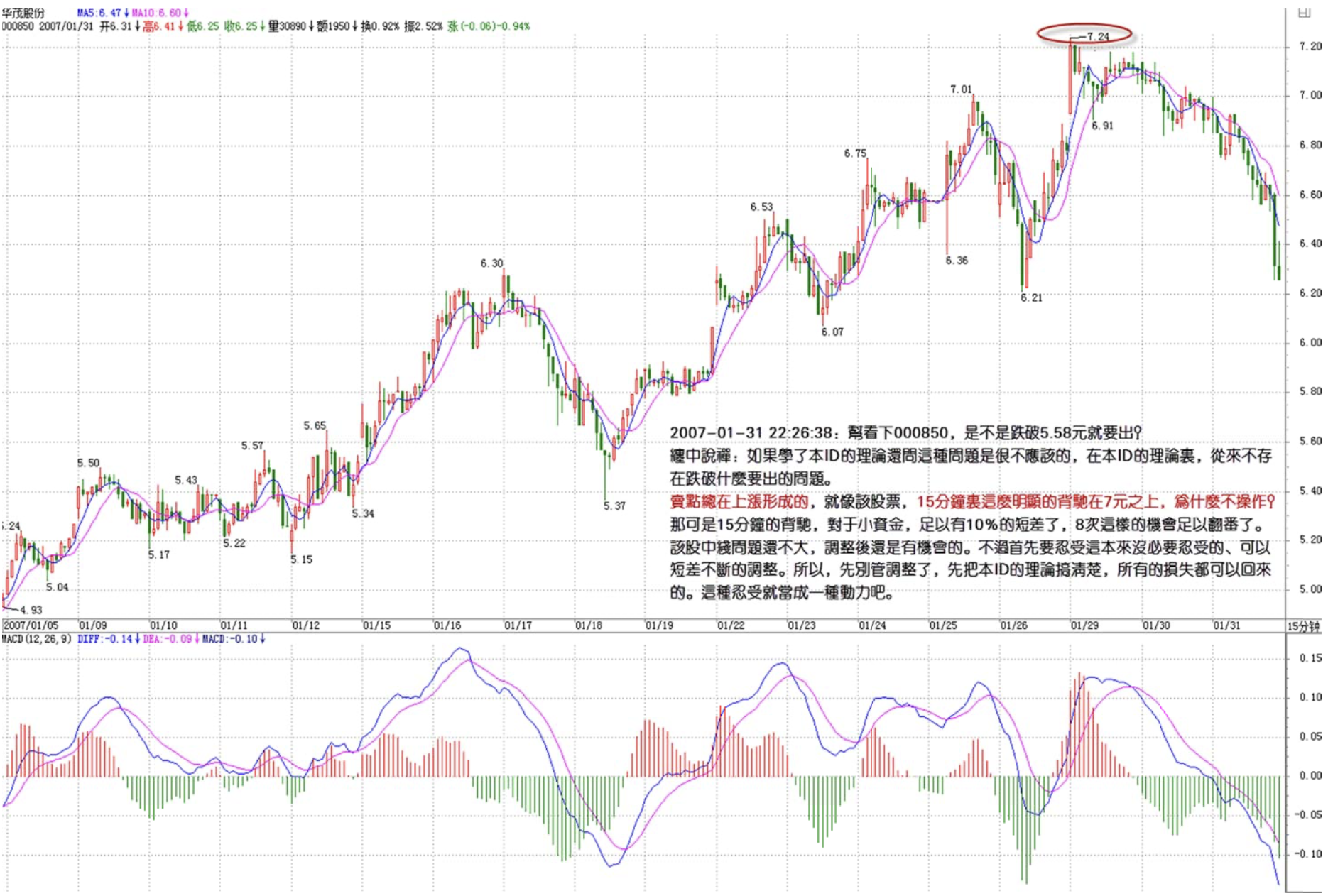
Hello Sister Chan, please look at 000850. Should I sell if it breaks below 5.58 yuan? Thanks.
===
If you've studied this ID's theory and still ask this kind of question, that's really not acceptable. In this ID's theory, there is never a case of "it breaks below X so you must sell." Sell points are always formed during rallies. Take this stock — on the 15-minute chart, there was such an obvious divergence above 7 yuan. Why didn't you act? That was a 15-minute divergence. For small capital, that's easily a 10% swing trade. Eight such opportunities would be enough to double your money. This stock's medium-term outlook isn't a big problem — there'll still be chances after the correction. But first you have to endure this correction that was completely unnecessary to endure, where continuous swing trading could have been done instead.
So stop worrying about the correction — first understand this ID's theory thoroughly. All losses can be recovered. Consider this endurance as motivation.
缠中说禅 2007/1/31 22:40:53
[Anonymous] 微微果二
2007-01-31 22:33:44
I started late — only began studying the blog host's technical analysis last night. Tried it out a little this afternoon. Using the 5-minute chart, I bought Liuhua Shares at 14.32 yuan at 14:33 and Minsheng Bank at 12 yuan at 14:37 for short-term trades. Blog host, did I pick the right buy points? I've just finished reading the chapter on "kisses."
==
When just starting out, it's best to write down the reason for each buy and sell. If it's a technical short-term trade, note what level it was based on and why. You must write it down for comparison.
Therefore, even if you bought right and there's profit tomorrow — if you say you bought based on the 5-minute chart, then making money is still wrong, because there was no buy point on the 5-minute chart. Whether there was one on the 1-minute is a separate matter.
The key isn't making money — it's not making money in a confused way. You must make money with clarity. So keep working hard.
缠中说禅 2007/1/31 22:44:13
[Anonymous] 满目山河
2007-01-31 22:25:04
[Anonymous] 满目山河
2007-01-30 19:28:05
Sister Chan, I suggest speeding up the stock learning content.
I estimate there's still a lot of material on hubs, plus volume and such.
So far, even after studying, there are still aspects hard to grasp. Once I actually trade, problems pop up everywhere. I think the later content might address these.
If I had an overview of Sister Chan's full theory before studying, the learning might be more effective. It's like reading a book — glancing at the preface and chapter titles helps a lot. That's just how I am, haha.
-----
Yesterday's comment.
===
The problem right now isn't that. It's that many people haven't grasped even the earlier material. And what's been covered so far is actually sufficient for regular operations — the key is to practice more. What comes later is about improving precision, and I'll write it as soon as I can. But everyone also needs to study faster. Stop asking what a hub is every day.
缠中说禅 2007/1/31 22:44:33
It's too late tonight. Heading out now, goodbye.
缠中说禅 2007/1/31 15:24:33
Today the market's movement was completely natural, and with the interest rate hike scare layered on top, it was even more dramatic. But that's nothing — the key is that your operations are sound. That's what matters. Stop asking "what do I do" only after it drops. Where were you when the sell point appeared? Don't look down on short-term trading — only those without the skill to do it look down on it. If you've got the skill, why wouldn't you do it? Master the technique — stocks are all waste paper, but this ID's theory can turn waste paper into gold.
The weekly-level hub oscillation of the index wasn't first mentioned today either, so swings up and down are perfectly normal. Following short-term divergence can find excellent buy and sell points. For skilled traders, a ranging market is the best for making money. Even if you can't do it yet, study hard.
Nothing more to say — mindset first. Reform yourself!