Detailed Analysis of "The Analects": For All Those Who Misinterpret Confucius (52)
2007/2/12 15:13:58
子曰:温故而知新,可以为师矣。
Yang Bojun: Confucius said: "When reviewing old knowledge and gaining new insights and discoveries, one can become a teacher."
Qian Mu: The Master said: "One who can gain new understanding from reviewing old knowledge may serve as a teacher."
Li Zehou: Confucius said: "Review the past to know the future — thus one can be a teacher."
Detailed explanation: This chapter is probably known to virtually every Chinese person, yet all conventional interpretations, like the three above, are wildly off the mark. Following the conventional interpretation, if everyone could "review the old and know the new," wouldn't everyone become a teacher? And wouldn't those with no foundation at all, who overturn things merely for the sake of overturning, become the greatest teachers of all? "Review the past to know the future" qualifies one to be a teacher — then who can guarantee that "reviewing the past" will necessarily lead to "knowing the future"? What god's Cold War makes the past necessarily map onto the future, old knowledge necessarily generate new knowledge?
In fact, "可以" is not a single compound word as in modern Chinese, but "可" + "以." "温故而知新" is fronted for emphasis; the full sentence is equivalent to "可以温故而知新为师矣." "可" means "should/ought to." "师" should not be narrowly understood as necessarily being a specific person — all objects and goals of learning and emulation are "师." "温" is a phonetic loan for "蕴" — to accumulate, to contain. "故" means the established — here referring to wisdom that has been sedimented and tested by time. "知" is the original character for "智" — wisdom. "新" means fresh, living creation and manifestation. "温故而知新" — to accumulate and store established wisdom that has been sedimented and tested by time, while maintaining wisdom's fresh, living creation and manifestation in the present moment.
"由知、德者,鲜矣!" — the junzi who tread and practice the wisdom and attainment of "seeing, hearing, learning, and practicing" the "Way of the Sage" exist in perpetual innovation and creation. "故" is the wisdom attained through treading and practicing "seeing, hearing, learning, and practicing" the "Way of the Sage." To "温" this attainment is a kind of accumulation and storage. Without "reviewing the old" (温故), there can be no innovation and creation of wisdom, no "由知、德者,鲜矣!" And "knowing the new" (知新) — if that "new" cannot "review the old," it cannot achieve truly living wisdom. Without accumulation and storage, there is no wisdom to speak of. This mutually reinforcing "reviewing the old" and "knowing the new" — this is what "seeing, hearing, learning, and practicing" the "Way of the Sage" can take as a "teacher" (为师).
Confucius and Confucianism absolutely do not cling to antiquity. To model the ancients and to love the ancients is to model their wisdom and love their wisdom. And wisdom must be able to be vitally applied and renewed in the present moment to be true wisdom. Otherwise, treating "reviewing the old" as rummaging through old texts for principles and guidelines to frame and predict the future can only be foolish action. "Reviewing old knowledge to open up new knowledge" can only be one pathway for expanding knowledge — it is by no means the only one, and certainly cannot serve as a "teacher." No matter how the "old knowledge" of an ape-man is "reviewed," it cannot open up the "new knowledge" of the internet age. But wisdom transcends all of this. Whether "new knowledge" or "old knowledge," neither can do without wisdom's living creation and manifestation in the present moment — this is what can truly serve as a "teacher."
Chán Zhōng Shuō Chán's Vernacular Direct Translation
子曰:温故而知新,可以为师矣。
Confucius said: One should take "accumulating and storing established wisdom that has been sedimented and tested by time, while maintaining wisdom's fresh, living creation and manifestation in the present moment" as the model and goal that the junzi emulates in "seeing, hearing, learning, and practicing" the "Way of the Sage."
(To be continued)
Plagiarism is strictly prohibited; violators will be prosecuted.
Replies
缠中说禅 2007/2/12 15:20:08
[Anonymous] 资本黑客
2007-02-12 15:16:20
First, I declare: I am not a mole sent by institutions and market makers. If needed, I am willing to defend the blogger's right to free expression.
I merely wish to explore a theoretical matter. No need for others to worry — it won't affect the accuracy of the blogger's theory, and even if there were any impact, it would be something decades away, a result of market laws operating on their own.
Having accidentally come across your serial "Casual Discussion on Foundational Problems in Modern Mathematics" on the internet, I deeply admire your profound understanding of mathematics and bookmarked your blog. Recently, your "Teaching You to Trade Stocks" has entered its climax (perhaps it's still just a small climax), and my own thinking has risen with it. Frankly, my level of understanding of the blogger's theory may still be at the infant stage, so I dare not question the theory itself. But as I've been exposed to various market theories, I've been pondering a question: what would happen if every market participant deeply believed in, mastered, and traded according to a certain theory? Here I'd like to cite a few passages as a counter-argument, and frankly, also as a sideways response to your challenge to all the world's men.
"Rules, once discovered, inevitably fail — Hart's theorem and reflexivity theory"
In social science there is also a Hart's theorem. It is...
==
What you raise is not a single problem. Tomorrow's post happens to address a similar issue — see tomorrow's post.
缠中说禅 2007/2/12 15:30:11
Little Muddled Little Dance
2007-02-12 15:16:05
Hello OP! A question about the Analects: regarding "有教无类." This section was written very briefly. The key explanation was about "教," while "无类" means "not attaching to appearances." If so, can't we just delete "有"? If "有" takes its original meaning (opposite of "无"), how should it be interpreted? If used as a particle (meaningless), doesn't deleting it make no difference? If it means the phonetic loan for "友" (friend) as in "有朋自远方来," then "有教无类" seems to express a different meaning: people who are like-minded in "hearing, seeing, learning, and practicing" the "Way of the Sage" — the "teaching" (reverting to its original meaning) between them should not be approached with "appearances." They share the same purpose, and though their paths differ, they converge, all ultimately wanting to flow into the sea. If interpreted this way, it seems consistent with and connected to the later explanation of "the junzi is harmonious but not identical"? Thanks.
==
What about teaching the non-friends? In truth, there's fundamentally no such thing as different paths inevitably converging at the same destination. Nowadays they talk about "five religions unified as one" — that's just mixing everything into mush. The Analects doesn't mix mush.
缠中说禅 2007/2/12 15:39:26
[Anonymous] 新手
2007-02-12 15:25:43
Star
2007-02-12 15:17:41
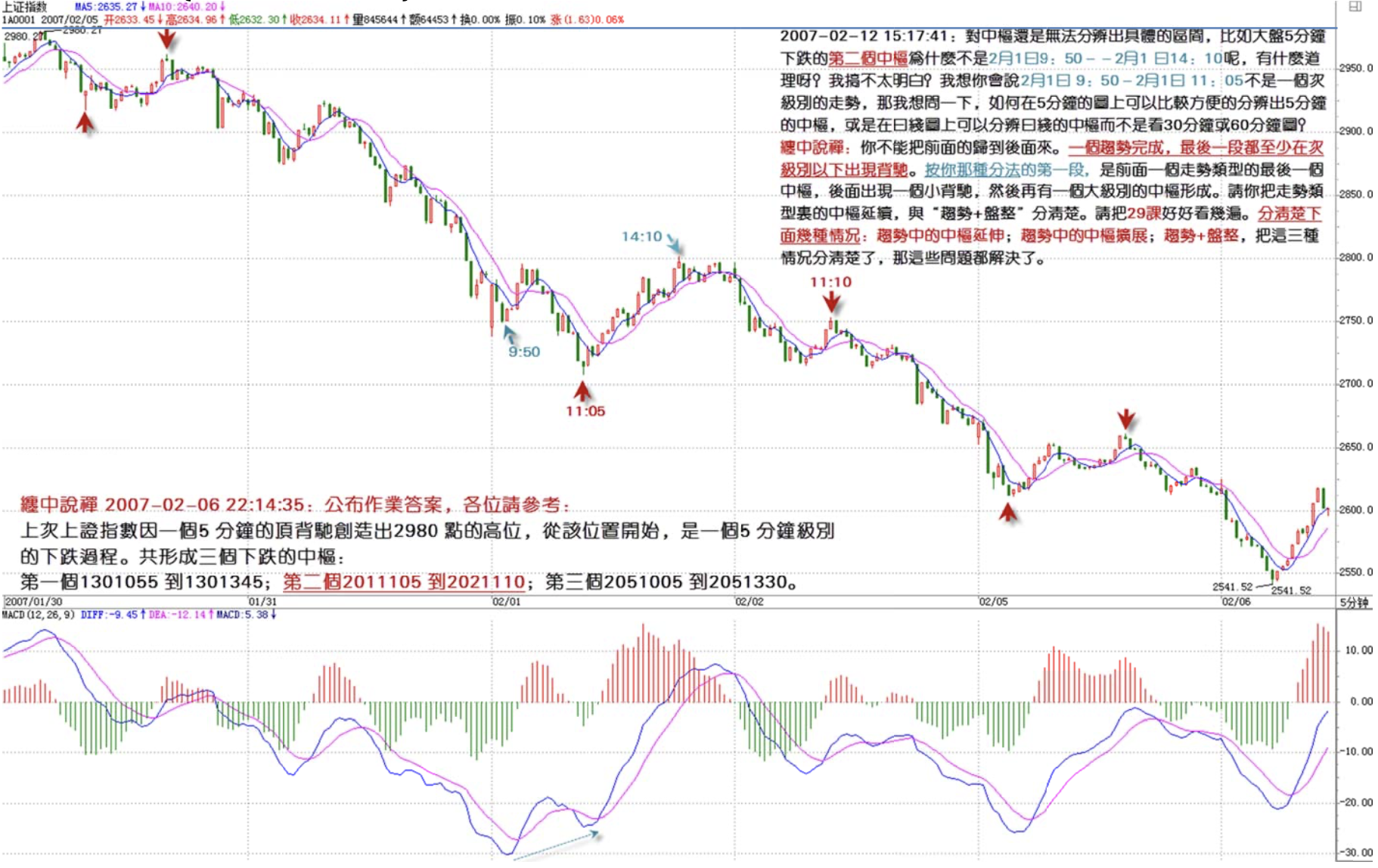
OP, I still can't identify the specific range of hubs. For example, why isn't the second hub of the market's 5-minute downtrend from 2/1 09:50–2/1 14:10? What's the reasoning? I can't figure it out. I expect you'll say 2/1 09:50–2/1 11:05 isn't a sub-level movement, so I want to ask: how can one conveniently identify a 5-minute hub on a 5-minute chart, or a daily hub on a daily chart without looking at 30-minute or 60-minute charts? Thanks!!!
Eagerly awaiting OP's response — this has troubled me for a long time.
===========
I'm also very confused about this. Hope OP can answer.
==
You can't attribute the preceding part to what follows. When a trend completes, the final segment must at least show divergence at a sub-level or below. The first segment in your division is the last hub of the preceding movement type. After that comes a small divergence, then a larger-level hub forms.
Please distinguish the following within movement types: hub continuation versus "trend + consolidation."
缠中说禅 2007/2/12 15:44:20
[Anonymous] mmhh
2007-02-12 15:35:31
The market has clear 1-minute divergence — why is it still rising? Could Chan MM please explain? Thanks!
==
When the 30-minute is in an obvious breakout phase, a 1-minute divergence just creates an intraday oscillation to resolve itself — just like this afternoon. I've repeatedly emphasized: you must look from large levels to small levels, using the nested interval method. 1-minute divergence exerts great power only when it's within a divergence segment of a larger level. If the larger level is at a second-type buy point beginning its initial rise, or even in a main rising segment — how meaningful is looking at small-level divergence? Even if you sold, you'd have to immediately find a position to buy back. Otherwise, if everyone just looked at 1-minute divergence, wouldn't that be chaos?
This ID's theory is applied systematically and comprehensively across all levels — not by looking at just one level. Please get this clear.
缠中说禅 2007/2/12 15:47:14
Little Muddled Little Dance
2007-02-12 15:37:54
Chán Zhōng Shuō Chán
2007-02-12 15:30:11
Little Muddled Little Dance
2007-02-12 15:16:05
Hello OP! A question about the Analects: regarding "有教无类..."
==
What about teaching the non-friends? In truth, there's fundamentally no such thing as different paths inevitably converging at the same destination. Nowadays they talk about "five religions unified as one" — that's just mixing everything into mush. The Analects doesn't mix mush.
---------
Thanks for the reply... but in the Analects detailed explanation, only 2 types of people are distinguished: people who "do not understand" and people who "hear, see, learn, and practice" the "Way of the Sage." From this angle, can't we separate "friends" and "non-friends"?
==
There is only one kind of person. The junzi comes from the xiaoren, transforms from the xiaoren. Without the xiaoren, where would the junzi come from? A true junzi has no so-called appearance of a junzi. The junzi "does not attach to appearances, does not conform" — if one still holds onto the appearance of being a junzi, that's a hypocrite. "Friends" and "non-friends" have their positions without being worried about.
缠中说禅 2007/2/12 15:49:24
[Anonymous] 在路上
2007-02-12 15:44:09
Hello Chan sis!!!
=
Hello.
缠中说禅 2007/2/12 15:51:46
[Anonymous] 温柔的股客
2007-02-12 15:43:32
2007-02-12 15:17:41
OP, I still can't identify the specific range of hubs. For example, why isn't the second hub of the market's 5-minute downtrend from 2/1 09:50–2/1 14:10? ... I'm still confused... Usually I just look for up-down-up along the downtrend for hubs, but how many K-bars each segment should have really confuses me. Please clarify, Chan sis.
==
Please read lesson 29 carefully several times. Distinguish the following situations:
Hub continuation within a trend
Hub expansion within a trend
Trend + consolidation
Once you separate these three situations clearly, all these problems are solved.
Generally speaking, the more complex hub patterns are triangles or rectangles — this will be covered later.
缠中说禅 2007/2/12 15:52:57
Dubai
2007-02-12 15:49:03
cjj:
Good afternoon!
Thank you for your tireless work every day. On behalf of all Chan fans, thank you!
==
No need — when there's time, I say a few more words; when there isn't, I don't. No need for courtesy.
缠中说禅 2007/2/12 15:57:21
[Anonymous] Xiao Ming
2007-02-12 15:19:03
Chan mm, is the sensitive period for the broader market over? Can individual stocks launch a wave now?
==
Second and third-tier stocks aren't very sensitive to the broader market. As long as the market doesn't plunge, there will be opportunities. In the short term, large-caps will probe upward somewhat, but the current approach to 3000 is all exploratory in nature. If nothing special happens, it'll just pass through. If someone pops up to make trouble again, there'll be another wash. The market is like that. Second and third-tier individual stock movements are relatively independent.
缠中说禅 2007/2/12 16:00:32
Star
2007-02-12 15:55:13
OP said to look from big to small, but your reply seems to go from small to big. How should I understand this? My question is simply: is there a straightforward way to identify hubs at the current level on the current level's chart, without looking at the next lower level?
==
This problem doesn't exist. You can judge it at that very moment. There are standard definitions regarding hub extension given earlier — whether a hub extends or expands has standard mathematical formulas. Find them yourself. You can judge by looking at the chart in the moment.
Looking at divergence at the current level — of course you can do that without looking at other levels. But how much impact that divergence has depends on conditions at other levels. These are two different kinds of questions — please get them straight.
缠中说禅 2007/2/12 16:01:12
[Anonymous] 乐土
2007-02-12 15:57:05
May Chan MM always be happy and beautiful!
==
Thank you.
缠中说禅 2007/2/12 16:07:02
[Anonymous] 温柔的股客
2007-02-12 15:43:32
... also confused. Usually I just look for up-down-up along the downtrend for hubs, but how many K-bars each segment should have really confuses me. Please clarify, Chan sis.
==
How has this gone back to such an elementary question? The hub has nothing to do with how many K-bars — unless it's the lowest level. Since it can't be defined using the next lower level, the lowest level can be defined as the overlapping area of three consecutive K-bars.
For those decent at math, you'll know the hub is actually a classic recursion:
That is, the lowest level A0=?, An+1=F(An). Understand this mathematical formula and you'll understand the definition of hubs at each level.
缠中说禅 2007/2/12 16:12:08
[Anonymous] 乐土
2007-02-12 16:07:00
Chan M:
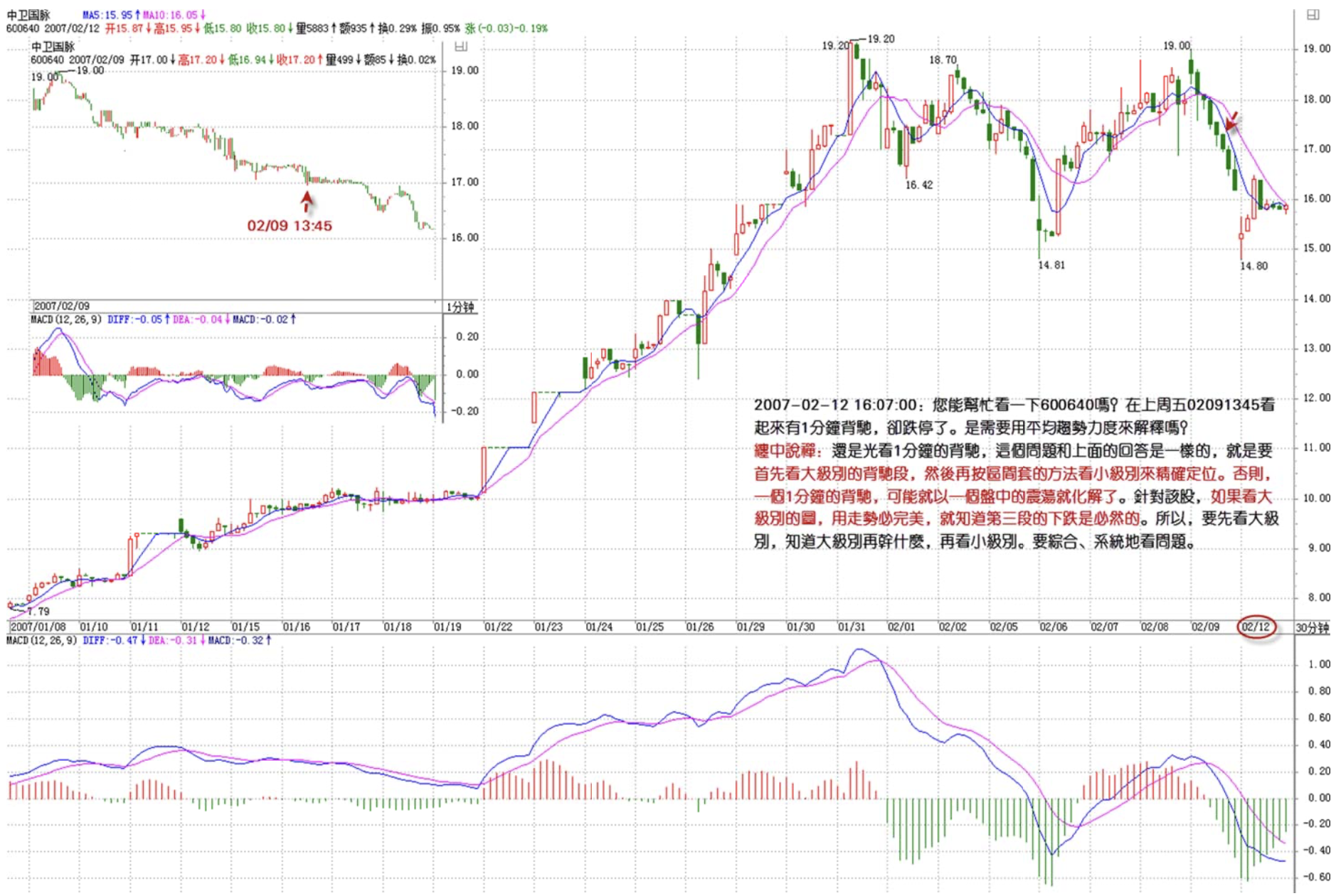
Could you help look at 600640? On 02/09 at 13:45 there appeared to be a 1-minute divergence, yet it hit limit-down. Does this need to be explained using average trend momentum? Thanks.
==
Again, just looking at 1-minute divergence — this is the same answer as above. You must first look at the divergence segment of the larger level, then use the nested interval method at the smaller level for precise positioning. Otherwise, a 1-minute divergence might just be resolved by a single intraday oscillation. For this stock, if you look at the larger-level chart and use "trend completeness is inevitable," you'll know the third-segment decline is inevitable. So — look at the big level first, understand what the big level is doing, then look at the smaller level. Look at things comprehensively and systematically.
缠中说禅 2007/2/12 16:14:33
[Anonymous] 戈石
2007-02-12 16:07:34
Your Majesty:
Your Unicom moved very strongly today. Last night, studying Chan Theory, my mind wandered: Your Majesty battling in Unicom must be a clash of titans. Having heard the "stay away from drugs" warning, as a small retail investor, I'd better step aside and cheer Your Majesty from the sidelines. I'll keep monitoring the 30-minute hub breakout. Wishing you success.
==
Stocks are drugs on weekends — because the market is closed and you still can't let go, so of course it's drugs. When the market is open, stocks are just stocks. Whatever should happen, happens. The chart decides everything.
缠中说禅 2007/2/12 16:22:39
[Anonymous] asdf
2007-02-12 16:14:19
Please, Your Majesty, resolve my doubts:
==============================================
I'm confused about your theory. In a trend a-A-b-B-c, if segment c diverges, why must it rise into B? I know that if it doesn't rise into B, the decline forms a new hub. But doesn't a decline forming a new hub also constitute divergence? It feels somewhat like circular reasoning — using divergence to explain a rise into B, then using failure to rise into B to explain it's not divergence. Please resolve my doubts.
Also, what is the foundational basis of your investment theory system? Like mathematics, there's a set of axioms. From the beginning of reading your articles, I've felt led into a framework of thinking based on a certain foundation. From my vantage point, your thought is indeed very rigorous. But I've always been unable to figure out what the foundation of this theory system is, and doubt always persists — because based on an incorrect foundation, one can also construct a logically rigorous system. Please resolve my confusion.
I suspect the foundation is empirical knowledge from a priori operations, but that's a paradox — using a practice-based foundation to prove theory, then using theory to guide practice.
=========================================
First question: clearly distinguish between hub expansion and extension. These two situations must absolutely not be confused. There are precise mathematical formulas given earlier — please find them and study carefully.
As for the divergence question: divergence necessarily leads to reversal — this can be rigorously proven. There's no circularity. Because of divergence, movement extension is impossible. It's that simple. As for why, and what the proof looks like — that can't be disclosed yet. The proof employs very advanced mathematical tools that ordinary people can't understand for now — they only need to know the conclusion.
Divergence also has a precise definition, but for ordinary people, the precise definition is also meaningless — it requires extensive knowledge from measure theory. Using MACD as a supplementary judgment is at least 95%+ accurate, more than good enough. For ordinary people, there's no need to further explore the specific definition.
缠中说禅 2007/2/12 16:31:52
[Anonymous] 袖手旁观
2007-02-12 16:18:11
A challenge on the details:
In chapter 49 of the Analects explanation, the mutual illumination of "learning without thinking" and "thinking without learning" is excellent; that difference and identity cannot be severed is also excellent.
But I don't quite agree that "learning takes difference as its premise and thinking takes identity as its premise." In my view, both learning and thinking simultaneously examine both difference and identity — or it can be understood as mutual illumination.
"Learning" ... "校对" (calibrating) — since it's "calibrating," there must be two aspects: verifying the identity and correcting the difference.
The premise of "thinking" lies in identity. — I think the process of "thinking" should simultaneously examine identity and difference of the object. Without difference, identity cannot be discussed either. For instance, Darwin's thought of evolution arose during classification of plant and animal specimens — classification necessarily examines both identity and difference simultaneously. For "thinking," identity and difference cannot be ranked by priority.
But the final paragraph's "learning takes thinking as its premise, thinking takes learning as its premise" seems to indirectly circle back?
==
The so-called premise here emphasizes the leaning/emphasis. Otherwise, if both said "takes difference and identity as premises," that's the same as saying nothing. The identity emphasis of "thinking" has its historical pedigree — from Descartes to Heidegger, all followed this path.
As for your Darwin example, the initial identity is the research subject. In determining what to study, there is already an identity premise — classification only comes later. The identity premise precedes all logic — that is the true identity premise.
缠中说禅 2007/2/12 16:34:41
[Anonymous] 勤学好问
2007-02-12 16:23:27
A weekend finance article said ultimately CR (China Resources) will win. I recall OP once said CR's price was too low — impossible. Has the situation changed?
==
State-owned Assets wants them to win. Apart from State-owned Assets, nobody else wants them. It's that simple. As for reporters — this ID has no interest in knowing about their activities.
缠中说禅 2007/2/12 16:42:55
[Anonymous] 墩子
2007-02-12 16:25:02
After carefully reading sis's articles and everyone's replies, I operated with more confidence today. Experimented with a few ST stocks — worked well.
Thank you sis!
==
Knowing how to buy isn't enough — you must also know how to sell. That's what makes it complete.
缠中说禅 2007/2/12 16:45:09
[Anonymous] Jill
2007-02-12 16:36:19
I recently started reading the blogger's theory. There's a basic point I'm not sure about yet, and I'd appreciate blogger's clarification:
<Regarding judging "divergence": first define a concept called "Chan Theory trend momentum" — the area formed between the short-term and long-term moving averages from the end of the previous "kiss" to the beginning of the next "kiss." When Chan Theory trend momentum in a later same-direction trend is weaker than the previous one, "divergence" is formed.>
Question: is the strength of trend momentum directly or inversely proportional to the area formed by moving average intersections? Should be directly proportional, right?
==
This can only be considered a rough definition. Generally, using MACD as a supplementary judgment is sufficient.
The precise definition of divergence and related proofs require extensive knowledge from measure theory. Ordinary people only need to accept the conclusion. Using MACD for judgment is more than sufficient.
缠中说禅 2007/2/12 16:48:47
Star
2007-02-12 16:41:47
OP, could you leave more homework on hubs, hub extension, expansion, consolidation, and the first, second, and third types of buy/sell points, then critique them? With a solid foundation, we can learn better.
==
There are precise mathematical formulas in the earlier posts. First, just understand the formulas. And I've already given many examples before — they're all there. Since new people keep joining, repeating these issues every time means the course will never finish.
The simplest method: analyze some individual stocks according to your understanding, and this ID will correct them. That might be more effective.
缠中说禅 2007/2/12 17:04:25
[Anonymous] 百思不解
2007-02-12 16:35:24
Question 1:
Trend + consolidation — is the consolidation's hub level higher than the trend's? (In that case, the consolidation can't be called a sub-level movement, right?) Is the third-type buy point after the consolidation ends, or at the end of the first sub-level movement within the consolidation? With trend + counter-trend combination, there's no such doubt.
==
In trend + consolidation, the consolidation's hub level is definitely higher than the hub level within the trend. Without a hub, where would a third-type buy point come from? The first sub-level movement forming the hub hasn't even formed the hub yet — how can you talk about that hub's third-type buy point?
Question 2:
Consolidation + counter-trend — is the consolidation's hub level the same as the counter-trend's?
=
Same as trend + consolidation.
Question 3:
Consolidation + consolidation — "if a sub-level consolidation type leaves the hub, the return naturally cannot also be a consolidation type, otherwise it would constitute a larger-level consolidation type, contradicting the premise of the original hub's maintenance." How to understand this? The [dn,gn] of two sub-level consolidation movements, whether either is the Z segment, both overlap with the hub range. How would this constitute a larger-level consolidation? Why isn't it hub continuation?
=
Note — the consolidation + consolidation discussed here is under the premise of a third-type buy point. The low of the latter consolidation won't fall back into the previous hub. In this case, no matter what follows, at least one [dn,gn] won't overlap with the hub — so it can't be an extension.
缠中说禅 2007/2/12 17:07:50
[Anonymous] 红欲然
2007-02-12 17:01:30
Sis, a question: suppose a stock rises from 4 to 6, forms a hub between 5 and 6, then rises to 7 and falls back to 6.5 where divergence appears at a sub-level. Does this mean a third-type sell point is formed?
==
That's a buy point. But note — third-type buy points work best after the first hub. If it's after the Nth hub in a trend, there's still profit, but it's unnecessary.
缠中说禅 2007/2/12 17:19:24
[Anonymous] 听缠释禅
2007-02-12 16:18:17
Many thanks to "Chan Lord" for the Feb 9 critique of He Xin that left me "deeply astonished." Someone who was once an advisor to rulers on political and economic matters and yet cannot enter "Chan Lord's" sight — if not for the many brilliant insights illuminated by the wise one in your ID, it would instead raise some questions.
I've often heard that a wise person who has studied traditional culture to the utmost must have delved into the deepest studies, such as the I Ching and destiny numerology — those esoteric arts. Because those things, like the stock market, are full of allure and wonder, and are challenges to the limits of human intellect. I'd very much like to hear Chan's interpretation of the word "destiny." Because sometimes I truly believe in the existence of something called "destiny." And I wonder how much human effort can truly achieve in the face of "destiny."
==
Discussing destiny within the six consciousnesses is the blind leading the blind. Human effort is itself a part of destiny — where is there any human effort that exists apart from destiny? If one truly wants to unravel the mystery of destiny, one must first illuminate one's mind and see one's nature. Otherwise, spinning within form, feeling, perception, volition, and consciousness — all is within destiny.
As for the question about He, this has nothing to do with what positions he's held. Here we only discuss his insight, not his status.
缠中说禅 2007/2/12 17:26:25
[Anonymous] 高位被套
2007-02-12 17:10:37
Could OP please help look at 600268 — any chance the ex-rights gap gets filled soon?
Thanks.
PS: Just recently started reading OP's theory on buy and sell points. Deeply touched. Had I read it sooner, I wouldn't have suffered such a big loss.
==
Filling the gap — that's setting your sights too low. Look at all the good stocks — which one hasn't surged dramatically after filling the gap? For specific operations, there's no need to predict anything. Just trade by the chart. The key is to set your operating level based on your capital — daily or 30-minute. For example, if it's daily, once the daily enters a divergence segment, use the nested interval method to locate the precise sell point. Otherwise, don't worry about it.
缠中说禅 2007/2/12 17:28:09
[Anonymous] 请教楼主
2007-02-12 17:23:00
OP, I'm studying your theory. Since I started late, many of the examples you used in earlier lessons can no longer be seen on the charts. Is there a solution? Please advise! Thanks.
==
Some 1-minute charts can indeed no longer be viewed. Actually, it's best not to look at charts at all — instead, study the mathematical formulas of the definitions carefully. Draw your own charts for understanding. If you understand the abstract definitions first and then look at charts, it'll be much more profound.
缠中说禅 2007/2/12 17:36:47
[Anonymous] 缠文观止
2007-02-12 17:21:16
Hello OP! A few questions about divergence — the previous answer resolved one, but several remain. I humbly ask OP to clarify:
-
If market makers deliberately create chart patterns using divergence, does divergence fail?
==
Divergence does not have a failure problem. As long as the two premises of this ID's theory exist, this conclusion won't change. Both premises will be discussed in tomorrow's post. -
First-type buy points mostly involve trend divergence, second and third-type mostly involve consolidation divergence. Are the second and third types still sub-level first-type buy points? They should be sub-level "quasi-first-type buy points," right?
==
There's a theorem about this given earlier. All buy points ultimately reduce to first-type buy points. To precisely find second and third types, you must go to the sub-level or below to find first-type ones. -
The original text states that using MACD to judge divergence requires two same-direction trend segments. Must the last two divergence segments of a large trend be trends? The two segments connecting before and after the last hub of a large trend can be sub-level or below movements — not necessarily trends. Is divergence still valid in this case?
==
Consolidation divergence doesn't necessarily require a trend — but otherwise, they must of course be trends. If it's just two segments oscillating before and after the hub, that's only consolidation divergence. These are two different situations. -
In an extended ascending large trend, suppose the two sub-level trend segments before and after the last hub don't diverge, but stock price produces consecutive limit-down due to bad news. In this scenario, divergence can't give advance signals, right? Without seeing divergence, how to operate?
=
For a real market, your hypothesis doesn't exist. In practice, even with the sudden real estate negative news this time, the final high was still under the control of the first-type sell point. In the real market, there are always those who know first. So-called bad news is always secondhand.
缠中说禅 2007/2/12 17:38:02
[Anonymous] 戈石
2007-02-12 17:35:21
Discussing with [Anonymous] 缠文观止:
Hello OP! A few questions about divergence...:
-
If market makers use divergence for fake signals, does divergence fail?
=====Fake signals can affect divergence judgment, but divergence itself is beyond worry. -
Are second/third-type buy points sub-level first types?
=====Your Majesty discussed this in detail before — check the earlier articles. -
Must trend divergence segments be trends?
======Your Majesty also discussed this in detail. Distinguish between divergence and consolidation divergence. -
If no divergence appears but bad news causes limit-down?
=======Asking this shows insufficient study of Chan Theory. No wall is leak-proof — the movement reflects news in advance.
==
Not bad — your answers are all correct. Thank you.
缠中说禅 2007/2/12 17:38:53
Sorry, signing off first. Goodbye. Will come back tonight if there's time.
缠中说禅 2007/2/12 15:15:26
Not a single surprise in the broader market. After the triangle, another wave. The pressure above 2850 was warned about long ago. This ID also very much wants to drive Unicom up to 5 yuan like herding ducks and push the market to 3000 so everyone can have a nice New Year — but the traitors aren't happy about that. Whether we'll see 3000 before the holiday is uncertain. Just watch. The key is still individual stocks. Actually, 3000 is just a psychological issue — not ours, but the traitors' and the regulators'. At worst, we'll go back and forth a few more times to cure those with psychological problems, then go above 3000. Hopefully, there'll be fewer people with psychological issues.
Nothing to say about individual stocks. Find your own food — you've learned so much, don't let it go to waste. As for what this ID has mentioned before, aside from one or two that rallied too much during the previous stage and need a wash, the rest are still fine. Just practice looking at charts. This ID can't say too much — being the athlete, referee, and commentator all at once is really no fun.