Detailed Explanation of The Analects: For All Those Who Misinterpret Confucius (40)
2006/12/13 11:56:24
The Master said: I am not one who was born knowing. I am one who loves antiquity and verifies and selects from it.
Yang Bojun: Confucius said: "I am not a person born with knowledge. I am one who loves ancient culture and diligently and swiftly seeks it."
Qian Mu: The Master said: "I was not born already knowing! I am one who is fond of antiquity and diligently seeks after it!"
Li Zehou: Confucius said: "I was not born with knowledge. I love antiquity and strive to seek it."
Detailed Explanation: This chapter follows completely from the previous one. The previous chapter discussed the question of wisdom and practice more from the perspective of humanity in general, while in this chapter, Confucius uses himself as an example to illustrate how a specific individual acquires wisdom. "生" means innate, a priori. "之" refers back to "生"; "知之" means to gain wisdom from it — to gain wisdom based on what is innate and a priori. "好古" means to love the legacies of ancient sages, the classical canons, and so forth. "敏" is a phonetic loan for "拇" (thumb), with the extended meaning of "to verify" or "to corroborate." To be "好古" cannot mean going merely from books to books — it must be verified through practice in reality. "求" means to select. "敏以求" means to verify and select.
For thousands of years, the image of Confucius has been intentionally or unintentionally distorted by countless pedantic Confucians and anti-Confucians. For thousands of years, the lie that Confucius was fixated on antiquity and wanted to restore the past has become "truth" in the mouths of both pedantic Confucians and anti-Confucians. Yet in The Analects, Confucius plainly expressed his view of "antiquity" using himself as an example — it is to "敏以求之," where "之" refers to "antiquity." One must verify and select from "antiquity" — this is Confucius's true attitude toward antiquity. In the previous chapter, Confucius already made clear that wisdom comes from practice. And in this chapter, Confucius further specifies that the legacies of ancient sages and classical canons must be verified and selected. Verification and selection are both inseparable from the practice of people in the present — only this way can one truly claim to be "好古" (fond of antiquity).
In this chapter, Confucius proposes three steps for learning from the knowledge and wisdom of predecessors: 好 (to appreciate), 敏 (to verify), and 求 (to select). First, the legacies and canons in which predecessors' knowledge and wisdom are crystallized must be respected, treated well, and then studied and researched — only then can one speak of 好 (appreciation). After respecting, treating well, studying, and researching — truly grasping them — one still needs to continue verifying them in practice. This is 敏 (verification). "敏" has two layers of meaning: first, predecessors' knowledge and wisdom all originated from the practice of their time, and as times change and conditions change, their application may become ineffective or need modification — this can only be discovered through verification in practice. Second, grasping predecessors' knowledge and wisdom — especially those insights that penetrate through time — requires slow experience and exploration in practice to discover the predecessors' true meaning. One absolutely cannot do what some people do with Confucius or Marx — claiming to represent them without having actually understood them. That kind of thing doesn't qualify as 好 (appreciation), let alone 敏 (verification). With verification, there is naturally a basis for selection. Selection is not mechanical picking; it doesn't use simple criteria like right or wrong to divide things. Rather, it organically develops and extends based on current practice — only this way does one neither fail the ancients nor fail oneself. Only this qualifies as 求 (selection).
Chán Zhōng Shuō Chán's Vernacular Translation
子曰:我非生而知之者,好古,敏以求之者也。
Confucius said: I am not a person who innately and a priori gains wisdom by depending on the innate and a priori. I am merely one who loves to study and research the legacies of ancient sages and classical canons, and who verifies and selects from them in practice.
(To be continued)
Plagiarism is strictly prohibited; violators will be prosecuted.
Replies
缠中说禅 2006/12/13 12:17:52
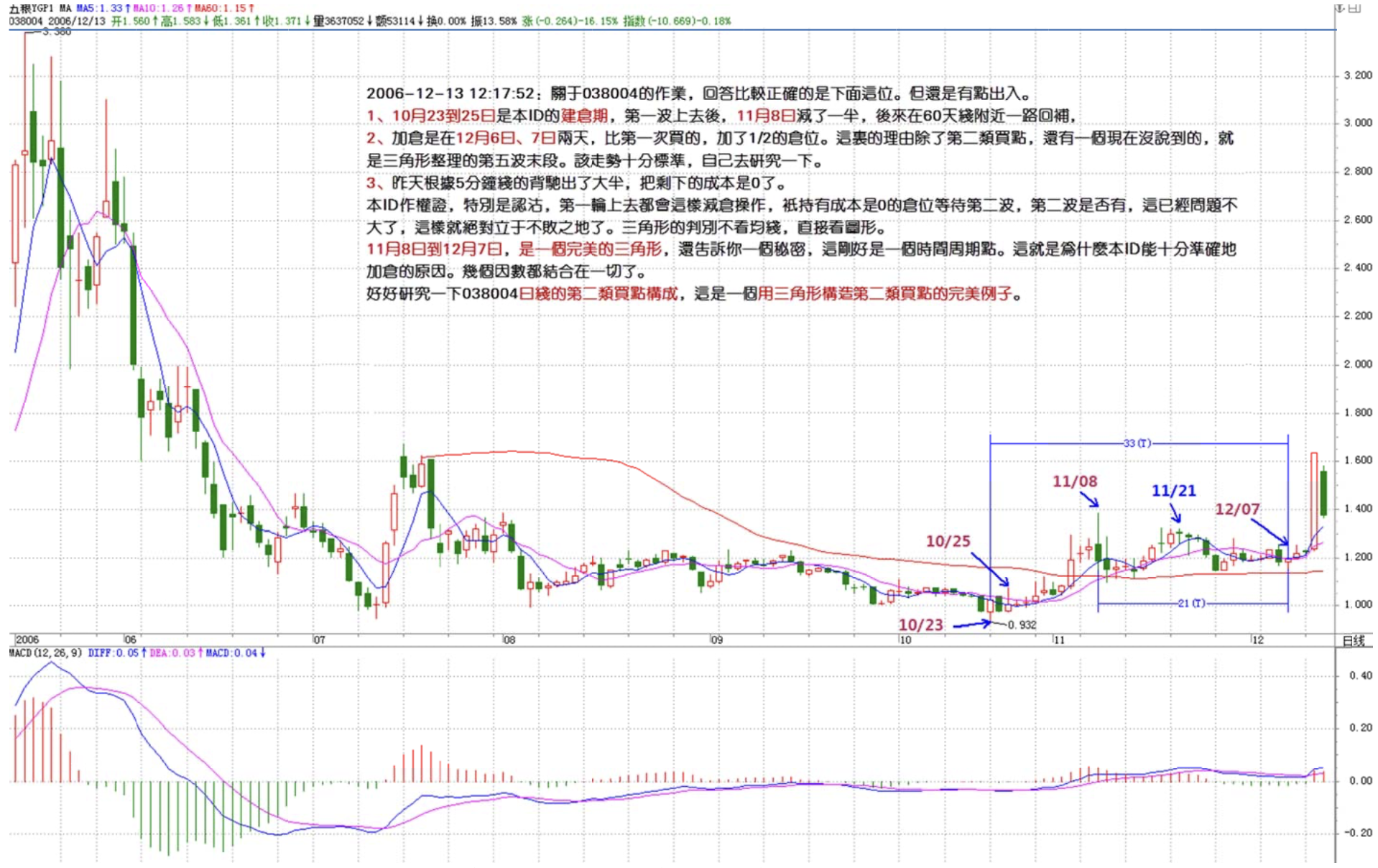
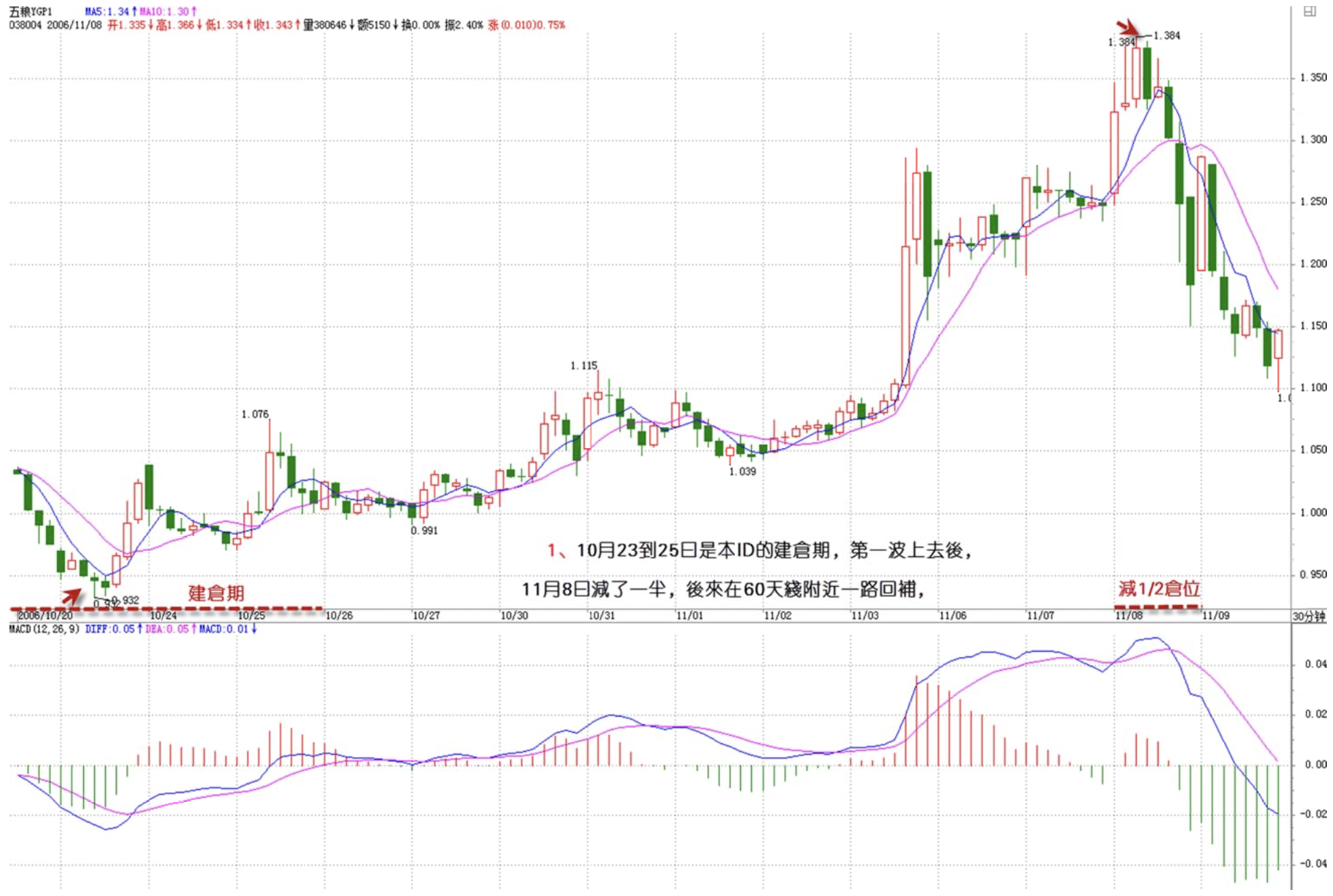
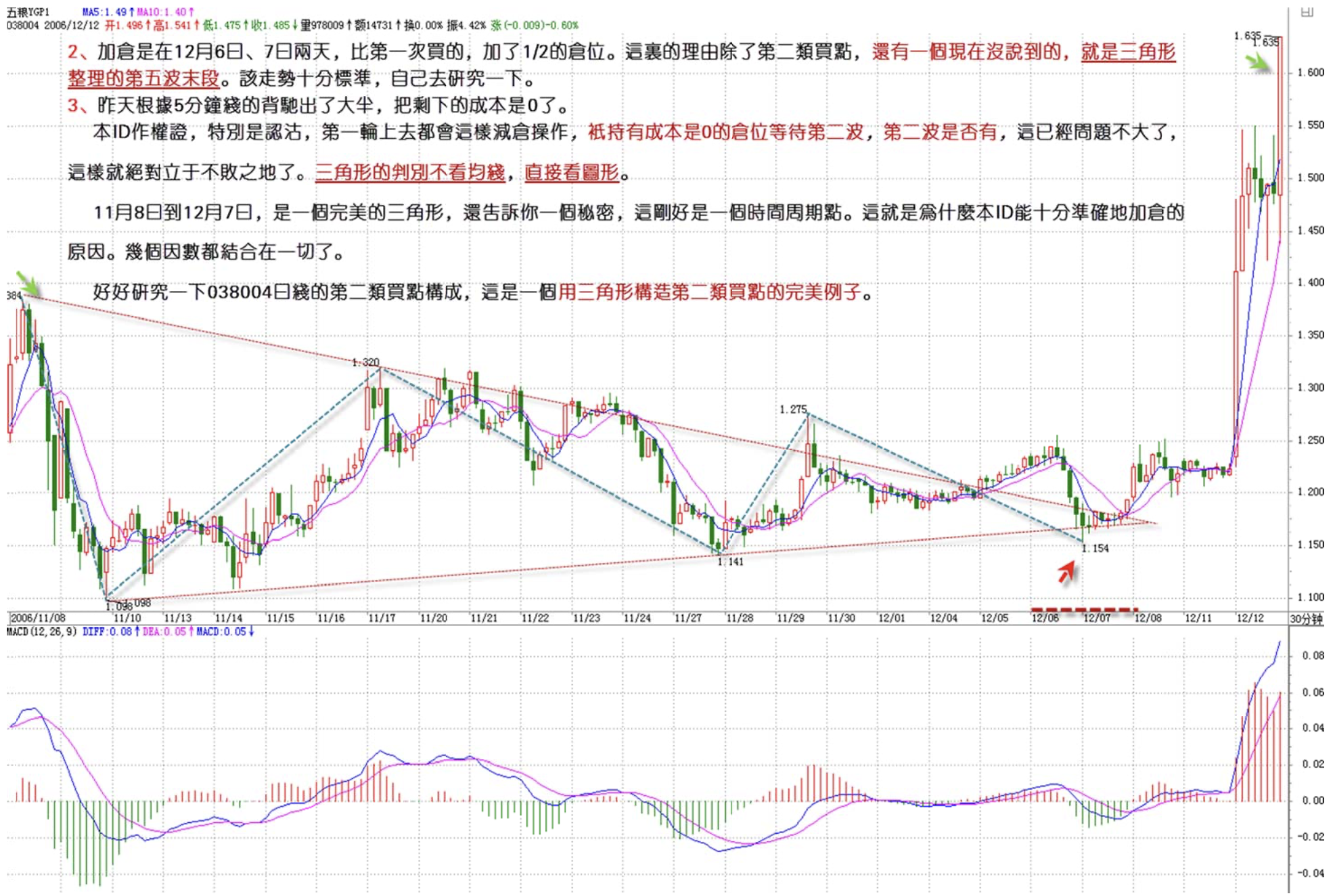
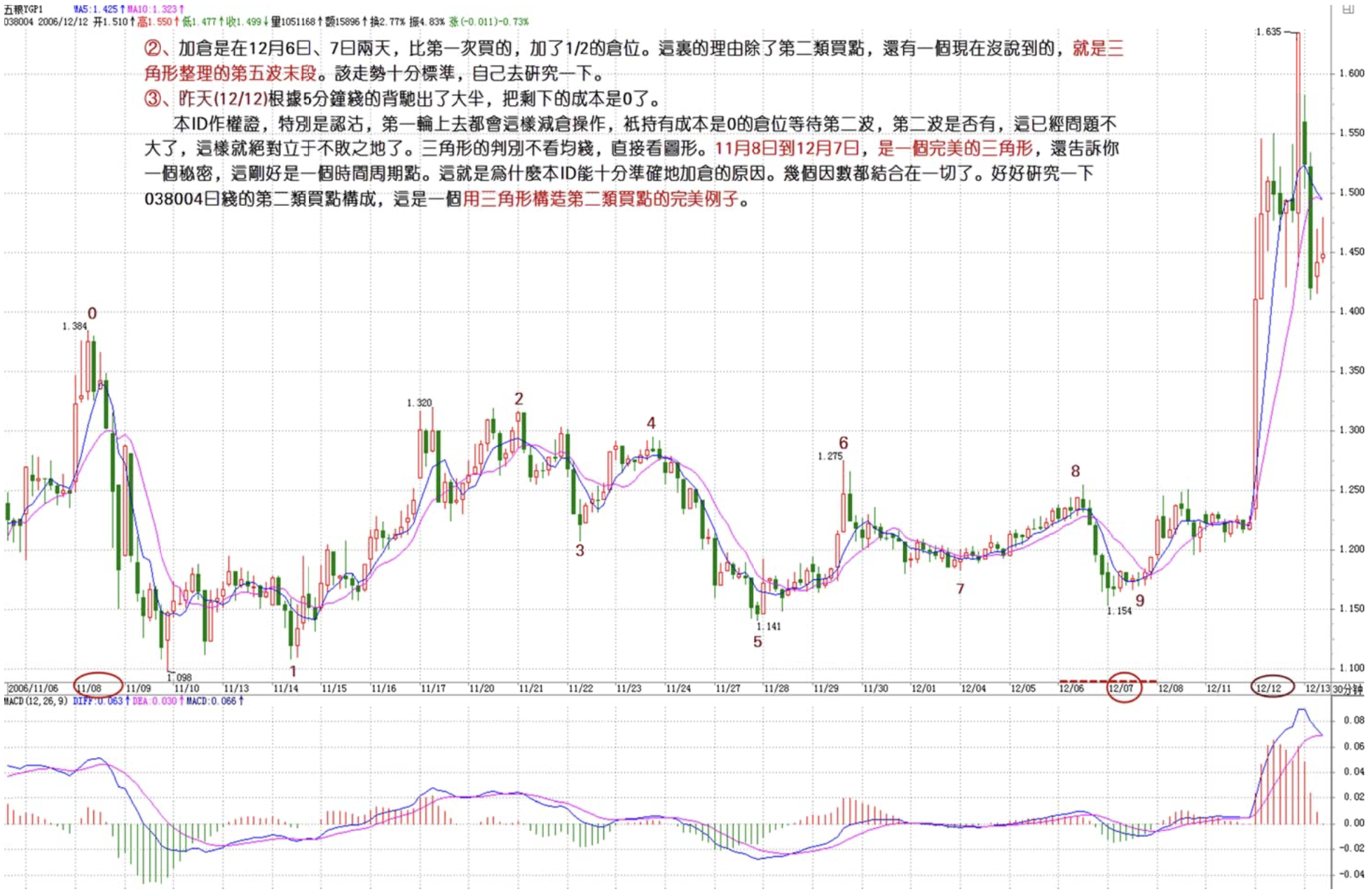
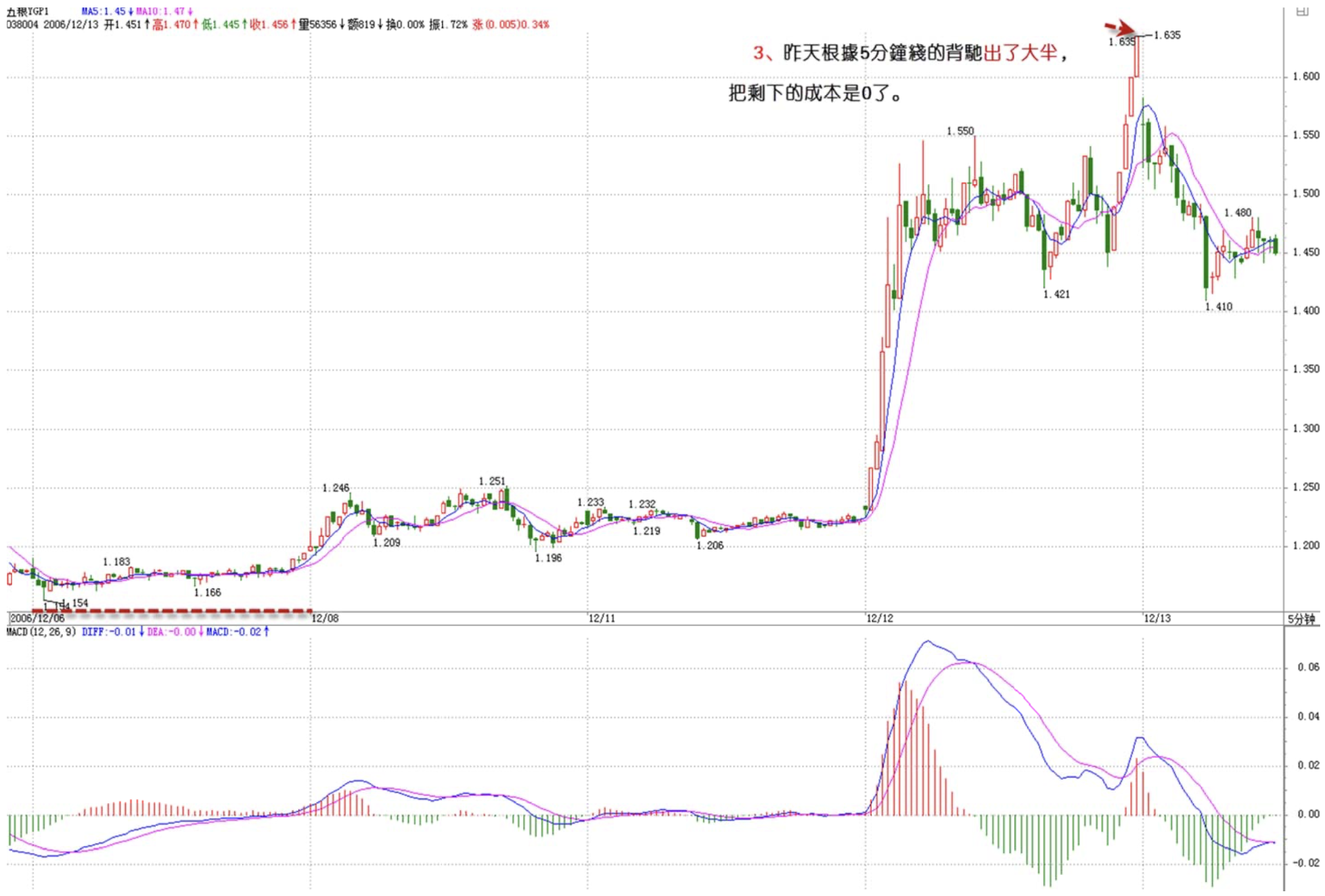
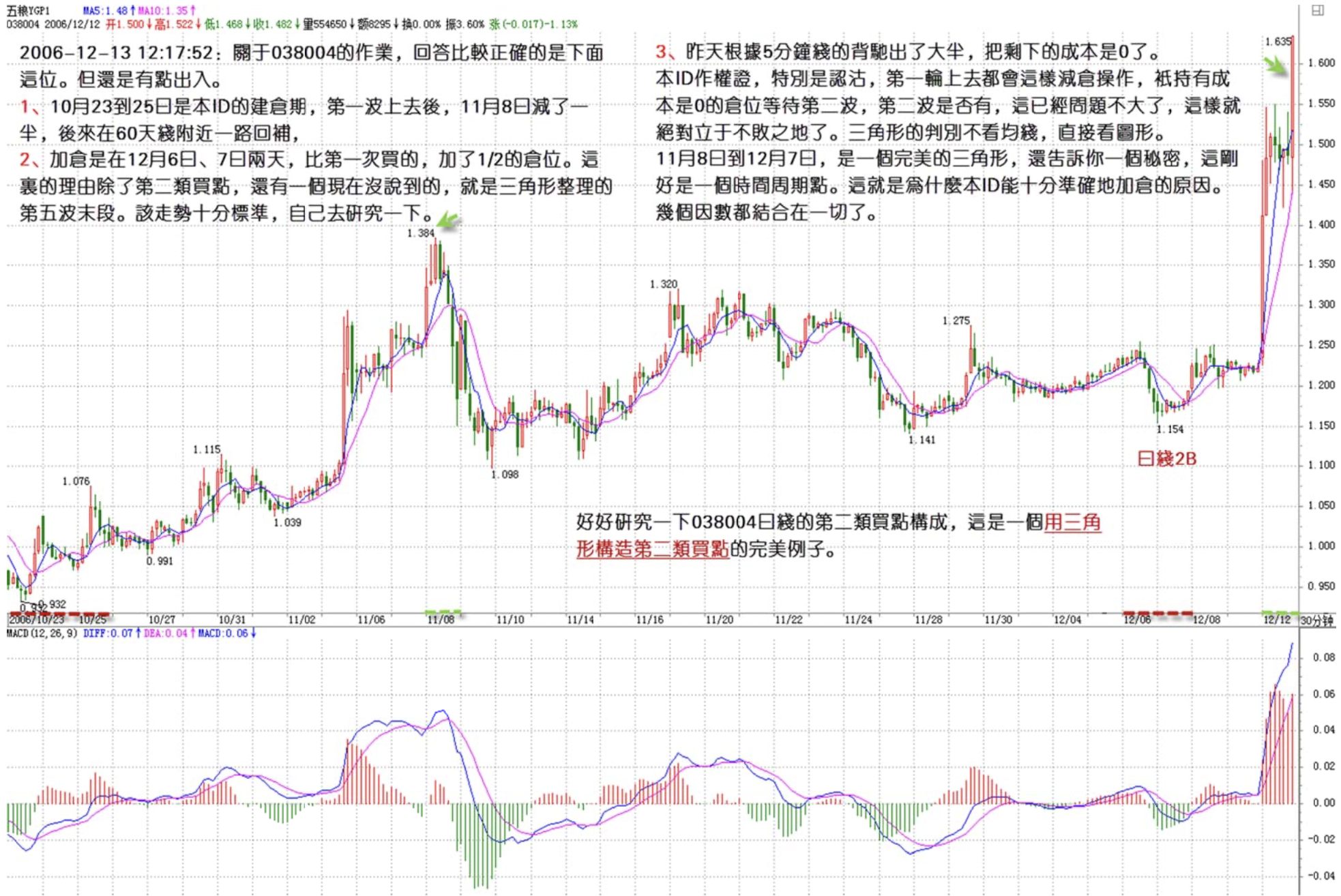
Regarding the 038004 homework, the person with the most correct answer is the one below. But there are still some discrepancies. October 23 to 25 was this ID's position-building period. After the first wave up, this ID reduced by half on November 8. Then around the 60-day moving average, this ID gradually replenished. The additions were on December 6 and 7, adding 1/2 more shares compared to the first purchase. The rationale here, besides the second-type buy point, includes something not yet discussed — that is, the fifth wave of a triangle consolidation at its end stage. The pattern is very standard — study it yourself. Yesterday, this ID exited most of the position based on divergence on the 5-minute chart, leaving the remaining cost at zero. When this ID trades warrants, especially put warrants, this is how this ID reduces positions after the first wave up — only holding zero-cost positions to wait for the second wave. Whether the second wave materializes is no longer a major concern — this ensures standing on absolutely invincible ground.
[Anonymous] 在路上
2006-12-12 23:48:54
Let me try answering Sister Chan's question about 038004 to test what I've learned recently from her. Right or wrong, I hope Sister Chan and fellow practitioners will correct me so we can progress together.
Daily chart: (5/10-day moving averages)
- After 038004's powerful rally ended, it entered a "male-on-top" position on May 26, 2006. Then on July 3, there was a very shallow "wet kiss." According to the Chán Zhōng Shuō Chán theorem, the subsequent decline (July 12) was not a first-type buy point.
July 17 brought a second "wet kiss," but no divergence appeared afterward (the intermediate fluctuations without breaking the highest/lowest prices constituted what Sister Chan calls consolidation).
October 12 brought another "wet kiss." The area of decline after this kiss to October 31 was smaller than the previous decline area, forming a divergence and constituting a first-type buy point. However, I'm not entirely sure about the optimal position on the 30-minute chart. Also, should this divergence area be compared with the decline from May 26 to July 3, or the one from September 18 to October 12? Although this divergence is smaller than both, the comparison question remains. These two issues, I'd appreciate guidance from Sister Chan and all.
Additionally, confirmation can be found in the MACD — green bars are clearly shorter than the previous two declines, with much smaller area. The yellow and white lines also made a golden cross below the 0 axis without making a new low compared to the most recent decline. This is indeed a perfect example. I believe Sister Chan bought on October 23. - Having found the first-type buy point, the second-type buy point is easier to identify (this is also my recent insight — if the first-type buy point is wrong, then the second-type buy point is also likely wrong). It was the first entanglement after the "female-on-top" position on November 14. Perhaps December 7, because November 14 shows consolidation on the 30-minute chart, while December 7 looks more like divergence but without making new lows. Comparing with Sister Chan's explanation about divergence after an MACD M-top (which I don't fully understand either), it should be December 7 as the adding position, which is also when the MACD yellow/white lines pulled back after the first approach to the 0 axis from below and had already flattened.
I hope Sister Chan will correct this, and I'd be grateful if you could address the unclear points!
缠中说禅 2006/12/13 12:21:37
This ID doesn't only trade 038004 warrants. There's another classic example — and it's new homework.
Please use the Chán Zhōng Shuō Chán MACD theorem discussed in yesterday's replies to analyze 580991 carefully. Why was this ID able to resolutely build a position from October 23 to 25?
Let me share a Chán Zhōng Shuō Chán MACD theorem: first-type buy points are all formed by divergence below the 0 axis; second-type buy points are all formed on the first pullback confirmation after crossing above the 0 axis. The situation for sell points is reversed.
缠中说禅 2006/12/13 12:26:04
Xiao Ming
2006-12-13 12:06:16
Chan mm, it's 999, right? You still haven't changed your tone — still calling us male apes!
Is my analysis of 038004 correct?
==========
This ID said it's suited for male apes — this ID didn't say it's suited for you all. Don't get confused. The answer for 038004 is above. And there's new homework.
缠中说禅 2006/12/13 12:28:46
Everyone
Read the reply comments more in the future, because in the replies, many things that can't be covered in the main articles will be discussed, including special problems. This ID's homework must be understood on your own. For the case of 580991, once you've thoroughly studied it, you'll have a solid grasp of using MACD to judge divergence.
缠中说禅 2006/12/13 12:30:16
Xiao Ming
2006-12-13 12:27:43
Chan mm, my answer wasn't bad either — how come you didn't mention me?
I originally thought your capital was very large, but now it seems this is probably just a small portion of your portfolio. Am I right?
==========
Relative to this ID's total capital, the position isn't large. But relative to the average person, it's quite large. This ID doesn't manipulate stocks, so don't think this ID pumped them up.
缠中说禅 2006/12/13 12:31:18
[Anonymous] 零零六三
2006-12-13 12:05:22
About when will you finish writing and publish?
=========
Probably after a year or so.
缠中说禅 2006/12/13 12:35:32
[Anonymous] 在路上
10.12 brought another wet kiss. The area of the decline after this kiss to 10.31 was smaller than the previous decline area, forming a divergence and constituting a first-type buy point. However, I'm not sure about the optimal position on the 30-minute chart, and whether this divergence area should be compared with the decline from 5.26 to 7.3, or the one from 9.18 to 10.12 — although this divergence is smaller than both.
=============
But your MACD analysis is not quite right. Study this carefully:
Chán Zhōng Shuō Chán's MACD theorem: first-type buy points are all formed by divergence below the 0 axis; second-type buy points are all formed on the first pullback confirmation after crossing above the 0 axis. The situation for sell points is reversed.
Hint: don't look at it too piecemeal — look at it as one large section.
缠中说禅 2006/12/13 12:37:50
Heart Zen
2006-12-13 12:33:33
"Master Chan," regarding the "fifth wave at the end of the triangle consolidation" mentioned above — in the known case of 038004, it's clear. But correctly, from which "kiss" point should one start counting?
=========
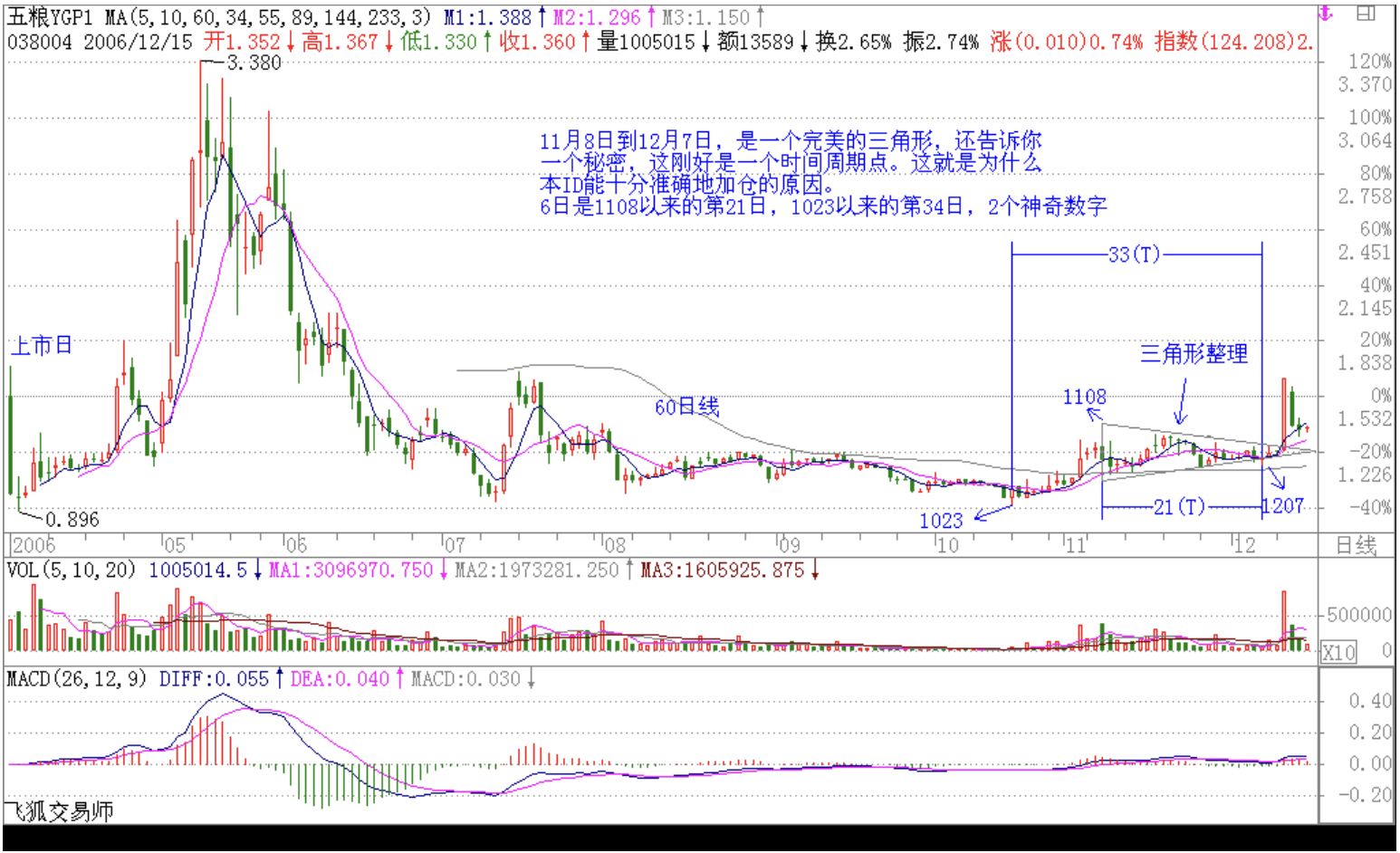
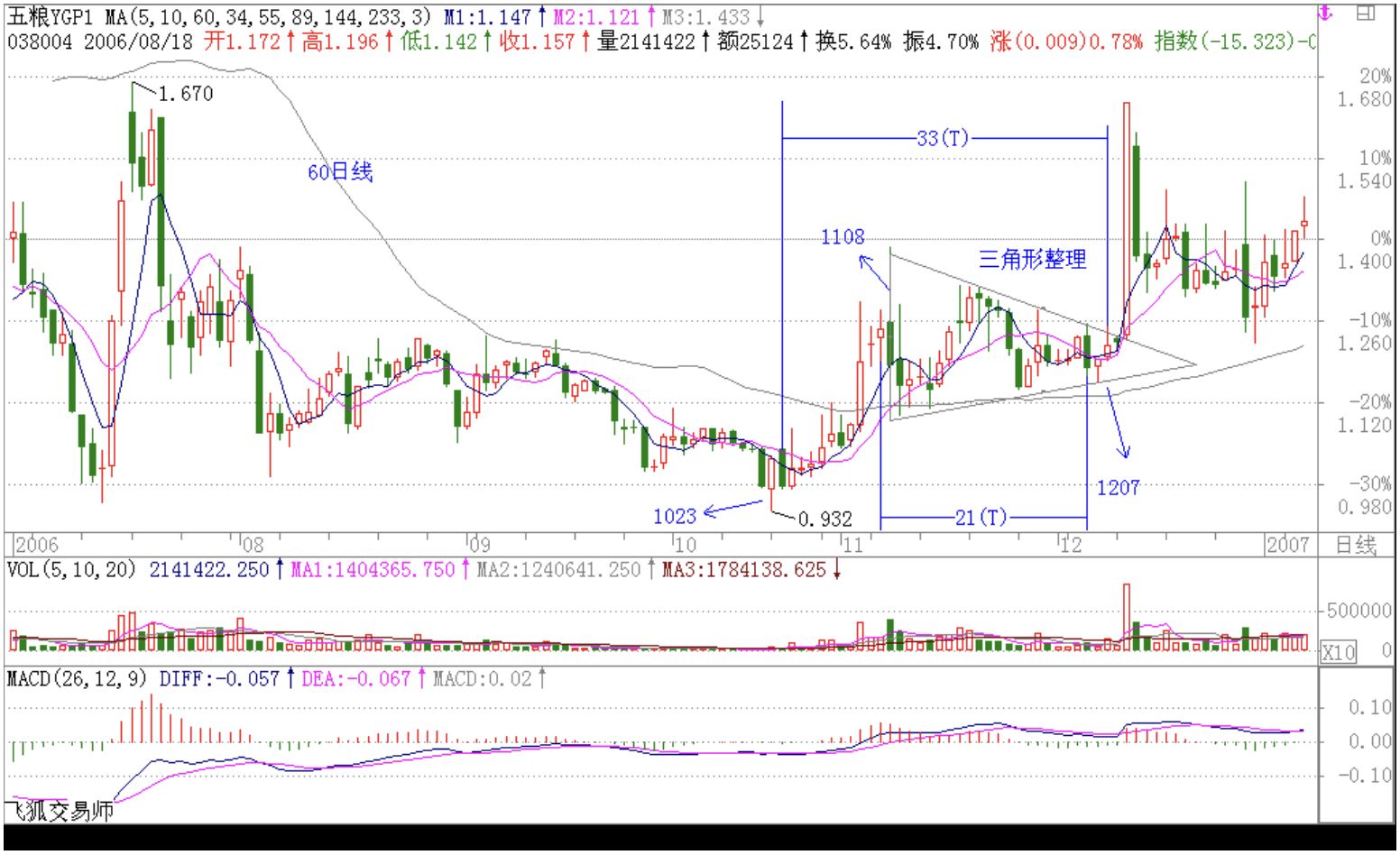
Triangle identification doesn't look at moving averages — look directly at the chart pattern. November 8 to December 7 is a perfect triangle. Let me also tell you a secret: this is precisely a time cycle point. This is why this ID could add positions so accurately — several factors all converged at once.
缠中说禅 2006/12/13 12:40:03
Xiao Ming
2006-12-13 12:37:05
Chan mm, you're definitely a big player. No need to be so modest. Hehe
===========
Big player? A big player is just a type of retail investor.
缠中说禅 2006/12/13 12:47:38
Everyone, just study the technique well — stop worrying about who this ID is. Yesterday, this ID used Baidu and found that "Chán Zhōng Shuō Chán is who" appeared in the search suggestions. Clearly, quite a few people have been searching this question on Baidu.
Who this ID is — basically no one knows. What this ID has done — basically everyone knows.
Don't waste your time on anything else.
缠中说禅 2006/12/13 12:49:00
Market opening, signing off first. Spend your time studying technique, reading The Analects, listening to music — stop overthinking.
缠中说禅 2006/12/13 15:07:41
[Anonymous] 中间体
2006-12-13 13:55:06
Chán Zhōng Shuō Chán
2006-12-13 12:21:37
This ID doesn't only trade 038004 warrants. There's another classic example — and it's new homework.
Please use the Chán Zhōng Shuō Chán MACD theorem discussed in yesterday's replies to analyze 580991 carefully. Why was this ID able to resolutely build a position from October 23 to 25?
--------------------------------------
According to the Chán Zhōng Shuō Chán theorem (I previously only knew Newton's theorems): October 23 to 25 formed the first-type buy point. Sister Chan should have exited half on November 8 (start of reversal), because divergence formed on November 21. She then exited another 1/2, leaving 1/4. She possibly added some on December 7-11 because the triangle consolidation was about to complete.
Please grade!!
============
First read the question carefully. Now you can't simply say "a first-type buy point" and be done with it. Why is it a first-type buy point? This must be figured out clearly — how to judge it. Now you must answer this question more carefully.
A first-type buy point is produced when divergence appears in a downtrend. The question now is: how is this divergence judged, and how do you see it? This is one of the most important questions in actual trading.
缠中说禅 2006/12/13 15:09:09
[Anonymous] 想飞
2006-12-13 14:53:11
LZ, when analyzing the weekly chart of 600000 (Shanghai Pudong Development), between 2004/3/12 and 2004/10/15, both the area and MACD seem to show divergence. Is that correct?
Also, you mentioned not to get involved with stocks whose first wave rise is too large. How to judge this? Should one use "forward-adjusted" prices to view the K-line chart? Because looking at "unadjusted" prices, the discrepancy between the two is quite significant.
==============
One should definitely enter at first-type and second-type buy points. Also, on the weekly chart during that time period, how would that constitute divergence? Without a trend, there is no divergence — get this question clear first.
缠中说禅 2006/12/13 15:12:27
[Anonymous] 想飞
2006-12-13 14:31:23
"The second worthwhile buy-in or adding position is the low formed during the first entanglement after the female-on-top position."
LZ, does this entanglement necessarily have to be a wet kiss? Do a flying kiss and lip kiss count?
============
This isn't necessary. On fast-moving charts, it's perfectly normal for no wet kiss to appear, but the foundation for it is often questionable. Study carefully how the second-type buy point was constructed on 038004's daily chart — this is a perfect example of using a triangle to construct a second-type buy point.
缠中说禅 2006/12/13 15:19:03
Have to leave soon, signing off now. Please think carefully about the homework above. Why use warrant examples? First, these are all real-battle examples. Second, if warrants — and even put warrants at that — can meet the requirements, this further proves the applicability of this ID's method. For ordinary stocks, the patterns are more standard and even easier to work with.
If you can figure out warrant movements, everything else will be even easier.
See you.
缠中说禅 2006/12/13 15:28:18
Heart Zen
2006-12-13 15:22:31
"Master Chan," do all "gaps" have to be filled? I planned to buy 000400 today, but saw it opened with a gap at 8.85, so I waited for the gap to fill, but it kept going up instead. Why wasn't it filled? Hope for an answer!
=======
One last answer before I leave. A gap not being filled indicates strength. Especially breakaway gaps and island reversal gaps — they don't get filled. The gap on the Shanghai index in the 300s back in 1994 wasn't filled for over 10 years. The only gap certain to be filled is an exhaustion gap in a consolidation range or at the end of an advance.
缠中说禅 2006/12/13 15:40:00
[Anonymous] 学习中
2006-12-13 15:25:57
According to the Chán Zhōng Shuō Chán MACD theorem: first-type buy points are all formed by divergence below the 0 axis; second-type buy points are all formed on the first pullback confirmation after crossing above the 0 axis.
Did the 600567 I bought this afternoon at 3.24 qualify as a second-type buy point?
Please comment, host.
===========
First get the basic concepts clear. A buy point must first be defined in terms of which chart — daily? Weekly? What? Without this premise, where is there any buy point?
缠中说禅 2006/12/13 15:41:57
No choice — really have to leave. Questions can be left here; I'll answer them in the evening if there's time. See you.
缠中说禅 2006/12/13 21:01:50
[Anonymous] yjbtxy
2006-12-13 16:01:38
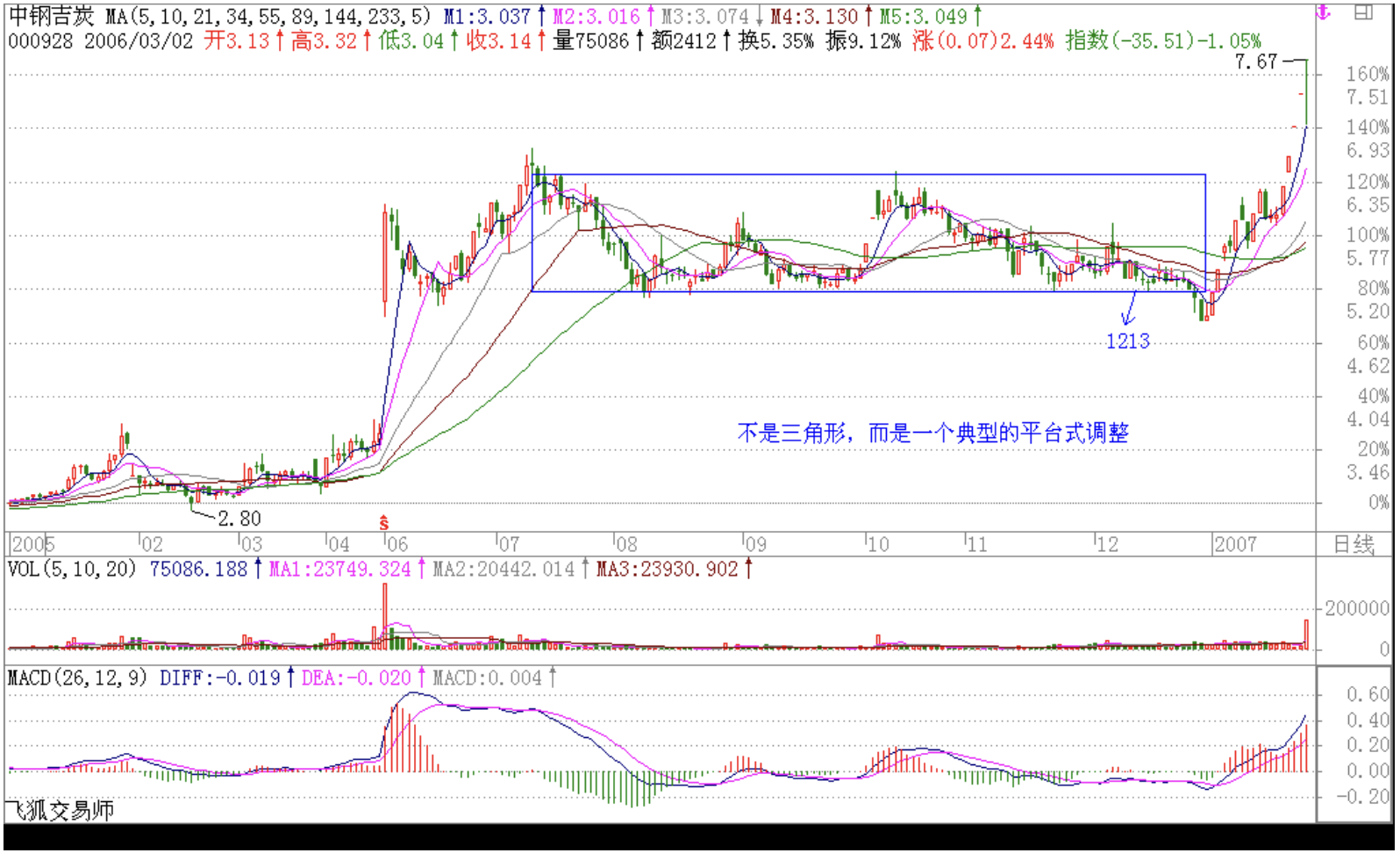
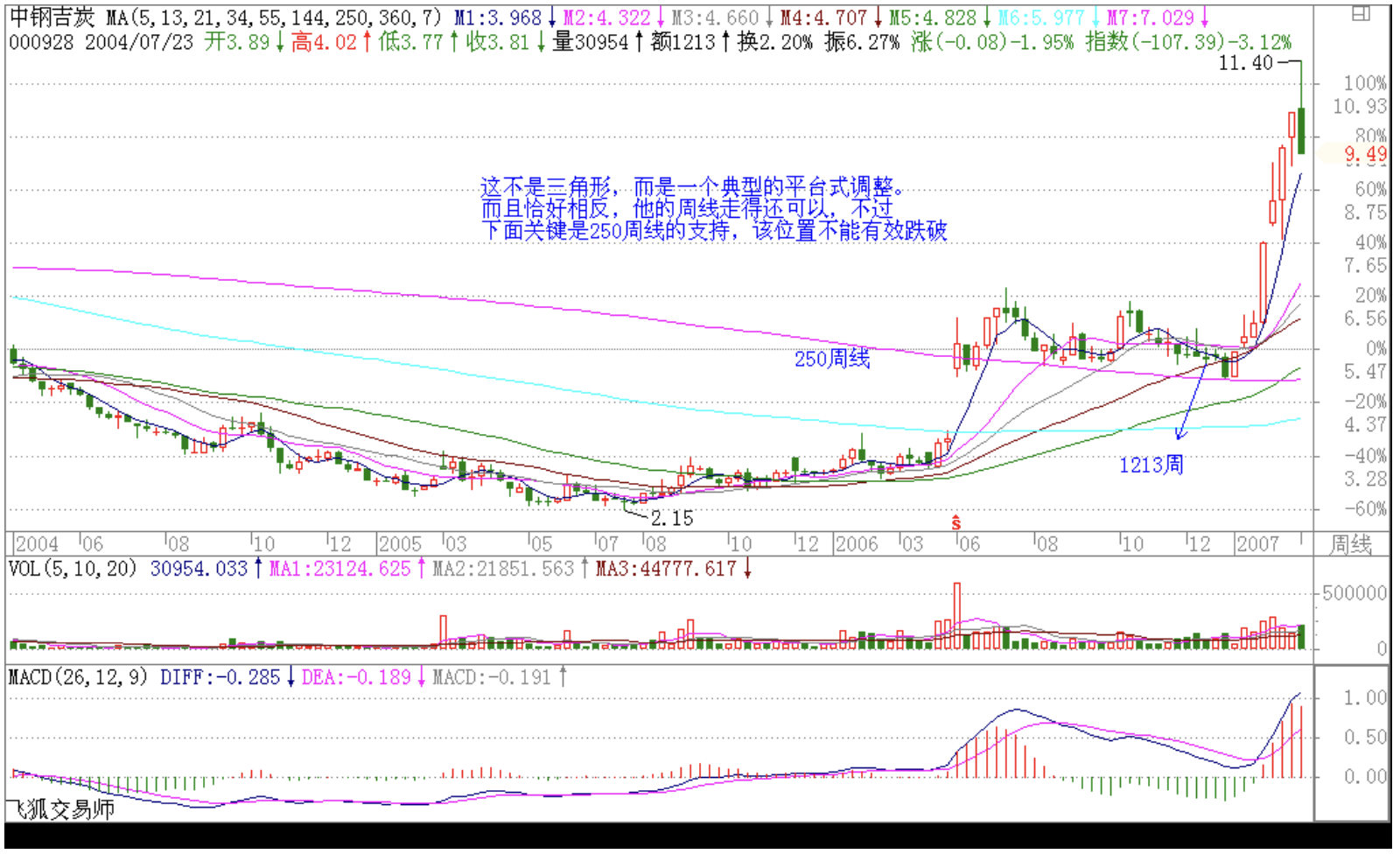
May I ask, Chan lady: is 000928 currently facing a triangle consolidation breakout?
The minute and daily charts look good, but the weekly chart doesn't look good.
==============
This is not a triangle — it's a classic platform-type correction. And it's actually the opposite — its weekly chart looks decent. The key below is the support of the 250-week moving average, which must not be effectively broken.
缠中说禅 2006/12/13 21:04:04
[Anonymous] 中间体
2006-12-13 15:52:40
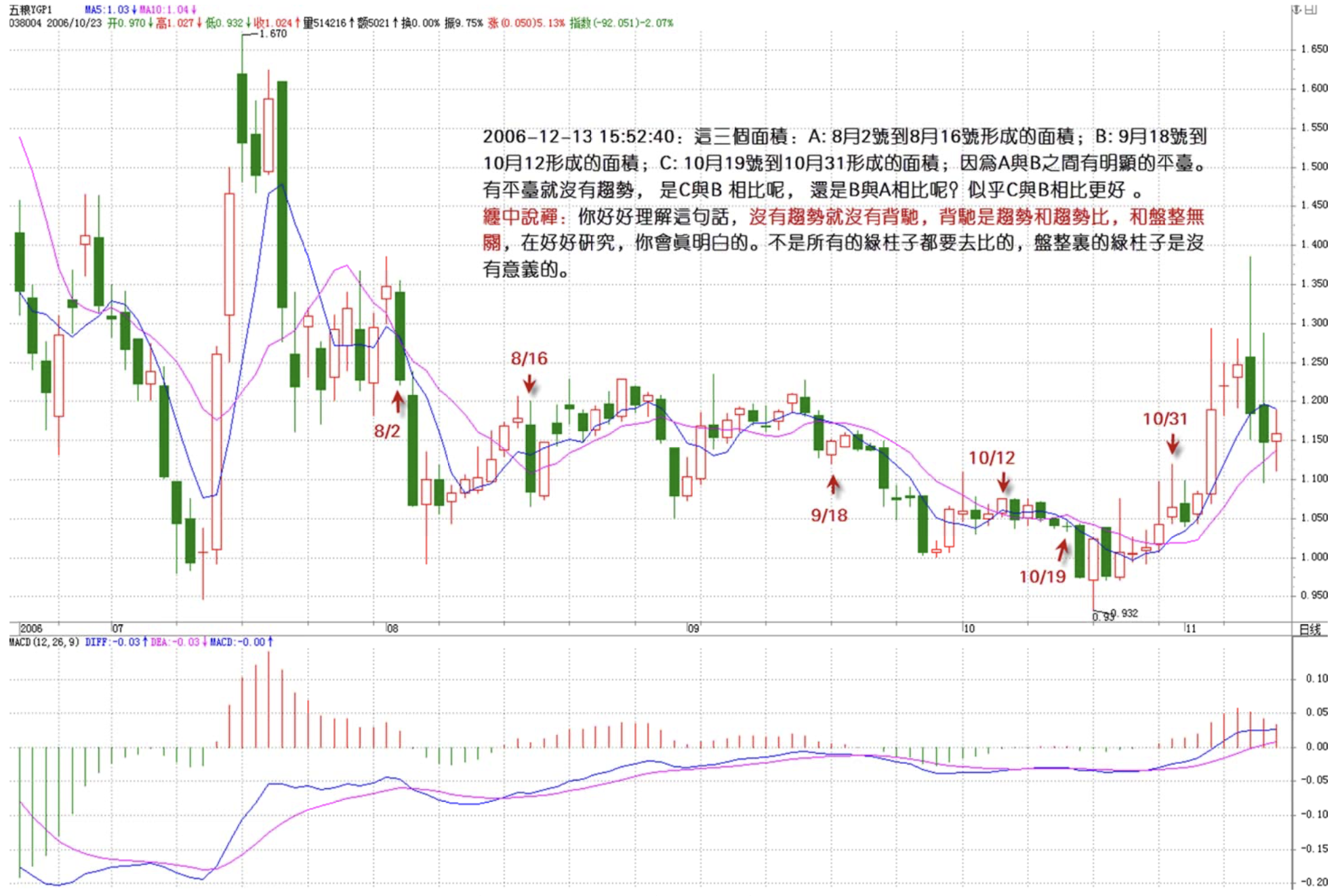
Actually I'm still confused about these three areas:
A: Area formed from August 2 to August 16
B: Area formed from September 18 to October 12
C: Area formed from October 19 to October 31
Because there's a clear platform between A and B. With a platform there's no trend. Should C be compared with B, or B with A? It seems comparing C with B makes more sense.
============
Study this sentence carefully: without a trend, there is no divergence. Divergence is a comparison between trends — it has nothing to do with consolidation. Study carefully, and you'll truly understand. Not all green bars need to be compared — the green bars during consolidation are meaningless.
缠中说禅 2006/12/13 21:08:16
[Anonymous] 无言
2006-12-13 15:38:07
Sister Chan, thank you so much! Last night I read your reply comments and the Chán Zhōng Shuō Chán theorem — the second buy point being when the yellow/white lines rise to above the 0 axis. I checked various stock charts, and this morning I rushed in to compete with market makers for shares. I entered 002069 at 64.30, 65.20, and 65.36 — fully invested. The feeling of riding the palanquin is truly delightful! I hope for continued guidance in the future. Thank you!
=============
For the short term, the key is to watch whether the box top can be effectively broken through.
缠中说禅 2006/12/13 21:10:49
[Anonymous] 想飞
2006-12-13 21:07:48
LZ, when analyzing 580991, could you also discuss how to identify trends, preferably from the first day of trading all the way through?
=============
First get clear on how to read MACD. Identifying trends and consolidation is simpler than MACD. Go carefully absorb the definitions this ID gave in "Without a Trend, There Is No Divergence," and you'll naturally understand.
缠中说禅 2006/12/13 21:13:48
wy1499
2006-12-13 15:41:40
Host, put warrants on the Shanghai market have very strong sector correlation. Warrants 990, 991, 992, 993, and 994 all simultaneously showed divergence to second-type buy point lows from 2:30 PM on December 6 to 10 AM on December 7. But it's very difficult to judge which specific one will have the largest rally and the order of their rallies. On the afternoon of the 6th, I picked 993. I planned to first make 40% on this one, then make another 20% on whichever pulled up later. But on the 7th at noon, it had barely risen 20% before it "prematurely ejaculated." In the end, I found a low point and ran. How frustrating!
============
Look for the one whose consolidation pattern is complete. Ones that aren't complete are just box patterns. Compare with 038004's perfect five waves and you'll understand. 993 can only have a major performance after its consolidation pattern is complete.
缠中说禅 2006/12/13 21:18:42
All questions about 991 will be addressed tomorrow. Let everyone have sufficient time to think it over.
Good night, see you.
缠中说禅 2006/12/13 12:04:19
An Efficient Buy-Sell Method Suitable for Small and Medium Capital
Will be uploaded tomorrow.
That pharmaceutical company — today the mystery has been revealed. Everyone should know who it is, because it went limit-up right at the opening.
Today's announcement didn't tell the whole story. The foreign party is one of the world's largest pharmaceutical companies. They have a product particularly suited for male apes.