Detailed Analysis of "The Analects": For All Those Who Misinterpret Confucius (46)
2007/1/12 15:12:51
The Master said: Scholars of old studied for themselves; scholars of today study for others.
Yang Bojun: Confucius said: Ancient scholars aimed to cultivate their own morality and knowledge, while modern scholars aim to impress others.
Qian Mu: The Master said: Ancient scholars studied for their own improvement. Today's scholars study for others.
Li Zehou: Confucius said: Scholars of old studied to improve themselves; scholars of today study to lecture others.
Detailed explanation: This is a much-debated chapter, but all interpretations are rooted in the approach of venerating the past and disparaging the present. They split "for oneself" (为己) and "for others" (为人) into two opposing halves, vilifying "for others" while sanctifying "for oneself." This is merely the trick of Song-Ming rotten Confucians to "elevate Inner Sageliness and denigrate Outer Kingliness." That both the Song and Ming dynasties were ultimately destroyed by foreign peoples is absolutely no historical coincidence — great credit goes to their ruinously misleading tricks.
"Inner Sageliness and Outer Kingliness" are fundamentally one body. How can Inner Sageliness without Outer Kingliness last? What use is Outer Kingliness without Inner Sageliness? The so-called "learning" is the "comparison and calibration" based on "hearing widely" and "seeing widely," inseparable from the great flow of change within "Heaven, Earth, and Person." Both "for oneself" and "for others" must ultimately accomplish "Inner Sageliness and Outer Kingliness" — how can "for oneself" and "for others" be severed? The exclusively "for oneself" and the exclusively "for others" alike can only manufacture the vicious cycle of "hunger, farming, feeding." Whether it is the Anglo-American capitalism that champions "for oneself" or the Stalinist capitalism that champions "for others," neither escapes this cycle.
Grammatically, this chapter is clearly a case of literary parallelism (互文). In classical Chinese, for the sake of linguistic fluidity and symmetry, this is extremely common. Here, there is no need to pursue the chicken-and-egg question, no need to determine whether it's "for oneself in order to be for others" or "for others in order to be for oneself." At root, it is all "Inner Sageliness and Outer Kingliness," "for oneself and for others" as one. This admits of no ancient-modern distinction. Learning that departs from this can only be pseudo-learning — it cannot possibly be genuine scholarship. And pseudo-learning — how could it be called "learning"?
Chán Zhōng Shuō Chán's Vernacular Direct Translation
子曰:古之学者为己;今之学者为人。
Confucius said: Whether ancient or modern, true learning and true scholars never depart from the unified learning of "Inner Sageliness and Outer Kingliness," "for oneself and for others" as one.
(To be continued)
Strictly prohibited to plagiarize, violators will be prosecuted
Replies
缠中说禅 2007/1/12 15:30:05
[Anonymous] Made Money
2007-01-12 15:19:01
"But there are exceptions too — like the Northeast stock this ID was involved with N years ago, four people rode it from ¥7 all the way to the ¥40s without stopping. Then everyone dumped at once and it came down like a waterfall."
---------------------
Sister Chan, why did you play it all the way to the ¥40s? Why not dump it all to them in the ¥30s? That should maximize profit, right? At the top, with everyone dumping together, would the effect even be good?
===
If all the shares could be collected, ¥30 wouldn't be expensive at all for that stock. Nobody wanted to give the opportunity to anyone else. Later, problems appeared in the broader market, word got out, and everyone scattered.
缠中说禅 2007/1/12 15:36:22
[Anonymous] whq999
2007-01-12 15:26:47
Sister Chan, will the market break 2600? That's what I'm most afraid of.
===
Wrong thinking mode. Don't predict — the key is to watch performance. The only thing that can be 100% certain is that trends must complete. So at the highs of the second segment, you should exit. After exiting, wait for the buy point to appear.
Of course, what I'm saying here is just the principle. If you're operating at the weekly level, you can use this to play short-term swings — there's no question of exiting.
缠中说禅 2007/1/12 15:37:50
Attention:
Don't still have thinking misunderstandings at this point. Don't predict — wait for buy and sell points to automatically appear, then react naturally.
缠中说禅 2007/1/12 15:45:32
[Anonymous] Made Money
2007-01-12 15:20:31
The Zhejiang faction must be furious today, right?
===
He didn't expect this ID to be even more ruthless. So market makers are actually a vulnerable group — this ID deeply sympathizes with them. In a big bull market, only those with water in their brains become market makers. A big bull market is a mass movement — the key is to mobilize the masses. That's what a real big player does.
缠中说禅 2007/1/12 15:51:36
Serious Attention:
Everyone, this ID's style of play is different from all of yours, which is why the individual stocks this ID initially told you about were limited to the medicine stock — because that stock's fundamentals support a major rally, so even encountering a deranged market maker doesn't matter.
As for the other four stocks, this ID is having great fun, but others might not be able to handle it. So you'd best not follow this ID's stocks — the concern is that when this ID goes after the market maker, you might get hurt in the crossfire.
Of course, if you want to train your nerves, you can follow along and watch how this ID performs live. If appropriate buy points appear, you can participate. But absolutely do not chase highs — only buy at buy points.
缠中说禅 2007/1/12 15:54:57
[Anonymous] Late Enrollee
2007-01-12 15:51:47
Blogger, I'm an office worker and consider my short-term skills not very good, so I planned to exit only when the tide turns. After all, my profits are already substantial — they won't plunge all the way to my cost basis.
Besides, even if I sell, the next stock I buy isn't guaranteed to outperform what I'm holding.
===
I've said it N times: when exiting, never be afraid of leaving too early. If your judgment isn't up to par, better to leave early — never leave late. With money, are you afraid you won't find new opportunities?
缠中说禅 2007/1/12 16:02:39
[Anonymous] XL
2007-01-12 15:47:07
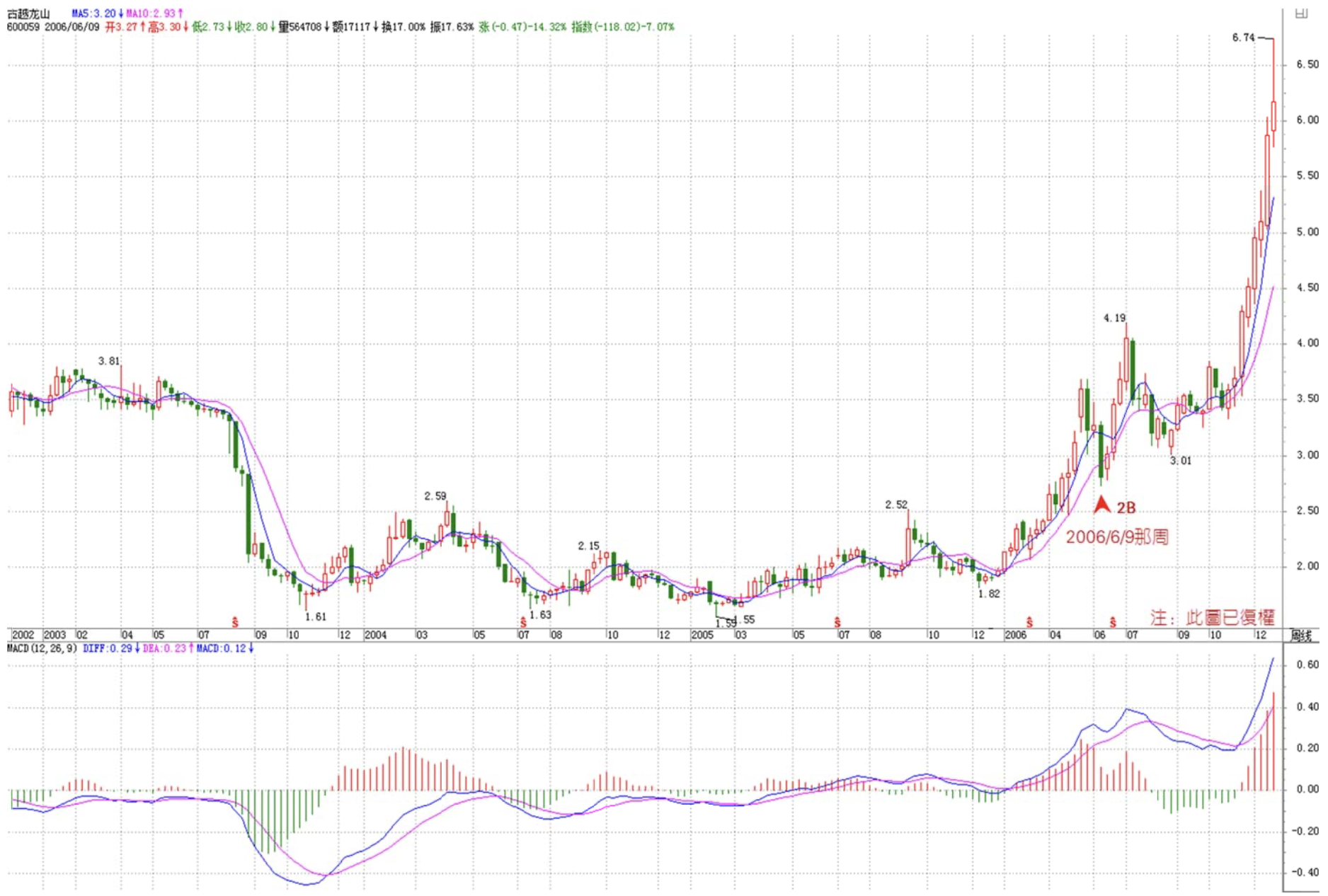
Does 600059 have no third-type buy point on the weekly chart? How should this kind of stock be handled? Thanks.
==
It has one on the daily chart! On the weekly chart, it's a classic second-type buy point.
缠中说禅 2007/1/12 16:13:58
[Anonymous] Made Money
2007-01-12 15:22:41
Today's battle on the energy stock — Sister Chan, were you the one doing the pushing down?
===
Why would I only push down? This ID isn't a market maker — if I dump everything, there's nothing left to play with.
This ID is playing short-term swings up and down — when he dumps, I catch; when he pulls, I give it to him. Drive him crazy. If he dumps hard, I dump even faster and harder. At the current price level, I'm not doing the pulling up anymore — I did it at lower levels, but not now. Tactics must vary — can't let the other side guess your moves.
But the principle is the same: lower your own cost, raise the opponent's cost. So for this ID, fighting is just a cost-reduction activity — I'm happy to do it every day.
缠中说禅 2007/1/12 16:15:34
[Anonymous] Deep Diver
2007-01-12 16:10:27
Blogger, if I operate on the daily chart, should I use the 30-minute chart to avoid short-term risks? And when I buy back, should I enter at the corresponding buy point on the 30-minute chart? Or can I buy back at an even lower sub-level buy point? Thanks.
===
Yes, but in rapidly changing situations, 30-minute is too slow — you can look at 1-minute or 5-minute.
缠中说禅 2007/1/12 16:20:25
[Anonymous] Learning
2007-01-12 15:30:26
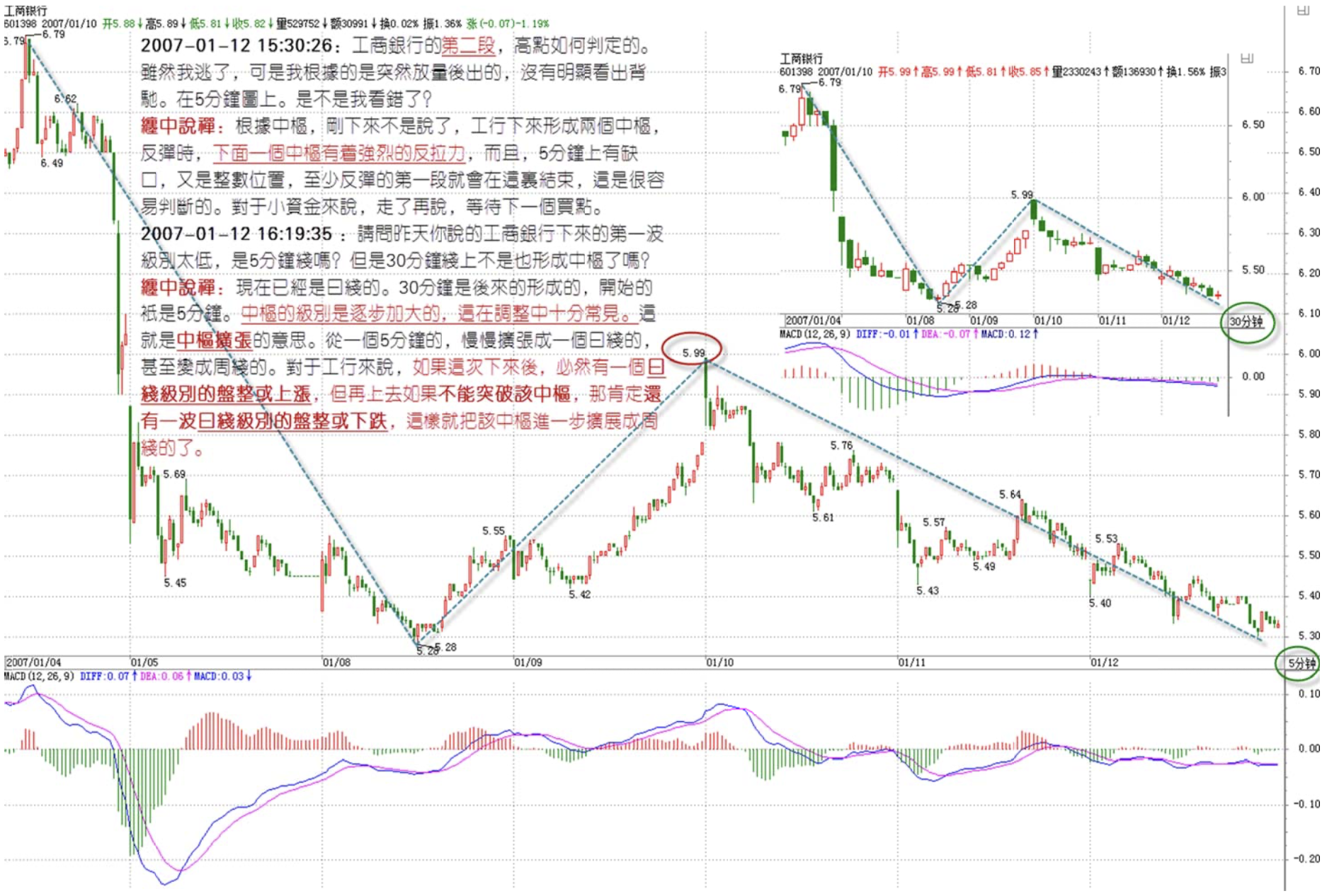
Sister Chan, how was the high point of ICBC's second segment determined? Although I escaped in time, I did so based on the sudden volume spike, not from clearly identifying divergence. On the 5-minute chart. Did I read it wrong?
==
Based on the hub. Didn't I just say when it came down that ICBC had formed two hubs? During the bounce, the lower hub exerts strong pulling force. Moreover, there's a gap on the 5-minute chart, plus a round number level — at the very least, the first segment of the bounce would end here. This is very easy to judge. For small capital, exit first and wait for the next buy point.
缠中说禅 2007/1/12 16:21:32
[Anonymous] Logic for Life
2007-01-12 16:20:27
Since accidentally discovering the ID's articles in early December, I've basically made no mistakes. However, I can't always watch the market — for instance, from 2 PM yesterday to 2 PM today I had no time to check, which brings some short-term losses. But most of the time I can manage to monitor the market. So is there any good strategy to reduce losses from not watching the market? Of course, I'm not a greedy person.
==
Look at the daily chart. At larger levels, you can ignore intraday fluctuations.
缠中说禅 2007/1/12 16:24:20
[Anonymous] Made Money
2007-01-12 16:19:56
[Anonymous] Stock Market Lei Feng
2007-01-12 16:10:55
Please advise, Sister Chan. Does 580003 still have a chance? I've held it for 3 months. I wanted to wait to sell at ¥4, but currently I'm feeling like selling. Please give some guidance!
------------------
Friend, people who come here should have learned to only sell when a sell point arrives. Your sell point has already passed and you're asking this now. Personal opinion: selling now is really not the right time.
===
That's right. Once the sell point has passed, you can do whatever you want — nothing left is something you must do. Just let fate decide. But are you willing to always be like this? Why not take control of your own destiny?
Taking control of your own destiny means only buying at buy points and selling at sell points.
缠中说禅 2007/1/12 16:42:21
[Anonymous] Happy New Year
2007-01-12 16:19:35
Chán Zhōng Shuō Chán
2007-01-12 16:02:39
[Anonymous] XL
2007-01-12 15:47:07
Does 600059 have no third-type buy point on the weekly chart? How should this kind of stock be handled? Thanks.
==
It has one on the daily chart! On the weekly chart, it's a classic second-type buy point.
============================
I can't see this buy point either!
Also, Sister Chan, why aren't you answering my questions? Are there too many? Let me trim them down.
===
If you can't see it, go look at the definitions of the second and third types. You must find them yourself. This ID can tell you whether you're right or wrong, but don't just expect ready-made answers — that won't make it your own ability.
- Was ICBC's first wave down the kind of level you mentioned yesterday — the 5-minute chart? But didn't a hub also form on the 30-minute chart?
==
Now it's already at the daily level. The 30-minute was formed later — initially it was just 5-minute. Hub levels gradually increase, which is very common during adjustments. This is what hub expansion means. From a 5-minute hub, it slowly expands into a daily one, and can even become a weekly one. For ICBC, after this drop, there will inevitably be a daily-level consolidation or rise. But if it goes back up and can't break through this hub, there'll definitely be another wave of daily-level consolidation or decline, which would further expand this hub to the weekly level.
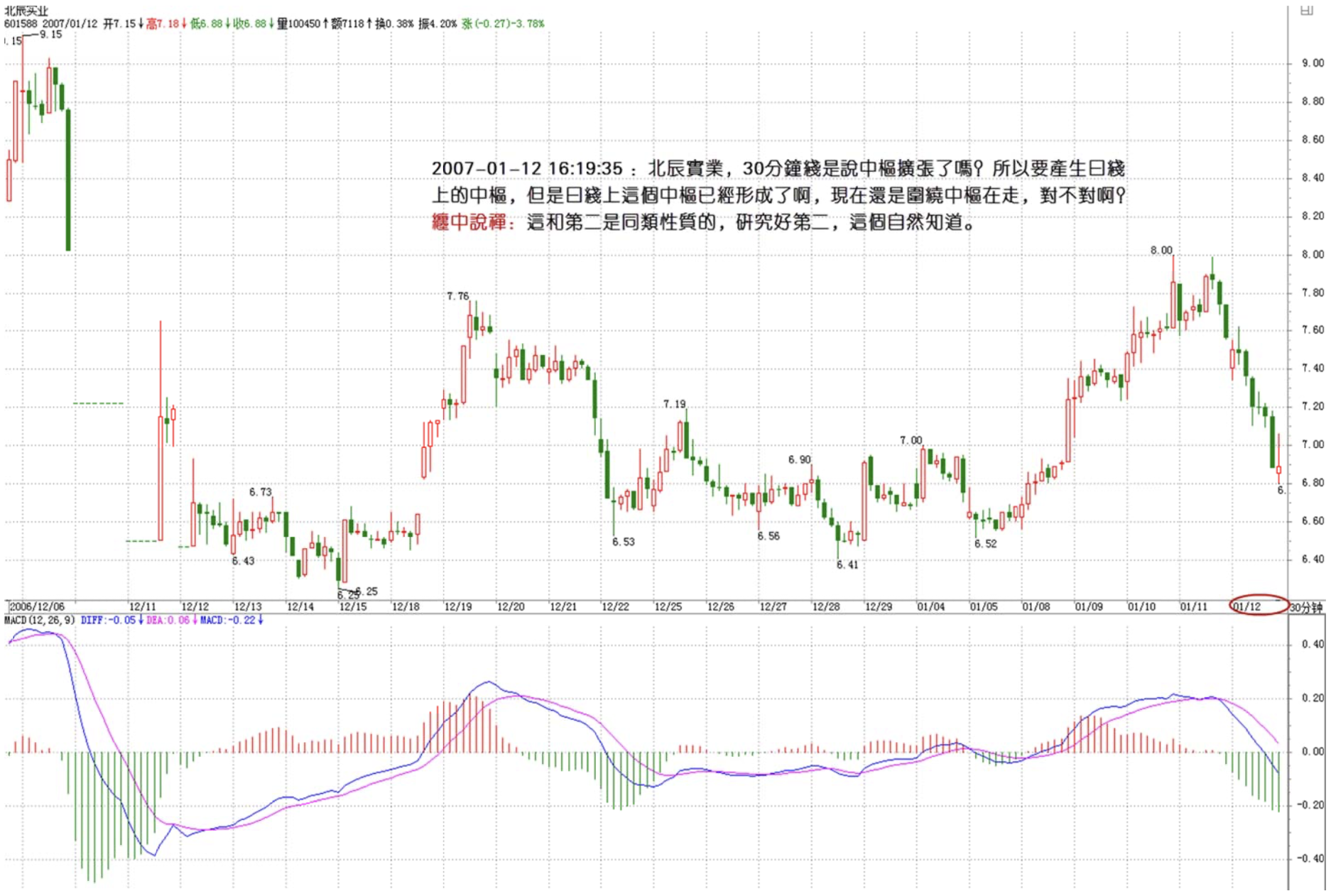
- And Beijing North Star — on the 30-minute chart, did the hub expand? So a daily-level hub needs to form, but the daily-level hub has already formed, and it's still oscillating around the hub, right, Sister Chan?
===
This is the same type of issue as the second question. Study the second one well and you'll naturally know this one.
缠中说禅 2007/1/12 16:45:13
[Anonymous] Passerby
2007-01-12 16:31:35
Reporting in, Miss. I'm battered and bruised today.
===
Getting hurt in a bull market — there are plenty of recovery opportunities. The key is understanding why you got hurt. What bad habit caused the injury?
缠中说禅 2007/1/12 16:51:23
[Anonymous] Zhi Hu Zhe
2007-01-12 16:39:58
Sister Chan: I'm still not clear about hubs.
Hubs in consolidation are easy to understand — kind of like an N shape. But if it's sub-level up + consolidation + up, does that constitute an upward hub at this level? Take an extreme example: on the 1-minute level, 3 consecutive minutes of K-lines are 5-5.1, 5.1, and 5.1-5.2. Does this mean a 5-minute level hub has formed, with the hub [ZD, ZG] being just the single price point of ¥5.1?
===
Incorrect. First, there's no concept of an "upward hub." An uptrend has two hubs — which one would you call the "upward hub"? Sure, you can colloquially call them pullback hubs or rebound hubs, but those are just descriptive, not precise concepts.
Your example only forms an extension of a single 1-minute hub.
Also, in Chapter 17 "Trends Must Complete Perfectly," Sister Chan mentioned 600497 Chihong Zinc Germanium had 2 hubs during the period from July 27 to October 25, 2005. I can't figure out how to delineate these two hubs — to me they look like only one hub. Could Sister Chan please specify the exact dates dividing the 2 hubs!
===
This question, this ID is not going to answer. Why? First, please get the mathematical formula for hubs clear on your own. Otherwise, answering one specific case leads to more specific cases — better to get the abstract formula clear, and all problems are solved.
Note: hubs have three types of movement: extension, expansion, and generation. Get these clear.
缠中说禅 2007/1/12 16:54:09
[Anonymous] Logic for Life
2007-01-12 16:42:17
I think one of the essences of the ID's theory is the mathematical decomposition of stock movements. Wet kisses and consolidation are transitional processes for any movement. I've been wanting to ask: due to the scale relationship of chart coordinates, a certain time period on an un-zoomed chart appears as continuous consolidation like up-down triangles (the 5 and 10 MAs can be clearly separated). If followed by a large up or down movement, then on the next screen, visually at least, it looks like multiple MAs forming a wet kiss.
So can we understand it this way: there's no essential distinction between a wet kiss and consolidation — whether they merge is just a matter of coordinate scale, and it's not necessary to insist that MA values must be equal?
===
The wet kiss of moving averages is merely a phenomenon produced by hub movement — not the most essential cause. First get the most basic hub concept and its movement patterns clear. That's the key. Also, repeatedly contemplate the principle that trends must complete perfectly — this is the most important foundation.
缠中说禅 2007/1/12 16:55:49
[Anonymous] Fast
2007-01-12 16:51:25
- "I've said it N times — when exiting, never be afraid of leaving too early. If your judgment isn't up to par, better to leave early — never leave late. With money, are you afraid you won't find new opportunities?"
- "Any buy point should be entered during a pullback, not by chasing up. The only difference is the level of the pullback."
Can the above two be considered golden rules for those still learning yet not content to sit on the sidelines? Earnestly requesting Miss Math's reply.
===
These aren't absolute. For example, some people have masochistic tendencies and want to get hurt — in that case, they're free not to follow them.
缠中说禅 2007/1/12 17:00:15
[Anonymous] Xiaoming
2007-01-12 16:40:56
Today's big rally in liquor stocks, including 600059's big bullish candle on the weekly chart — does this indicate the liquor sector has topped out, and even if it rallies again, there'll be a long refractory period?
==
The liquor rally isn't over. This ID has said that the drug company's approval hasn't come through yet — they're still waiting.
Also, you mentioned in the text that both Song and Ming being destroyed by foreign peoples was no coincidence. I've thought about this too, and I also think Zhu Xi is the culprit — he ruined Confucianism. Made the Chinese people too effete, and even servile.
They say the Chinese were very martial in the Qin and Han periods! Can't compare now. A famous military expert who's also our nation's strategic advisor once called for the Chinese to be more martial!
Is this analysis correct?
===
Why separate the literary and the martial? Do martial men have no servility? Those martial men who sell their lives for their masters — how are they different from literary men who sell their words for their masters? Both the literary and the martial are just appearances. And cultural strength is often more meaningful than military strength.
缠中说禅 2007/1/12 17:06:30
[Anonymous] Happy New Year
2007-01-12 16:59:08
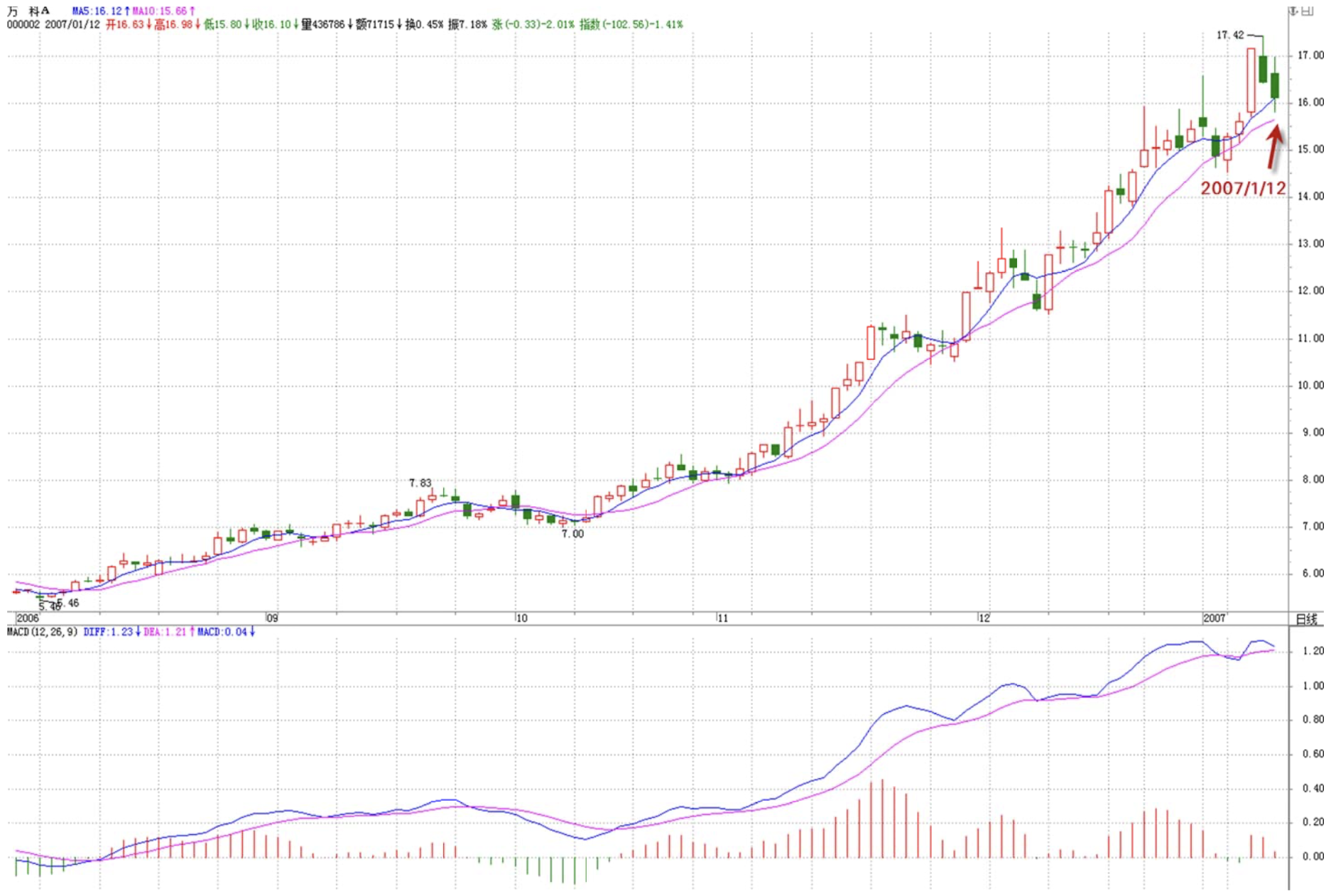
Sister Chan, why aren't you answering my questions anymore? Has Vanke already shown a sell point on the daily chart — specifically yesterday, when the price made a new high but the red bars didn't get taller?
===
At small levels, yes. But at large levels, if you want to use MACD for auxiliary judgment, you'd need at least the MACD to pull back near the 0-axis first, and then divergence when it goes up again would be real.
More precisely, judgment should be based on comparison between trends. If you think daily-level divergence has occurred, there must be at least two daily-level trends to compare, and connecting these two up-trends must be at least a weekly-level hub. Now — does 000002's chart show that?
So, you'll have to wait for the big daily-level divergence. But that doesn't mean it definitely won't fall — because small-level divergence means a first-type sell point appears at the small level, which also exerts downward pressure. For short-term traders, this is an opportunity to play short-term swings.
缠中说禅 2007/1/12 17:08:43
Two Tigers
2007-01-12 17:03:57
Fairy Sister, in your theory what I sense is "doing the right thing at the right time, with ease" — and almost nothing about what others constantly talk about: "stop-loss."
Today the market dropped like this. Watching my stocks shrink, I had no urge to sell. Though inside it felt like being cut.
===
If you can already competently judge all types of buy and sell points, then you don't need any special "stop-loss." Of course, if you frequently judge incorrectly, "stop-loss" is still necessary — otherwise, mistaking a large-level sell point for a buy point would cause big problems without a stop-loss.
缠中说禅 2007/1/12 17:10:51
[Anonymous] Passerby
2007-01-12 17:07:29
Miss, based on your analysis, can I still drink some liquor?
===
You should think this way: Is there a buy point? Is there a buy point at the level that matches your operating style? That's the thinking mode that will serve you for a lifetime.
缠中说禅 2007/1/12 17:21:04
[Anonymous] Happy New Year
2007-01-12 17:09:27
Haha, just saw Sister Chan's reply. Thanks.
Looks like Sister Chan was just too busy to get to it. I was too anxious — this kind of mentality isn't good for stock trading either. Need to train the mentality.
I've learned so much from Sister Chan's place — truly grateful.
===========
Just looked again — Sister Chan, is the daily-level third-type buy point you mentioned for 600059 on 2006/09/27? And the second-type buy point on the weekly chart on 2005/02/04? I feel like it's a first buy point though — before that, there was down + consolidation + down, with the second decline showing divergence. Isn't that a first-type buy point?
==
August is a standard second-type buy point on the monthly chart. On the weekly chart, it's on the week of June 9.
缠中说禅 2007/1/12 17:28:58
[Anonymous] Clarity
2007-01-12 17:20:56
Sorry... lots of annoying things recently, quite busy. Fallen behind on "this ID's" teaching by a big stretch. Still on the concept of hubs for now.
Hopefully the question isn't too basic. Regarding the third-type buy/sell point issue "this ID" discussed — on the daily level, one would watch the 30-minute chart. Using 600123 as an example, on December 28, according to the theory, is this chart showing a buy point or sell point? It's so confusing.
===
That day on the daily chart, it was neither a buy nor a sell point. Of course, at smaller levels, you can find it's a buy point. But a buy point isn't necessarily a daily one. In other words, a rise that appears on the daily chart isn't necessarily caused by a daily buy point — other levels can cause it too. But from the daily level's perspective, such rises aren't worth getting involved in. The issues here are still complex — later there are many theorems describing the relationships between buy/sell points across levels. Won't discuss here.
Another individual stock question — for stocks like 000839 and 600682, if you miss the 15-minute or 5-minute divergence sell signal, how should you operate afterwards?
Exhausting. Hoping to make stock trading an enjoyable thing.
==
First, think about why you missed it — next time you can't miss it. Second, decide what level you want to operate at — each person determines this based on their own situation. Low-level fluctuations can be used to play short-term swings.
缠中说禅 2007/1/12 17:42:50
[Anonymous] Intoxicated
2007-01-12 17:28:10
Chan,
Getting a bit confused again.
Regarding the concept of "trends must complete perfectly."
For example, Si Huan Bio, on the daily K-line,
from 2006-5-10 to 6-6, it apparently doesn't form two hubs, but it's indeed an uptrend. So how does the concept of "trends must complete perfectly" apply to this situation?
Or is it saying that from a longer time frame this trend is complete?
But wouldn't that also mean missing the sell point on the daily chart?
A bit confused...
===
Moving upward on the daily chart doesn't equal a daily-level uptrend. This upward move could be caused by lower-level movements — must be viewed in combination across levels. The movement connecting two large-level upward hubs isn't necessarily a sub-level trend. For example, after a consolidation, a sudden positive news causes continuous limit-ups before forming a hub — the continuous unbroken limit-ups between these two hubs can only count as a 1-minute trend.
Also, "trends must complete perfectly" has nothing to do with "two hubs." "Trends must complete perfectly" means: the completion of any movement chart must include three or more sub-level trend types. This is equivalent to "any trend type must contain at least one hub at its level."
缠中说禅 2007/1/12 17:44:41
Two Tigers
2007-01-12 17:25:30
Fairy Sister, please see if my application of "Chan Theory" to practice is correct!
Question: 600392 — on the daily chart, isn't it 2005.5.24-8.15 decline, 8.15-1.4 consolidation, 1.4-1.11 rise? Then 1.11 shouldn't be a sell point, right? Because MACD doesn't show divergence. Correct?
==
You need to study even harder — you haven't figured out the right approach at all. First, learn the concept of the hub (中枢) thoroughly.
缠中说禅 2007/1/12 17:48:46
[Anonymous] 清
2007-01-12 17:44:15
Hehe. One more question for "this ID" — if the stocks I hold all show a bullish-on-top pattern on the 30-minute chart, wouldn't the turmoil last a long time, since it needs to complete at least one hub (is this hub referring to the 30-minute chart for now)? At that point, aside from sitting and waiting for doom or consoling yourself that you're doing higher-level stocks, are there any other remedies?..
Exhausting. Asking questions is exhausting. Waiting for answers.
===
Your way of thinking must change. There's nothing to remedy about stocks. The only correct approach is to develop the habit of buying at buy points and selling at sell points at the level that suits your actual situation. Good habits need no remedies — anything that needs remedying is a bad habit, and if bad habits aren't corrected, nothing can be done. Even if something could be done, it would just be using an even worse habit to cover up the problem.
缠中说禅 2007/1/12 17:49:34
Everyone, signing off for now. Coming here, you must completely transform yourselves — otherwise it's all been for nothing.
Goodbye.
缠中说禅 2007/1/13 10:03:53
Sorry, I have business in the far suburbs today. I'll make up for the music session tomorrow when I'm back. Heading off, goodbye.
缠中说禅 2007/1/12 15:26:45
Today's market movement is very normal. Didn't I ask everyone a few days ago which segment ICBC was in? According to the principle that trends must complete, at least three sub-level segments are necessary — so the movement these past few days is completely normal. This inherently requires no reliance on anyone — the single principle of "trends must complete" is sufficient.
Individual stocks continue to be about low-price catch-up rallies. As long as volume doesn't contract excessively, individual stock action will continue — mainly low-priced stocks. Note, I've repeatedly said "catch-up rallies." Catch-up rallies, by definition, won't produce sustained mid-term rallies. When the catch-up is done, you still need to watch ICBC and similar stocks — if they don't restart, then the adjustment level will be bigger.
I specially pointed out before to watch for policy developments — this won't reverse the major trend, but it will affect the intensity and duration of adjustments. Recently, quite a few people have jumped out to apply verbal pressure on the market. But I believe this won't become the management's final position, because the management was the biggest beneficiary of last year's rally. Excessively rapid rises may be undesirable, but large declines are absolutely not permitted. This determines the current adjustment pattern: light on the index, heavy on individual stocks. As long as buy points appear, there are individual stock opportunities.
No major concerns for mid-term individual stocks — look at last year's liquor stocks, still rising today, and you'll understand.