Detailed Analysis of "The Analects": For All Those Who Misinterpret Confucius (45)
2007/1/8 15:22:02
The Master said: A gentleman does not attach to appearance.
Yang Bojun: Confucius said: A gentleman is not like a vessel, [limited to a single specific use.]
Qian Mu: The Master said: A gentleman is not like a utensil (limited to one particular use).
Li Zehou: Confucius said: A gentleman is not a utensil.
Detailed explanation: The above interpretations, and the common understanding, all derive from Zhu Xi, who said: "A vessel (器) is adapted to a specific use and cannot be employed for other purposes. A man of accomplished virtue possesses all proprieties, and so his usefulness is universal — he is not merely one talent, one art." Such an interpretation fueled the later vogue for hollow, superficial pursuit of the so-called "Renaissance man," which ultimately became one of the root causes of national decline. The so-called polymath is, in reality, a master of nothing — merely self-gratification. Yet this mode of thinking became a pursuit and badge of honor among the so-called scholar-literati, and to this day, charlatans continue to peddle the nonsense and whimpering of "understanding one thing means understanding everything." The so-called "understanding one thing means understanding everything" person is simply someone who assumes the world obeys one common invisible or visible hand — and once you've grasped this hand, you're a sage, you're God, you understand everything. This feeble-minded whimpering has been so prevalent since the Song Confucians precisely because of the misunderstanding of "A gentleman is not a vessel." According to their logic, being a "vessel" disqualifies one from being a "gentleman," and since rotten Confucians fancy themselves gentlemen, they naturally have to assume or disguise themselves as "not a vessel" — that is, "accomplished in virtue with universal usefulness," grasping some visible or invisible hand to make themselves gentlemen, to make themselves God. The result was that China was wasted by this herd of bloviating incompetents. Yet this habit was never truly uprooted from the Chinese character — given any opportunity, it springs back to life. This Eastern-style malady ultimately traces back to the misunderstanding of the I Ching. The thinking of Daoism and similar schools basically all derive from this misunderstanding, beginning from this self-gratifying "understanding one thing means understanding everything" model. The saying "Man follows Earth, Earth follows Heaven, Heaven follows the Way, the Way follows Nature" is the best portrait of this self-gratifying model. Confucius and Confucianism resolutely oppose such models, but starting from the Song Confucians — after Confucianism had been deeply depressed following the great expansion of Buddhism and Daoism during the Sui and Tang dynasties — these creatures, who were habitual interlopers and inveterate pilferers, understood nothing of Confucianism, even less of Buddhism and Daoism. They first interpreted Buddhism through a Daoist lens, then used Daoist-ized Chan Buddhism to adorn themselves, and then turned around to suppress Chan Buddhism and Daoism. From then on, the Confucianism corrupted by rotten Confucians became the most shameless group in the history of Chinese culture.
In the Western tradition, this kind of so-called polymath has no market. Of course, the West is not without so-called "encyclopedic" figures, especially before the nineteenth century, when truly great scholars were of the encyclopedic type. But the Western encyclopedic type is decidedly not the "understanding one thing means understanding everything" brand of the Chinese rotten-Confucian polymath. Rather, it was because scientific development was still in its early stages, knowledge was relatively not too vast or complex, and thus a single individual delving into most disciplines was no great feat. Today, the encyclopedic type is basically impossible. Even within a single major discipline — mathematics, for example — new branches keep emerging, and no one can delve deeply into every branch. A broad-angle grasp of mathematics is possible, but once you get into specific problems, it's simply no longer feasible. The situation is similar in other disciplines, which is the main reason for the prevalence of specialists today. The drawbacks of this are obvious: specialists can form small groups, and these groups increasingly resemble Church organizations within Catholicism — the corruption and degradation therein is not hard to imagine. Humanity's predicament lies precisely between these Eastern and Western predicaments. The East's "understanding one thing means understanding everything" self-gratification, and the West's eventual Church-ification and self-flagellation, constitute humanity's two predicaments. One result of Western Church-ification is the theologizing of science, and the root cause of the scientification of society lies in capitalist society itself, which is based on the homogenization by capital. As for the East's "understanding one thing means understanding everything" self-gratification, to put it bluntly, it's merely the residue of shamanistic culture. When charlatans use so-called Chinese civilization to oppose Western scientific hegemonism, they're merely using a residual ape-tail to oppose an equally delusional divine phallus. The East's "understanding one thing means understanding everything" self-gratifying shamanistic culture is nothing but a residual ape-tail; the West's Church-ified scientific theology is nothing but a divinely tumescent phallus destined to die of hyperactivity. Two equally ugly objects — a farce of stick against stick.
What is "器" (vessel)? The I Ching's "Xici" says: "That which has form is called a vessel (器)." "器" is "form" (形); what is "形"? "形" is "相" (appearance/aspect). What is "君子不器" (A gentleman is not a vessel)? It is "A gentleman does not reify/does not attach to appearance" (君子不相). "The Way — not the same, not sharing, not planning together" — the gentleman who aspires to "hear, see, learn, and practice" the "Way of the Sage" must "hear, see, learn, and practice" the planning of "not attaching to appearance." The Eastern ape-tail and Western divine phallus predicaments described above both lie in self-imposing their own appearance. The Eastern ape-tail, believing that understanding the tail means understanding all stick-like objects — "understanding one thing means understanding everything" — self-imposes a delusory appearance of universal comprehension, and ultimately the East was thoroughly ape-tailed. The Western divine phallus, believing that as long as life persists and the phallus remains erect, everything in the world can be thoroughly divine-phallused — everything, whether stick or non-stick, can be divinely phallused — a classic nymphomaniac masochist, self-imposing the appearance that everything can be and should be divinely phallused, ultimately the West was thoroughly divine-phallused. Unfortunately, the most supposedly virile implement in imagination often means complete impotence in reality. Whether the world can be phallused is not something a phallus can phallus, still less something all the stick-related self-gratification and self-flagellation can stick into being. Self-gratification and self-flagellation, all self-imposed appearances — at root they come from human greed and fear, from "hunger" (馁), from the vicious cycle of "hunger, farming, feeding" — all the same stock-in-trade. This cycle exists not only on the material and social planes but equally on the plane of the human heart and mind. The so-called "field of the heart" — once sown with the seeds of "hunger," the person self-imposes an appearance to cultivate it, then harvests illusory fruit to self-gratifyingly consume, and in the end returns to "hunger." The illusory fruit becomes yet another seed of "hunger," and the vicious cycle continues. Such a society produces such hearts, and vice versa; a society trapped in the vicious cycle of "hunger, farming, feeding" likewise has heart after heart trapped in the same vicious cycle, and vice versa. A gentleman does not attach to appearance; a gentleman is not a vessel; a gentleman is not the same — what is "not the same, not a vessel, not attached to" is precisely this vicious cycle of "hunger, farming, feeding."
Chán Zhōng Shuō Chán's Vernacular Direct Translation
子曰∶君子不器。
Confucius said: A gentleman does not attach to appearance.
(To be continued)
Strictly prohibited to plagiarize, violators will be prosecuted
Replies
缠中说禅 2007/1/8 15:39:19
[Anonymous] CCTV
2007-01-08 15:35:38
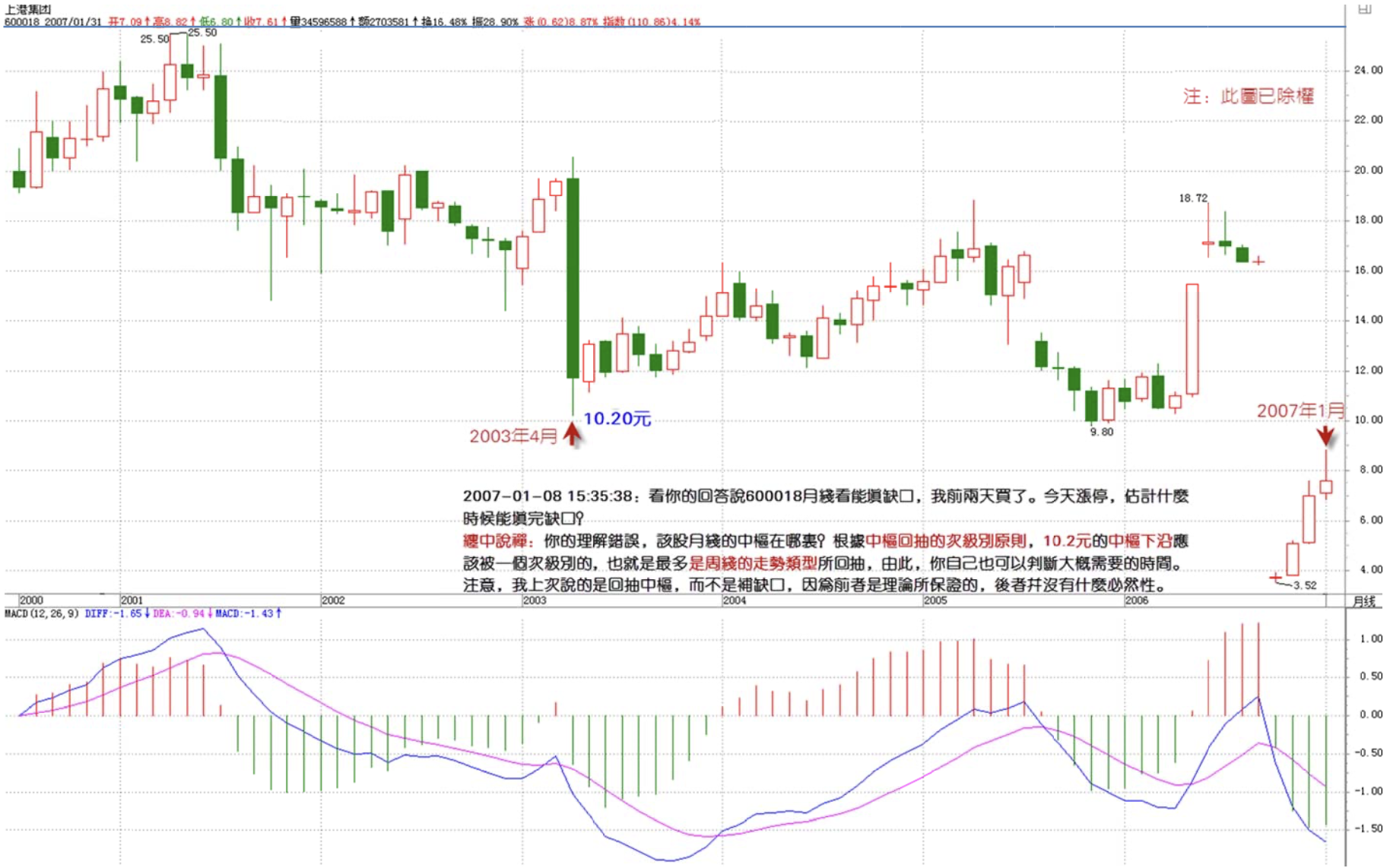
Sister, you mentioned that 600018 could fill the gap on the monthly chart. I bought some a couple of days ago. It hit the limit up today. Roughly when can it fill the gap?
===
Your understanding is incorrect. Where is this stock's hub on the monthly chart? According to the principle that a hub must be retested by a sub-level movement, the lower boundary of the hub at ¥10.2 should be retested by a sub-level movement — meaning at most a weekly-level trend type. From this, you can estimate the approximate time needed yourself.
Note: what I said before was retesting the hub, not filling the gap, because the former is guaranteed by the theory while the latter has no necessity whatsoever.
缠中说禅 2007/1/8 15:44:10
China Life being hyped tomorrow is inevitable. As for whether 2007's medicine is 2006's wine, we'll know by 2008.
缠中说禅 2007/1/8 15:53:56
Logging off first. Goodbye.
缠中说禅 2007/1/8 20:45:31
[Anonymous] Photography Friend
2007-01-08 20:19:31
[Anonymous] Later Student
2007-01-08 19:54:23
By my understanding, the hub interval is the b1–b2 segment.
Is that correct? Please correct me, teacher. ________________________________________
Not correct. What you described is only when C1>b1 (a1=b1) and a2>b2 (c2=b2).
==
Thanks. If there are those who understand clearly and have time, you can also answer others' questions. This trains yourself and also helps this ID a bit.
缠中说禅 2007/1/8 20:50:22
[Anonymous] Clarity
2007-01-08 16:14:52
Having read this ID's views from the past two days on the possible factors causing a bull market adjustment — roughly that central government regulation is needed, hopefully I didn't misunderstand — and today the People's Bank of China raised the reserve requirement ratio by 0.5 percentage points. This should be one of the warnings, right? But the bull market continues accelerating. Does it really need something like an interest rate hike or a Xinhua commentary to appear? Would like to hear your views. As they say, bull market conditions are surprisingly exhausting.
Thank you!
==
What happened today is nothing. Haven't we seen cases where it took a dozen golden mandates to bring the market down? As long as rotation continues, the market is developing healthily. Nothing to worry about. The key is keeping the right rhythm. Of course, if you don't have time to follow short-term rotation, just hold your selected component stocks well — in the end, the gains are roughly similar, just a matter of earlier or later.
缠中说禅 2007/1/8 21:11:59
[Anonymous] Not-Know
2007-01-08 20:23:21
Sister Chan, having studied your stock trading theory, I'm very impressed! Currently in my studies I have three questions to ask.
-
If at a certain level, its sub-level completes three trend types — up + consolidation + down or down + consolidation + up — can this be considered a hub formed at that level? Is this hub equivalent to the sub-level consolidation hub? Or must the sub-level complete up + consolidation + down plus an additional up-segment before it constitutes a hub at that level?
===
First get the concepts clear. A sub-level uptrend means at least two hubs have formed at the sub-sub-level. If you're talking about sub-level up + sub-level consolidation + sub-level down, then that's already three segments at the sub-level, and of course it constitutes a hub at the current level. If it's only sub-sub-level up + sub-sub-level consolidation + sub-sub-level down, that only constitutes one sub-level segment — two more would be needed to constitute a hub at the current level. This is very clear and strict. -
If a stock opens at the limit-up and breaks away from its original hub, and the limit-up opens at some point during the day — does this also constitute a third-type buy point?
===
Again, concepts must be clear. What is the "original hub"? First you need to clarify what level that hub is. If it's a weekly-level hub, then within a single day, no matter what happens, it can't constitute a sub-level retest. The key is the level. -
For example, China Bank of China's recent plunge — on the 5-minute chart, a third-type sell point hadn't appeared yet before the sharp drop! By the time of the bounce, it was already around ¥5.6! That's a ¥0.30 drop! How do you prevent situations like this?
===
Why wait for the third-type sell point to sell? What about when the first and second type sell points appeared — why didn't you sell then? Also, the third-type sell point is guaranteed to occur, but it's the last escape opportunity at that level. In rapid movements, it often flashes by in an instant — this happens even more in futures.
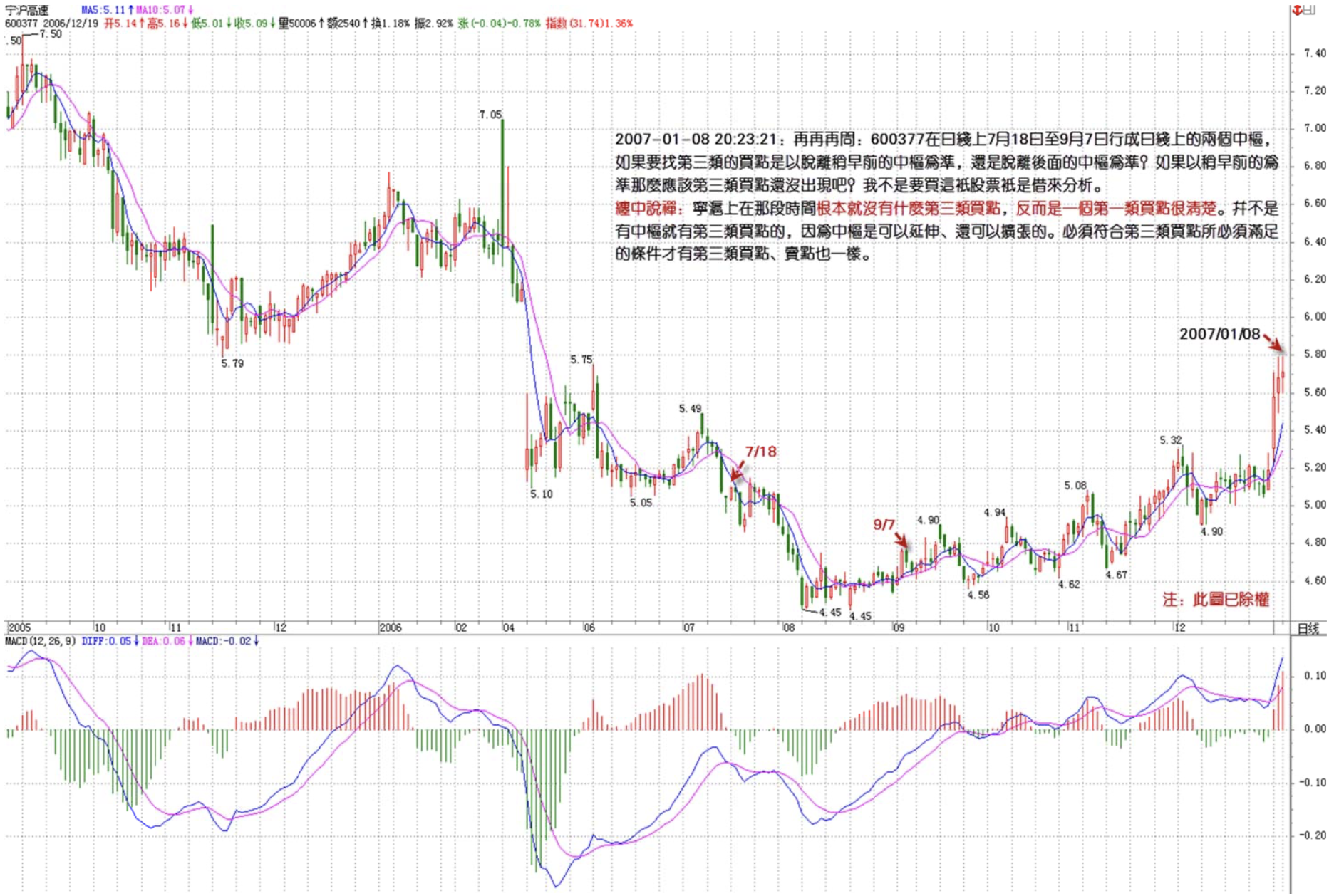
4. For 600377, on the daily chart from July 18 to September 7, two hubs formed. If looking for a third-type buy point, is it based on breaking out from the earlier hub or the later hub? If based on the earlier one, then the third-type buy point hasn't appeared yet, right? I'm not looking to buy this stock — just using it for analysis.
==
NingHu Expressway certainly had no third-type buy point during that period — instead, a first-type buy point is very clear.
Having a hub doesn't automatically mean there's a third-type buy point, because hubs can extend and also expand. A third-type buy/sell point only exists when the conditions required for a third-type buy/sell point are met.
缠中说禅 2007/1/8 21:14:56
[Anonymous] Surgeon
2007-01-08 20:57:01
For example, Bank of China's recent plunge — on the 5-minute chart, a third-type sell point hadn't appeared yet before the sharp drop! By the time of the bounce, it was already around ¥5.6! That's a ¥0.30 drop! How do you prevent situations like this?
Same question. Thanks.
===
The third-type sell point is the last escape line — after escaping, it will necessarily decline further. What does how much it's already fallen have to do with anything? Also, why must you wait for the third-type sell point to sell stocks? Where were you during the first and second types?
缠中说禅 2007/1/8 21:17:49
[Anonymous] Speechless
2007-01-08 20:53:00
Sister Chan, today turned into a "19 phenomenon" — everyone's making money. Where's the money coming from? I'm selling stocks tomorrow. Question:
Is there a technical indicator to help confirm third-type buy points? The first type is formed by divergence; the second type is when the MACD yellow-white lines pull back near the 0-axis. What about the third type? Thanks!
===
Didn't I say this long ago? Rotation. First-tier doesn't move, the others catch up. Absolutely stop having the bear market mentality. Don't sell stocks because they've gone up too much — the only reason to sell is that a sell point has appeared. Without a sell point, even a 10,000% gain means don't sell.
The second question will be addressed later.
缠中说禅 2007/1/8 21:19:09
[Anonymous] kkk
2007-01-08 21:08:30
Hi blogger! I'm your loyal fan, checking in every day. Here are some candid thoughts:
Besides the Analects, stocks, and music, is there nothing else in the blogger's real life worth sharing, other than sex? Do you know why Xu Jinglei's blog is so popular? Your talent is no less than hers, and you should be about the same age. Xu Jinglei simply shares her life feelings sincerely with everyone. You're clearly a good person too, so why not share some beneficial life reflections? If you write your blog as earnestly as Xu Jinglei, I'm sure this blog would be even hotter than Kong's blog.
===
Attached to appearance yet not attached to appearance; not attached to appearance yet attached to appearance — so are you attached or not?
缠中说禅 2007/1/8 21:22:24
Some people above are debating the leading stock issue. Since ICBC listed, the biggest leader can only be ICBC. But after China Life lists, it will become the second most important leader — used to open up upward space. ICBC is the pillar; China Life is the vanguard.
缠中说禅 2007/1/8 21:28:18
If China Life does end up with a price around ¥30, anyone should actively buy in. But this price probably won't happen. Around ¥40, for large capital, you must find an opportunity to allocate some — around ¥50, opening at this price wouldn't be surprising either. If vying for market leadership, ultra-large funds must first grab some shares and then find opportunities to average down and add positions later.
For large capital, sometimes buying stocks isn't necessarily about making money immediately — market leadership is most important.
缠中说禅 2007/1/8 21:29:11
[Anonymous] On the Road
2007-01-08 21:22:28
Discussion Question 1: Can a third-type buy/sell point coincide with a same-level second-type buy/sell point?
Answer: No. The second type forms the highs and lows of the hub. The third type is produced when a sub-level trend breaks out from the original hub and the pullback doesn't touch the hub. So they can't.
Discussion Question 2: Did ICBC form a daily-level third-type buy point on December 22?
Answer: No, because the consolidation before December 22 doesn't constitute a daily-level hub.
===
Please reconsider the first question.
缠中说禅 2007/1/8 21:30:03
It's too late. Logging off first. Goodbye.
缠中说禅 2007/1/8 15:33:49
[Anonymous] whq999
2007-01-08 15:26:26
Upvoted! Second-tier blue chips did great today. Sister Chan, please continue tomorrow! Thanks, haha.
===
Trading stocks in a bull market has basically no technical content — it's just sector rotation. For example, in the current first phase of the bull market, it's component stocks going up. First the first-tier (the largest cap) launches, then second-tier, third-tier — that's basically the rhythm. First-tier won't drop much; whenever the market needs to push through a barrier, first-tier will come out and make an appearance. First-tier gets rotated repeatedly.
In a bull market, don't talk about any individual stock's "top." Think about 1996 — when Fazhan was at ¥6, who could have known that a year later, after a 10-for-10 bonus, it would dare to push toward ¥50?