Detailed Analysis of "The Analects": For All Those Who Misinterpret Confucius (44)
2007/1/4 15:13:50
The Master said: The gentleman plans for the Way, not for food. In farming, hunger is found therein; in learning, blessing is found therein. The gentleman worries about the Way, not about poverty.
Yang Bojun: Confucius said: A gentleman devotes his energy to scholarship, not to food and clothing. Even farming often leads to hunger; but learning often brings a salary. A gentleman only worries about not attaining the Way, not about lacking wealth.
Qian Mu: The Master said: A gentleman only plans for the Way, not for food. Farming may still bring hunger; studying the Way can bring an income. So a gentleman only worries about the Way not being made clear or practiced, not about poverty and lack of food.
Li Zehou: Confucius said: A gentleman considers his career and not his meals. Farming still often means going hungry; studying can bring a salary. A gentleman worries about his career, not about poverty.
Detailed explanation: The misinterpretation of this chapter has provided an important pretext both for the distortion of Confucius since the Qin and Han dynasties and for the attacks on Confucius since the May Fourth Movement. Like these three commentators, all misinterpretations stem from not understanding what "planning for the Way" (谋道) and "planning for food" (谋食) mean. According to the usual misinterpretation, calling Confucius a great scoundrel would not be the least bit unjust. Under the misinterpreted "a gentleman plans for the Way, not for food," only two scenarios are possible: First, if everyone becomes a "gentleman" and plans only for the Way, not for food — can the "Way" fill your stomach? Yet this laughable scenario is not rare in history. Even more laughable is that during a certain era when attacks on Confucius were most rampant, everyone was planning for the "way" of the New Man, cutting off the "tail of materialism," elevating spirit above matter — performing the misinterpretation of Confucius's "plan for the Way, not for food" as a farcical drama with climax after climax, those who attacked Confucius most became his most faithful followers. This was truly a brilliant historical farce. Second, let a small portion of people first become "gentlemen" to plan for the so-called "Way," while another portion become so-called "petty men" who plan for "food" to supply the "gentlemen"'s planning for the "Way." This historical tragedy existed widely in slave and feudal societies, and has become the most universal reality in capitalist society. In capitalist society, there is only one true gentleman — "capital" — and only one true "Way" — the "Way" of capital. All people, whether capitalists or workers, without exception become "petty men" under the rule of the "gentleman" called "capital." The "petty men"'s desire for and behavior of seeking food accomplishes the moral glory of the "gentleman"'s planning for the Way. This is the truth of all human relationships in the world of "people not understanding."
The real scoundrels are those who misinterpret Confucius — including all those who champion and all those who attack Confucius. They are all utter scoundrels because they never figured out what Confucius was actually saying. In the chapter "The Way — not the same, not sharing, not planning together," this ID wrote: "'谋' (planning/consulting) means 'seeking opinions or methods for resolving difficulties,' extended to mean 'planning, discussing solutions,' etc. The Analects later has the so-called '谋道' (planning for the Way) and '谋食' (planning for food), and the '谋' there is consistent with the one here." As this passage points out, the "谋" in this chapter doesn't carry the usual meaning of "pursuing" or "seeking," but rather refers to "planning" or "intentional pattern." For human beings, all behaviors, thoughts, and desires are underlain by certain "planning" and "intentional" patterns. Confucius performed a high-level synthesis of these patterns, dividing them into two categories: the planning-pattern of the Way and the planning-pattern of food. These are the two most fundamental patterns underlying all of humanity's desires, thoughts, and behaviors.
What is "the planning-pattern of food"? It is the trinity of "hunger (馁), farming (耕), and feeding (食)." "馁" means hunger — if everyone were born never to feel hunger, then "food" wouldn't exist. If one day humans could live without eating, all class distinctions and divisions of labor would naturally disappear. If everyone never needed to eat or sleep, were immortal, could traverse the universe and kick the sun around like a football, wouldn't the model of human society necessarily be different? Both Marx and Confucius start from a very simple premise: the existence of real people. Real people need to eat and will die. As long as this premise exists, Marx and Confucius will endure for all eternity. Being "hungry," one must "farm" — no pies fall from the sky. This necessarily leads to material production, then to social division of labor, and finally to a certain social structure composed of an economic base and superstructure. Having "farmed," one can "feed" — and the distribution problem of this "feeding" becomes the core issue of all class societies. "Hunger, farming, feeding" encapsulates all behavioral patterns of the "people not understanding" society. All theories and practices related to the "people not understanding" society cannot depart from this pattern.
Confucius's profundity lies not merely in pointing out this inevitable pattern of the "people not understanding" society, but in explicitly stating "耕也,馁在其中矣" (farming, and hunger is found therein). Originally, because of "hunger" one "farms," but in a "people not understanding" society, "farming" cannot eliminate "hunger" — instead, it continually reproduces "hunger." This has two layers of meaning: First, a certain level of "hunger" produces a certain level of "farming," which in turn stimulates new "hunger." The development of productive forces further stimulates new human desires — "gain Gansu, desire Sichuan" — human desires extend ceaselessly, human creativity extends ceaselessly, productive forces extend ceaselessly. This continuously constitutes the vicious cycle of "hunger, farming, feeding" at the species-level of humanity. Second, under the production relations determined by a certain level of "farming," a corresponding distribution pattern of "feeding" is produced, making relative "hunger" the normal state of "people not understanding" societies. The development of "farming" and productive forces often cannot eliminate "hunger" but instead continuously manufactures it. This constitutes the vicious cycle of "hunger, farming, feeding" at the social level of humanity.
Confucius firmly opposes both of these vicious cycles. The first cycle concerns the relationship between humanity and nature. What makes this cycle vicious is its corresponding absurd premise: in the relationship between nature and humanity, nature has infinite space to allow the infinite expansion of human desires; correspondingly, productive forces can develop infinitely, matter is infinitely divisible, and humanity is assumed to be a "quasi-God" that, given enough time, can do anything. The absurdity of this assumption has been repeatedly demonstrated in human practice, and Confucius clearly pointed this out over 2,000 years ago. The second vicious cycle concerns the relationship between humanity and society. In those theories that absurdly postulate a so-called "invisible hand," "farming" becomes a new "quasi-God." Whether Stalinist or Anglo-American capitalism, this is the intellectual core of their social construction. The Stalinist type Hegelianizes "productive forces determine production relations," treating social development as an inevitable, absolute process. The Anglo-American type treats the "invisible hand" as "God" and the market as "God" — essentially isomorphic in logic with the Stalinist type's treating the laws of social development as "God." The shared absurd logic of all types of capitalism is the need to posit an "invisible hand." Stalinist capitalism is like Catholicism or Eastern Orthodoxy, where salvation requires an intermediary like the Church — a social movement that hypnotizes the world into accepting the absoluteness and inevitability of the laws of social development. Anglo-American capitalism is like Protestantism, where salvation can be directly and individually achieved through "justification by faith" in the market — using the so-called market, market laws, and every moment's capital self-gratification to administer the same worldly hypnosis. There is no God — all gods are merely human self-gratification. Such worldly hypnosis, however superficially different, essentially must conjure up an invisible hand, a "hand of God," to theorize, practice, and ideologize like an ejaculation of fluid. This correspondence between religious tradition and capitalist models, while first articulated by this ID, has the most direct verification in Euro-American history: Stalinist capitalism took root in Eastern Europe and South America where Catholic or Eastern Orthodox traditions flourished, while Anglo-American capitalism took deep root in Western Europe and North America where Protestantism flourished.
Confucius explicitly opposes both of these absurd logics and explicitly opposes all "God" and "quasi-God" modes of thinking, behavior, and social organization. Confucius explicitly states that the "planning-of-food" pattern of "hunger, farming, feeding" necessarily leads to the vicious cycle of a "people not understanding" society. Confucius proposes "a gentleman plans for the Way, not for food." Those who "hear, see, learn, and practice" the "Way of the Sage" must first break this absurd "planning-of-food" pattern, thereby revealing the "planning-of-the-Way." What is "the planning-of-the-Way"? "The Way — not the same, not sharing, not planning together" — it is "not the same, not sharing" with the "planning-of-food" pattern of "hunger, farming, feeding." "The planning-of-the-Way" does not depart from "hearing, seeing, learning, and practicing." The previous chapters have repeatedly emphasized the importance of "hearing widely" and "seeing widely." "Hearing" and "seeing" are the foundation of "learning" — without "hearing" and "seeing," there is no "learning," and without "learning," there is no "practicing." In the second chapter, it was explicitly stated that "learning" encompasses two inseparable aspects: 1. Comparison (对照); 2. Calibration (校对). And this comparison and calibration is all grounded in "hearing and seeing," all grounded in reality. The "extent" of "hearing and seeing" ultimately never departs from these two aspects: humanity and nature, and person and person. The kind of "hearing and seeing" that starts from "hunger" can never be truly "extensive." To "hear widely, see widely" and thereby truly "learn" — truly face reality in comparison and calibration — the prerequisite is "not the same, not sharing" with "hunger."
Engels offered a vector-addition metaphor for the development of human society: each person constitutes a vector, and the direction of human social development is the sum of all vectors. If every person has a component of "hunger" that expands infinitely in a common direction, then no matter how many regime changes human society goes through, the "hunger, farming, feeding" pattern based on "hunger" cannot possibly change within that total sum. To change this pattern, one must be "not the same, not sharing" with "hunger." Note that this is not advocating asceticism — rather, in the relationship between humanity and nature, through "hearing widely and seeing widely" about nature and the relationship between nature and humanity, one engages in corresponding "learning and practicing" to "compare and calibrate" humanity's "hunger" within a range that the real relationship between nature and humanity can sustain. Human self-awareness begins with self-awareness of human "hunger," because unconscious, unlimited "hunger" can only lead to humanity's extinction, and human existence is the sole premise for all theory and practice concerning humanity. Without this premise, all theories and practices are nonsense.
But being "not the same, not sharing" with "hunger" does not mean manufacturing some "New Man" or perpetuating the farce of soul transformation. All lies and reckless acts concerning the transformation of human nature rest on the absurd premise that human nature exists a priori. Human "hunger" does not exist a priori — it is not "不患" (positionless) — but has its positions. It arises constantly within the real relationships between humanity and nature and between people. As long as such real relationships exist, human "hunger" will continue to be produced. What needs to be transformed is reality itself, not humanity itself. From this one can see that anyone whose premise is the reform of national character, human nature, or the soul — even if wrapped in a Marxist cloak — still cannot conceal their thoroughgoing un-Marxism. Any premise of reforming national character, human nature, or the soul is essentially a reluctance to touch or a disguised protection of the genuinely fundamental real interests. Without starting from "farming and feeding" and being "not the same, not sharing" with "farming and feeding," there can be no genuine "not the same, not sharing" with "hunger."
In the relationship between "farming and feeding," what manifests most fundamentally in reality is the corresponding productive forces, production relations, and distribution systems. From the standpoint of human society, the distribution system is most critical. "The people regard food as heaven" — here, "food" refers not solely to eating but to all "food" related to the satisfaction of human desires, and all related distribution systems. The earlier analysis has explained in detail that "farming" based on "hunger" necessarily leads to the normalization of "hunger," thereby perpetuating and expanding the vicious cycle of "hunger, farming, feeding." And "feeding" based on "farming" is the same. "Feeding" based on "farming" means that production relations determine distribution relations — those who hold the dominant position in production determine the dominant position in distribution. This involves the private ownership of the means of production. Private ownership necessarily leads to the side that owns the means of production holding a ruling position in distribution, thereby making class-based "hunger" an inevitable feature of society at the social level. Classes are ultimately determined by the private ownership of the means of production. Therefore, to break this social-level vicious cycle of "hunger, farming, feeding," one must be "not the same, not sharing" with "farming and feeding," and the key is to be "not the same, not sharing" with the private ownership relationship of the means of production within "farming."
Of course, through the power of the state, distribution within "feeding" can be adjusted while preserving private ownership of the means of production — but this only treats the symptoms, not the root cause, and the vicious cycle continues. More importantly, from a realistic standpoint, in a world composed of different nations, beyond the vicious cycle within each nation caused by private ownership of the means of production, the vicious cycle of "hunger, farming, feeding" between nations due to differing degrees of control over the means of production is equally impossible to ignore. This vicious cycle, at least until now, has never seen the kind of symptomatic adjustment that nations can perform internally by preserving private ownership while adjusting distribution — let alone a cure. And symptomatic treatment is useless; the key is to cure the root cause. At the end of the day, without overthrowing private ownership, everything is nonsense.
Being "not the same, not sharing" with the vicious cycle of "hunger, farming, feeding" means transforming it into a virtuous cycle. In human real existence, "hunger, farming, feeding" cannot be changed. "The planning-of-the-Way" cannot be separated from "the planning-of-food" — otherwise, the so-called "not the same, not sharing" would itself be a self-imposed appearance. It is precisely because the vicious cycle of "hunger, farming, feeding" exists as a phenomenon that there arises the "not the same, not sharing" of "the planning-of-the-Way." Here, one must, on the basis of "hearing widely" and "seeing widely," "compare and calibrate" what the real relationship between humanity and nature truly "needs," and according to this "need" determine the distribution of "feeding," which then determines the "farming," which in turn constitutes the real "hunger" of humanity. In other words, the gentleman who "hears, sees, learns, and practices" the "Way of the Sage" must transform the vicious cycle of "hunger, farming, feeding" in the "way-of-food" by reversing it through "not the same, not sharing" into the virtuous cycle of "feeding, farming, hunger." Human self-awareness, the self-awareness of humanity as a whole, lies in this "hearing, seeing, learning, and practicing" of real "need."
To let desires and "hunger" determine "need" is to be no better than beasts. Human "need" requires first becoming a "person" — becoming the "person" in the "Heaven, Earth, Person" structure, becoming the "Heart of Heaven and Earth." Only then is one qualified to be a truly human being. In the "Heaven, Earth, Person" structure, the determination of human "need" can only proceed through the "hearing, seeing, learning, and practicing" of the relationship between humanity and "Heaven and Earth." This determination is "不患" (positionless) yet has its positions. Because for the existence of "Person," there is one thing that is "不患": "Person" necessarily exists in the world, necessarily exists within "Heaven and Earth." The state of human existence is necessarily determined within the structural relationship of "Person" and "Heaven and Earth." This determination is "不患" — regardless of whether humanity is self-aware, this "不患" cannot be changed, unless one day humanity can exist outside of "Heaven and Earth." And a self-aware humanity will, within this "不患," shift its positions, thereby causing "need" to also shift positions, resulting in the virtuous cycle of "feeding, farming, hunger" at different positions. And this is what Confucius calls "the planning-of-the-Way." It is also what Marx calls the "distribution according to need" of a communist society after the genuine resolution of the relationships between humanity and nature and between humanity and society. The so-called resolution is not stagnation — it is a true beginning, a true beginning of the virtuous cycle between humanity and nature, between humanity and society. This is also the true "harmony" that Confucius and Confucianism speak of from within the "Heaven, Earth, Person" structure.
Therefore, Confucius says "学也,禄在其中矣" (learning, and blessing is found therein). This "learning" — this self-aware comparison and calibration of humanity within the "Heaven, Earth, Person" structure — is the key to "hearing, seeing, learning, and practicing" the "Way of the Sage." "Hearing widely, seeing widely" is ultimately for the sake of "learning," and the purpose of "learning" is "practicing." And humanity's true happiness, true "blessing," is found within "learning." Therefore, "a gentleman worries about the Way, not about poverty." So-called "poverty," whether material or spiritual, is ultimately the inevitable result of the vicious cycle of "hunger, farming, feeding." Spinning within it cannot break it — worrying about it is useless. Spinning within "the planning-of-food" is useless. One must "hear, see, learn, and practice" "the planning-of-the-Way," transforming the vicious cycle of "hunger, farming, feeding" through "not the same, not sharing" into the virtuous cycle of "feeding, farming, hunger." This is the only real solution.
Chán Zhōng Shuō Chán's Vernacular Direct Translation
The Master said: The gentleman plans for the Way, not for food. In farming, hunger is found therein; in learning, blessing is found therein. The gentleman worries about the Way, not about poverty.
Confucius said: The gentleman who "hears, sees, learns, and practices" the "Way of the Sage" plans according to "the planning-of-the-Way" and not according to "the planning-of-food." In production based on human desire and hunger, new desire and hunger are found therein. In determining human need through comparison and calibration within the relationship of humanity and Heaven and Earth, blessing — true happiness — is found therein. The gentleman only worries about how to "hear, see, learn, and practice" "the planning-of-the-Way" of the "Way of the Sage," and does not worry about the poverty in both material and spirit that the vicious cycle of "hunger, farming, feeding" in "the planning-of-food" inevitably produces.
(To be continued)
Strictly prohibited to plagiarize, violators will be prosecuted
Replies
缠中说禅 2007/1/4 15:28:42
Everyone hold on a moment. This ID needs to fix the formatting first. The market taking a dive like this isn't the first time — a bull market is like summer storms, where drops are fierce. For this kind of movement to ultimately reverse, very strong policy intervention is needed. Pay attention to developments on that front.
缠中说禅 2007/1/4 15:47:22
This post is finally formatted properly. Everyone take a good look. If you have any questions, feel free to ask.
缠中说禅 2007/1/4 16:01:37
[Anonymous] Heart Yi
2007-01-04 15:55:13
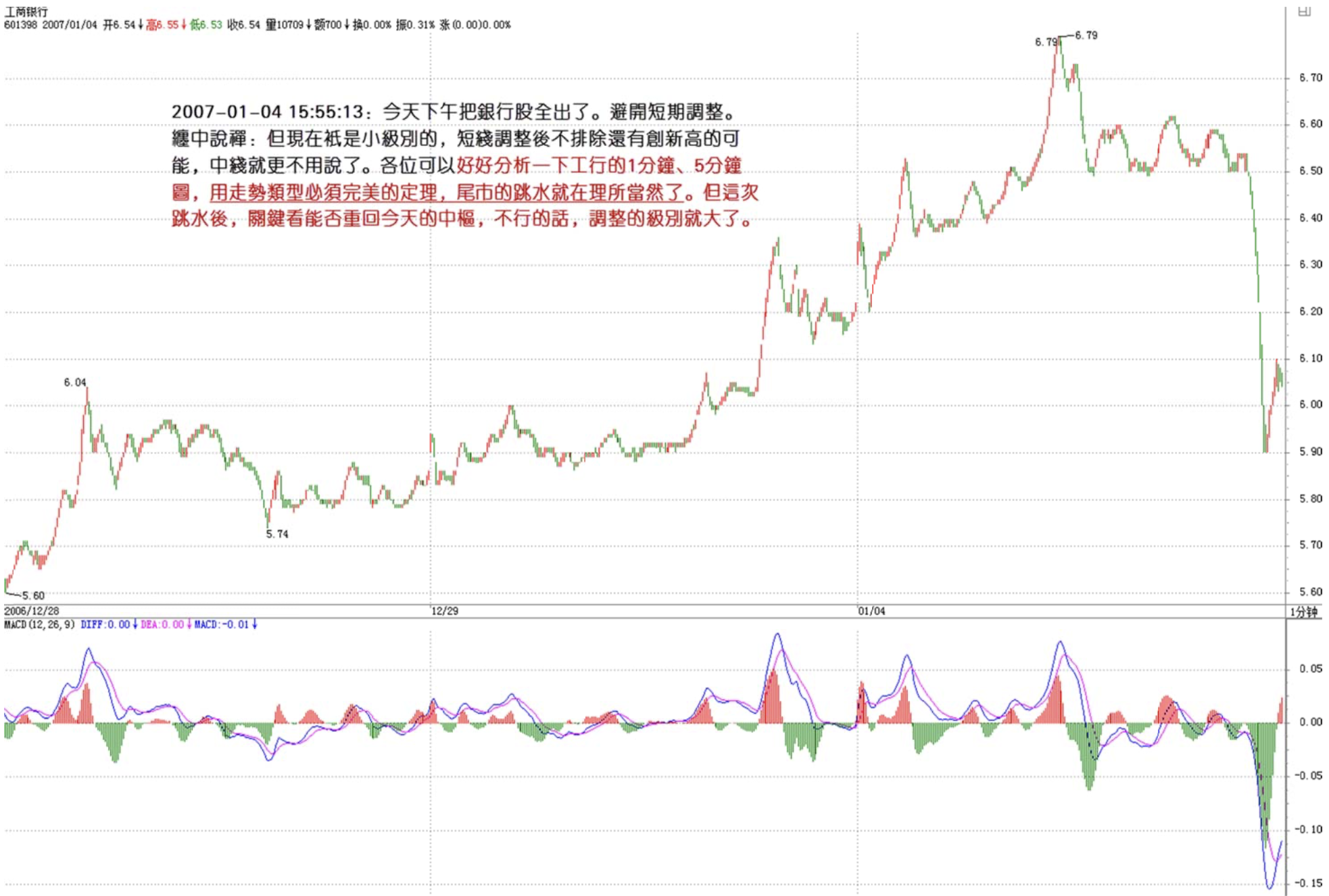
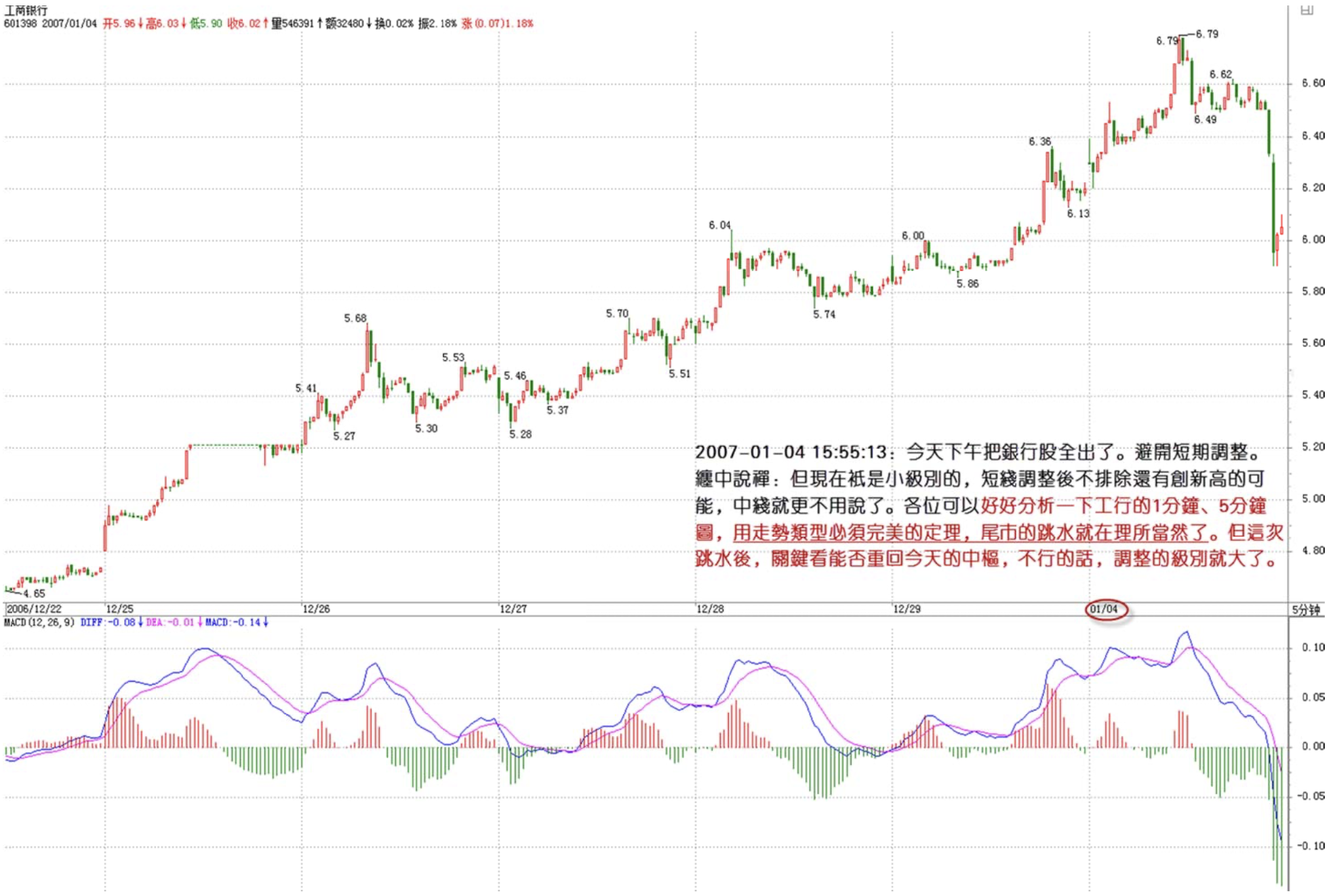
Thank you for the divergence theory, LZ!!! This afternoon I sold all my bank stocks to avoid the short-term adjustment. LZ is truly saving all sentient beings!!!
==
But currently this is only small-level. After a short-term adjustment, a new high cannot be ruled out. The mid-term is even less in question.
Everyone should carefully analyze ICBC's 1-minute and 5-minute charts. Using the theorem that trend types must be complete, the end-of-day plunge was entirely expected. But after this plunge, the key is whether it can return to today's hub — if not, the adjustment level will be larger.
Also, here's another tip for you all: when the catch-up rally of the second-tier leader is stronger than the first-tier leader, this is often a sign that the sector is about to enter adjustment. Compare ICBC's and Bank of China's movements today and you'll understand.
缠中说禅 2007/1/4 16:12:10
[Anonymous] Ge Shi
2007-01-04 15:21:23
Dear blogger:
You're back. Happy New Year, Tashi Delek.
Over the holiday I was chewing on big trees — Chan is not Chan, Zen is not Zen, the dead tree's dragon cry illuminates the great thousand worlds.
What wonderful writing — every word a star. What wonderful poetry — the blogger's level of attainment.
It needs much reading, slowly understood. Having only grasped a fraction, not sure if it's correct?
What is Chan?
Answer: Chan is not Chan, Zen is not Zen, the dead tree's dragon cry illuminates the great thousand worlds. Dead tree is yang, dragon cry is yin — one yin and one yang is called the Way.
All dharmas can be dharma, but all dharmas rest upon the world and time; all dharmas come from present-moment realization, not from speculation.
Understanding the ultimate of all dharmas, one can become Chan, and only then be Zen.
Praise: "Why do you all worry about loss? The world has been without the Way for so long — Heaven will use the Master as its wooden-tongued bell."
Slowly following you, slowly knowing the outcome...
===
Don't talk about Chan and don't talk about Zen yet. Get the Analects figured out first — only then are you qualified to talk about Chan. Otherwise you're just blind men groping the elephant.
From Confucianism to Chan — for modern people, this is probably the safer path.
缠中说禅 2007/1/4 16:16:50
wy1499
2007-01-04 16:08:37
Finally able to hear the blogger's teaching again!
Blogger, if a stock's upward movement is oscillating upward within an ascending channel, wouldn't the hub be different? The third sub-level movement would run outside the range of the first two. How should this be understood? The same goes for descending channels.
====
You still haven't figured out how to calculate hubs. The third segment running outside the first two is perfectly normal. The key is looking at the overlapping portion of the three segments.
缠中说禅 2007/1/4 16:23:21
[Anonymous] Happy New Year
2007-01-04 16:12:14
Chán Zhōng Shuō Chán
2007-01-04 16:01:37
[Anonymous] Heart Yi
2007-01-04 15:55:13
Thank you for the divergence theory, LZ!!! This afternoon I sold all my bank stocks to avoid the short-term adjustment. LZ is truly saving all sentient beings!!!
==
But currently this is only small-level. After a short-term adjustment, a new high cannot be ruled out. The mid-term is even less in question.
Everyone should carefully analyze ICBC's 1-minute and 5-minute charts. Using the theorem that trend types must be complete, the end-of-day plunge was entirely expected. But after this plunge, the key is whether it can return to today's hub — if not, the adjustment level will be larger.
Also, here's another tip for you all: when the catch-up rally of the second-tier leader is stronger than the first-tier leader, this is often a sign that the sector is about to enter adjustment. Compare ICBC's and Bank of China's movements today and you'll understand.
===============================================
Now that Sister Chan has explained it, I understand — that's why Bank of China hit the limit up today while ICBC barely moved. Frustratingly, I actually added more ICBC shares today. I hope it gets back into the hub tomorrow, otherwise I'll have to sell at a loss.
====
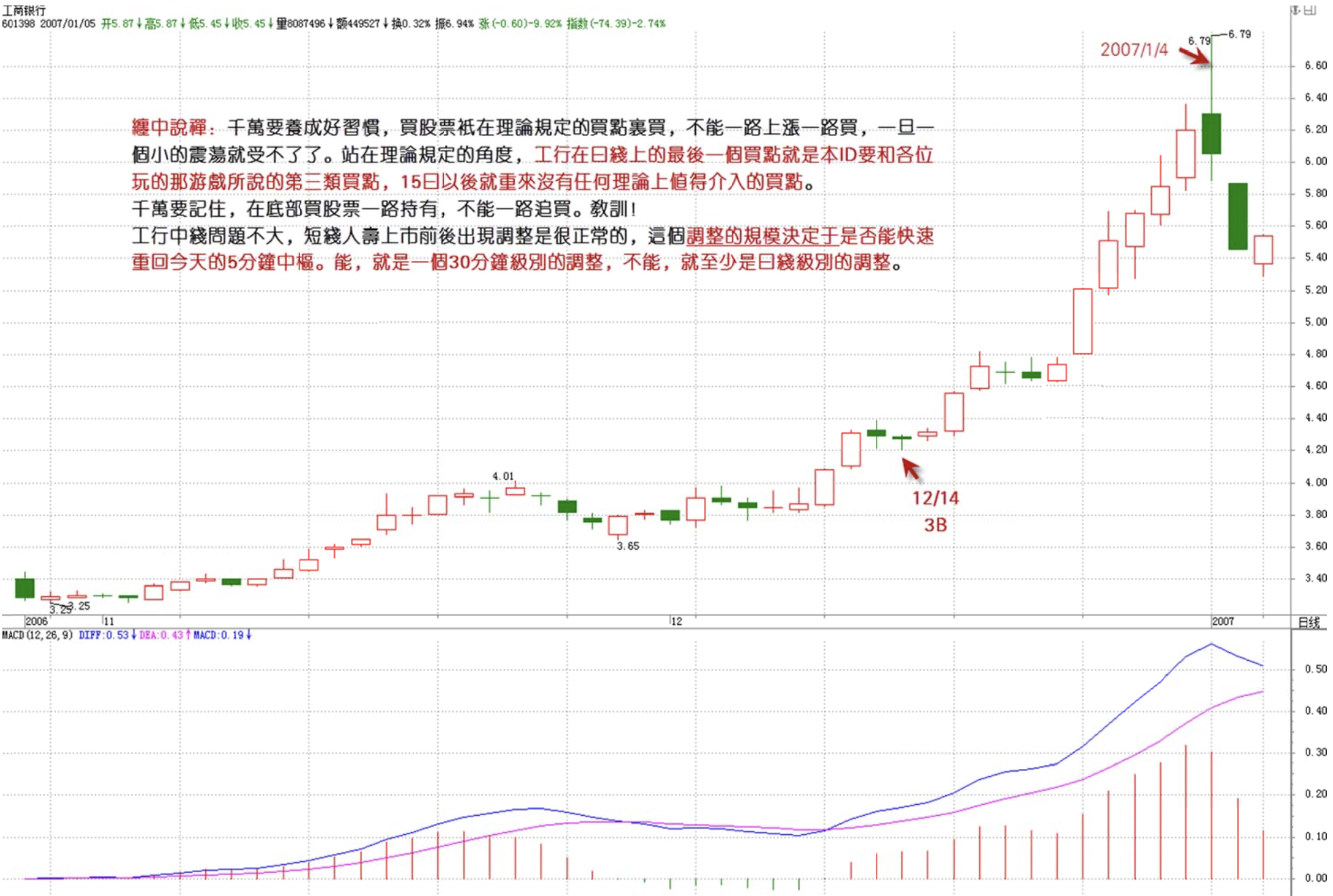
You absolutely must develop good habits — buy stocks only at the theoretically specified buy points. Don't keep buying as it goes up — once there's a small shock, you can't handle it. From the theoretically specified standpoint, ICBC's last buy point on the daily chart was the third-type buy point mentioned in the game this ID was going to play with you all. After the 15th, there has never been any theoretically worthwhile entry point.
Remember: buy stocks at the bottom and hold. Don't chase-buy all the way up. Learn from this lesson!
ICBC has no medium-term problems. Short-term, an adjustment around the time China Life lists is perfectly normal. The scale of this adjustment depends on whether it can quickly return to today's 5-minute hub. If it can, it's a 30-minute level adjustment. If not, it's at least a daily-level adjustment.
缠中说禅 2007/1/4 16:28:06
[Anonymous] Xiaoxiao
2007-01-04 16:20:24
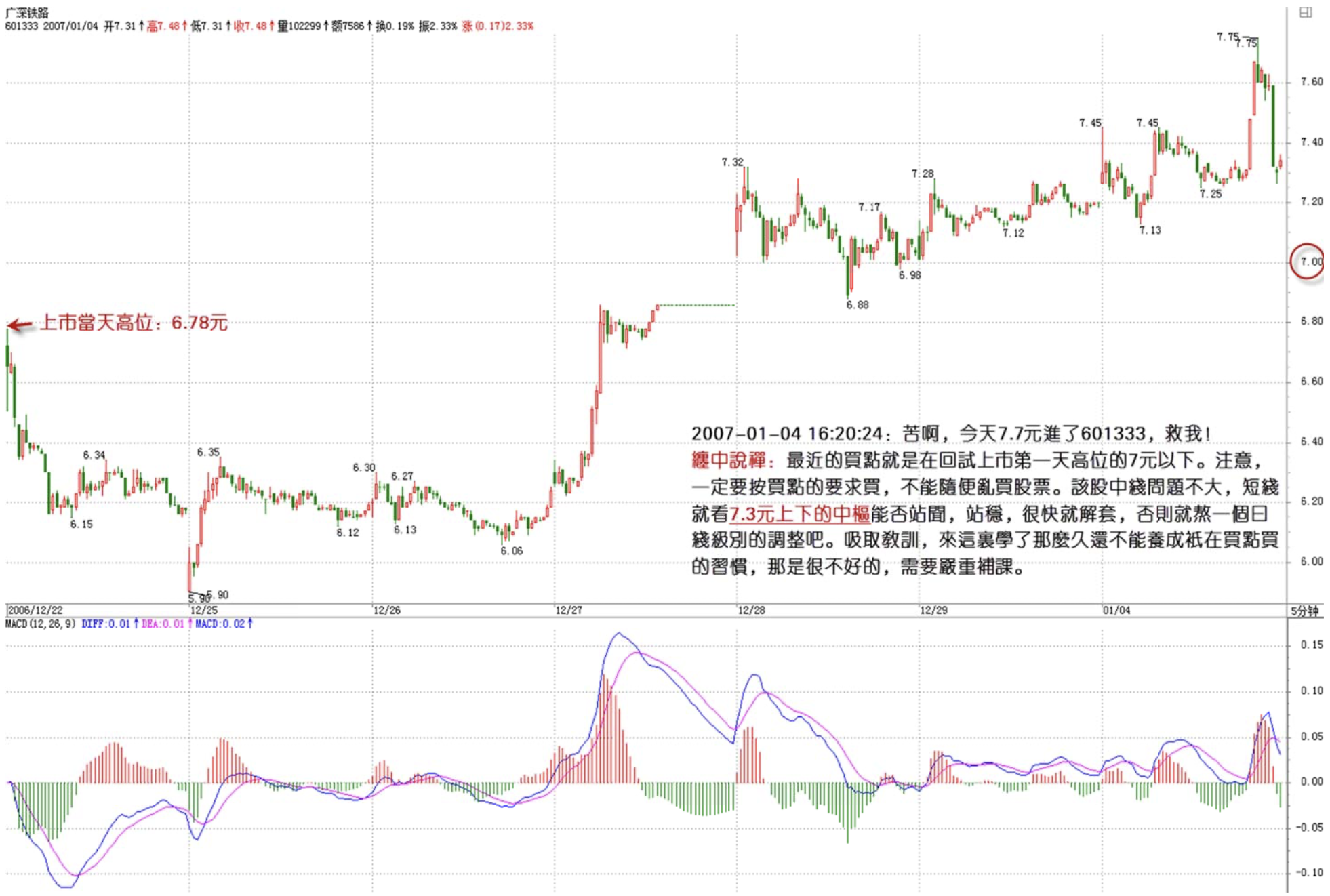
Painful — today I entered 601333 at ¥7.7. Sister Chan, save me!
===
The nearest buy point was below ¥7, when it retested the first-day high from listing.
Note: you must buy according to buy-point requirements — don't randomly buy stocks. This stock has no medium-term problems. Short-term, watch the hub around ¥7.30 — if it holds, you'll be quickly unburdened; otherwise, just endure a daily-level adjustment. Learn from this lesson. After studying here for so long, if you still can't develop the habit of only buying at buy points, that's very bad and requires serious remedial study.
缠中说禅 2007/1/4 16:29:31
[Anonymous] Dongshan
2007-01-04 16:23:49
Where has Sister Chan been playing these few days? Did you have a good time?
===
Boao. It was fine.
缠中说禅 2007/1/4 16:32:40
Attention everyone:
You must first identify your bad habits, write them down, and resolutely correct them. Otherwise, we're in a bull market now — if you make a mistake you still have a chance to correct it. In a bear market, you won't even have that chance. A single bad habit is enough to make all your investments come to nothing. You must correct them — otherwise there will be big trouble, even if right now you might not suffer much.
缠中说禅 2007/1/4 16:42:42
[Anonymous] Intoxicated
2007-01-04 16:32:23
After reading through the stock articles, Chan's thinking is very clear and logically complete. Admirable.
But looking at some of the questions being raised here, my initial reading also raised similar confusions. Respectfully request an explanation.
Thank you, Chan, for the hard work of exchange.
As a newcomer, please be patient with your answers...
Question 1: People seem confused about divergence. It probably stems from the judgment of what constitutes a "trend."
Looking at this case -----
On the daily chart, using Maotai as an example with the 5-day and 10-day MAs:
On August 7, after the second entanglement with the male-dominant position, a decline occurred, but volume and other indicators clearly showed divergence, forming a small bear trap, constituting the first buy point around ¥41.
On September 14, the female-dominant position's first entanglement decline formed the second buy point around ¥44.
Following this analysis, it should be the area formed from July 4 to June 21, 2006, compared to the area formed from August 2 to August 11, 2006. The reason August 7 is the first buy point is based on the "trend average force: the area between the short-term and long-term MAs from the current point to the end of the previous 'kiss,' divided by time. Because this concept is real-time, you can immediately judge the comparison between current and previous trend average forces. Once the current one is weaker than the previous one, you can determine that 'divergence' is about to form. Then based on the distance between short-term and long-term MAs, once the extension length shortens, the true bottom is about to form." This method compares two adjacent declining trends.
But on 580991, on the daily chart, why can't the areas from September 22 to October 17 and from October 17 to October 30 be compared?
Chan's point is that there must be a trend, but in the Maotai case, the patterns are basically the same. And in the 30-minute upward divergence of 601588, the patterns are even more similar, and Chan directly compared them.
Puzzled...
Question 2: Someone raised whether there can be multiple divergences, probably from this case:
601588 Beijing North Star
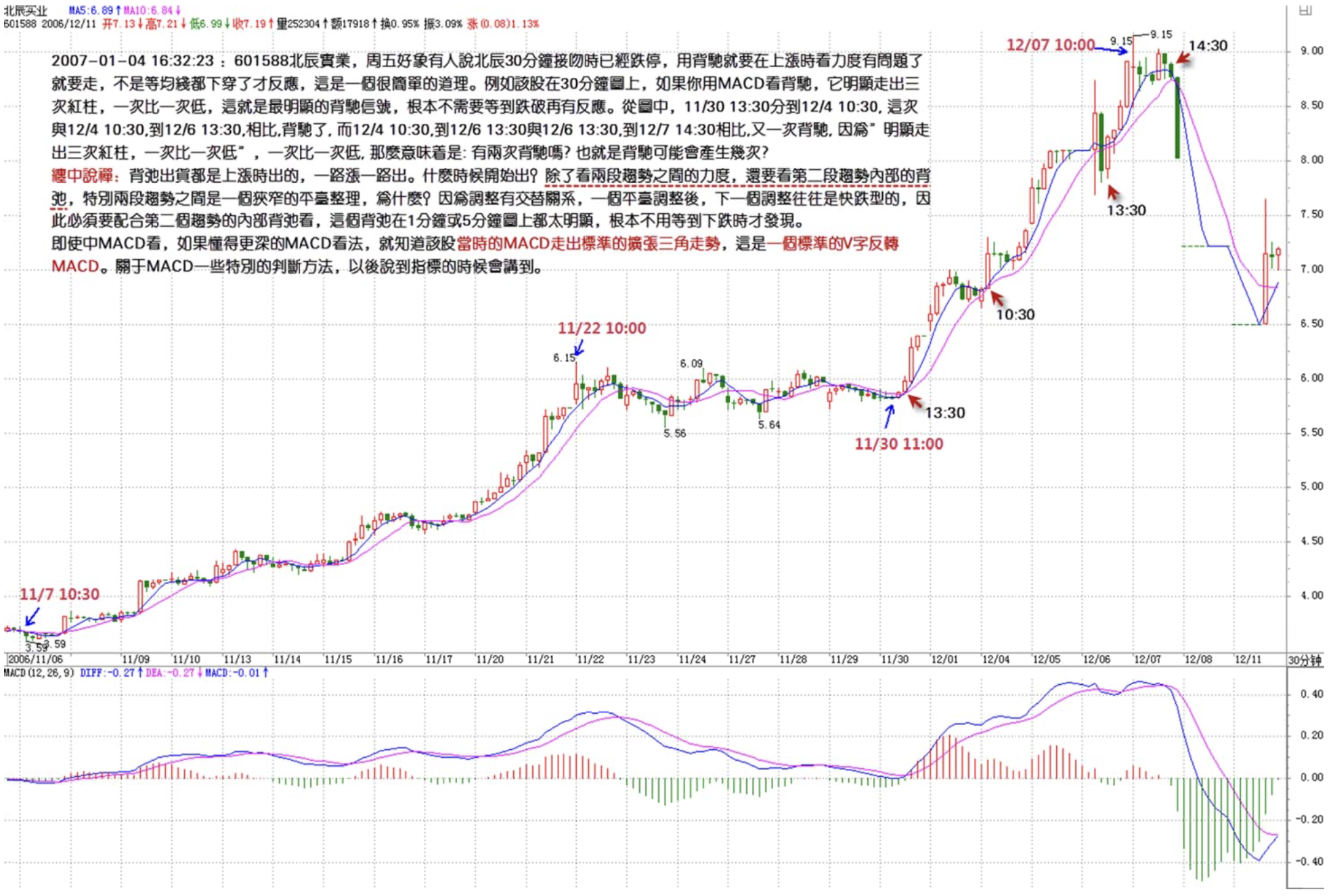
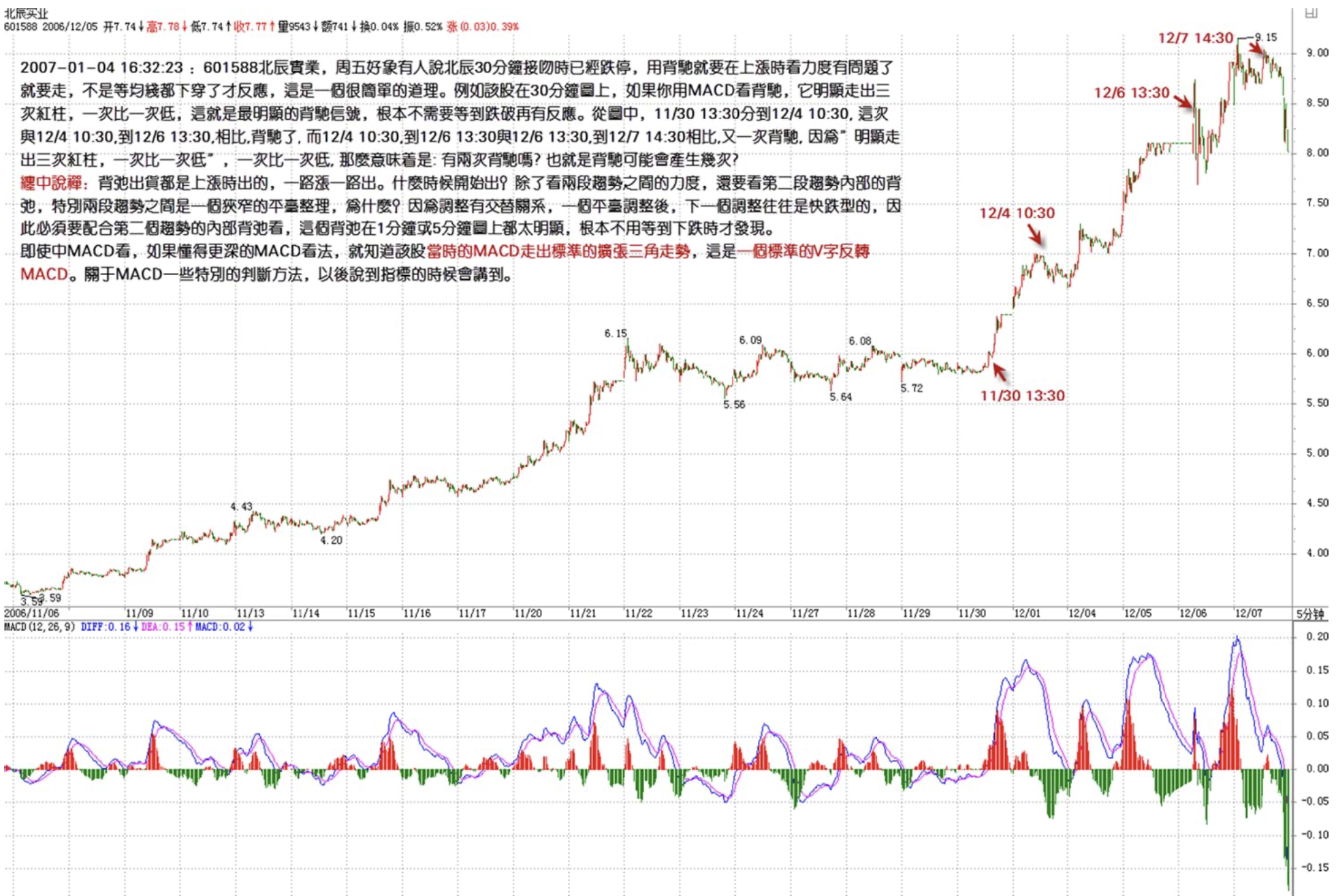
"Also, on Friday someone said that by the time the 30-minute kiss appeared, the limit-down had already happened. With divergence, you should exit when you see force weakening during the rise, not wait until the MAs cross down — this is a very simple principle.
For example, on the 30-minute chart of this stock, if you use MACD to see divergence, it clearly shows three red bar clusters, each lower than the last — this is the most obvious divergence signal. There's absolutely no need to wait for a break before reacting."
Each lower than the last — does this mean there are two divergences?
From the chart: 11-30 13:30 to 12/4 10:30 compared with 12/4 10:30 to 12/6 13:30 shows divergence, and then 12/4 10:30 to 12/6 13:30 compared with 12/6 13:30 to 12/7 14:30 shows another divergence, because "three red bar clusters clearly appeared, each lower than the last."
==
Selling on divergence is always done during the rise — sell as it goes up. When do you start selling? Besides looking at the force between two trend segments, you also need to look at the internal divergence within the second trend segment — especially when the gap between two trend segments is a narrow platform consolidation. Why? Because adjustments have an alternating relationship. After a platform adjustment, the next adjustment tends to be a sharp-fall type, so you must combine the internal divergence of the second trend to assess. This divergence is too obvious on 1-minute or 5-minute charts — there's absolutely no need to wait until the decline to discover it.
Even looking at MACD, if you understand deeper MACD reading methods, you'd know this stock's MACD at that time formed a standard expanding triangle pattern — a standard V-reversal MACD. Some special MACD judgment methods will be discussed later when we cover indicators.
缠中说禅 2007/1/4 16:44:02
[Anonymous] Xiaoxiao
2007-01-04 16:38:03
I'll absolutely remember Sister Chan's teaching. Boao is a great place! I didn't make money from 580010 — I really need to reflect!!!!!!!!!
===
Study your own buy and sell points carefully — whether they meet the requirements. That's how you improve.
缠中说禅 2007/1/4 16:49:16
[Anonymous] Whoever It Is
2007-01-04 16:34:11
===
Don't talk about Chan and don't talk about Zen yet. Get the Analects figured out first — only then are you qualified to talk about Chan. Otherwise you're just blind men groping the elephant.
From Confucianism to Chan — for modern people, this is probably the safer path.
======
Why? Is it saying one should first learn the Way of engagement with the world, learn how to be a person, a sage, before exploring the Way of transcendence regarding life and death? Did the Sixth Patriarch know Confucianism?
===
The Sixth Patriarch is the Sixth Patriarch. Modern people should still start with Confucianism — but not the nonsensically distorted Confucianism.
Also, don't trap yourself with the framework of life and death. No one has bound you — what are you liberating yourself from? No one has given you life and death — what are you transcending? Those who seek to transcend life and death are precisely in life and death; those who don't seek to transcend life and death are also precisely in life and death.
Chan is neither seeking nor not-seeking, neither resolving nor not-resolving. Using a business model to frame it is useless.
缠中说禅 2007/1/4 16:55:51
wy1499
2007-01-04 16:45:17
wy1499
2007-01-04 16:08:37
Finally able to hear the blogger's teaching again!
Blogger, if a stock's upward movement is oscillating upward within an ascending channel, wouldn't the hub be different? The third sub-level movement would run outside the range of the first two. How should this be understood? The same goes for descending channels.
====
You still haven't figured out how to calculate hubs. The third segment running outside the first two is perfectly normal. The key is looking at the overlapping portion of the three segments.
===================
What I mean is, the third segment has no overlap with the first two, or only overlaps at the very boundary of the first two — does this still count as a hub?
==
The fact that you're saying this proves you haven't even figured out how to find the three segments. The three segments are connected to each other — three consecutive segments always have overlap. It's simply impossible for there to be "only boundary overlap."
The simplest example: draw an N shape yourself — up, down, up. No matter how you draw it, you cannot draw one without overlap.
How could there be no overlap? For example, up, up, up — but that only constitutes one up-move. You can't treat that as three segments.
缠中说禅 2007/1/4 17:01:28
demarking
2007-01-04 16:47:39
I enjoy reading LZ's articles on Confucius. Trading stocks is really like everything else — the key is personal cultivation. The real skill is always outside of stocks.
===
Just like if someone is very clear on the theory that they should buy at the first, second, and third type buy points, but then forgets everything when they look at the screen — no theory or method would be useful. Why? Because they're completely controlled by their own greed and fear. A good investor must first conquer themselves and become a self-aware person; otherwise nothing means anything.
缠中说禅 2007/1/4 17:08:26
[Anonymous] Speechless
2007-01-04 15:54:26
Sister Chan, after reading your replies last night, I studied until after 11 PM and got a bit clearer. Generally, a hub's K-line combination should have at least a dozen-odd candles, right? I found 002065 — does it look like a second-type buy point has appeared on the daily chart?
===
Conceptual error. A new stock, if it hasn't experienced a large decline on the daily chart, won't have a first-type buy point — and therefore even less a second-type buy point. Of course, at smaller levels, there will be.
Generally speaking, for new stocks that rise from the opening, there's typically only a third-type buy point.
缠中说禅 2007/1/4 17:13:18
wy1499
2007-01-04 17:05:36
My understanding of overlap is that the vertical-plane projections of three segments have a common portion — that should be correct, right!
Could the blogger also take a look at Baosteel from 2006.11.07 to 2006.12.08? If those two declining segments had slightly steeper angles, wouldn't the situation I described be possible?
==
Completely wrong understanding. Those are clearly two hubs at the 30-minute level or below — what do they have to do with "three segments"? Baosteel hasn't formed a daily-level hub at all since November.
缠中说禅 2007/1/4 17:25:37
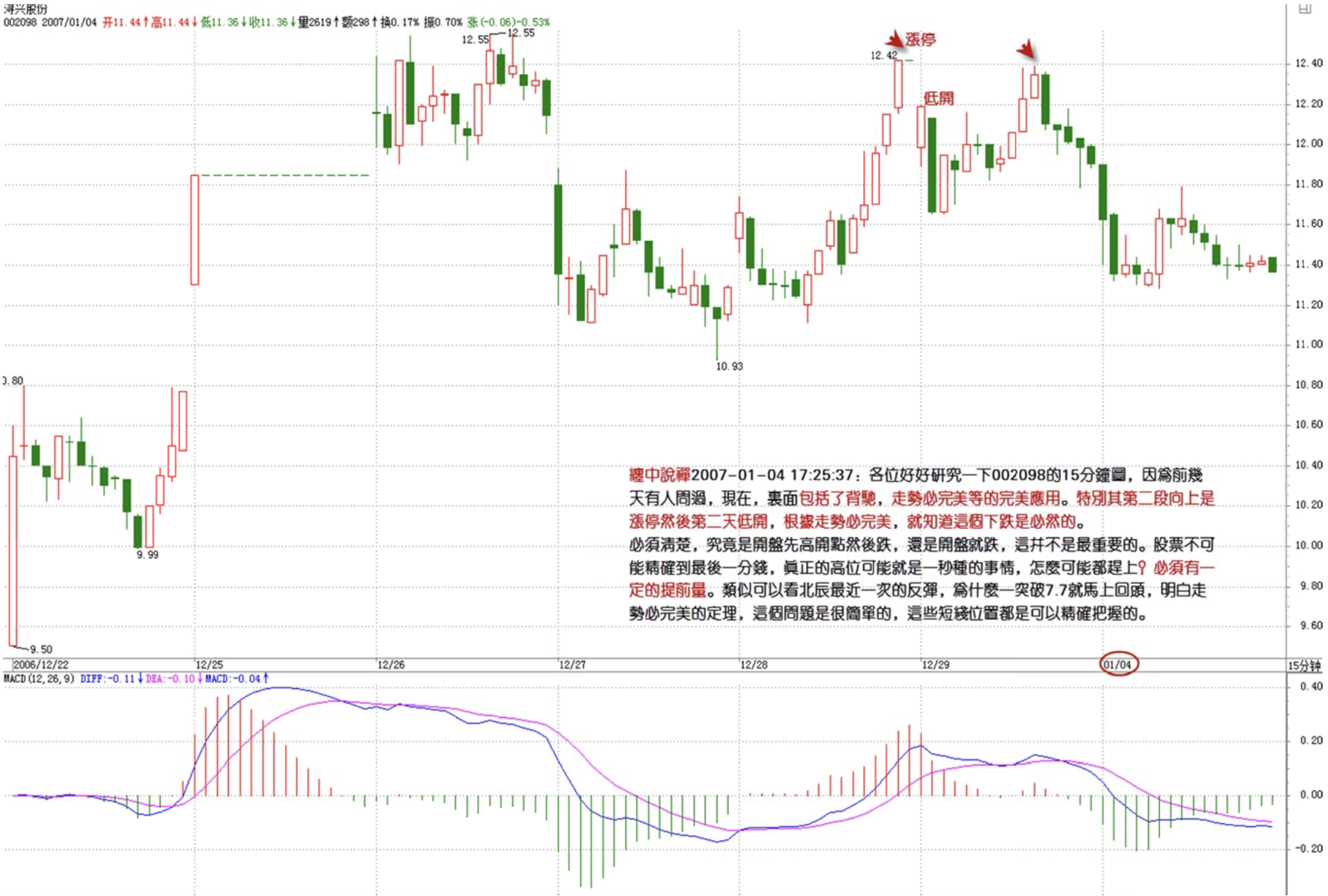
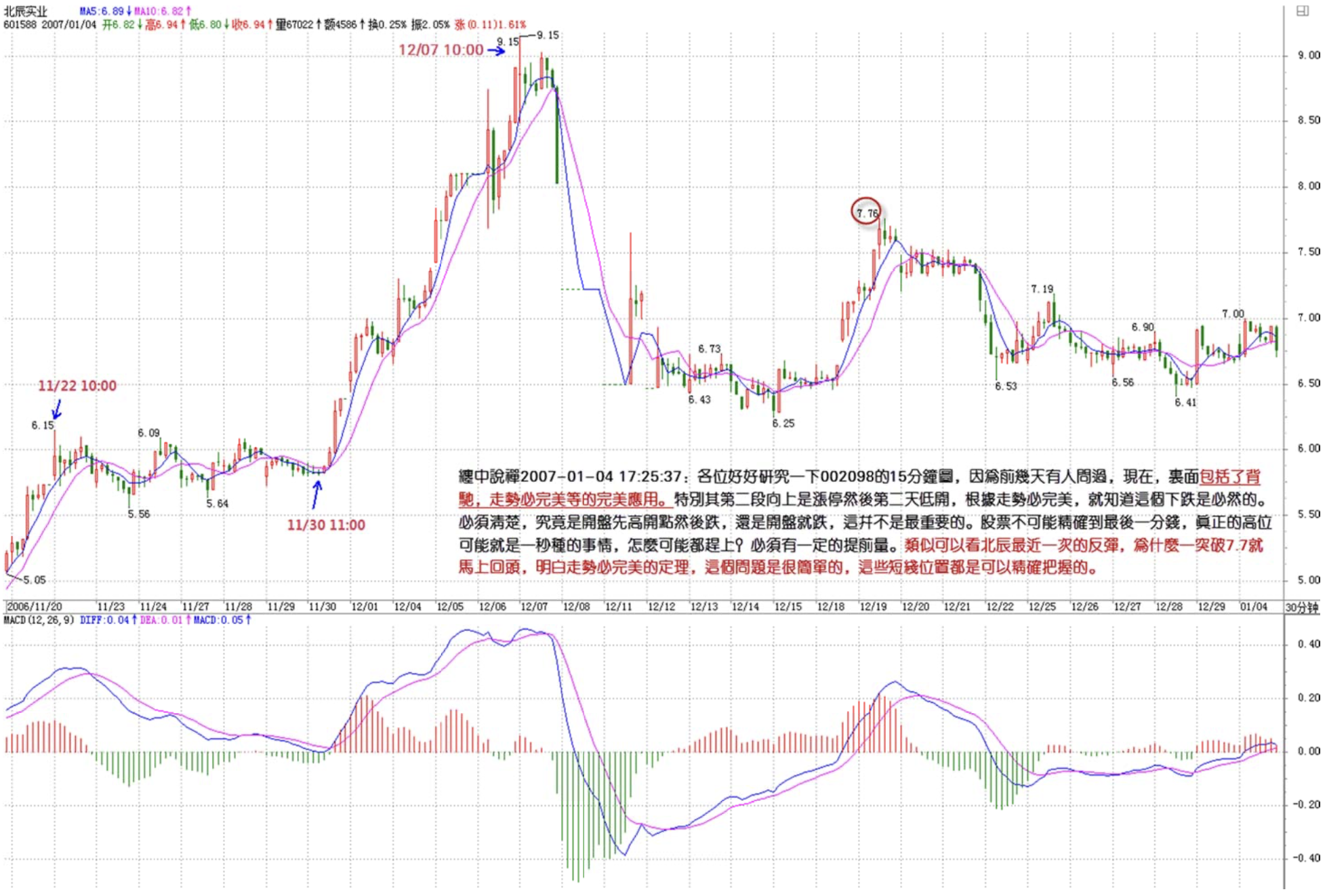
Everyone should study 002098's 15-minute chart carefully. Someone asked about it a few days ago. Now, it contains a perfect application of divergence, the principle that trends must complete, and more.
Particularly, its second upward segment was a limit-up followed by a gap-down open the next day. According to the principle that trends must complete, this decline was inevitable.
You must understand that whether it opens slightly higher and then drops, or opens directly lower, is not the most important thing. Stocks can't be accurate to the last cent. The actual high could be a one-second affair — how could everyone catch it? You must have a certain margin of anticipation.
Similarly, look at North Star's most recent bounce — why did it immediately reverse upon breaking ¥7.7? If you understand the principle of trends must complete, this is a very simple question. These short-term positions can all be precisely grasped.
缠中说禅 2007/1/4 17:27:04
[Anonymous] Xiaoxiao
2007-01-04 17:23:26
Sister Chan, I always have trouble comparing trend force — they all look equally strong to me. So frustrating!!
===
We'll continue discussing this later. Don't rush. Tomorrow's post is extremely important — you must study it thoroughly.
缠中说禅 2007/1/4 17:28:42
Everyone, I'm logging off first. You can all study and discuss with each other too — this ID alone may not be able to answer everyone. Studying among yourselves, and if you can't resolve something, you can ask this ID. This way, having gone through the thought process yourself, the learning will be truly effective.
Leave questions here and I'll address them tonight. Goodbye.
缠中说禅 2007/1/4 20:34:11
[Anonymous] Not Cordyceps
2007-01-04 19:26:53
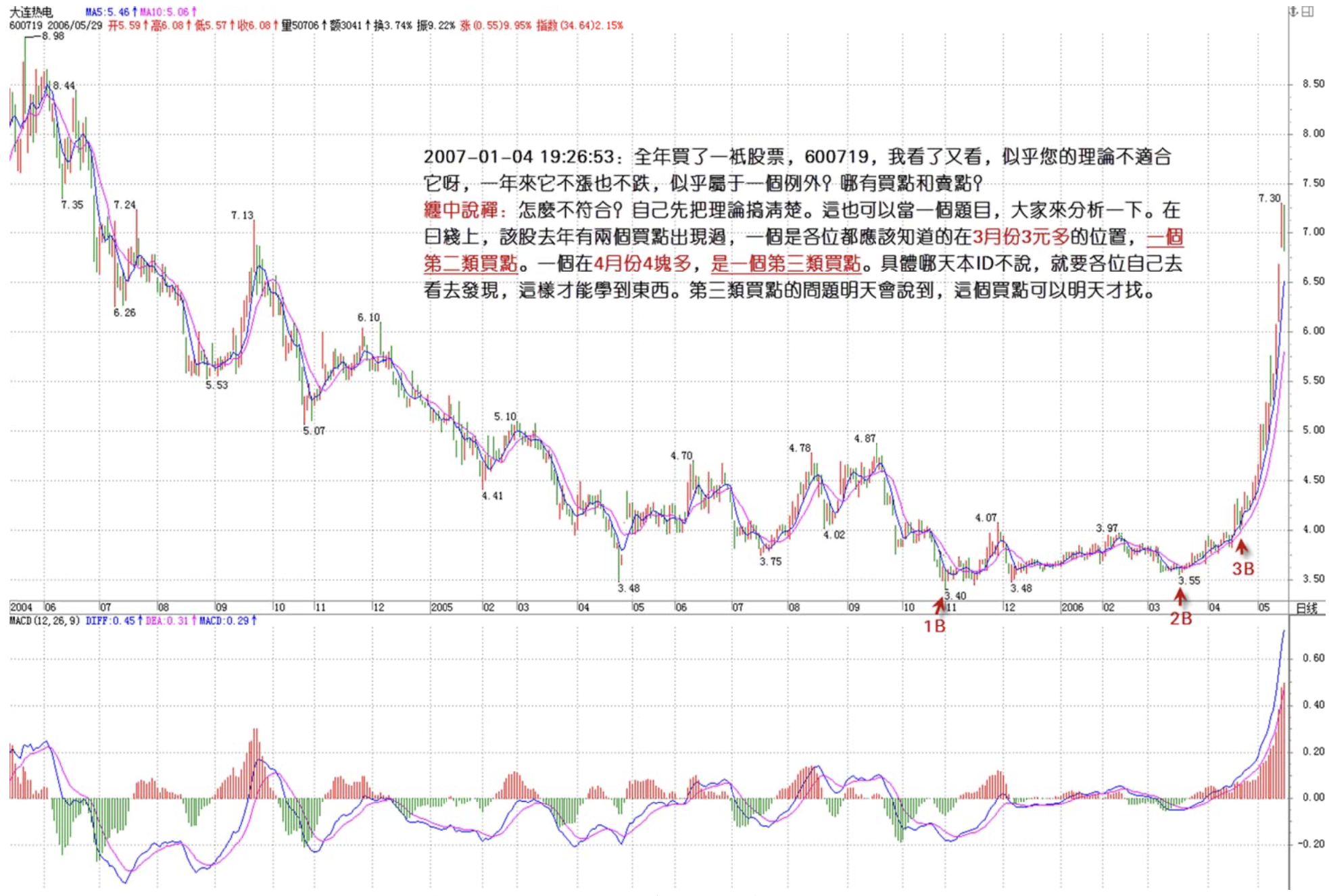
I bought just one stock all year — 600719. I've looked at it top-down, left-right, looked and looked again. It seems Chan Theory doesn't apply to it. For a whole year it neither rose nor fell — seems like an exception? Where are the buy and sell points?
==
How doesn't it fit? First, get the theory clear. This can also serve as an exercise — everyone analyze it. On the daily chart, this stock had two buy points appear last year. One is what you all should know — around ¥3-plus in March, a second-type buy point. The other was around ¥4-plus in April, a third-type buy point. This ID won't say the exact dates — you all need to look and discover them yourselves. That's how you actually learn.
The third-type buy point issue will be discussed tomorrow, so you can look for that one afterward.
缠中说禅 2007/1/4 20:39:33
[Anonymous] Speechless
2007-01-04 19:26:33
Dizzy. Looks like I still haven't figured out the buy point issue. But Sister Chan, I asked before — when a buy point appears, how do you judge the strength of the subsequent movement? You said it wasn't time yet. We small investors don't have insider information, so of course we want to buy in after the trend is confirmed; we can only find small-level buy points. How could we possibly buy at the bottom and hold all the way to the sell point? Also, could Sister Chan please look at 600704 — what level of buy point appeared today? Thanks!
===
First, understand this: any rise definitely results from some type of buy point at some level. But not every buy point is worth acting on. Generally, the larger the level, the more valuable.
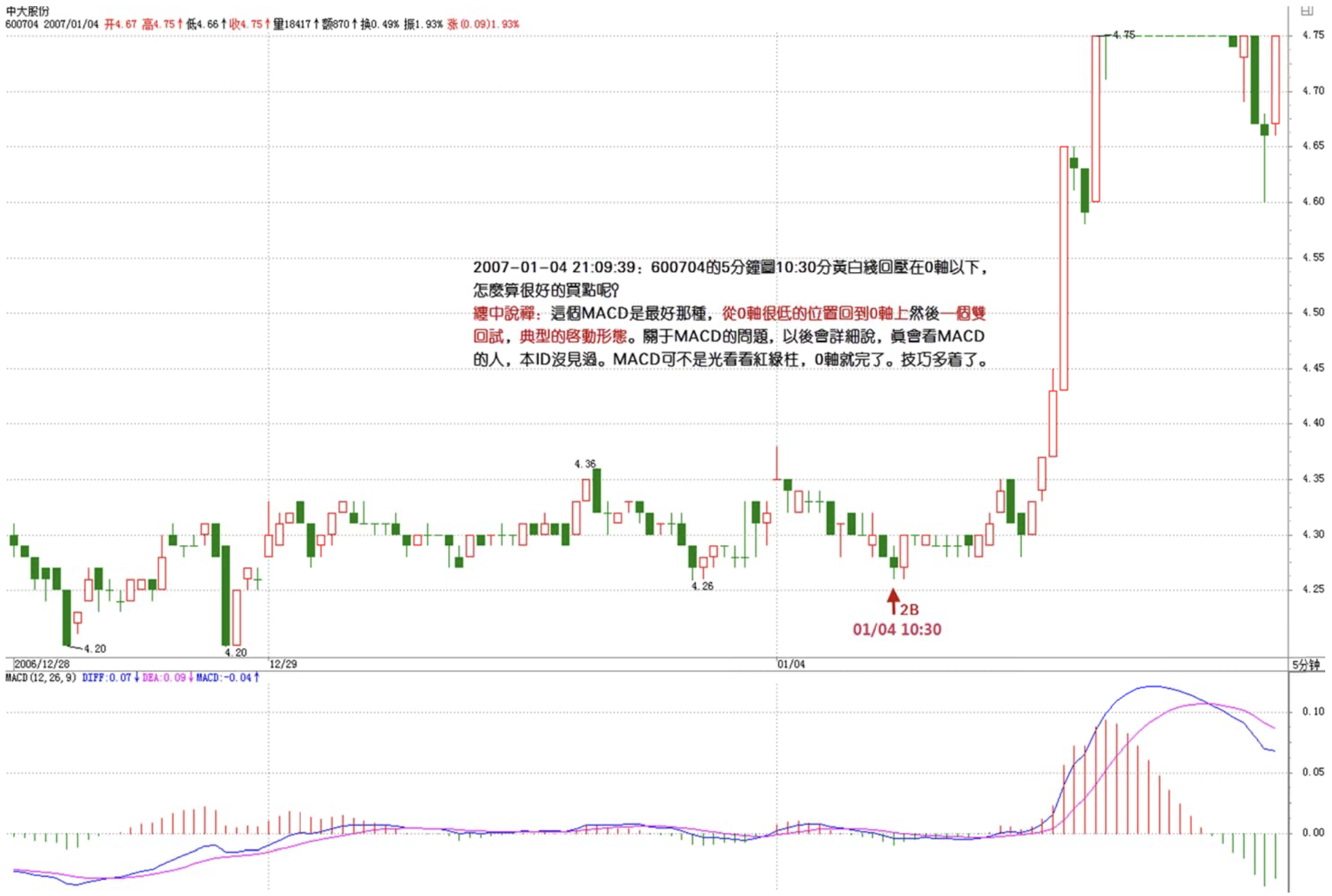
For 600704, at 10:30 today, you can find a very good second-type buy point on the 5-minute chart.
You need to put more effort into the theory — that's how it becomes your own skill.
缠中说禅 2007/1/4 20:45:30
[Anonymous] 12asd
2007-01-04 19:37:58
Blogger, could you find a more typical chart and explain it in slightly more detail? It would help with understanding.
===
Note: theoretically, charts of any level are no different. That is, the same theoretical tools can be used to analyze charts at any level, with equal accuracy.
Theoretically, if you truly understand this ID's theory and have the capability to simultaneously monitor every stock's movements at every level, you could capture any rise at any level of any stock.
Of course, in practice, this is impossible to achieve. You can only narrow your monitoring scope as much as possible and increase the level as much as possible, based on your actual circumstances. For example, only looking at daily charts, and under current conditions only watching component stocks — this way, the workload becomes manageable.
But the prerequisite is that you must master the theory itself. Put in more effort. Start with any daily chart, analyze it using what you understand, and if there's something you can't figure out, ask. That's the only way to learn real skills.
缠中说禅 2007/1/4 20:49:57
[Anonymous] Happy New Year
2007-01-04 18:10:30
Regarding the 15-minute chart of 002098, I have some questions, please advise Sister Chan:
Per Sister Chan's earlier explanation, the pre-listing period counts as one up-move. On the day of listing, a hub formed — this should be an upward hub. Since there should be more than one upward hub, a limit-up immediately formed a second hub (completed within 12/26 alone).
After the second hub completed, a downward movement formed. Then from 12/27 09:45 to 12/28 13:45, a hub formed; then from 12/29 09:45 to 12/29 15:00, another hub; and today another hub formed, but this one isn't complete yet. If this is the case, what's the relationship between these three consecutive hubs? I really can't figure it out. Or perhaps from 12/27 to today counts as just one hub? I get confused whenever I see these ambiguous situations. Please help, Sister Chan, how should we read this kind of chart? If it's the second interpretation (only one hub from 12/27 until now), then this downward movement isn't complete yet, and there should be at least one more downward hub before it's finished.
===
Note: this stock's situation is different from that railway stock. This stock only has one hub on the 15-minute chart, while the railway stock has two. Also, there aren't "three consecutive hubs" — rather, three consecutive sub-level movements constitute one hub.
Please get these basic concepts clear first.
缠中说禅 2007/1/4 20:50:33
[Anonymous] Photography Friend
2007-01-04 20:39:20
Dear blogger:
Welcome back. My feelings toward you grow warmer and warmer. I even talk about you with my mom!~~
She just says, "That girl." Heh!~~~
==
Thank you
缠中说禅 2007/1/4 20:57:07
[Anonymous] Iron Smelting Equipment
2007-01-04 18:28:34
601988, 601398, 601333. All that excitement for nothing — the correction came so fast it left me completely at a loss.
===
First, once you buy a stock, you must constantly monitor for exit positions — stocks are bought to be sold.
Second, when to sell? The key is where you bought. The most basic principle is: if you bought at a buy point of a certain level, sell at the sell point of that same level. If you bought at the daily level, you can basically ignore 30-minute corrections. Of course, if you have the time, you can play short-term swings using the 30-minute sell points — sell at the 30-minute sell point and buy back at the 30-minute buy point.
Finally, and most crucially, the biggest problem most people have now is buying stocks blindly — not buying at an acceptable buy point of some level, but buying on impulse and selling on impulse. If that's how you operate, you'd be better off not trading stocks at all — just go gamble on dice, at least that's more fun.
Let me say it again: develop good habits first.
缠中说禅 2007/1/4 21:00:54
[Anonymous] d
2007-01-04 17:36:22
OP:
I feel there are bigger opportunities in call warrants, but with stock index futures about to launch, will they have a major impact on warrants? Thanks.
===
This question has already been answered in previous posts. Once futures launch, big money will all go play futures — that's the main army. Warrants will become the game of small players and the market makers of their underlying stocks. Warrants will increasingly be constrained by their underlying stocks, and independent price movements will be much rarer than now.
缠中说禅 2007/1/4 21:08:48
[Anonymous] Anonymous Nobody
2007-01-04 20:43:41
Regarding foreign exchange — China exchanged rivers of migrant workers' blood and tears and mountains of miners' ashes for massive foreign exchange reserves, only to hand them over to America for free. Facing China's unprecedented resource catastrophe and people's catastrophe, China's mainstream economists cheered rapturously, claiming we earned precious foreign exchange. We do indeed hold one trillion dollars in foreign exchange reserves, but rather than being China's precious wealth, it would be more accurate to call them America's precious wealth. On one hand, over two-thirds of the trillion in reserves are dollar-denominated assets. What is the US dollar? Plainly speaking, it's paper printed by American printing presses — America can print as much as it wants. As dollar printing increases and the American economy weakens, China's hard-earned foreign exchange depreciates sharply with the dollar. Calculated in euros, dollar assets have depreciated 50% in recent years. Over 700 billion dollars in China's reserves have evaporated by half — the evaporated purchasing power equals China's entire national wage income last year. This year, reserves calculated in RMB evaporated another 6%, equivalent to 60 billion dollars, exceeding the national total for healthcare, education, and pension funds combined. On the other hand, the vast majority of our reserves went to buying US Treasury bonds. There used to be a slogan mobilizing the people: "Buy government bonds to support national construction." Now we're buying US Treasury bonds to fill America's fiscal deficit, using massive reserves to stabilize American prices, flatten American living costs, and support American national construction.
===
This view is extreme. Saying foreign exchange "evaporated" is downright ignorant — it shows a fundamental unfamiliarity with how international finance operates. The key isn't how much foreign exchange you have, but that these reserves can't become dead money — they must become a powerful weapon for overseas expansion.
缠中说禅 2007/1/4 21:16:17
[Anonymous] Ge Shi
2007-01-04 21:08:48
===
Don't talk about Chan yet — first get the Analerta clear, then you'll be qualified to discuss Chan. Otherwise you're just blind men groping an elephant.
Going from Confucianism to Chan Theory might be a safer route for modern people.
========
The OP's teaching is right — one really shouldn't aim too high. I was just overestimating myself out of curiosity. Studying Chán Zhōng Shuō Chán trend hubs, I have a question: the "N-shape" or "inverted N" seen on a K-line chart isn't necessarily a Chán Zhōng Shuō Chán trend hub — you need to check whether each of the three segments is a completed trend type on the sub-level K-line chart, and whether it's completed depends on whether it has formed at least one Chán Zhōng Shuō Chán trend hub. Is that correct? Before, I was vaguely looking for "N-shapes" or "inverted N's" to find Chán Zhōng Shuō Chán trend hubs, but once I tried to be precise about it, the more I tangled with it the more confused I got. Isn't there a simpler prajna? OP, have mercy, please!!!
====
Of course. For instance, at a certain level an up move + consolidation + down move can be called N-shaped at that level, but you can't say that constitutes a hub. In fact, within an up + consolidation + down sequence, there are at least 5 hubs at that level.
A hub must be composed of three completed trend types at the sub-level — this is a requirement.
缠中说禅 2007/1/4 21:29:36
[Anonymous] Learner
2007-01-04 21:15:42
[Anonymous] Learner
2007-01-04 17:13:44
OP, hi
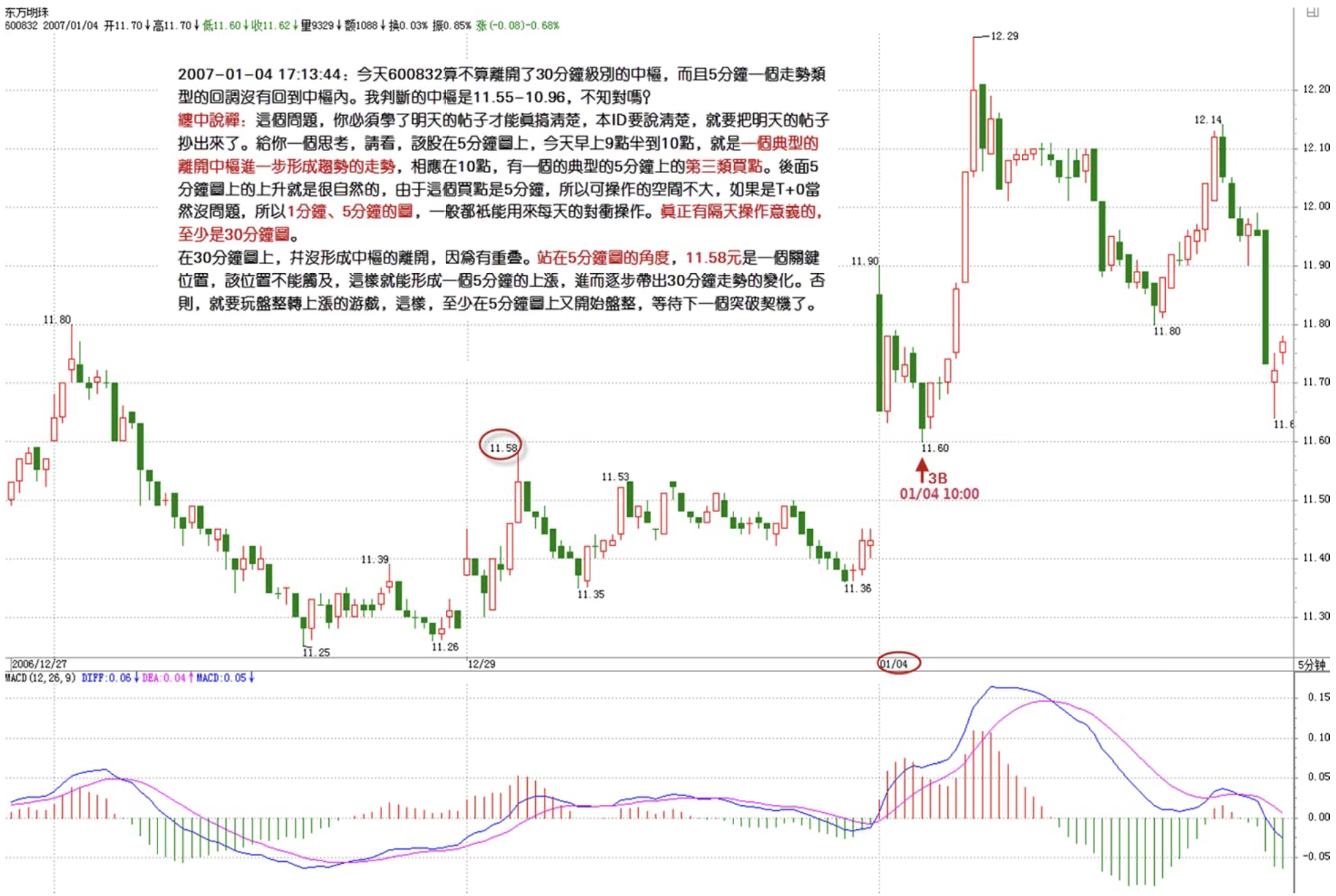
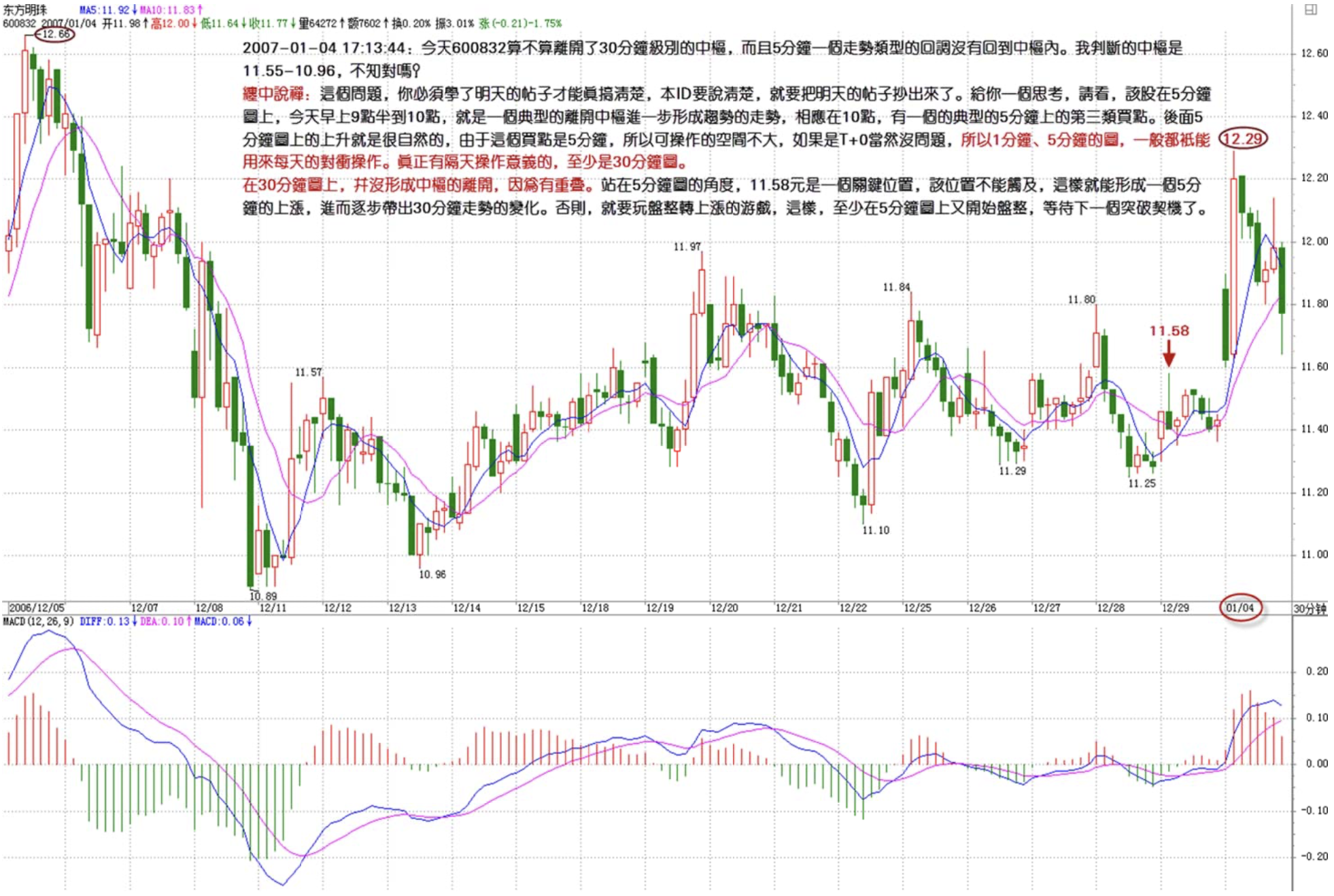
Does 600832 today count as having left the 30-minute level hub, with the 5-minute trend type pullback not returning into the hub? I'm judging the hub to be 11.55--10.96
------------------------
OP, could you evaluate whether I'm right or wrong so I can gain some insight?
====
For this question, you really need to study tomorrow's post to fully understand it. If this ID were to explain it clearly here, I'd have to copy out tomorrow's post.
Here's something to think about. Look — on the 5-minute chart for this stock, from 9:30 to 10:00 this morning, there was a classic move of leaving the hub and further forming a trend. Correspondingly, at 10:00, there was a classic third-type buy point on the 5-minute chart. The subsequent sharp rise on the 5-minute chart was perfectly natural. Since this buy point is at the 5-minute level, the operational space isn't large — if it were T+0, of course no problem. So 1-minute and 5-minute charts can generally only be used for daily hedging operations. For meaningful overnight operations, you need at least the 30-minute chart.
On the 30-minute chart, no departure from the hub has formed, because there is overlap. From the perspective of the 5-minute chart, 11.58 yuan is a key level — if this level is not touched, a 5-minute uptrend can form, which would gradually bring about changes in the 30-minute trend. Otherwise, it becomes a game of consolidation-to-uptrend conversion, meaning at least on the 5-minute chart, consolidation starts again, waiting for the next breakout opportunity.
缠中说禅 2007/1/4 21:31:50
[Anonymous] Seeking Advice
2007-01-04 21:23:30
Dear OP:
Do all stocks with gap-up openings eventually have to fill the gap? When does it usually get filled?!!!
===
Shanghai had a big gap at the 300-something point level in August '94 — it wasn't filled for over ten years. What does that tell you? Of course, gaps that appear after a strong rally, and gaps during consolidation, will definitely be filled. But breakaway gaps will definitely not be filled before the trend is complete.
缠中说禅 2007/1/4 21:35:57
[Anonymous] Speechless
2007-01-04 21:09:39
Sis Chan, on 600704's 5-minute chart at 10:30, the yellow and white lines pulled back below the zero axis — how can that be a great buy point?
===
This MACD is the best kind — it came back from well below the zero axis to above zero, then had a double retest. A classic launch pattern. This ID will discuss MACD issues in detail later. This ID has never met anyone who truly knows how to read MACD. MACD isn't just about looking at red and green bars and the zero axis and calling it done. There are tons of techniques.
缠中说禅 2007/1/4 21:37:32
[Anonymous] nn
2007-01-04 21:32:49
Fewer and fewer people are discussing the Analerta these days, so let me pop in. I feel this post by the OP is a bit of a stretch. Confucius's heart really did harbor contempt for farmers — and there's nothing wrong with that. Let alone his era, even today, how many people truly respect our farmer brothers? Why else does the central government repeatedly urge against defaulting on migrant workers' wages? Of China's 1.3 billion people, farmers make up 900 million to 1 billion, yet the weak are still farmers — why? This is exactly the root of Confucius's contempt for farmers. After the OP reads the following dialogue, what else is there to say?
Fan Chi asked to learn farming. Confucius said: "I am not as good as an old farmer." He asked to learn gardening. Confucius said: "I am not as good as an old gardener." Fan Chi left. Confucius said: "What a petty man Fan Xu is! If the rulers love ritual, the people will not dare to be disrespectful; if the rulers love righteousness, the people will not dare to be disobedient; if the rulers love trustworthiness, the people will not dare to be insincere. If it were so, then people from all directions would carry their children on their backs and come — what need would there be for farming?"
Looking forward to everyone's discussion!
====
Get today's lesson clear first before talking about that. This ID will address this passage later — it doesn't mean what you think it means.
缠中说禅 2007/1/4 21:40:24
Everyone, please spend more time reading the explanations of the Analerta. The explanation of this chapter is essentially Confucius's version of Das Kapital — study it well when you have time.
缠中说禅 2007/1/4 21:43:30
[Anonymous] 戈石
2007-01-04 21:24:00
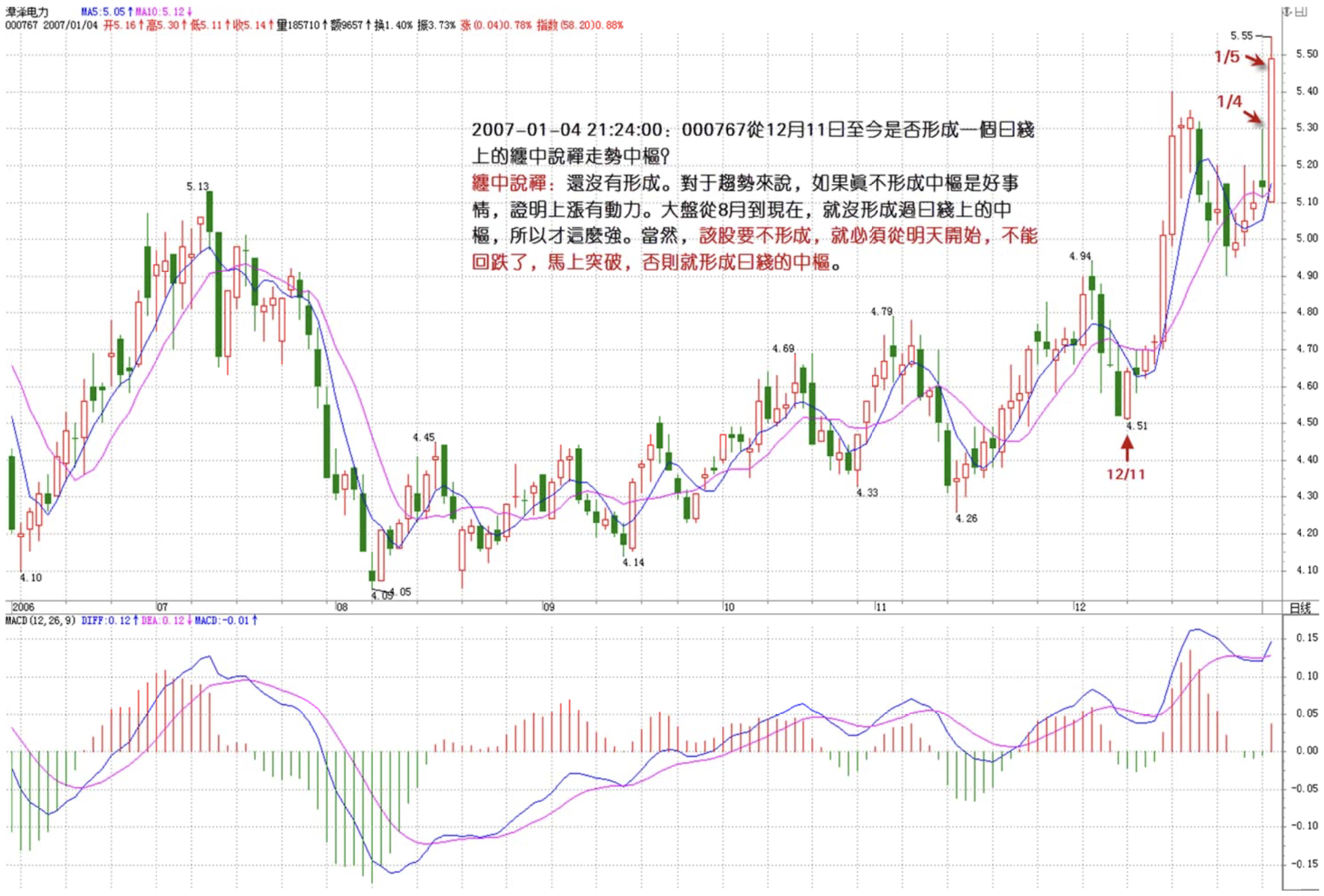
Has 000767 formed a daily-level Chán Zhōng Shuō Chán trend hub from December 11th to now?
===
Not yet. For a trend, if a hub truly doesn't form, that's a good thing — it proves the uptrend has momentum. The broader market hasn't formed a daily-level hub from August until now, which is why it's been so strong. Of course, for this stock to avoid forming one, starting tomorrow it can't pull back — it must break through immediately, otherwise a daily-level hub will form.
缠中说禅 2007/1/4 21:47:55
[Anonymous] Not-Winter-Worm-Summer-Grass
2007-01-04 21:40:51
I've left comments on this blog n times, and this is the first time I got a reply from the blogger. Thank you, thank you so much. I had great math grades in school and considered myself reasonably smart. Discovered this place a dozen or so days ago and studied everything in order, only to end up completely confused. Haha, how embarrassing. I hope one day your blog will have the highest click count in the world. I really want to hear the Vienna New Year's Concert — couldn't find it at my local music store. If you have it, could you play it? Thanks!
===
Sorry, sometimes I can't attend to everyone. This ID really doesn't have anything by the so-called Waltz King or people like that. If you want to truly appreciate music, don't listen to that stuff. You can't even finish listening to Bach and Beethoven — listening to the so-called Waltz King, you might as well listen to pop music. He was essentially the pop music of his era. And truly great music can never be popular.
缠中说禅 2007/1/4 21:51:16
[Anonymous] Heard That
2007-01-04 21:47:49
OP:
Once stock index futures launch, will the stock market plummet? Because right now the big players are grabbing CSI 300 chips to prepare for shorting the index futures. Once they dump the market, just imagine.....
====
Tell me — is there more money or more stocks? Some volatility at the start is normal, but the bulls always have leverage. Especially at a level of 2,000-something points — how much room is there to short? Same 1,000 points, same magnitude, but is it easier to go from 2,500 to 1,500 or from 2,500 to 3,500?
Futures are designed to squeeze people to death. Once the shorts are lured in, you squeeze them to death. It's that simple.
缠中说禅 2007/1/4 21:52:27
[Anonymous] 无言
2007-01-04 21:48:29
Sis Chan, you have so many chart-reading techniques — by the time you finish explaining them all, the bull market will be over. Why not tell me first? I'll leave my QQ?
===
Mastering just one is enough. Take first-type buy/sell points for example — if you truly master them, 95% of people are no match for you. The key is mastery.
缠中说禅 2007/1/4 21:52:53
It's too late. Heading off, goodbye.
缠中说禅 2007/1/4 15:24:10
The blog formatting is a bit hard to use — once you start formatting it exceeds 10,000 characters. Everyone make do for now.